A somewhat subdued week saw continuing high water levels, although rainfall was significantly lower than that during the week prior. Unfortunately, there was little to shout about in terms of new arrivals and more than a feeling that we are, at present, just bumping along the bottom. For avid birders in the field, trying to find new birds was, as they say, rather like pulling teeth but Sand Martin in Kent and Swallow in Dorset this week hint that things, in general, are on the move …
Locally, though, it was back to basics, kicking off with Stanford Reservoir’s Pink-footed Goose still present on the Northants side of the border on 10th. Two Bewick’s Swans were reported at Earls Barton GP’s New Workings (South) on 15th but there was no sign of any there the following day. Last week’s drake Green-winged Teal at Stanwick GP scraped in to steal the crown in this week’s lineup on 10th but there was not even a sniff of it thereafter. A drake Red-crested Pochard found at Earls Barton GP’s New Workings (North) on the same date was likely the bird present at nearby Billing GP’s Ecton Lake on 27th January.

This week’s waders were last week’s waders with a Ruff still at Stanwick on 10th and a Jack Snipe at Hollowell Res on the same date, plus at least four more of the latter still at Daventry CP between 12th and 15th.
Gulls were few and far between and included two second-winter Mediterranean Gulls – Stanford and Pitsford Res producing one apiece on 12th and 16th, respectively, while an adult Yellow-legged Gull was present at DIRFT 3 on 11th.
Cattle Egrets were a little more obliging this week, with one commuting between Stanford Res and nearby Stanford on Avon, on and off, throughout the week. One was also at Stanwick on 15th and two were mobile around Summer Leys LNR between 13th and 16th.
Summer Leys also produced an immature male Marsh Harrier on 10th and 12th, the same bird being present further up the valley at Earls Barton GP’s New Workings (South) on the last of these two dates. One, possibly the same individual, also visited Stanwick on 13th. It’s not so long ago that Marsh Harrier was a scarce passage migrant in the county and, in 1971, this species was Britain’s rarest breeding raptor with just one pair at Minsmere in Suffolk. Since then, after intense conservation efforts, one estimate puts the UK population at between 590 and 695 breeding pairs – undoubtedly the source of our recent wintering birds.

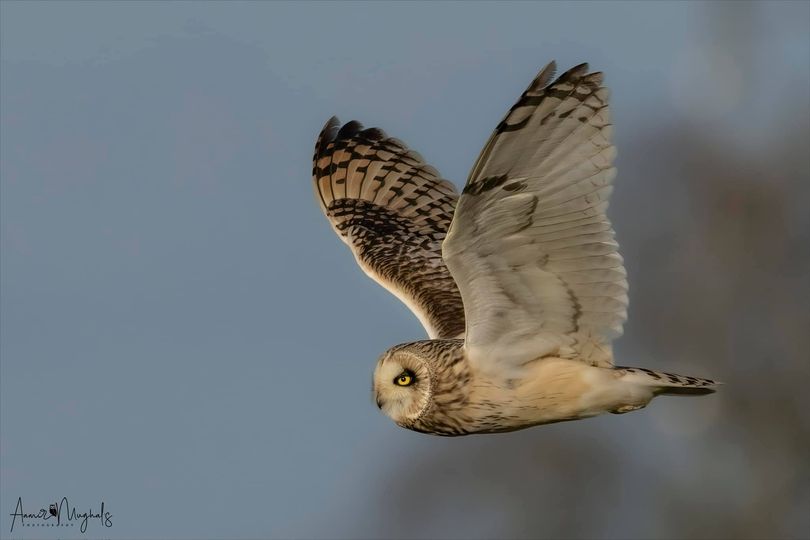
Short-eared Owls remained prominent in the news with Blueberry Farm, Maidwell and Neville’s Lodge, Finedon carving up this week’s quota between them, each locality producing up to four birds throughout the period.
Two Merlins comprised a male between Cottesbrooke and Hanging Houghton, in the Brampton Valley on 13th and a female/immature at Pitsford Res on 16th.
As far as this week’s Waxwings were concerned, a dozen or so were seen flying away from Dallington Cemetery (Duston, Northampton), just before dusk on 10th – and that was the first and last that was seen of them. Following the Duston Vanishers, Northamptonshire was left wanting, while, not a million miles away in suburban Milton Keynes, numbers went from strength to strength, with at least seventy-five on the eastern outskirts of the city near Kingston by the week’s end. Needless to say, the surrounding counties of Bedfordshire Cambridgeshire, Leicestershire and Warwickshire all enjoyed double-figure flocks.
The Brampton Valley, Daventry, Earls Barton, Hollowell, Stanwick and Summer Leys all held Stonechats this week, with the highest count of five at Hollowell on 10th, while Crossbills scraped in with single birds over Daventry on 14th and at East Carlton CP the following day.

Discover more from Northants birds
Subscribe to get the latest posts sent to your email.

 Northants birds