With little rain, and winds chiefly from the south-west, local temperatures reached a balmy 15°C at the week’s end. The local birdscape remained largely unchanged, although the discovery of the year’s first Bearded Tits, headed up by an exceptionally showy male, proved to be a popular draw throughout the period.
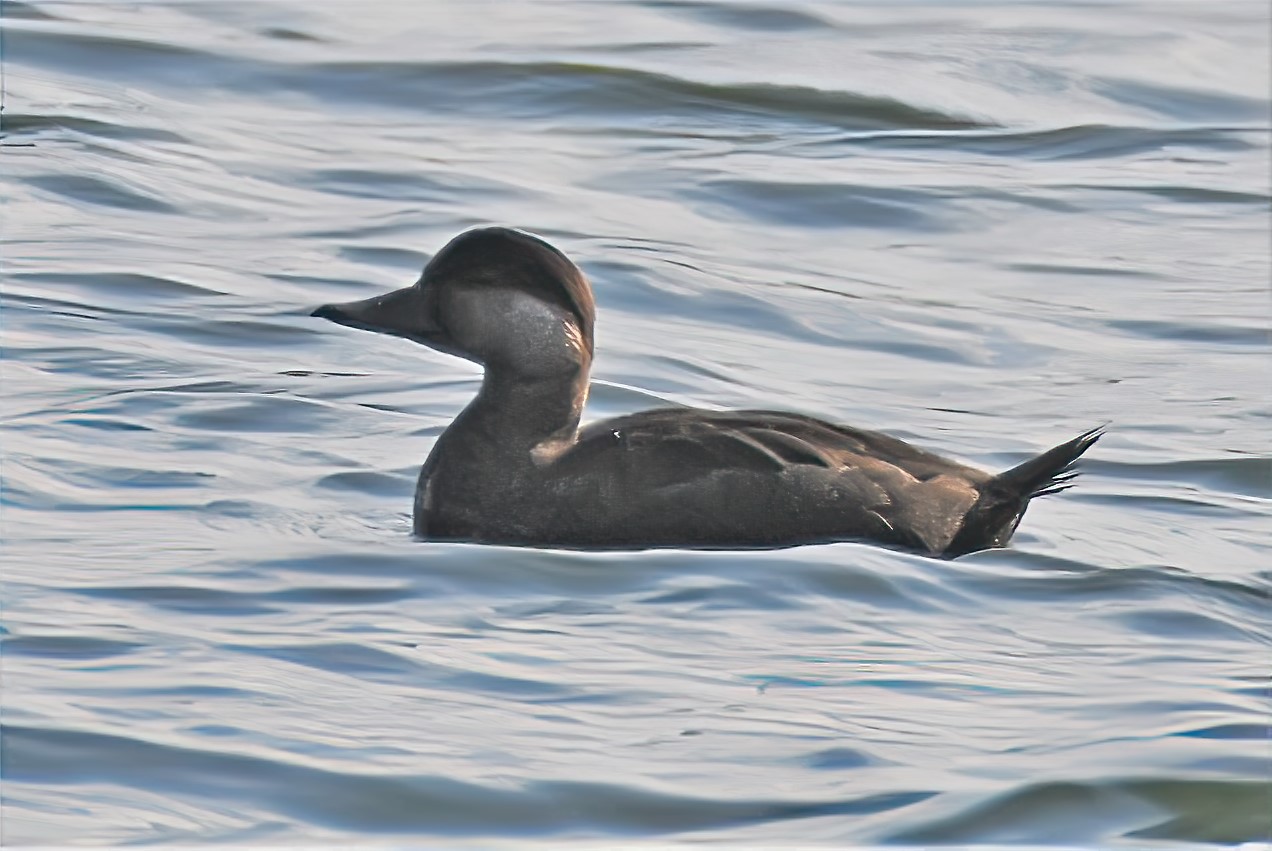
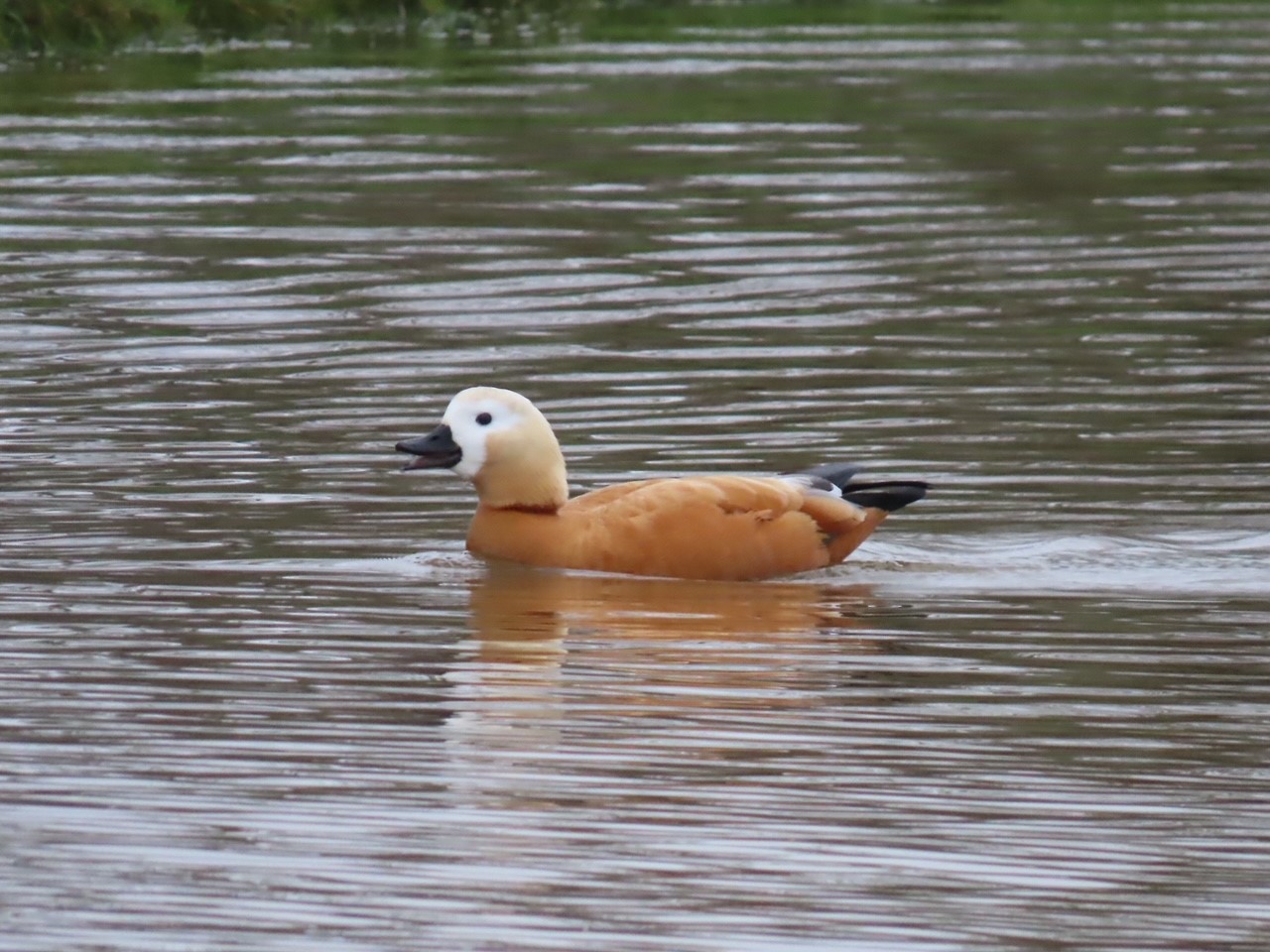
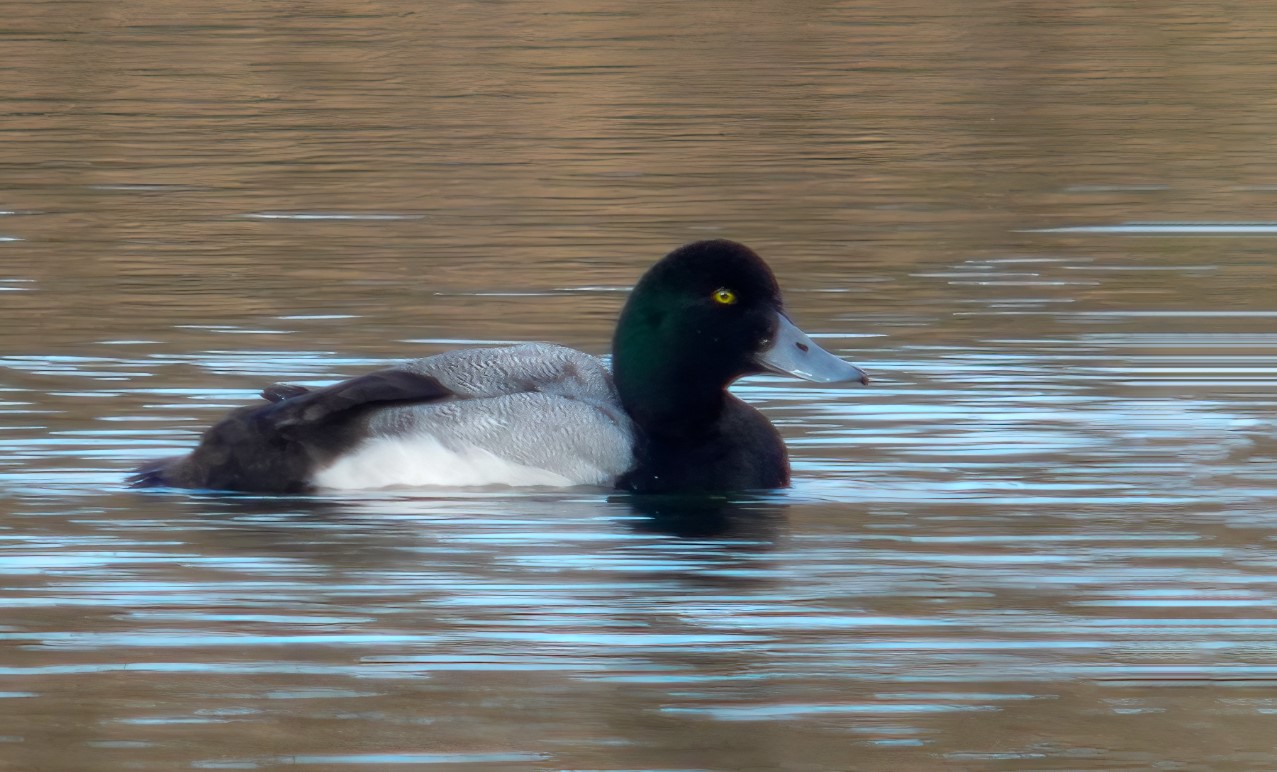
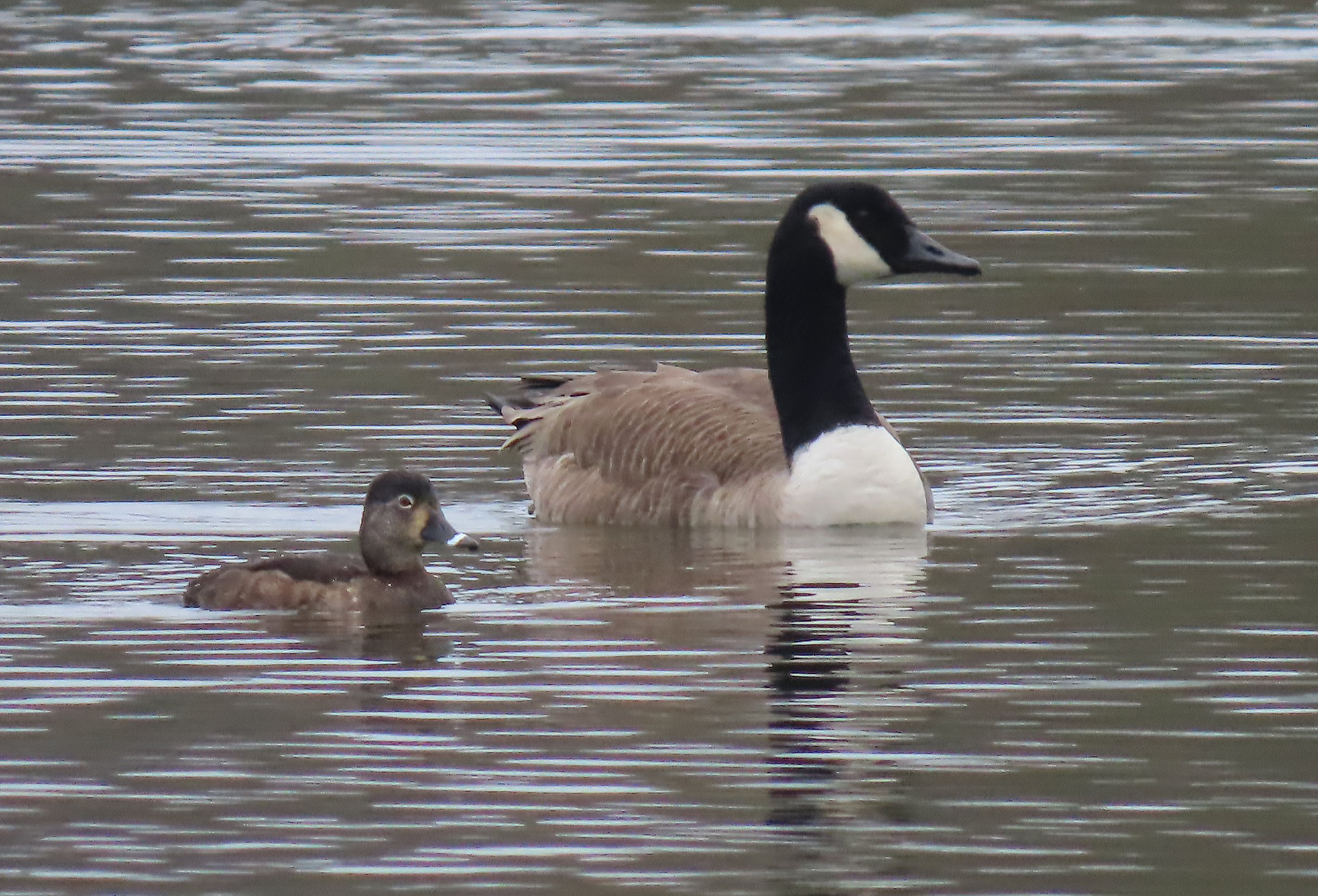
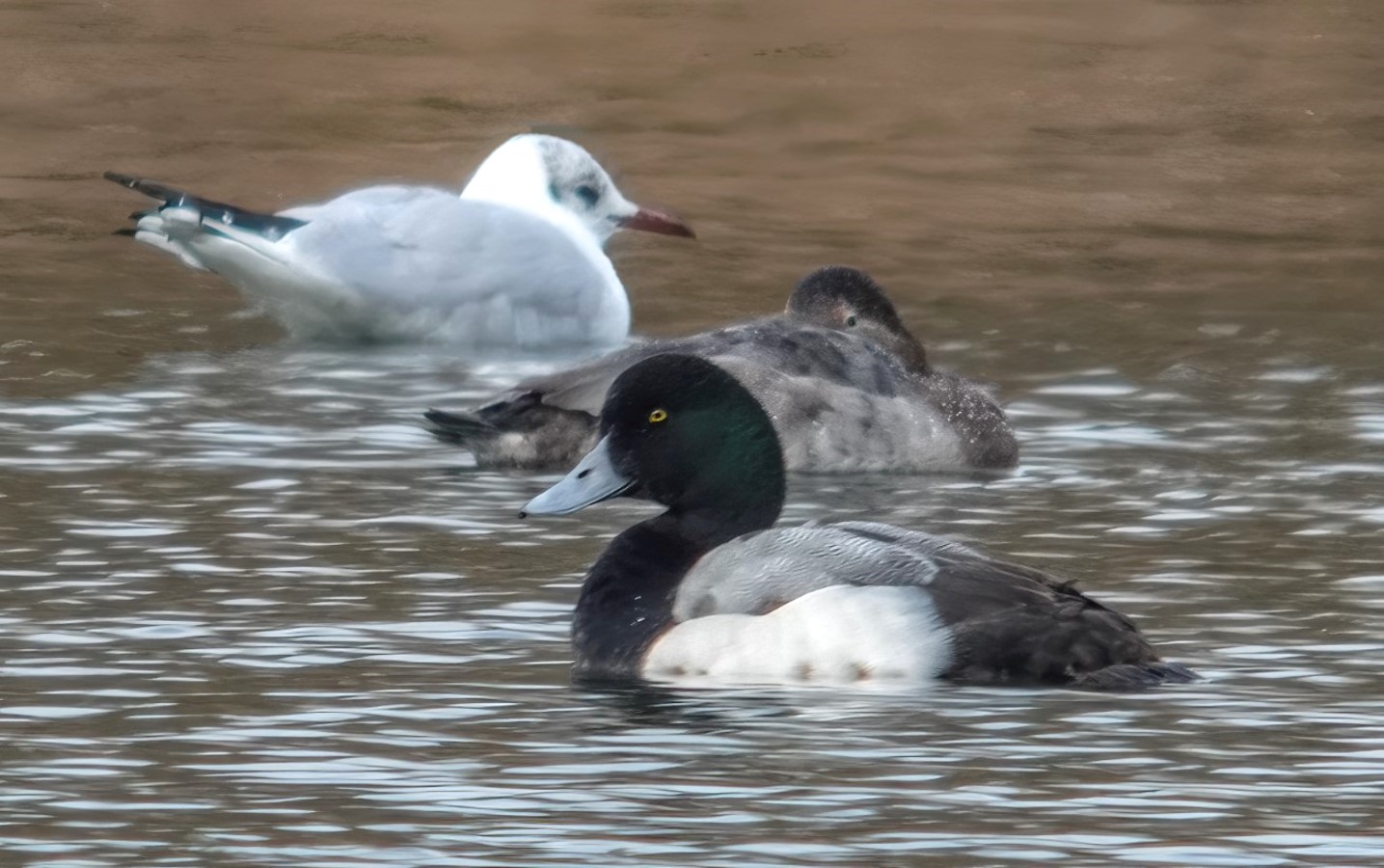
Wildfowl continued in very much the same vein as last week with, in the north-west of the county, the female Ruddy Shelduck still at Winwick Pools on 11th and the drake Red-crested Pochard seeing another week out at Stanford Res. Another drake was found at Pitsford Res on 15th. Not so far away, Ravensthorpe’s female Ring-necked Duck remained faithful to the location, moving into its fourth week on site at the end of the period. The same could not be said for the female GreaterScaup in the same area as it alternated between Hollowell and Ravensthorpe but it was still present at the latter site at the week’s end. Blatherwycke Lake’s drake, found on 10th, remained until at least 12th.
Drake Greater Scaup, Blatherwycke Lake, 12th February 2023 (Mike Alibone)
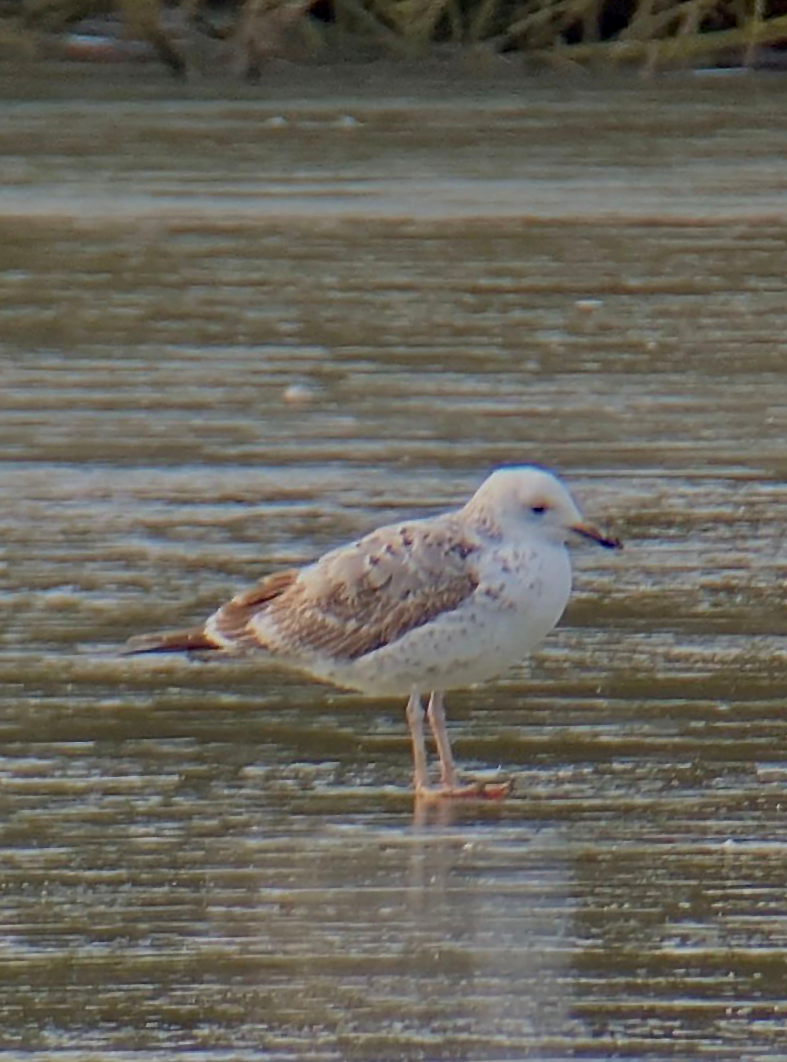
After wildfowl, and in the absence of any notable waders, gulls rule the wetlands. This week’s pick of the crop includes the first-winter Mediterranean Gull again in the roost at Stanford on 12th and 13th and an adult at Daventry CP, briefly, on 17th.
Adult Mediterranean Gull, Daventry CP, 17th February 2023 (Gary Pullan)
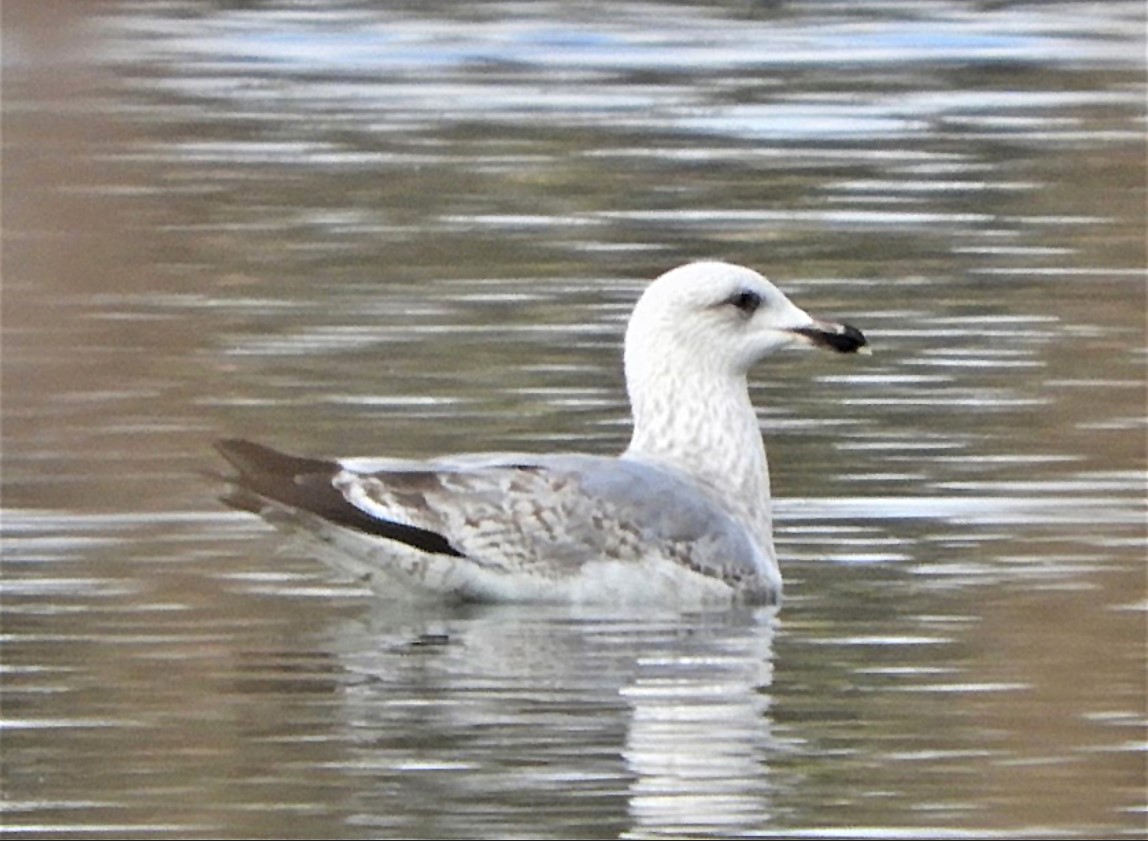
Stanford also produced an adult Caspian Gull on 13th, two adults and a near-adult were at Hollowell on the same date, a first-winter was at DIRFT 3 on 16th and two first-winters were at Daventry CP the following day.
First-winter Caspian Gull, DIRFT 3, 16th February 2023 (Mike Alibone)
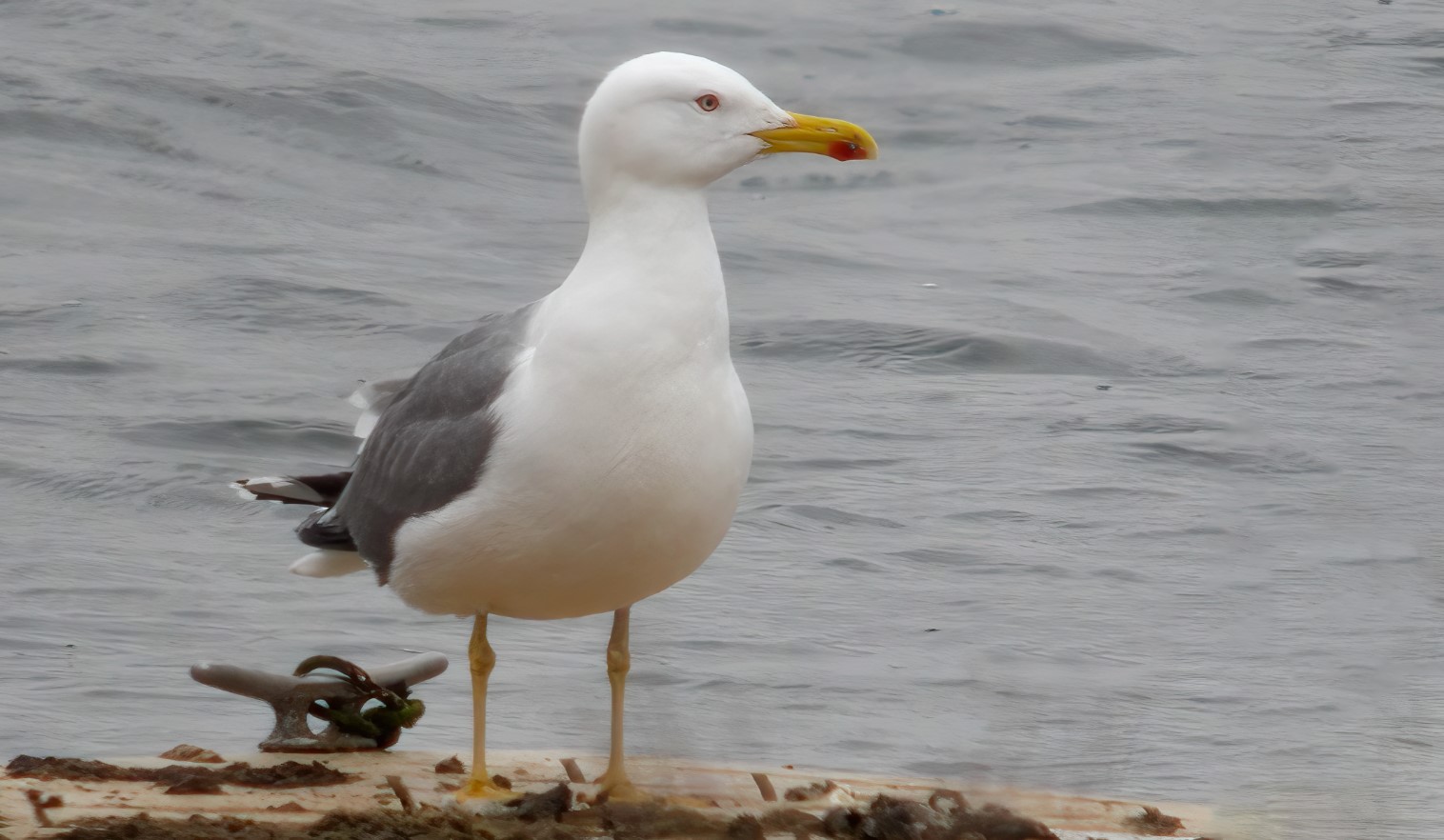
Daventry also held a first-winter Yellow-legged Gull on 17th, while the regular wintering adult was still at Pitsford on 14th and 15th.
The first Short-eared Owl of 2023 was seen between Canons Ashby and Eydon on 12th. There have been very few about over the current winter period with the last being seen at Daventry CP on 15th December 2022.
Similarly, the first Bearded Tits of the year appeared at Stanwick GP on 11th. Two were present until 13th, after which a particularly showy male remained on site, wooing the crowds and revealing itself as a true exhibitionist, until the week’s end.
Male Bearded Tit, Stanwick GP, 13th February 2023 (Nick Parker)
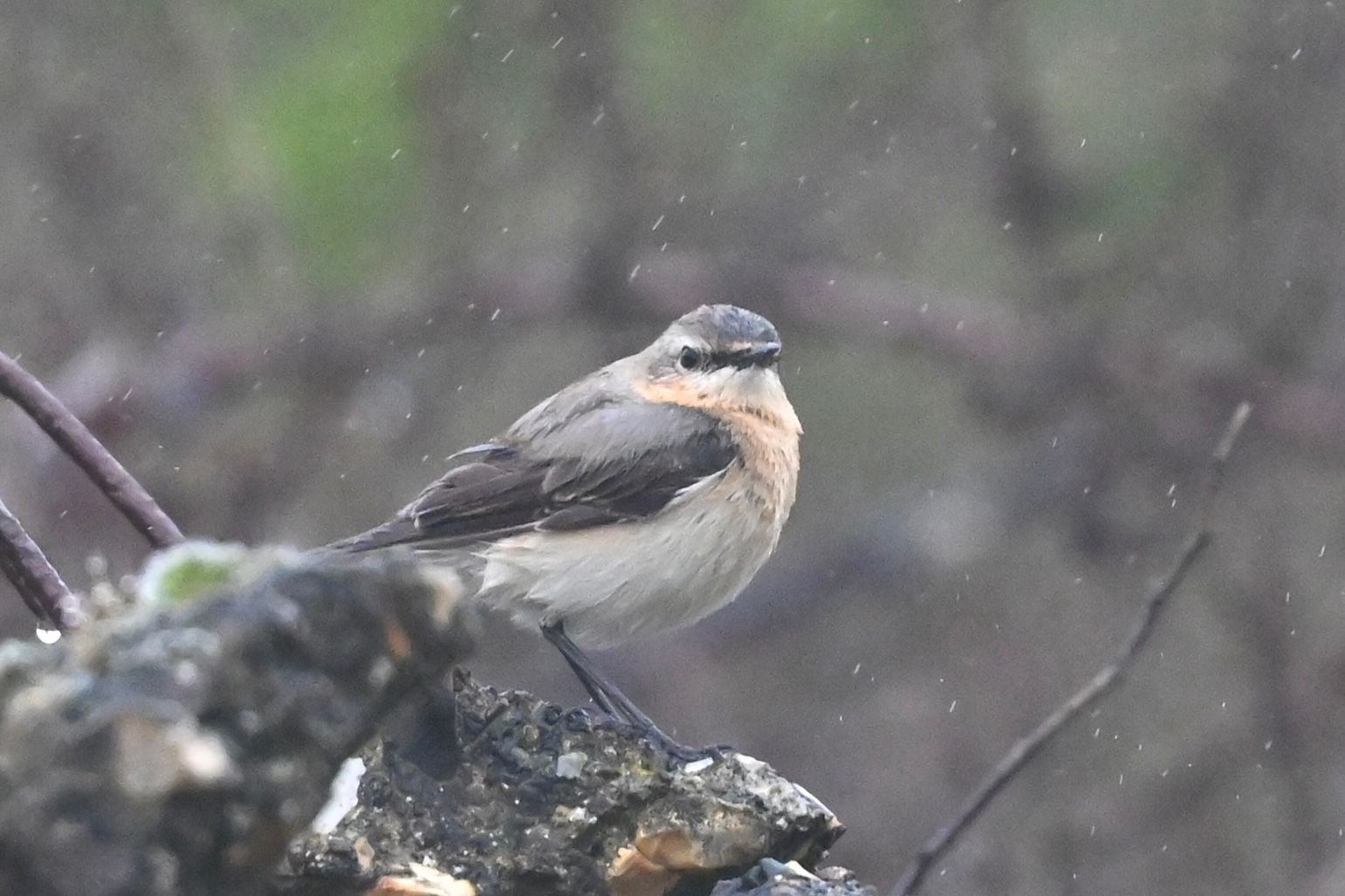
At the rather more subtle end of the scale, further up the Nene Valley, two Siberian Chiffchaffs remained at Ecton SF until at least 13th, while Stonechat numbers appeared to fall away to just two at Ditchford GP on 12th and the same number at Earls Barton GP on 15th-17th.
Female Stonechat, Earls Barton GP, 15th February 2023 (Leslie Fox)
A mainly westerly airstream, a series of overnight frosts and generally dry conditions throughout appeared to have little influence on what was being seen over the review period. With nearly all of last week’s rares still in place, things remained pretty much unchanged as the week panned out.
A goose-free week means we can avoid the debate on whether or not some locally reported species are truly wild – or can we? Some interesting news emerged this week concerning the female Ruddy Shelduck which has been visiting the north-west of the county for the last few years. Seen at Winwick Pools on 8th and 9th, the local farmer has confirmed its presence there on most days over the last three winters, normally arriving in November and, one year, staying until April. This explains its more often than not absence from Hollowell and several other regularly birded localities in the area … but where does it go during the spring and summer months?
Female Ruddy Shelduck, Winwick Pools, 8th February 2023 (James Urwin)
Meanwhile, last week’s female Red-crested Pochard stayed at Summer Leys LNR until at least 8th and the long-staying drake remained on site at Stanford Res throughout the period. Similarly settled, the Ravensthorpe Ring-necked Duck saw another week out and the female Greater Scaup appears now to be favouring the latter site over its former abode at nearby Hollowell. Another Greater Scaup – this time a drake – was found at Blatherwycke Lake on the last day of the week. The fine drake Smew lingered at Pitsford Res until at least 6th and a Slavonian Grebe was present at the same site on 5th but apparently not since.
The sole representative for this week’s waders was Jack Snipe, one of which was present at Hollowell between 6th and 10th and the other was in the Brampton Valley below Brixworth on the first of those two dates.
And as for gulls … in terms of species, it was all pretty much as last week, with Stanford’s roost pulling in two Mediterranean Gulls – an adult on 7th and a first-winter on 9th and 10th. It also produced a near-adult Caspian Gull on 8th and three (two adults and a third-winter) on 10th. Hollowell held four adult Caspians on 8th and two adults and a second-winter on 10th, while two adults were among the many large gulls at DIRFT 3 on 8th.
The Brampton Valley played host to this week’s raptors on 6th, when a Marsh Harrier was seen near Blueberry Farm and a Merlin was below Hanging Houghton.
Passerines were at a premium during the period, with just one Siberian Chiffchaff identified at Ecton SF between 4th and 9th, the number of Common Chiffchaffs there also down in numbers compared to a couple of weeks ago.
And that just leaves Stonechat, with twos at Ditchford GP, Oundle Water Meadows and Pitsford – all on 6th, singles at Burton Latimer and Earls Barton GP on the same date, two again at Pitsford on 9th and one at Hartwell on 10th.
Male Stonechat, Upton CP, 8th February 2023 (Tony Stanford)
With winds off the Atlantic, a dry and ultimately mild week ensued as temperatures rose to above average by the end of the period. Much of last week’s fare lingered, including Ravensthorpe’s Ring-necked Duck and at least two Siberian Chiffchaffs at Ecton while, out of the rarity hat, a surprise appeared in the form of a White Stork, briefly, in Moulton.
Following due process, though, the Barnacle Goose of more than questionable origin remained with Canada Geese at Upton CP on 30th, while the almost equally eyebrow-raising single Pink-footed Geese were still present with Greylags at both Hollowell and Ravensthorpe Reservoirs on 28th and Wicksteed Park until 31st. On a similar theme, the itinerant female Ruddy Shelduck returned to Hollowell for the day on 30th.
Three Red-crested Pochards included the long-staying drake at Stanford Res all week, a new drake at Daventry CP on 31st and a female was present throughout the period at Summer Leys.
Drake Red-crested Pochard, Daventry CP, 31st January 2023 (Gary Pullan)
But moving into the higher echelons of more worthy wildfowl, appearing settled and prone to showing well off the causeway, the now popular female Ring-necked Duck completed its first full week at Ravensthorpe. The same cannot be said, though, for the other female found at Thrapston GP on the final day of the previous week. It was still present there, on Aldwincle Lake, the following day, 28th, but it’s not been seen since …
Female Ring-necked Duck, Ravensthorpe Res, 3rd February 2023 (Mike Alibone)
Much more obliging, however, and despite going AWOL for a day, was the female Greater Scaup at Hollowell, now into its third week. Keeping up appearances in Pitsford’s Walgrave Bay, the drake Smew remained until at least 29th.
Drake Smew, Pitsford Res, 29th January 2023 (James Skinner)
In the absence of any notable waders, gulls lined up in pretty much the usual places. The week’s token Mediterranean Gull, an adult, was found in the roost at Boddington on 3rd and Hollowell and Stanford carved up the majority of this week’s serving of Caspian Gulls between them. Of the latter, Hollowell produced an adult on 28th, two adults, a second-winter and a third-winter on 30th, three adults on 1st and two adults on 3rd. Stanford’s gull roost held an adult on 29th, two adults on 30th and a near-adult plus a third-winter on 2nd. It would appear likely that some of these are duplicates, moving between the two sites which, after all, aren’t too far apart as the gull flies. Meanwhile, DIRFT 3 produced an adult on 3rd.
Adult Caspian Gull, DIRFT 3, 3rd February 2023 (Mike Alibone)
Yellow-legged Gulls were down to just the regular, wintering adult at Pitsford, where it remained all week.
Adult Yellow-legged Gull, Pitsford Res, 2nd February 2023 (Mike Alibone)
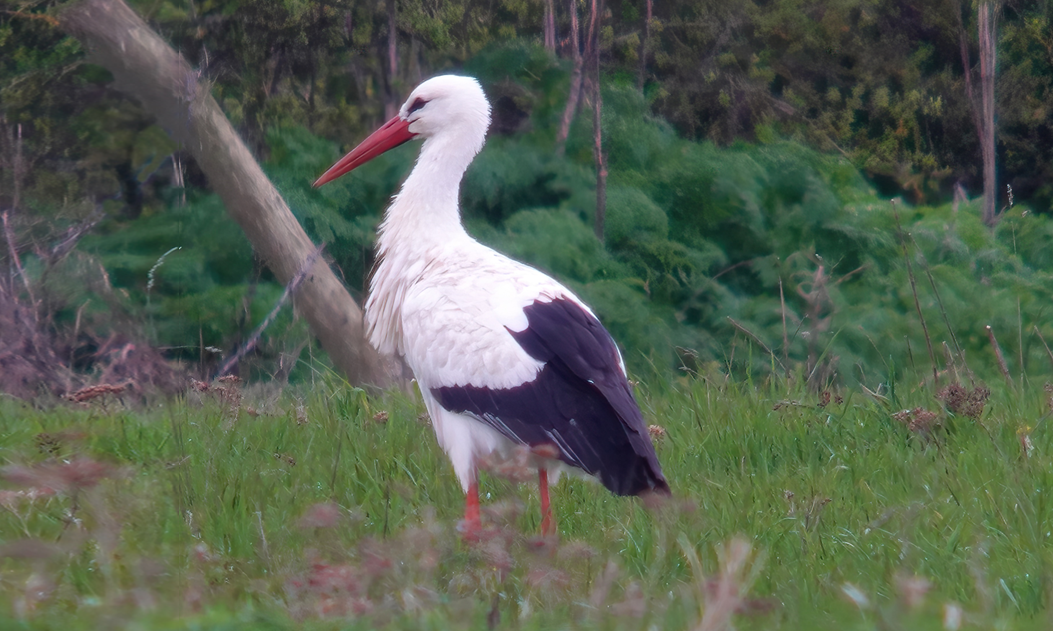
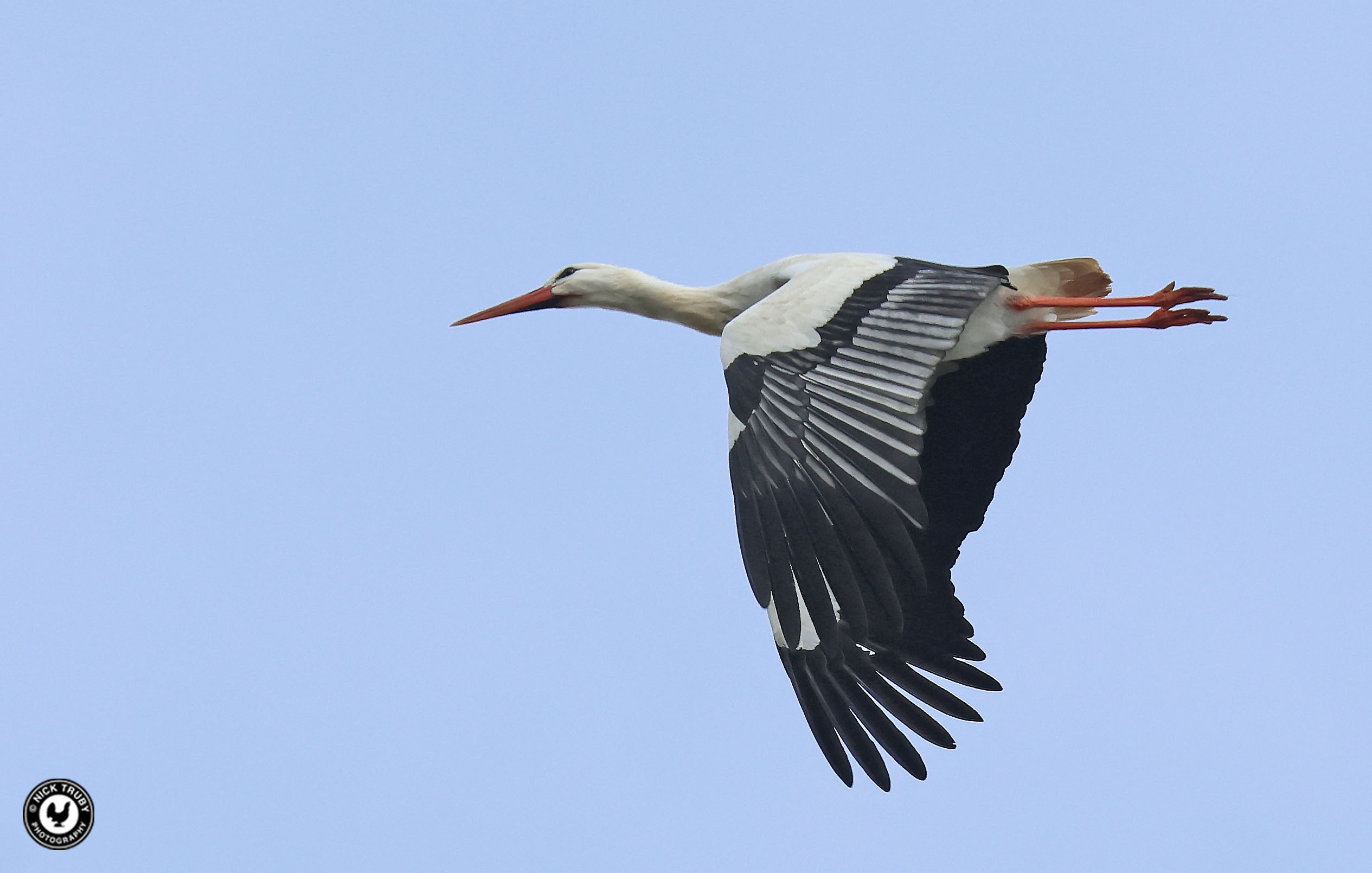
The week’s big surprise, then, came in the form of a White Stork on a house roof, briefly, in Moulton on 29th. Quick off the mark, the observer managed a hastily obtained record shot of it taking flight, which appeared on social media shortly after the event but it was not possible to determine if it had any rings. It did not linger, nor was it seen again …
This week’s Merlin decided to grace Ditchford GP’s Irthlingborough Lakes & Meadows LNR on 1st.
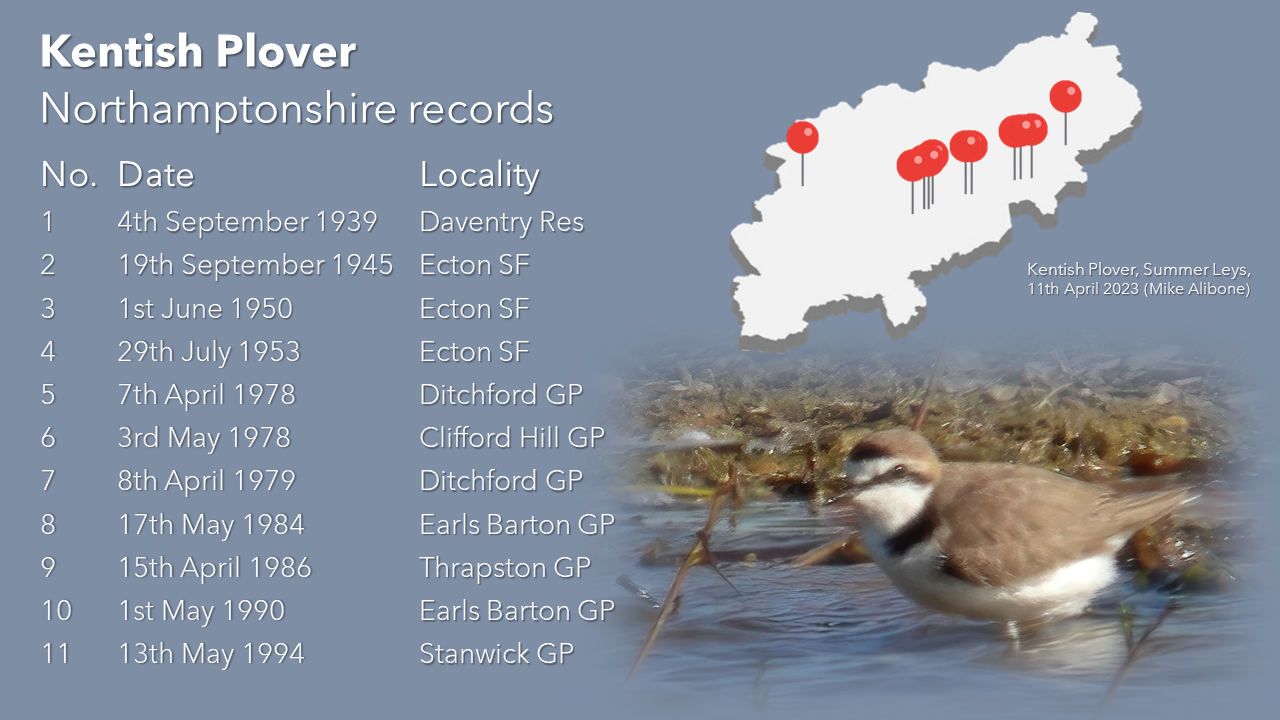
And sticking with the Nene Valley … At least two Siberian Chiffchaffs remained along the outflow at Ecton SF throughout the period. ‘SF’ is a simple abbreviation of ‘Sewage Farm’ and latter-day birders may be inclined to view the area as the more recently named ‘Great Billing STW’ (Sewage Treatment Works), or even Billing Gravel Pits, as some would have it. But for those of us birding for well over fifty years in Northants, the name ‘Ecton SF’ has heritage and dates back to the pre-1940s. Little Bittern, Night Heron, Montagu’s Harrier, Rough-legged Buzzard, Black-winged Pratincole, Kentish Plover, Sociable Plover, Buff-breasted Sandpiper, Greater Yellowlegs, Lesser Yellowlegs … the list is endless, the name can never be dropped or forgotten. The site is legend!
Siberian Chiffchaff, Ecton SF, 29th January 2023 (James Underwood)
Ecton SF also periodically produces Stonechats – but not this week, though, when they were limited to two at Upton CP on 30th and singles at Lilbourne Meadows NR and Hollowell Res on the same date and at Earls Barton GP on 1st.
Stonechat, Lilborne Meadows NR, 30th January 2023 (Mke Alibone)
The freezing temperatures and the attendant icy conditions of the previous week spilled over into the first half of the period, after which a thaw set in as the thermometer eased its way back up toward something approaching the seasonal norm. Once again, ducks stole the show in terms of overall rarity, although a quartet of easy-to-see Siberian Chiffchaffs proved equally popular, exerting a strong observer pull as the week rolled out.
And it’s probably because we’re becoming more accustomed to seeing Ring-necked Ducks as they’ve upped their numbers visiting the UK over the past few winters. A female discovered at Ravensthorpe Res on the penultimate day of the week, and remaining the following day, continued this species’ run of appearances in Northants for the third consecutive winter. As if to underline its increasing frequency of occurrence, another female was found at Thrapston GP’s Titchmarsh Reserve at the eleventh hour on 27th, setting a new standard for the multiple presence of Ring-necked Duck in Northamptonshire. The two birds constituted the 10th and 11th county records, following the long-staying female that visited Thrapston GP, Ringstead GP and Stanwick GP between December 2021 and April 2022.
Female Ring-necked Duck, Ravensthorpe Res, 26th January 2023 (Jon Cook)Female Ring-necked Duck, Ravensthorpe Res, 27th January 2023 (Mike Alibone)First-winter female Ring-necked Duck, Thrapston GP, 27th January 2023 (videograb, Nick Parker)
Knocked into second place by the above, Hollowell’s female Greater Scaup remained throughout the week.
Once again, the long-staying drake Red-crested Pochard saw another week out at Stanford Res, while the peripatetic female Ruddy Shelduck pitched up again at Hollowell on 23rd and stayed until 25th, when it relocated to Winwick Pools near West Haddon.
Feral to the core, a Barnacle Goose joined local Canadas at Upton CP on 26th while, of perhaps less questionable pedigree, Pink-footed Geese were found in three localities. Two flew north over Blueberry Farm, Maidwell on 23rd, the same date on which one also joined the resident Greylags at Wicksteed Park, Kettering and the Ravensthorpe & Hollowell bird was still at the latter locality on 27th.
Pink-footed Goose, Wicksteed Park, 23rd January 2023 (Julie Roe)
This week’s notable wader line-up was once again limited to Jack Snipe with singles at three localities, which included both the Brampton Valley and Ecton SF on 21st and Hollowell, two days later, on 23rd.
Gulls were a little more numerous than during the last period – this comment referring more specifically to Caspian Gulls which, on 21st, broke the record for a single site total when up to six were present in the roost at Stanford. Three were present the following evening and two adults, probably a pair, were regularly visiting throughout the remainder of the week. Elsewhere, two adults and a second-winter were at Hollowell on 27th, two were at Naseby Res on 21st and an adult was there on 27th, single adults visited both Clifford Hill GP and Ravensthorpe Res on 23rd, a second-winter was on ice at Daventry CP on 25th and a first-winter was at DIRFT 3 on 27th.
Second-winter Caspian Gull, Hollowell Res, 27th January 2023 (Jon Cook)First-winter Caspian Gull, DIRFT 3, 27th January 2023 (Mike Alibone)
A token appearance by Yellow-legged Gulls saw a second-winter in the roost at Hollowell on 22nd, single adults at Pitsford on 22nd and 27th and one at Clifford Hill GP on 23rd. That just leaves the rarest gull of the week, out on its own, a first-winter Mediterranean Gull which visited Daventry CP on 24th and 27th.
The rather depressed number of Cattle Egrets continued with just two flying over Summer Leys on 21st.
A Merlin flew over Greens Norton on 27th but making a far bigger impression for two observers in the south-west of the county on 27th, a White-tailed Eagle paid a low-level visit to Everdon Stubbs, where it was seen at one point to land in a tree. Unfortunately, it came under persistent pressure from five mobbing Red Kites before ultimately moving off. It appears that this individual was ‘G818’, a third calendar-year female from the Isle of Wight reintroduction scheme, which had roosted 30 miles north in Leicestershire, having flown over 100 miles south from the Forest of Bowland the previous day.
And from the large to the small … Up to four Siberian Chiffchaffs were present at Ecton SF at the beginning of the period, with at least one remaining as the week drew to a close. Variation in plumage and bare part colour gave rise to some debate on their identification but this is a complex area to delve into and recent DNA analyses on this race have thrown up some surprising results. A discussion will be forthcoming shortly.
Siberian Chiffchaff, Ecton SF, 21st January 2023 (James Underwood)Siberian Chiffchaff, Ecton SF, 24th January 2023 (Martin Swannell)Siberian Chiffchaff, Ecton SF, 24th January 2023 (Martin Swannell)
These ‘sibes’ were set against phenomenal, record-breaking numbers of wintering Common Chiffchaffs in the same area, in which at least seventy were present on 22nd and some fifty were counted on 25th. Too difficult? Stick to Stonechats – nice ‘n’ easy – unless, of course you run into a Siberian candidate … Ecton held up to two on 21st-22nd, five were at Upton CP on 25th, three were at Earls Barton GP on the same date and one was at Clifford Hill GP on 23rd.
Stonechat, Upton CP, 25th January 2023 (Tony Stanford)
After last week’s wet and windy washout, daily frosts ensued and daytime temperatures plummeted, bottoming out at a chilly 2°C, as a northerly, Arctic airstream quickly took hold. New birds were in short supply, however, and the main attraction for some this week was a female Greater Scaup at Hollowell Reservoir.
Seemingly settled after its discovery on 16th, this bird remained faithful to the eastern side of the reservoir throughout the remainder of the period. Over the last 5 years, Greater Scaup has averaged 11 records annually. No doubt there will be more to come.
Female Greater Scaup, Hollowell Res, 18th January 2023 (Mike Alibone)Female Greater Scaup, Hollowell Res, 19th January 2023 (Jon Cook)
Other ducks were available, of course, including the long-staying drake Red-crested Pochard clocking up another week at Stanford Res and the female remaining at Hardingstone GP until at least 17th. Also lingering until the latter date was a drake Smew at Pitsford Res.
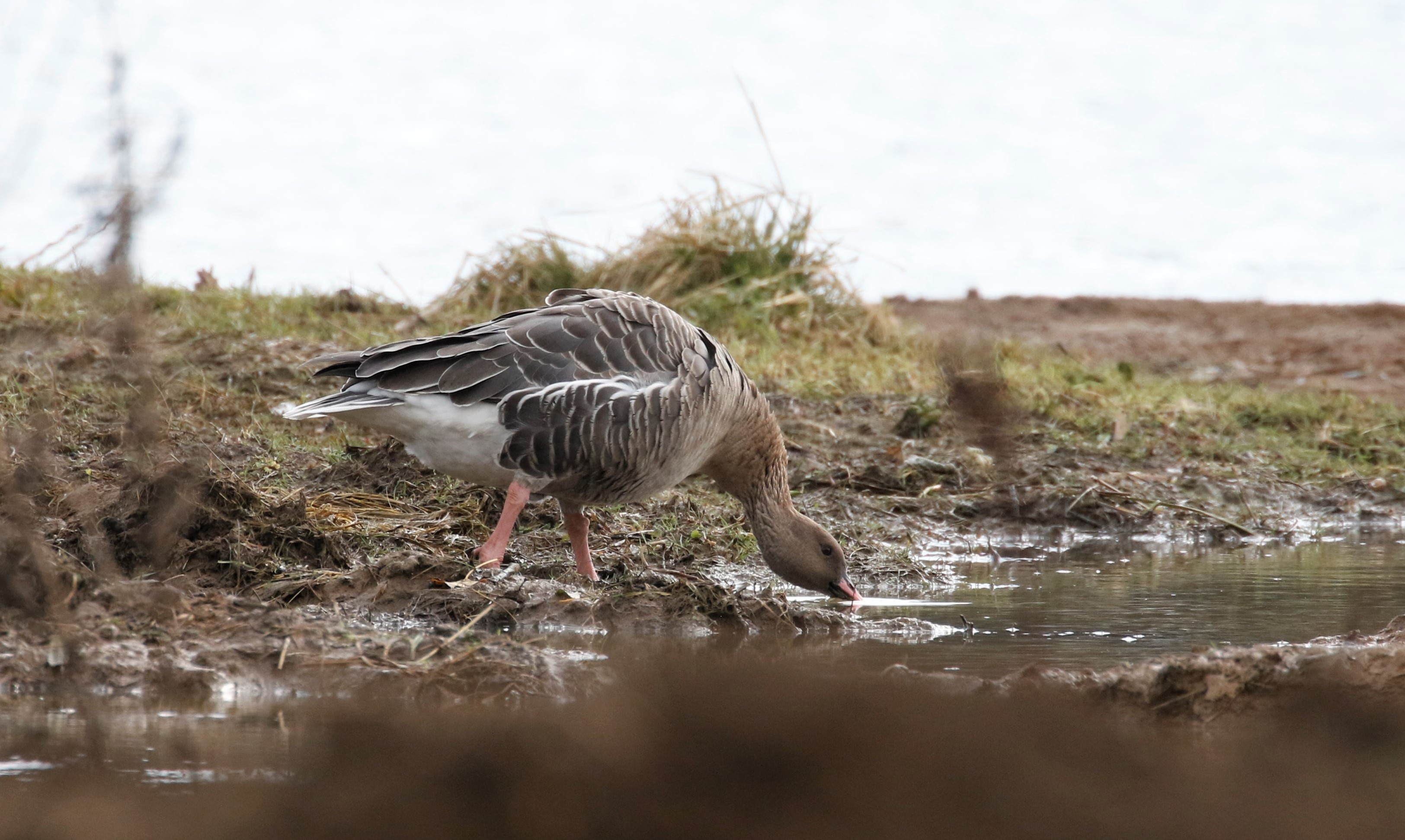
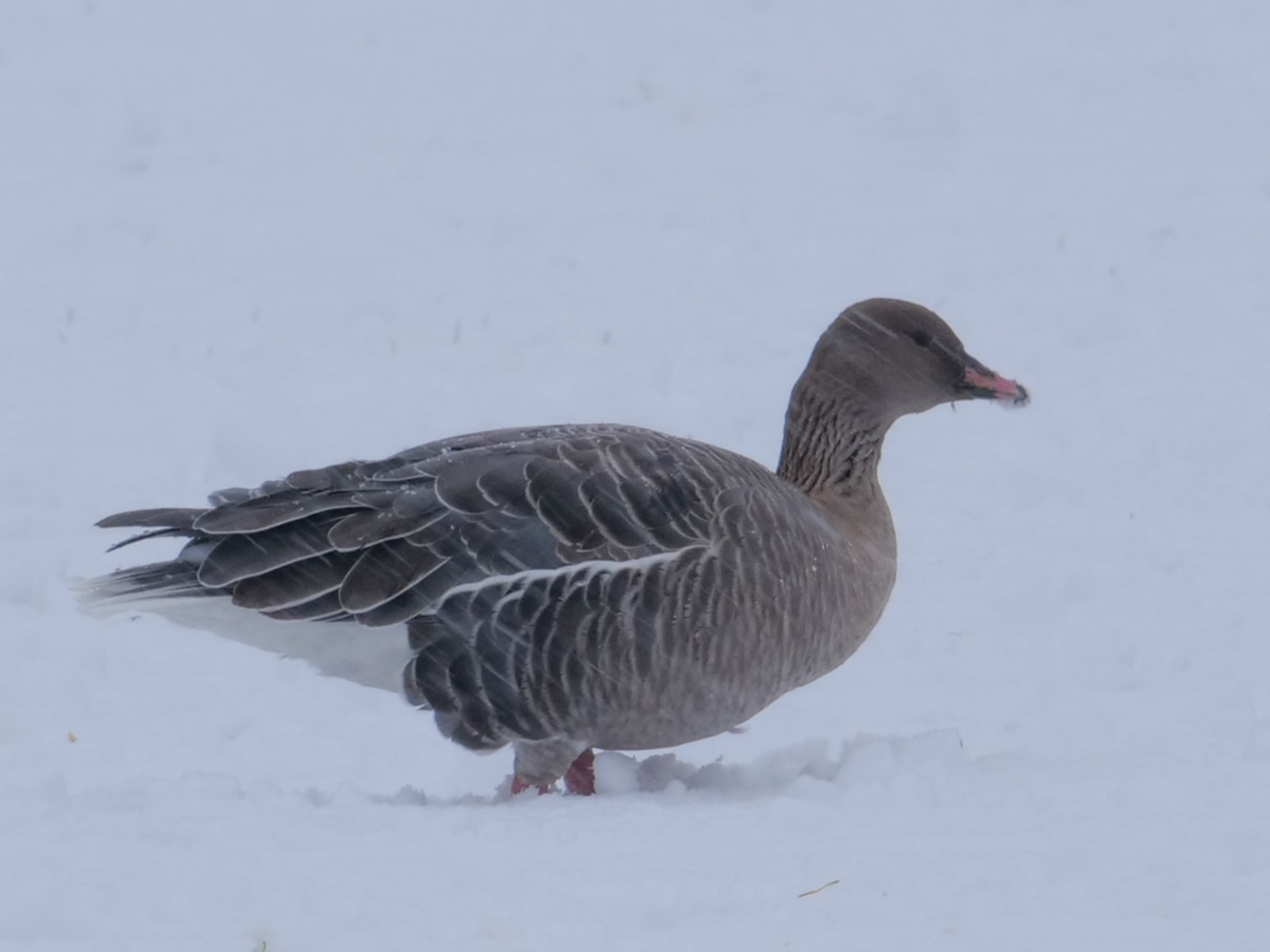
The county’s only Pink-footed Goose – normally to be found at Ravensthorpe Res – left the latter site with Greylags on 20th to visit nearby Hollowell.
Pink-footed Goose, Ravensthorpe Res, 17th January 2023 (Bob Bullock)
Once again, the week’s one notable wader species was limited to Jack Snipe with singles at three localities, which included both the Brampton Valley and Summer Leys on 17th and Hollowell, three days later, on 20th.
Gull numbers were down on last week and much of the action was to be had at the significantly sizeable gull roost at Stanford, where what was presumably the previous week’s first-winter Mediterranean Gull was seen on 19th. Two adult Caspian Gulls were also there on 14th, followed by one on 19th, while the regular adult at Hollowell was joined there by a second-winter on 16th. Single adult Yellow-legged Gulls visited both Naseby and Pitsford Reservoirs on 18th and Hardingstone GP on 19th.
The winter so far has not been the greatest for numbers of Cattle Egrets. The local Nene Valley population appears to have taken a dive and birds are currently by no means guaranteed at the localities at which they once were. Weather-related or not, the period’s sole record relates to just one, flying west over Summer Leys, on 15th.
Also down this week were raptors, with just a Marsh Harrier flying west at Pitsford on 14th representing the poorest showing for some appreciable time.
But on a more promising note, heading up the period’s passerines were at least two Siberian Chiffchaffs, discovered at Ecton SF on the last day of the week. Once again they were present with some twenty to thirty wintering Common Chiffchaffs, in the traditional place which normally attracts them, along the outflow into the River Nene. This outflow has its own microclimate, in which ‘warmer than ambient’ effluent water allows insects to develop and emerge throughout the winter. By no means annual here, they have been observed in previous winters from the locally famous ‘Bridge of Sibes’ or, in down-to-earth alphanumeric reference terms, bridge K121.
Siberian Chiffchaff, Ecton SF, 20th January 2023 (Alan Coles)Siberian Chiffchaff, Ecton SF, 20th January 2023 (Bob Bullock)
Identification is not always straightforward but we are better clued up than we were ten years ago (see here). Another bird showing characteristics of this race was found at Stortons GP on 15th and was still present there on 19th. This bird showed a minor excess of olive and yellow in its plumage and may simply be a variant colloquially known as fulvescens, usually associated with having originated from the western end of this (sub)species range. Common Chiffchaffs can, sometimes, also be quite grey, representing a potential ID pitfall. So, is Siberian Chiffchaff a species in waiting? The likelihood is high. Birdlife international have now split it …
Less challenging things abound, however, and the week’s Stonechats were found at Hollowell, Pitsford and Earls Barton GP, where there were one, two and three, respectively.
A Hawfinch was reported briefly at Yardley Gobion on 18th.
Looking initially like a largely flat week, the continuation of above average temperatures, rain and an erratic, wuthering wind off the Atlantic probably did little to lift local spirits. Factor in fleeting occurrences of the rare and the scarce, along with birds tantalisingly off limits and, arguably for many, there was seemingly little to shout about.
Routine reservoir watching established the ongoing presence of the Pink-footed Goose at Ravensthorpe, lingering until the end of the week. Also remaining on site throughout was the drake Red-crested Pochard at Stanford, while the female at Hardingstone GP went unreported after 8th. Pitsford continued to host two drake Smews until at least 8th, with one still present on 13th and a Greater Scaup was reported in Scaldwell Bay there, also on 8th.
Drake Smew, Pitsford Res, 8th January 2023 (Jon Cook)
The week’s only waders of note were Jack Snipes – one at Barnes Meadow LNR on 8th followed, on 9th, by one at Summer Leys LNR and two at Ditchford GP.
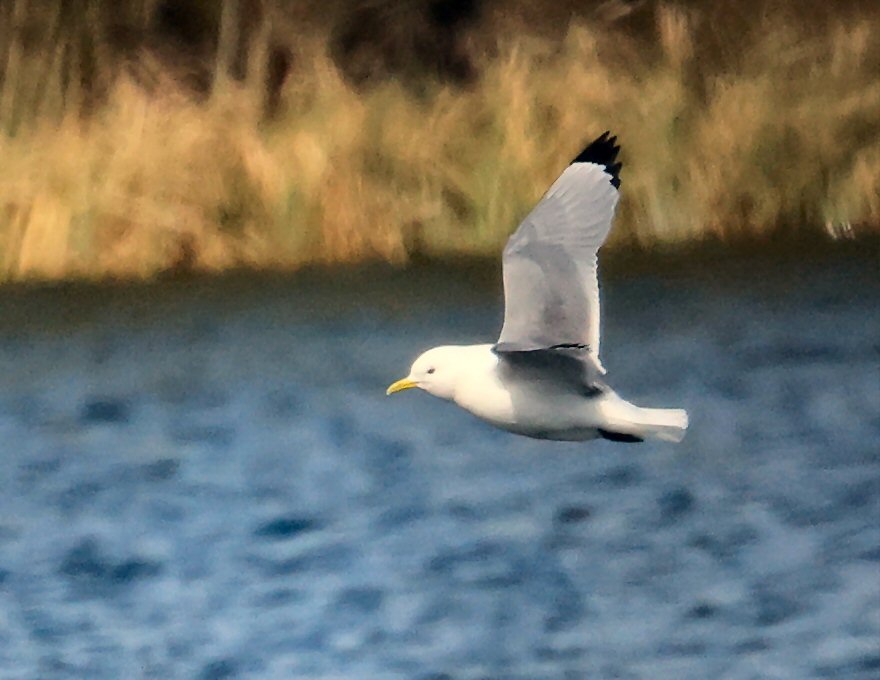
Hot on the heels of last week’s adult at Daventry CP was another Kittiwake – this time a first-winter and, this time, in the gull roost at Stanford on 9th. The past week has seen a number of records across the Midlands, namely in Bedfordshire, Gloucestershire, Nottinghamshire, Shropshire, Staffordshire and Worcestershire.
First-winter Kittiwake, Stanford Res, 9th January 2023 (Chris Hubbard)
The Stanford gull roost also produced the county’s first Mediterranean Gull of 2023, a first-winter, on 12th and it continued to work its magnetic magic by pulling in the highest single site total of Caspian Gulls with five (four adults and a third-winter) there on 13th. DIRFT 3 delivered two Caspian Gulls – a third-winter and a first-winter on 9th, while the regular adult was at Hollowell Res on 7th-9th and 12th-13th and single adults were at Stanford on 9th-10th and Ditchford GP on 12th.
First-winter Caspian Gull, DIRFT 3, 9th January 2023 (Mike Alibone)First-winter Caspian Gull, DIRFT 3, 9th January 2023 (Mike Alibone)
Once again outnumbered by the above species, single adult Yellow-legged Gulls visited Hardingstone GP on 7th and Ditchford GP on 12th, while Pitsford Res retained its regular adult on 12th-13th.
On the raptor front, Merlins were not in short supply but, as ever, being in the right place at the right time was a prerequisite for connecting with them. In this respect, single flyovers were seen at Yardley Gobion on 9th, New Duston (Northampton) on 12th and at Earls Barton GP on 13th.
As for passerines, well, once again, the same out-of-reach group of Waxwings made it into the news for the second week running. Tantalisingly close, the twenty or so birds on the wrong side of the River Ouse that is Buckinghamshire, were again seen in, and around, Stony Stratford on 10th, when it was reported that, for a second time, some had crossed into Northants, briefly visiting the rear gardens of some local houses. So near, yet so far …
By contrast, things were going swimmingly along Mary’s Lane at Earls Barton, where one Yellow-browed Warbler continued to perform throughout the weekend of 7th-8th. Come the working week, however, in line with the old proverb, all good things must come to an end – they did … and there was no subsequent sign of it.
Yellow-browed Warbler, Earls Barton GP, 7th January 2023 (John Kirkelionis)
Stonechats appeared settled at four localities, with four at Earls Barton on 12th, twos at Pitsford on 8th and at Raunds CP on 13th and one at Hollowell on 9th.
Male Stonechat, Pitsford Res, 8th January 2023 (Jon Cook)
Arguably for some, in terms of local rarity, the bird of the week slot was occupied by Twite, two of which were found close to the Grand Union Canal near Yardley Gobion, on 9th. If accepted, these would constitute only the fourth county record this century, the previous three being at Ditchford in December 2014, Pitsford in October 2011 and Borough Hill in October 2000. Twite was formerly a scarce, but almost annual, winter visitor, numbers of which peaked in the 1970s, with a flock of forty-one at Pitsford Res – the prime location for this species – in January 1976. Records continued through the 80s with notably smaller numbers, waning considerably in the 90s, when the last was down to just one in 1998. This represents a sad reflection of its precarious status in England, having suffered a steep decline this century, with the breeding population falling by 75% between 1999 and 2013.
A mild, wet and frequently windy backdrop to the local birding landscape set the scene for the first week of 2023. And while the dynamic duo of Yellow-browed Warblers clearly constituted the main point of focus for the new year, potentially more alluring fare lurked, overshadowed, in the background …
The bird quite literally in question, then, was an interesting-looking drake Aythya duck found during the last hour of daylight on 2nd, at Thrapston GP’s Titchmarsh NR. Initially identified and announced as a Greater Scaup, the subsequent publication of an image and videos quickly led to a debate over its true identity and a dichotomy of opinion has given rise to the emergence of a Lesser Scaup camp versus a pro-hybrid faction. While the quality of the published media do not allow detailed, feather-by-feather analysis, there were some pointers clearly leading the identification away from Greater Scaup.
Unidentified Aythya duck, Thrapston GP, 2nd January (Nick Parker)
Most evident was the head shape, which aligns convincingly with that of Lesser Scaup and was instrumental in setting alarm bells ringing. While an assessment of the true feather patterning on the flanks and mantle was just out of reach, there was no ‘write-off’ plumage feature to exclude that species. Plumage does not tell the whole story, however. The perceived size, shape and bulk appeared to match those of nearby Pochards, suggesting that this bird’s dimensions fall outside the parameters generally associated with the more compact appearance of Lesser Scaup and therefore point to a hybrid – suggested by some as being likely between Tufted Duck and Pochard. Advocates of Lesser Scaup point out, however, that there is an overlap in size between Pochard and Lesser Scaup, arguing the point that this bird could simply be one of the latter, at the top end of the size range. The jury is currently out, the bird hasn’t been seen again and hopes are high that it will reappear, providing the opportunity for greater scrutiny, ultimately leading to a positive identification. On the same date this bird was seen, a Greater Scaup was reported from Pitsford Res and, two days later, another was also reported from Summer Leys LNR.
And so from stranger things to things less complicated, a Pink-footed Goose accompanied a flock of Greylags as they flew in to Daventry CP on 6th and the local female Ruddy Shelduck made its first appearance of 2023 at Hollowell Res on 1st-2nd.
Pink-footed Goose, Daventry CP, 6th January 2023 (Gary Pullan)
This week’s Red-crested Pochards were limited to the long-staying drake at Stanford Res and the female at Hardingstone GP – both remaining throughout the period. Last week’s two drake Smews at Pitsford had grown to three on 1st, dwindling to just one by the period’s end, while a ‘redhead’ was discovered at Blatherwycke Lake on 2nd.
Smew, Pitsford Res, 2nd January 2023 (Alan Coles)
A wholly unexpected visitor to Daventry CP – at least during in January – was an adult Kittiwake, which was found loitering on the dam there during the morning of 5th. Approachable and seemingly moribund, it had departed by the afternoon and was no doubt the same bird which had been exhibiting the same ‘teasing’ behaviour at nearby Draycote Res, Warwickshire the previous day, before flying off strongly with other gulls.
Kittiwake, Daventry CP, 5th January 2023 (Gary Pullan)
Of far more regular occurrence, this week’s only to be expected gulls included up to two adult Caspian Gulls in the roost, nightly, at Stanford, two adults off the dam at Pitsford on 2nd and 5th and one at Hollowell on 2nd. Surprisingly outnumbered by the previous species, single Yellow-legged Gulls were seen at Pitsford on 1st, Stanford on 4th and at both Daventry CP and Hardingstone GP on 5th.
Remember the male Hen Harrier seen between Mears Ashby and Earls Barton, then later over Summer Leys LNR on 27th December? Well, it’s still around, having been seen again over Sywell Road, just east of Mears Ashby, on the afternoon of 3rd. And following two in the county last week, a male Merlin was seen near West Farndon on 6th.
Turning to passerines it would seem that, as far as Northamptonshire is concerned, flyover Waxwings are in vogue and, as if serving to underline this, a flock of approximately twenty was reported flying ‘well into Northants’ from Buckinghamshire, across the River Ouse, toward Cosgrove on 5th. In the context of the current so-called ‘invasion’, with the vast majority of birds in Scotland and northern England, this double-figure flock constitutes a sensationally large number for a location so far south and inland in the UK. The chance of nailing any down locally seems, at present, equivalent to a lottery win …
This is certainly not the case with the two crowd-pleasing Yellow-browed Warblers at Earls Barton GP, both of which were present until at least 2nd, with at least one remaining until the week’s end. Undoubtedly presenting the best photographic opportunity of all time in the UK, these birds have been highly obliging, regularly showing well and low to the masses, down to just a few metres – so much so that the observation area has now become a veritable mud bath!
Yellow-browed Warbler, Earls Barton GP, 6th January 2023 (Keith Jones)
Ending with a splash of colour, the week’s Stonechats were seen at Catesby, Earls Barton GP, Ecton SF, Hollowell, Pitsford and Sywell CP.
Female Stonechat, Earls Barton GP, 1st January 2023 (Leslie Fox)
Continuing last week’s theme, the relatively mild weather continued throughout, with some areas recording a positively balmy 14°C as the week unfolded. After Boxing Day though, the post-Christmas rush was not for the sales but instead to Earls Barton GP where, it seems, Yellow-browed Warblers abounded …
But first, paying due diligence to the systematic list, the Ravensthorpe Pink-footed Goose was back, around and about the area of the reservoir, on 27th and in fields behind the Fishing Lodge there on 30th. Three sites produced Red-crested Pochards during the period – Stanford Res hung on to its long-staying drake throughout, two drakes appeared at Pitsford Res on 24th and a female found at Hardingstone GP on 27th remained until at least 30th.
Female Red-crested Pochard, Hardingstone GP, 30th December 2022 (Mike Alibone)
Moving upmarket somewhat, last week’s two drake Smews were still at Pitsford on 24th, at least one of which was still present on 27th.
By the time the week closed, the back end of this year had notched up another Great Northern Diver – this second bird on Mary’s Lake at Earls Barton GP, on 27th, following the trait of the one at Pitsford in November insomuch as it was present for less than 24 hours. Such short visits are very much out of character for this species in Northants, where we’re much more accustomed to seeing protracted stays over the winter period. There’s still time for another …
Juvenile Great Northern Diver, Earls Barton GP, 27th December 2022 (Bob Bullock)
Following an apparent absence of any last week, a single Cattle Egret was found with cows on the edge of Southfield Farm Marsh NR, near Kettering, on 28th.
The long-staying ‘ringtail’ Hen Harrier remained in the north-central part of the county, being seen near Blueberry Farm, Maidwell on 24th and at Harrington AF again on 27th. The latter date also saw the appearance of a male between Mears Ashby and Earls Barton and what was presumably the same individual flew over Summer Leys LNR toward Bozeat not long afterwards.
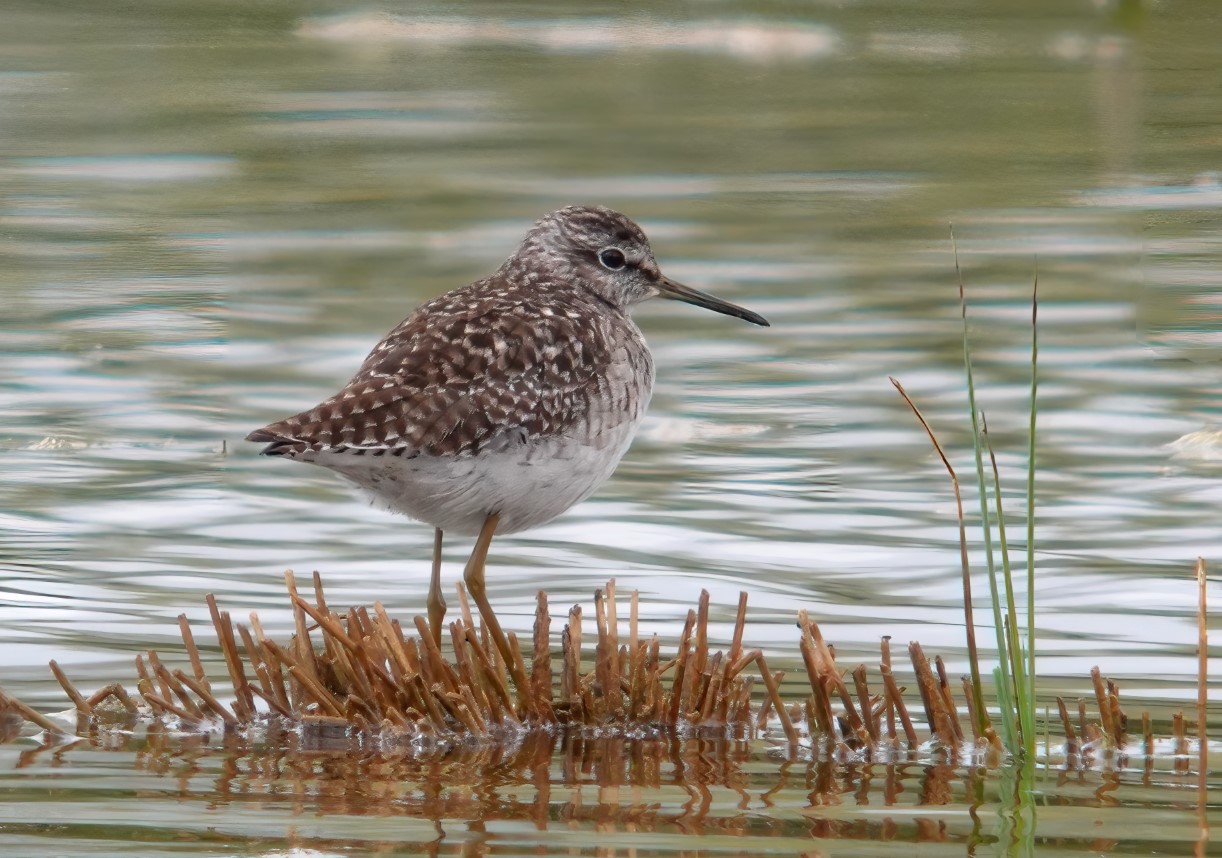
Waders were in short supply this week but in a bizarre turn of events, the Wood Sandpiper – last seen at Pitsford on 7th December – made a reappearance on 29th on the same building site pool at Upton, Northampton, as it did in early April, again after vacating Pitsford at the end of January. It didn’t stay beyond the morning of that date and, despite a local search, it wasn’t relocated by the time the week closed on 30th.
On the Larid front, two adult Caspian Gulls were at Hollowell on 27th and an adult visited Stanford on 28th and 29th, the latter date producing two Yellow-legged Gulls there, while an adult was seen briefly at Hardingstone GP on 30th.
Stanford also produced one of this week’s two Merlins, on 26th, while the other was seen between Harrington AF and Draughton on 29th.
A Waxwing was reported flying from the Gladstone Road area of Northampton toward Dallington Park on Boxing Day but there was never any doubt about the week’s top passerines when a veritable tsunami of Yellow-browed Warblers hit on 27th, as two were found in close proximity in trees and scrub adjacent to the entrance of Earls Barton GP’s Mary’s Lake. Clearly one of these birds was the individual first seen on the nearby island in the lake, briefly, on 16th. This stripey duo clearly saw fit to do the decent thing and remained, showing well, to the delight of all comers, until the week’s end.
Yellow-browed Warbler, Earls Barton GP, 27th December 2022 (Bob Bullock)Yellow-browed Warbler, Earls Barton GP, 27th December 2022 (Martin Swannell)Yellow-browed Warbler, Earls Barton GP, 27th December 2022 (Bob Bullock)Yellow-browed Warbler, Earls Barton GP, 27th December 2022 (Martin Swannell)
We’re so used to hearing of this species being trapped and ringed in the county (two at Stanford earlier, in the autumn) and these birds go some way to redress the balance. And two together? Well, that’s a first, locally! Winter records are rare in Northants but not without precedent. Indeed, with increasing numbers appearing in Europe during autumn and winter, Yellow-browed Warbler has been suggested as an ideal model for studying the links between vagrancy and the emergence of new migratory routes.
Female Stonechat, Earls Barton GP, 26th December 2022 (Leslie Fox)Female Stonechat, Upton CP, 29th December 2022 (Mike Alibone)
But back down to earth, the week’s Stonechats were seen at Earls Barton GP, Lilbourne Meadows NR, Pitsford Res, Summer Leys LNR, Sywell CP and Upton CP with no more than four at any one locality.
As the meteorological pendulum swung back to weather conditions more normally associated with the time of year, cold north-easterlies from the Arctic gave way to warm south-westerlies off the Atlantic and a rapid thaw ensued.
Local bodies of water became ice-free once again and wildfowl numbers had rallied by the week’s end. Overall, though, in the run up to Christmas the picture was bleak. Smew topped the bill with the discovery of two drakes at Pitsford Res on 22nd, otherwise a drake Red-crested Pochard at Stanford Res was the only one left holding the fort throughout the period.
Drake Smew, Pitsford Res, 22nd December 2022 (Matthew Cottrell)
The Nene Valley hung on to at least one Marsh Harrier, with one seen over Earls Barton GP’s new workings, both north and south, on 18th, while the long-staying ‘ringtail’ Hen Harrier continued to feature in the Brampton Valley at Blueberry Farm on 19th, crossing the Harborough Road to visit Harrington AF the following day.
In what transpired to be almost a carbon copy of last week’s waders, the Black-tailed Godwit remained at Thrapston GP’s Titchmarsh LNR on 17th and single Jack Snipes were at both Daventry CP and Hollowell Res on 21st.
On the Larid front, single adult Caspian Gulls continued to be seen at both Hollowell and Stanford on 21st and 23rd, while adult Yellow-legged Gulls were at both Daventry and Pitsford on 21st.
Propping up the passerines, a sprinkling of one or two Stonechats occurred in the Brampton Valley on 17th, at Chipping Warden on 18th, Weedon on 19th, Earls Barton GP on 20th and Hollowell on 23rd.
As the temperature dropped to minus 9°C in the early hours on the last day of the period, the week just gone gave us a taste of what winters used to be like, in the days when we were all made of sterner stuff. Although new birds were on offer, the continuing cold spell also delivered some casualties.
And the sub-zero temperatures resulted in increasingly extensive ice and more bodies of water freezing over, the resultant effect of which was a clear-out of wildfowl from many localities. Such displacements are not without reward, though, and, disregarding the appearance of a Barnacle Goose at Kislingbury GP on 10th, eight Pink-footed Geese flew east over Hartwell on 15th and the Ravensthorpe bird was still in place at the week’s end.
Red-crested Pochards were here and there, with Stanford’s quota up to seven again on 10th and the two drakes still at Kislingbury on the same date. By the following day, just one drake remained at Stanford and two drakes were found on Mary’s Lake at Earls Barton GP, while 14th saw three (two drakes) at Daventry CP.
Two new Smew – a drake and a ‘redhead’ – were found at Thrapston GP’s Titchmarsh LNR on the last day of the week.
Smews, Thrapston GP, 15th December 2022 (Nick Parker)
Sadly, two days after initially being reported, the period’s only Cattle Egret was found dead at Thorpe Malsor Res on 16th. Accompanying a small flock of sheep and having been present since at least 11th, it had become approachable down to 2 metres and it appears safe to conclude that its death resulted from not being able to find enough food in the frozen conditions. No other Cattle Egrets were reported from the usual localities during the week.
Cattle Egret, Thorpe Malsor Res, 16th December 2022 (Mike Alibone)
A juvenile Shag paid a brief visit to Daventry on the morning of 14th, checking out before midday, ahead of the expanding icy conditions which resulted in 90% of the water’s surface there being frozen by the following day. This is the second record for Daventry in 2022 and the fifth for the year as a whole – two at Pitsford and one in Towcester.
Maintaining their winter presence in the Nene Valley, Marsh Harriers were seen at Summer Leys LNR on 10th, Stanwick GP on 13th and at Titchmarsh LNR on 16th.
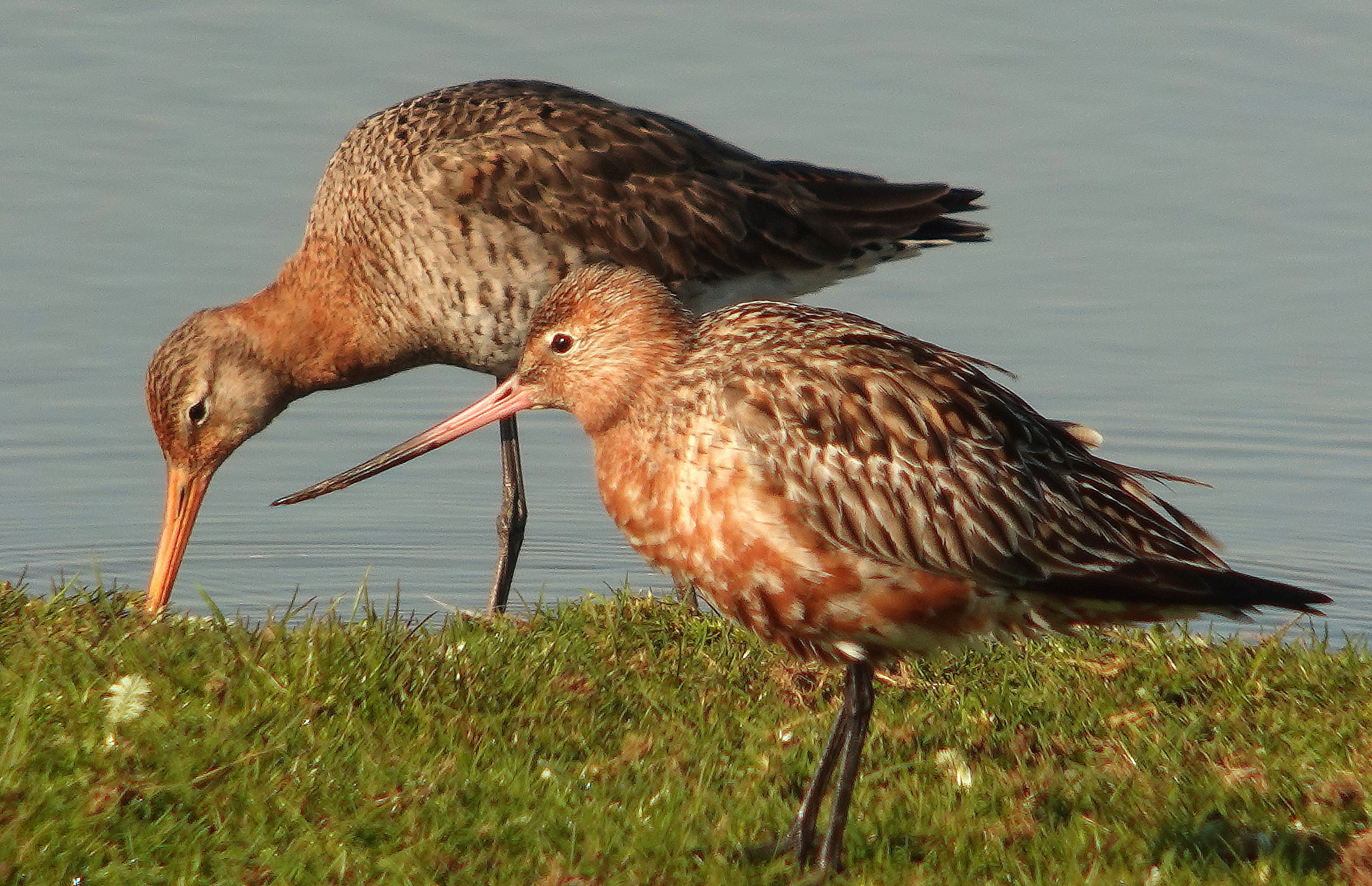
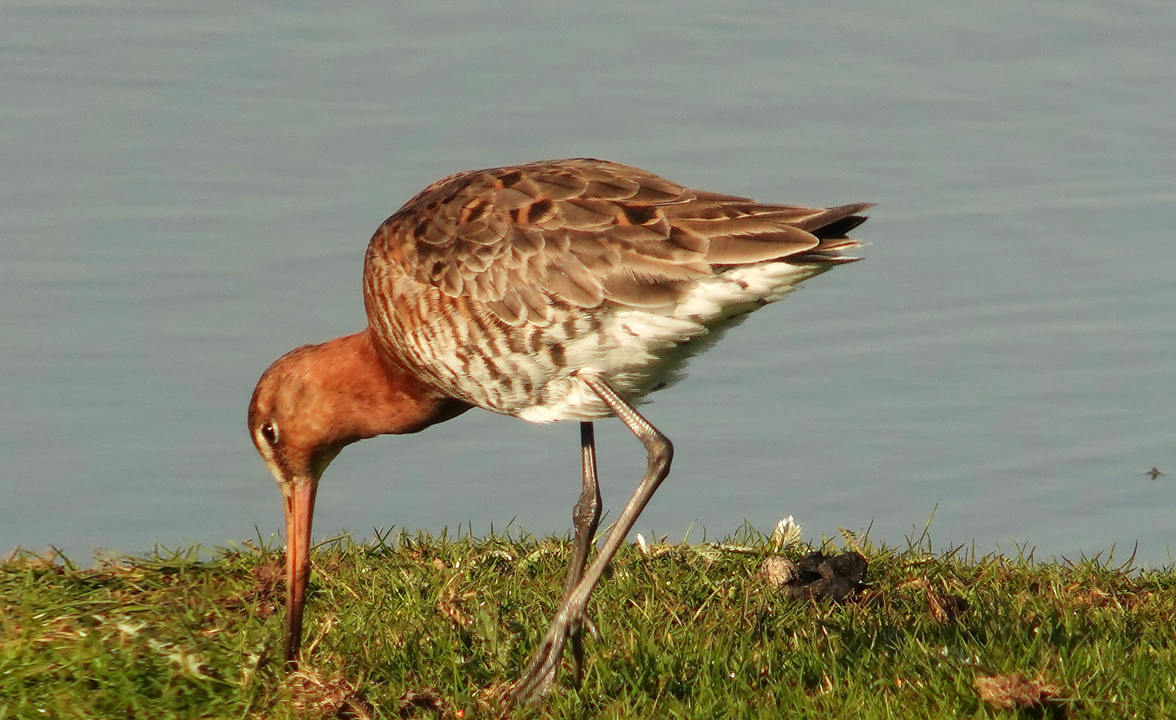
Obviously it’s not a standout time of year for waders, so the week’s tally remained low and was restricted to a meagre crop of a Black-tailed Godwit at Titchmarsh LNR on 16th and two Jack Snipes at Hollowell and Pitsford on 11th and 13th, respectively.
Black-tailed Godwit, Thrapston GP, 16th December 2022 (Nick Parker)
Gulls, too, had dwindled to just two adult Caspian Gulls at Hollowell on 11th and one there again on 16th, plus single adult Yellow-legged Gulls at Pitsford on 11th and 14th. Despite the sustained, icy, northerly blow, the number of ‘white-wingers’ remains surprisingly small, nationwide, so the chance of anything dropping in from the Arctic in the near future remains low.
This week’s token Short-eared Owl flew west-north-west over Daventry CP on 15th, while the period’s two Merlins were both seen on 14th – one at Blueberry Farm, Maidwell and the other near Burton Latimer.
Apart from the – or ‘a’ – Bearded Tit heard calling near the Visitor Centre at Stanwick, this week’s standout passerine was a Yellow-browed Warbler which showed briefly on the island in Mary’s Lake at Earls Barton GP during the last couple of hours of daylight on 16th. The observer’s caveat to the effect that Hume’s Warbler could not be ruled out, along with this bird’s appearance at one of the county’s most popular birding locations, should be more than enough to ensure it is searched for over the ensuing days.
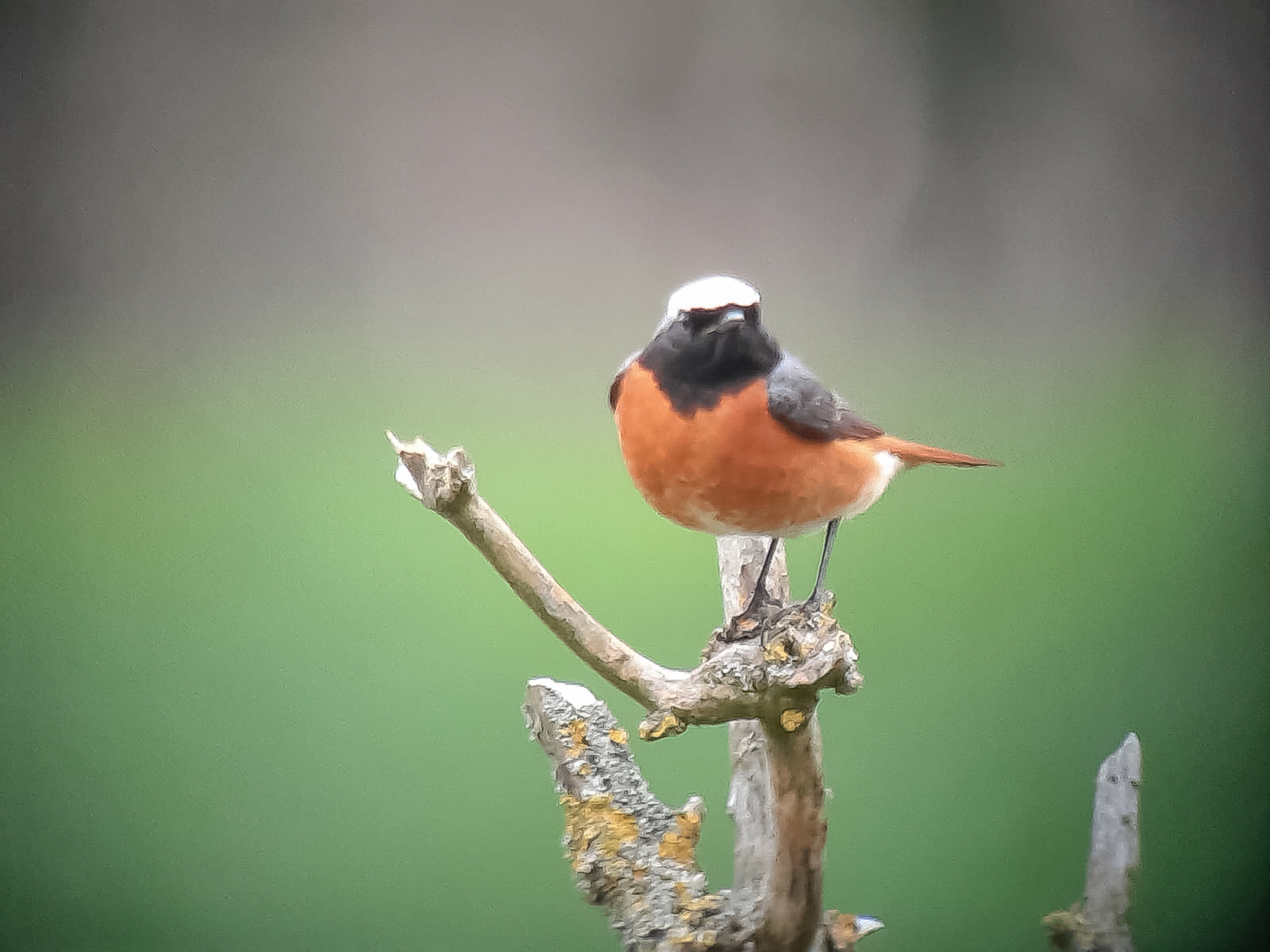
Making news for a different reason, however, was the Black Redstart that turned up inside Northampton General Hospital on 12th. An apparent male, it was initially reported by on-site personnel as a ‘pigeon’ trapped in a room, until photographed and subsequently identified by a member of staff, who opened the window to free the bird. A bizarre story indeed.
Black Redstart, Northampton General Hospital, 12th December 2022 (Jeanne Carr)
Otherwise, Stonechats provided a smidgeon of entertainment at six localities, which included Ditchford GP, Earls Barton GP, Hollowell Res, Sywell CP and Upton CP/Kislingbury GP, with a maximum of at least seven at Hollowell on 11th.
Stonechat, Upton CP, 14th December 2022 (Tony Stanford)
Following one over Oundle last week, another Crossbill was seen at Pitsford on 13th. Hopefully, 2023 will turn out to be a better year for this species than 2022 has.