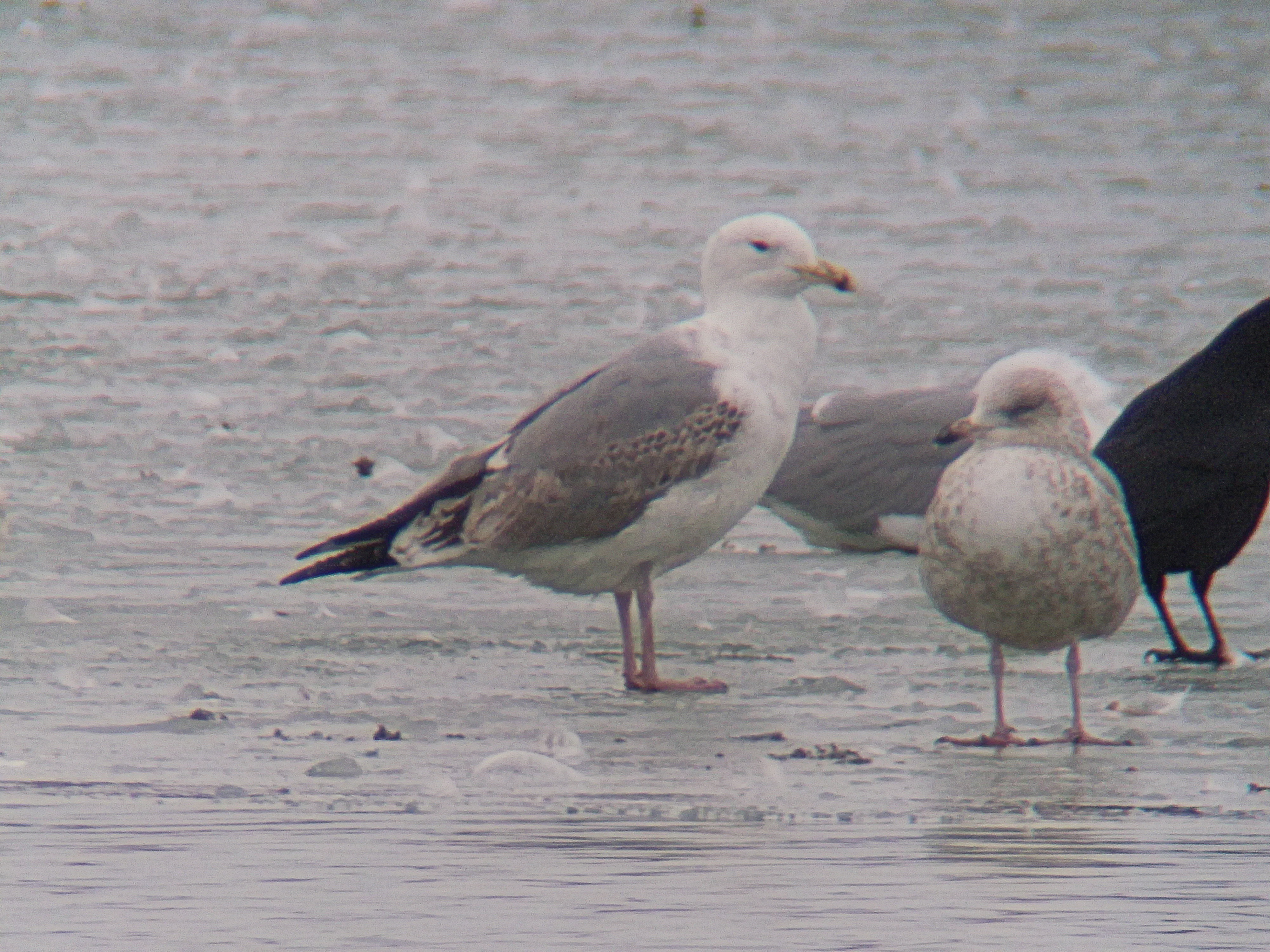
During late afternoon on Monday 22nd April, Steve Fisher was birding at his local patch, Stanwick Gravel Pits, when, at about five o’clock, he discovered a second calendar year (first-summer) Ring-billed Gull in the north-east corner of the main lake. Accompanying Lesser Black-backed and Common Gulls it was on the water and in the shallows only briefly, some distance from the hide. Steve managed a few distant record shots just before it got up and flew east.
First-summer Ring-billed Gull, Stanwick GP, 22nd April 2013 (Steve Fisher)
The images give a little of what was seen well in the field when compared with Common Gull, i.e. the fuller head with flatter crown, less placid appearance contributed to in part by the heavier, light pink bill with sharply demarcated dark tip (recalling first-winter Glaucous Gull) and paler grey mantle than Common Gull.
This is only the 12th record of Ring-billed Gull for Northants and, interestingly enough, Steve found the first – an adult – way back in 1984 at nearby Ditchford GP. The previous records are:
1984 29th March, adult, Ditchford GP 1991 28th November, first-winter, Stanford Res 1993 30th October & 4th November, first-winter, Boddington Res 1994 12th November, first-winter, Daventry CP 1998 24th February-2nd March, adult, Welford Tip 2000 13th January-3rd February, adult, Welford Tip 2000 8th March, second-winter, Daventry CP 2001 31st January, adult, Daventry CP 2001 9th-16th February, adult, Naseby Res/Welford Tip 2008 27th February & 7th-9th March, adult, Boddington Res 2011 9th March, adult, Boddington Res
This winter, in contrast to last, ‘white-winged’ gulls have been difficult to catch up with at Ditchford Gravel Pits, the only ‘regular’ wintering site in recent years for Glaucous and Iceland Gulls in Northants. Since the first one turned up in December there have been at least four Glaucous Gulls – an adult, a near-adult and two juveniles.
The Glaucous Gulls have been highly mobile and sporadic in their appearances, sometimes showing up on Viaduct Pit and only very occasionally coming in to roost at nearby Stanwick GP but, generally, they have been difficult to pin down. Despite numerous visits to Ditchford and the nearby Sidegate Landfill, I did not manage to catch up with one until a week last Sunday (26th February) when a juvenile was on Viaduct Pit and visible distantly from the Wellingborough to Irthlingborough Road. Yesterday (3rd March) I connected with this nice juvenile on the watersports pit, just west of Ditchford Lane, where I was able to watch it for a good hour or so.
Juvenile Glaucous Gull, Ditchford GP, 3rd March 2013 (Mike Alibone)
Ditchford and nearby Sidegate Landfill provide a combination of a safe bathing and loafing area and a ready source of continually topped-up food.
Get to grips with these gulls while you can. If Sidegate Landfill ever closes, Glaucous and Iceland Gulls will revert to their former rarity and become much more difficult to catch up with in Northants!
I was driving through Newnham, already on my way to the gull roost at Boddington Reservoir, when Gary Pullan – god bless him – phoned me with a message of just two words: “It’s here!” he said. Having visited the site twice yesterday and spent the last two hours of daylight shivering in the falling temperatures without it showing, it was comforting to know the adult Bonaparte’s Gull was there and on view.
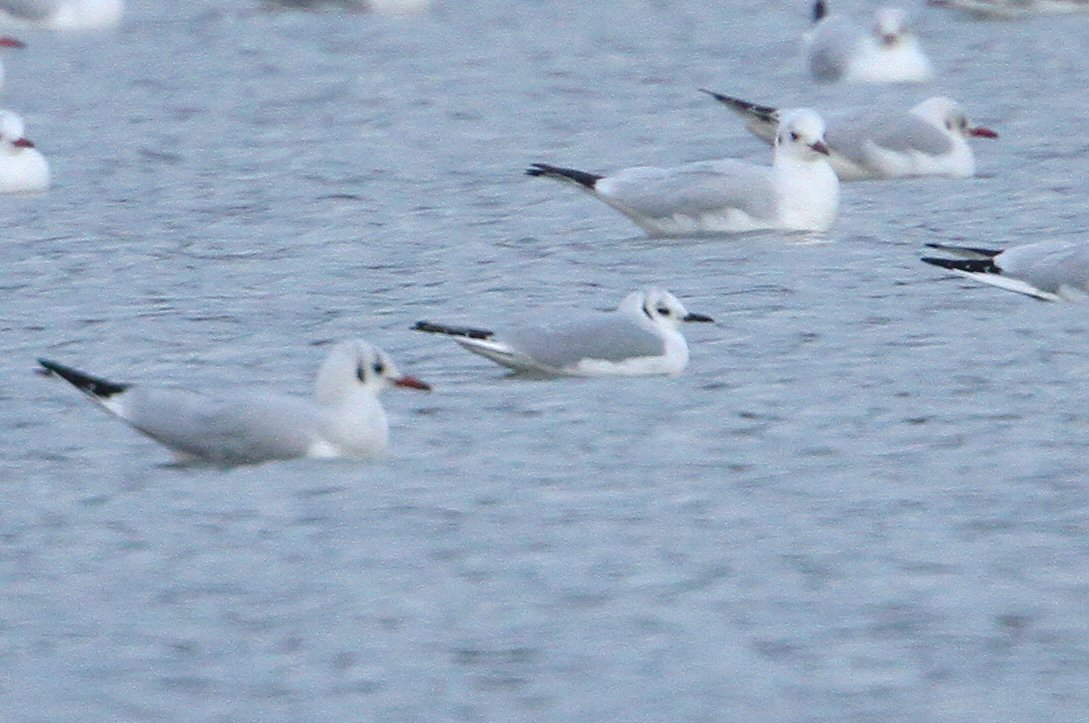
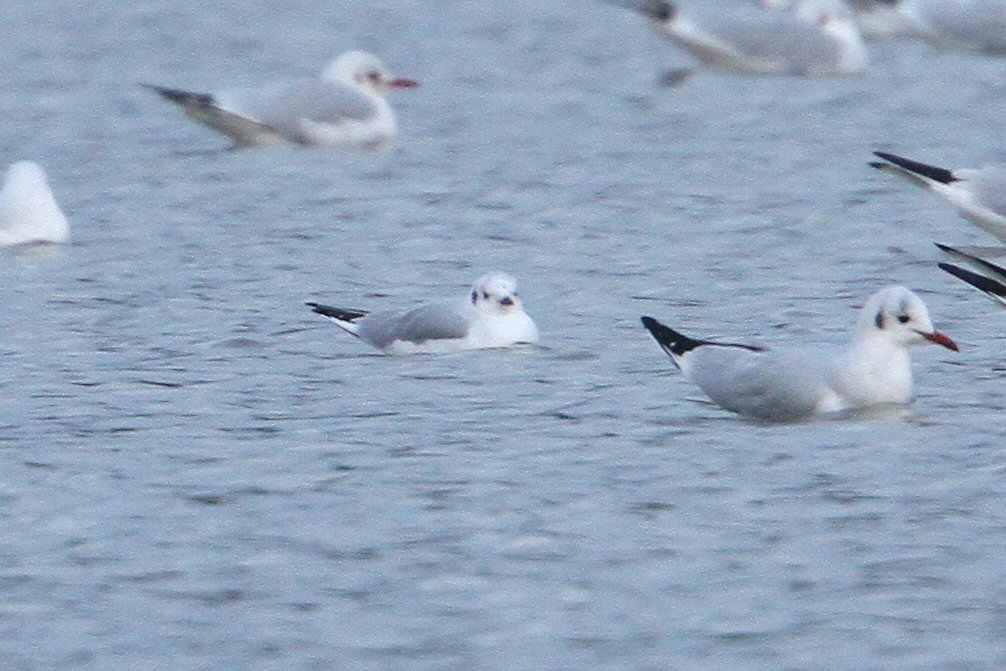
While Gary continued to spread the word I stepped up a gear, unashamedly broke the speed limit, and arrived shortly afterward to find just a handful of birders watching it. It was with about two hundred Black-headed Gulls. A cracking little gull (or should I say small gull), the proportions of which can be appreciated when compared with the accompanying Black-headed Gulls, numbers of which had built to well over 1000 by dusk.
Adult Bonaparte’s Gull, Boddington Res, 3rd November 2012 (RW Bullock)
It spent most of its time at rest, flying only a short distance on a couple of occasions. It may be something or nothing but most of the time it held its bill in a horizontal, or slightly raised, position compared to the Black-headed Gulls, which (most of the time) held their bills pointing down, below the horizontal. I don’t know if this might be a useful way of picking it out among Black-headed Gulls at a large gathering such as the Boddington roost – this needs testing.
There are about 180 records of this North American species for the UK but they are rare inland and this is the first for Northamptonshire, although the neighbouring counties of Warwickshire and Oxfordshire have had two and three records respectively. Well done Gary for finding it on Thursday and thanks are due to Bob Bullock for the accompanying images – which are better than my digiscoped stills – but I did manage to get the videoscope footage below.
Hanging out on boats, buoys and just about anything which provides a suitable loafing site, since late August a fourth-winter large, white-headed gull has been almost resident at Pitsford Reservoir’s yacht club. Identified by some as a Caspian Gull, it exhibits a suite of features which are not fully consistent with that species and which hint strongly at mixed parentage. It can be safely aged as a fourth-winter as it closely resembles an adult but it has retained extensive black in the primary coverts and alula while the rather liberally ‘messy’ appearance of the bill, with a yellow tip divided from a pale, washed out base by a diffuse, dark subterminal band, is also a pointer to its not being fully mature.
Presumed Caspian Gull hybrid, Pitsford Res, October 2012 (Mike Alibone)
Pro-Caspian features exhibited by this individual include the rather elongated body with a high-chested appearance and attenuated, sloping rear end, long, thinnish legs, largely white head (although there is a dark ‘eyebrow’ with some fine streaking on the ear coverts) with a restricted shawl of dark streaks on the hind neck, ‘Common Gull grey’ mantle and a washed out, green-tinged, yellow bill.
Conversely, anti-Caspian features are the absence of a long white tip to the upperside of the 10th primary (instead P10 has a very small white tip), absence of a long white tongue on the underside of P10 (where there is a single mirror set into an otherwise black distal end to the primary), broad – as opposed to fine – rear neck streaks, a rather deep, powerful-looking bill with a strong gonydeal angle and a sharply-angled and hooked culmen, a pronounced pale straw-coloured iris and a relatively large, ‘full’ head, lacking Caspian’s long, sloping forehead and ‘snouty’ appearance.
While pale eyes do not rule out Caspian Gull (a minority exhibit pale irises) and variation in wing tip pattern can be considerable, bill structure, head shape and jizz normally remain consistent and combine to lend a more ‘gentle’ appearance far removed from what we are seeing here. This individual appears to have a head shape, bill structure and a general ‘mean’ character much closer to Herring Gull or Yellow-legged Gull than to Caspian Gull.
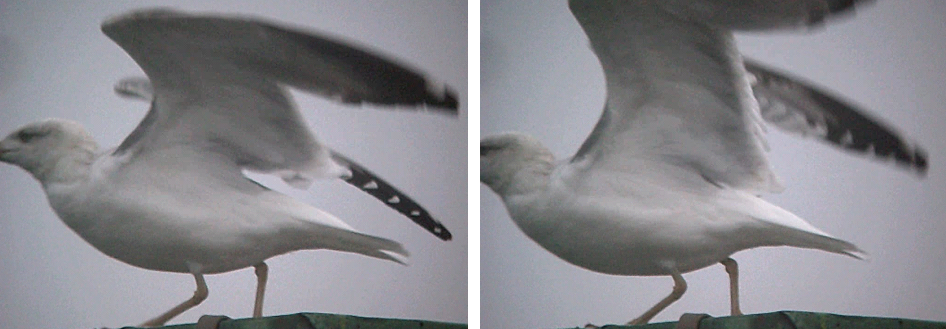
Presumed Caspian Gull hybrid, Pitsford Reservoir, October 2012 (Mike Alibone). From a distance. The image on the left was obtained in overcast conditions, the others in sunlight, accounting for the apparent difference in mantle colour. The long legs are clearly evident, particularly in the middle photograph.
However, the wing tip pattern is very similar to a known 4th year male Caspian Gull from Poland (see here) although the Pitsford individual has larger white primary tips. Interestingly, in threatening behaviour toward other gulls, this bird calls with its wings partly open, the bill pointing down initially before raising it to 45 degrees as it delivers a very convincing Caspian-like laughing call and posture.
It is easy to speculate but difficult to draw any firm conclusions but I would guess this individual comes from the East European hybrid zone where mixed pairs of Caspian Gulls and Herring Gulls of the ‘Scandinavian’ race argentatus are known to occur. Hybrid Caspian Gull x Herring Gull from this zone has occurred in the UK before see, for example, here . However, it can also appear quite square-headed and sometimes takes on the appearance of Yellow-legged Gull, although structure and jizz are not quite right for that species. It is an interesting individual but it is certainly not a pure Caspian Gull. Watch the video below. What do you think? Comments welcomed.
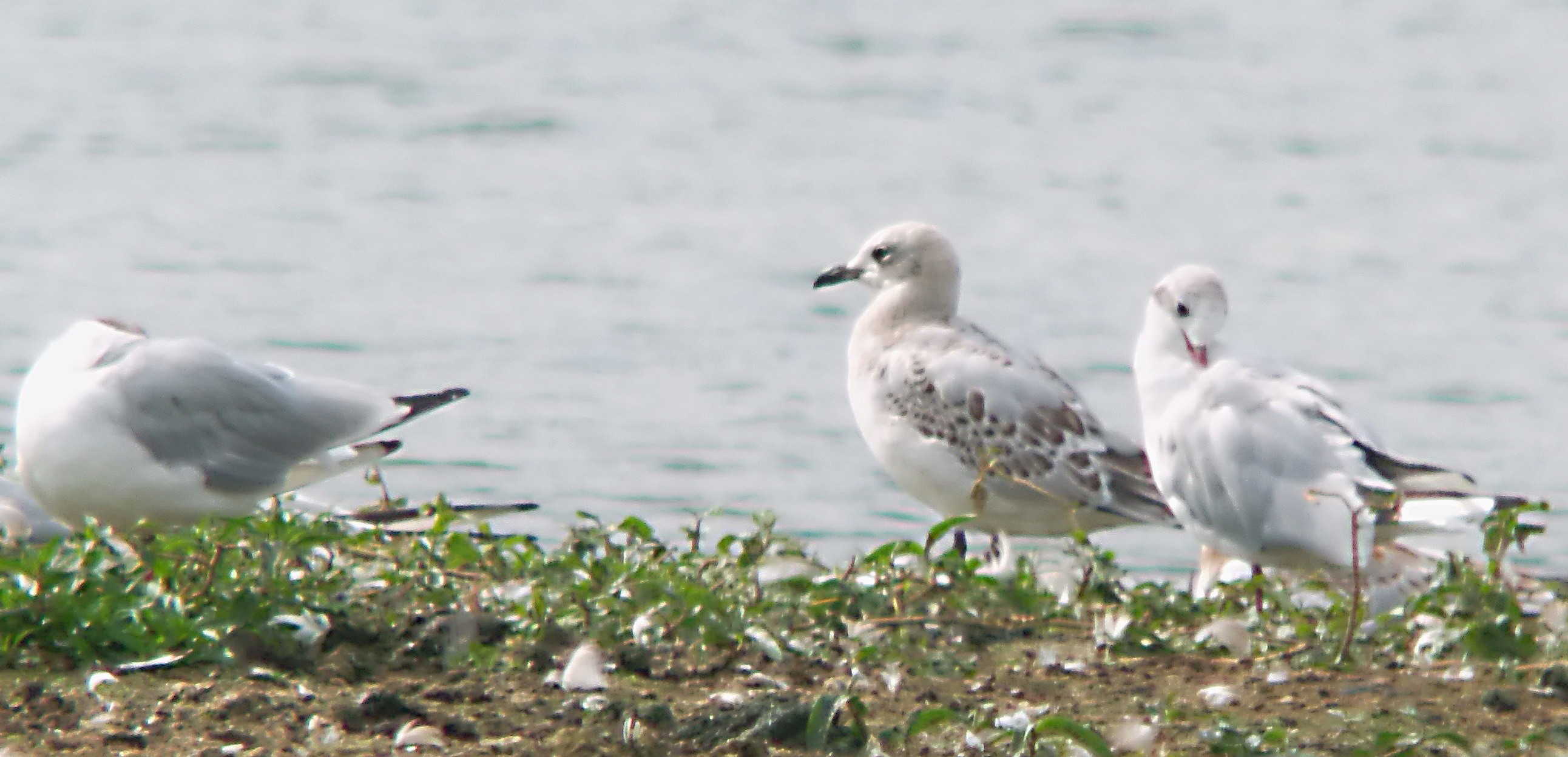
It has already begun its moult to first-winter plumage with most of the scapulars and many mantle feathers now light grey but it has not yet developed the dark mask of a full first-winter. In this respect it’s a very distinctive bird compared to the accompanying Black-headed Gulls, lacking the latter’s well defined, isolated dark ear covert spot but already showing white ‘eye-lids’, a much heavier, dark, blunt-ended, slightly drooping bill and dark legs.
So far this autumn there have been two juveniles at Stanwick GP on 28th July, and singles at Pitsford Res on 1st, 2nd and 12th August. Hopefully we can look forward to more arriving over the next few weeks …
Today has seen a big overland movement of Arctic Terns, with impressive counts at a number of inland localities. While some chose to linger at certain sites, many pushed straight through as they headed north toward their breeding grounds. Significant totals were logged at Rutland Water and Cropston Reservoir (both Leicestershire) with 70 and 60+ respectively, Buckden Gravel Pits, Cambridgeshire, where 61 were counted moving along the Ouse valley and 39 visited Paxton Pits (also Cambridgeshire) while Broom, Bedfordshire logged 57 and Wilstone Reservoir, Hertfordshire 30+.
The largest flock, however, was in our own county and recorded by Dave Holden at Thrapston Gravel Pits’ Town Lake, where he estimated 115 to have been present at 11 o’clock this morning. Smaller numbers locally were approximately 30 at Pitsford Reservoir at 8 o’clock with (a further?) 12 there early afternoon and 44 there late afternoon, 26 through east at Summer Leys early morning with a further 33 roosting on the island in nearby Mary’s Lake early afternoon, 25 at Daventry Country Park this morning, 5 at Hollowell Reservoir also this morning with 36 there at 6 o’clock this evening, 16 at Stanwick GP and 3 at Clifford Hill Gravel Pits this evening.
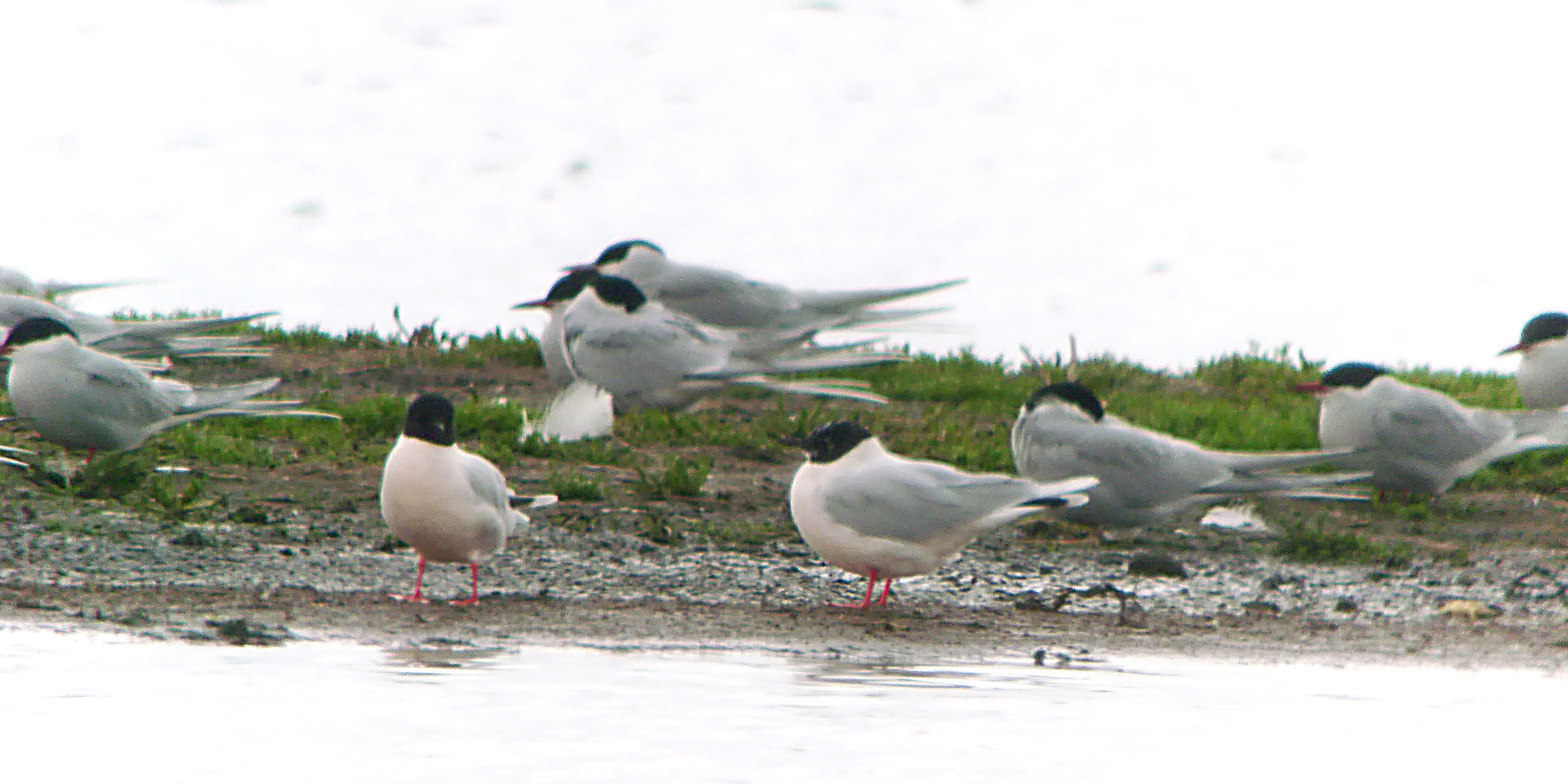
Little Gulls against a backdrop of 33 Arctic Terns and one Common Tern, Earls Barton GP, 24th April 2012 (Mike Alibone)
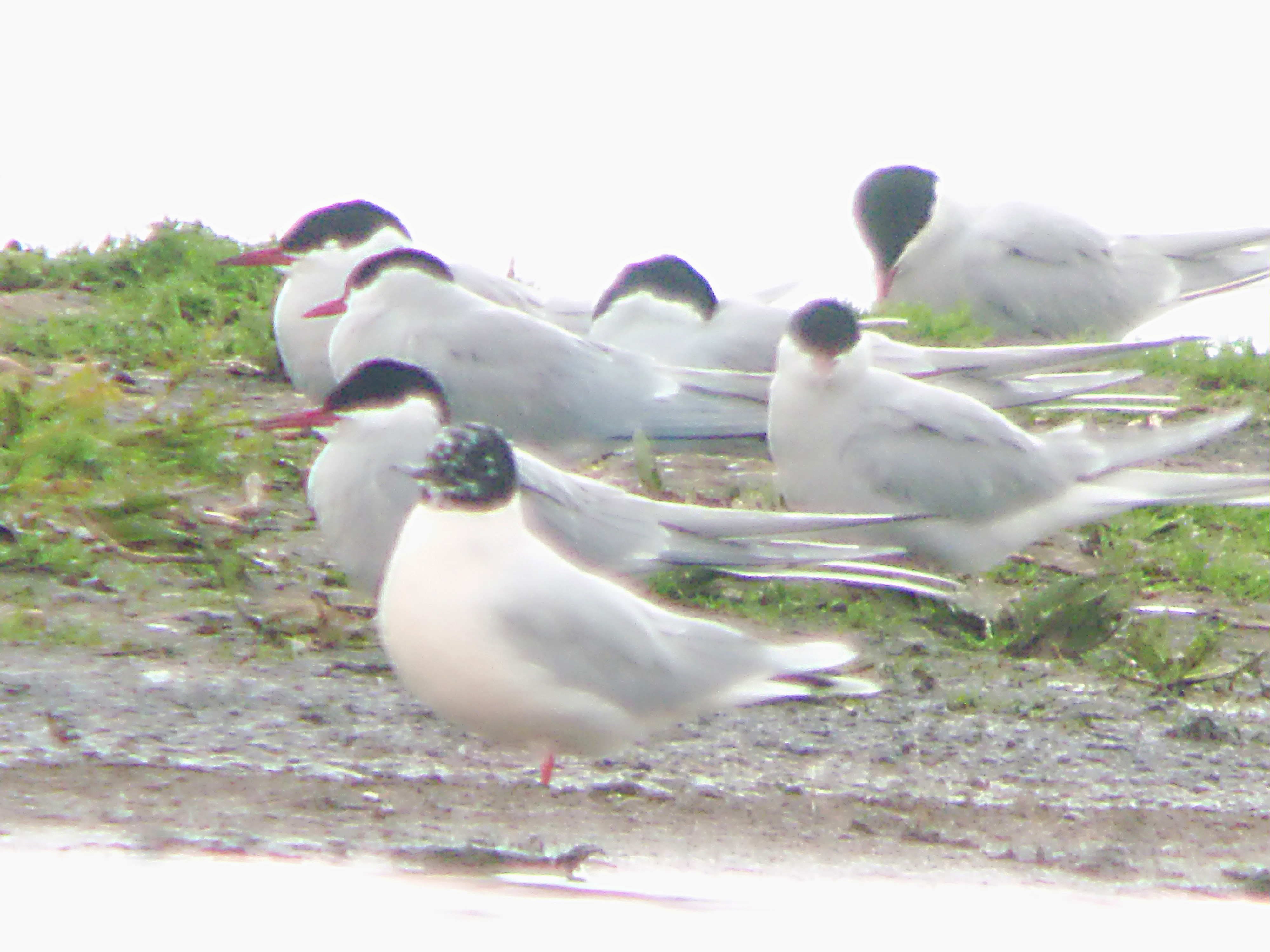
Those on the island in Mary’s Lake were accompanied by 2 smart adult Little Gulls, both of which showed a nice pink flush to their underparts – a feature often shown by this species.
Little Gull and Arctic Terns, Earls Barton GP, 24th April 2012 (Mike Alibone)
Gary Pullan was lucky enough to discover a first-winter Kittiwake at Daventry Country Park this morning. Although not particularly rare nationally, Kittiwakes can often be difficult to connect with in Northants as a result of the short stopovers at inland sites made by the few individuals which choose to migrate overland to reach their breeding sites anywhere between northern Britain and the high Arctic.
Apart from making a short flight around the reservoir while I was there, it spent most of its time loafing on the water, occasionally picking at surface insects, well out in the middle – hence the rather poor, heavily cropped digiscoped shot below.
First-winter Kittiwake, Daventry CP, 7th April 2012 (Mike Alibone)
With an average of four records per year over the last ten years, the overwhelming majority of Kittiwakes visiting the County in spring are adults so this individual is unusual insomuch as it is a first-year – apparently the first spring first-winter since 2001! At first sight it appears doubly unusual because it remained all day, allowing County year-listers ample time to catch up with it, although being immature is a likely explanation for it being in no hurry to reach any breeding grounds.
Mike Baron digiscoped this interesting-looking large gull at Sidegate Landfill yesterday.
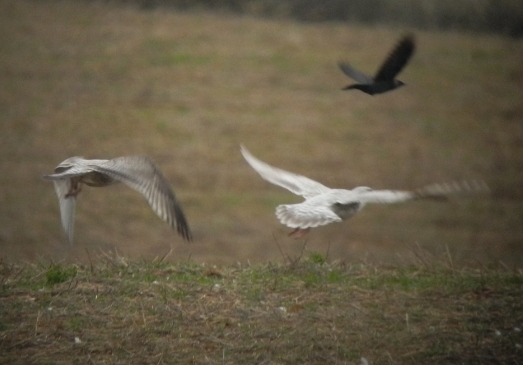
Herring Gull or hybrid, Sidegate Landfill, 21st February 2012 (Mike Baron)
In flight over the tip it bore a strong resemblance to a first-winter Glaucous Gull but upon closer examination, however, it clearly shows features more closely associated with Herring Gull.
Herring Gull or hybrid, Sidegate Landfill 21st February 2012 (Mike Baron)
Although it may be a Glaucous Gull x Herring Gull hybrid I think it more likely to be a leucistic Herring Gull as its head shape does not seem to fit Glaucous, it doesn’t appear to have Glaucous’s beady eye and, as well as the ghosted subterminal tail band, it has an indistinct secondary bar. It is larger, however, than any of the Herring Gulls present!
Herring Gull or hybrid, Sidegate Landfill, 21st February 2012 (Mike Baron)
It does not show a typical striking Glaucous Gull x Herring Gull hybrid bill pattern, which is often virtually identical to first-winter Glaucous but it is not too far adrift from this. Compared with the Herring Gull in the photos, the primaries and tertials are much paler. A pitfall for the unwary Glaucous Gull seeker!
The first 10 days of February have seen additional scarce gulls arriving at Ditchford GP. In addition to those mentioned in the previous summary a new second-winter Iceland Gull was discovered on 3rd, an adult Mediterranean Gull put in an appearance on 7th and Caspian Gulls were also seen intermittently, with adults there on 1st and 7th, a second-winter on 4th and a different second-winter there on 8th.
Interestingly there might have been a new Glaucous Gull there, too. Dave Warner’s photo, below, taken at nearby Sidegate Landfill on 28th January, appears to show a third-winter with an apparent patchy grey mantle and the dark subterminal band on the bill much reduced in comparison to those of the two ‘regular’ second-winters which have been visiting the site. But maybe long distance, light and camera have conspired to distort reality …
One of the Iceland Gulls was showing distantly on the ice when I was there on Wednesday. In this plumage it sticks out like a sore thumb among the many other large gulls and its small size and delicate proportions are obvious compared, for instance, to the nearby Herring Gull.
Second-winter Iceland Gull, Ditchford GP, 8 February 2012 (Mike Alibone)
Also interesting was this advanced second-winter Caspian Gull, well on its way to second-summer with a reasonably bright bill and very clean neck and breast (just a few small spots at the base of the neck).
Second-winter Caspian Gull, Ditchford GP, 8 February 2012 (Mike Alibone)
This is a fairly typical individual with small head, dark iris, tapered, parallel-sided (though
Second-winter Caspian Gull, Ditchford GP, 8 February 2012 (Mike Alibone)
a little short) bill and a small white mirror on P10, the latter not present on Yellow-legged Gull or argenteus Herring Gull and only on some argentatus Herring Gulls of this age. Second-winter Caspian Gulls are highly variable, some closely resembling first-winters while others can appear much more adult-like.
It’s been a record year for Glaucous Gulls at Ditchford already and we’re only at the end of January. With the discovery there in December of a juvenile, followed by a second-winter in early January, there has been a total of five Glaucous and two Iceland Gulls at this site, all birds commuting between the gravel pits and nearby Sidegate Landfill. The records so far can be summarised as follows:
Glaucous Gull juvenile: 14th to 28th December; second-winter (#1): 10th December to 28th January; second-winter (#2): 27th to 30th January fourth-winter: 15th and 23rd January adult: 7th to 27th January
Iceland Gull second-winter: 16th to 30th January adult: 12th to 21st January
I was lucky enough to find the fourth-winter Glaucous Gull there on 15th January and to catch up with both the second-winters but the juvenile and the adult have (so far) managed to elude me. The most recently discovered second-winter was on show yesterday, distantly in the field opposite the entrance to Sidegate Landfill (see below).
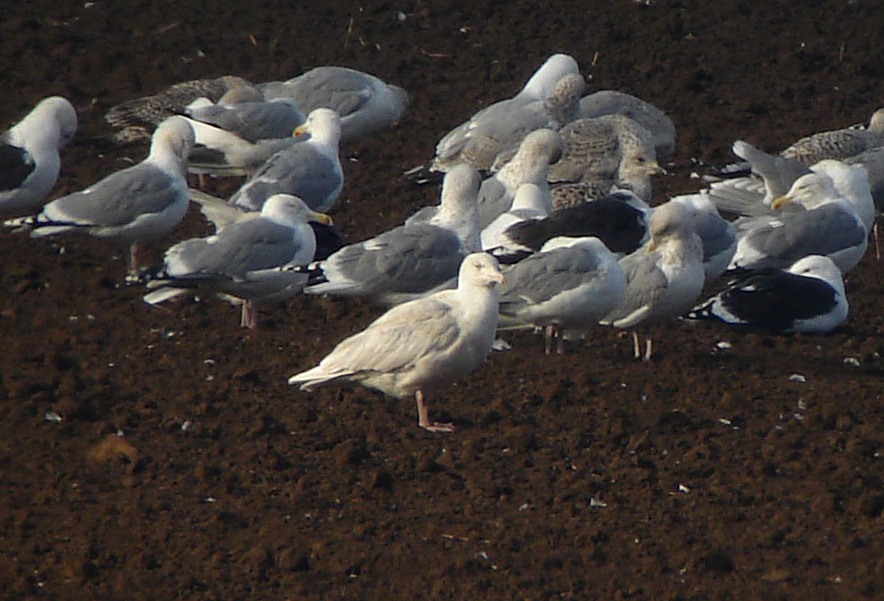
Second-winter Glaucous Gull, Sidegate Landfill, 30 January 2012 (Mike Alibone)
It’s a different individual to the original one which is still present, being ‘whiter’, i.e. less brown in the plumage, and with a different bill pattern – the pale tip being a little more prominent and the black subterminal band being a different shape.
Second-winter Glaucous Gull, Sidegate Landfill, 30 January 2012 (Mike Alibone) showing deep pink legs and short primary projection
Hopefully more white-winged gulls will appear here before the winter is out. March is a recognised passage month for Iceland Gull and there’s always the outside chance of Ring-billed Gull – long overdue at this site, which hosted the first County record of this species in March 1984.











 Northants birds