Only hours after bemoaning the fact in Week In Focus that there had been no Little Stints in Northants this year, I did what any desperate birder would do – went out to my local patch and found one. Ok, so it may be pure coincidence but next weekend I’m going to try it again … with White-rumped Sandpiper 🙂
Juvenile Little Stint, Clifford Hill GP, 21st September 2013 (Mike Alibone). Click on the cogwheel to increase resolution to 720p to watch in HD.
It’s a sad fact, though, that in recent years Little Stint has been relegated to (or promoted to, depending on your point of view) the status of very scarce passage migrant in the county. In the ‘70s and ‘80s we all took them for granted. Small numbers would arrive on cue every September at Pitsford and the other reservoirs; unfortunately, however, this is no longer the case. A quick look at the records over the ten years 2002-2011 gives an average of just 4 per year compared to many more than this during the latter decades of the last century.
Fresh autumn juveniles are beautifully marked birds. Catch ’em while you can!
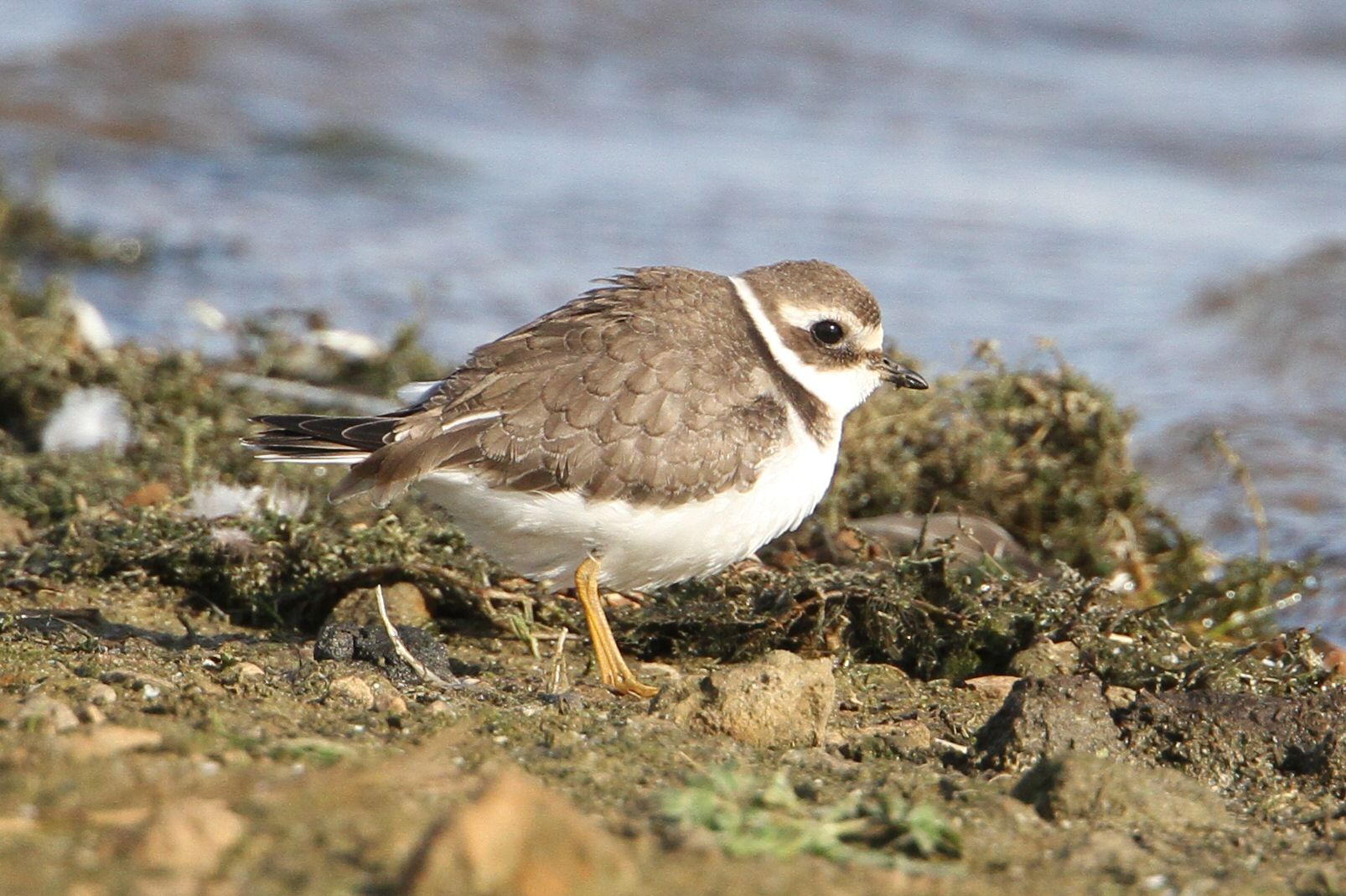
In the early part of the week Bob Bullock was photographing waders at Clifford Hill Gravel Pits when he came across this juvenile Ringed Plover with a rather Semipalmated Plover-like face pattern feeding with other Ringed Plovers and Dunlin on the north shore of the main barrage lake.
Juvenile Ringed Plover, Clifford Hill GP, 16th September 2013 (Bob Bullock). Click image for larger version.
Enough to arouse interest as close examination reveals a) the dark band on the lores narrowing considerably where it joins the base of the bill and b) the join is clearly above the gape-line, the latter protruding into the white part of the lores. This loral arrangement is supposedly a key identification feature of Semipalmated Plover – Ringed Plover’s loral band normally broadens and joins the bill base at the gape line, which is clearly not the case with this individual.
However, other Semi-p supporting features are entirely absent: no trace of a narrow yellow eye-ring, lack of stubby bill, and the dark subterminal fringes on the coverts are too broad (many of the whitish terminal fringes have already worn/are wearing off).
Furthermore, closer inspection would reveal a lack of palmations between the middle and inner toes, as can be seen in the image below. Both Ringed and Semipalmated Plovers have palmations between the middle and outer toes but only Semi-p has them between all toes.
Juvenile Ringed Plover, Clifford Hill GP 16th September 2013 (Bob Bullock). Click image for larger version.
The excellent, detailed, close up images from Bob enable this level of scrutiny!
Late on Thursday, 9th May, I made a flying visit to Summer Leys LNR in the hope that the strong south-westerlies sweeping southern parts of the UK had brought with them something a little different to the run-of-the-mill birds we have been used to seeing in recent days. I had seen nothing from the feeding station or on the adjacent Mary’s Lake and viewing conditions were not ideal, even from the screen hide, which did not offer as much protection from the strong, blustery wind as I had expected.
I was about to leave when a small flock of Dunlins suddenly arrived in front of me on ‘The Slips’. A quick count totalled twelve, all in smart summer plumage with fresh, bright fringes to the upperpart feathers, although it immediately became apparent that one bird was a little different. Closer scrutiny revealed a slightly smaller individual with less brightly patterned upperparts, grey and buff fringes to many of the mantle and scapular feathers (with black centres), sparse streaking above the black belly patch and a more prominent supercilium and shorter bill than most – if not all – the accompanying birds.
I had little more than ten minutes of observation before a very low-flying Hobby skimmed the water’s surface nearby, flushing the flock, which promptly vanished and I was unable to relocate it anywhere on the reserve.
‘Arctic’ Dunlin (left) Summer Leys, 9th May 2013 (Mike Alibone). The difference in upperpart pattern is obvious, the bright, rusty fringes of the schinzii Dunlin on the right being replaced by buff and grey in arctica, the latter being a marginally smaller individual (exaggerated in the photograph by the slightly different angles of the two birds relative to each other) while the shorter bill length of arctica is not visible in the image.
During this time I shot a series of short, wind-shaken videos through my scope and the best of a bad bunch appears below. The same windy conditions left me with one dreadful and barely usable digiscoped shot (above), which serves to illustrate some of the above differences. To my eyes this bird showed all the characters associated with arctica, ‘Arctic’ or ‘Greenland’ Dunlin, the rarest of the three races of Dunlin (schinzii and nominate alpina being the other two) which occur annually in Britain.
‘Arctic’ Dunlin (left) Summer Leys, 9th May 2013 (Mike Alibone). [Run video, click on cog-wheel icon and change image quality to 720p HD to watch at highest definition].
The UK status of arctica is one of a regular passage migrant in relatively small numbers and supposedly with a westerly bias. It breeds in north-east Greenland and Svalbard and its population was recently estimated to be between 7,000 and 15,000 pairs; compare this with schinzii – the race breeding in the UK, northwestern Europe and Iceland – which has an estimated population of 270,000 pairs in the latter country alone (see Gunnar Thor Hallgrimsson) and its relative rarity becomes apparent!
As far as I know, there are, to date, no other records of this race for Northamptonshire, although it must surely have occurred in the past. Trying to identify one which is not in fresh summer (= early spring, unworn) plumage would be a greater challenge.
The unseasonally inclement weather this weekend paid dividends to those who ventured out to brave it. Strong north to north-easterly headwinds and sustained heavy rain from Friday onwards put paid to the progress of many northbound migrants resulting in large numbers of birds being grounded across southern Britain.
Notable among these locally were record numbers of Northern Wheatears (minimum counts of 80 at Clifford Hill GP and 71 at Borough Hill including many Greenlanders) and sizeable flocks of Black-tailed Godwits with 30 on floodwater at Irthlingborough, 26 at Summer Leys and 9 at Clifford Hill. Flooded pools at the latter locality also attracted a Turnstone and at least 21 Yellow Wagtails, including a female presumed ‘Channel Wagtail’ (Yellow x Blue-headed hybrid). Two more Ring Ouzels at Borough Hill and one at Summer Leys completed a remarkable run of records for this species this spring. With three hours between them, two Kittiwakes also went through at Summer Leys on Saturday and a Slavonian Grebe (not from Stewartby, Bedfordshire) was found at Thrapston Gravel Pits on Titchmarsh reserve. I caught up with this soggy-looking summer-plumaged individual early this morning while it was feeding on North Lake, seemingly oblivious to the choppy water, high winds and lashing rain.
Later this morning the Black-tailed Godwits were performing well, down to just a few metres, in front of the Screen Hide at Summer Leys. Fantastic-looking summer-plumaged Icelandic race birds, I was frustrated by the lack of camera (having smashed it yesterday when the wind blew my tripod over at Clifford Hill!). Neil Hasdell came to the rescue, however, and kindly sent me the photos below, which are no doubt better than anything I would have achieved by digiscoping :-).
The shorter-legged, shorter-billed and considerably more extensively rufous-patterned islandica race is the one most frequently encountered in Northants, with nominate limosa, ‘Continental’ Black-tailed Godwit, being considerably rarer, even though it breeds no further away than East Anglia.
I managed to catch up with the Grey Phalarope at Daventry Country Park this evening, although it was along the western shoreline and therefore showing distantly from the dam. Low light conditions, coupled with too long a range, ensured digiscoping was not an option so I have included below an image by Bob Bullock, captured yesterday in the remnants of late afternoon sunlight.
First-winter Grey Phalarope, Daventry CP, 12th October 2011 (Bob Bullock)
This is the first in Northants since September 2007, when singles visited Thrapston GP and Clifford Hill GP and the record prior to those was in 2003. This is a first-winter, aged by dark crown feathers, dark tertials and all-dark bill. What a nice bird! Next one due in 2015, then …
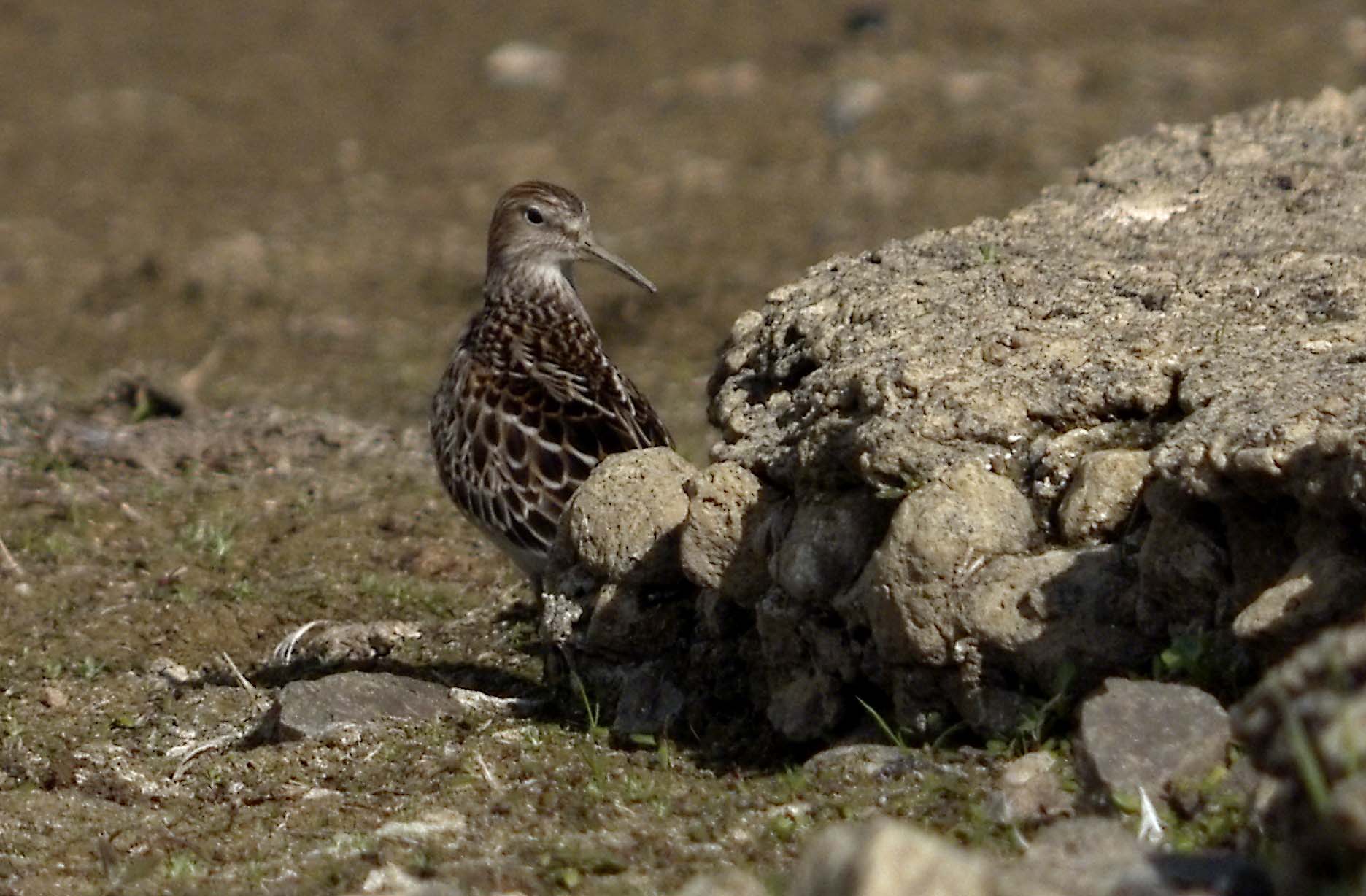
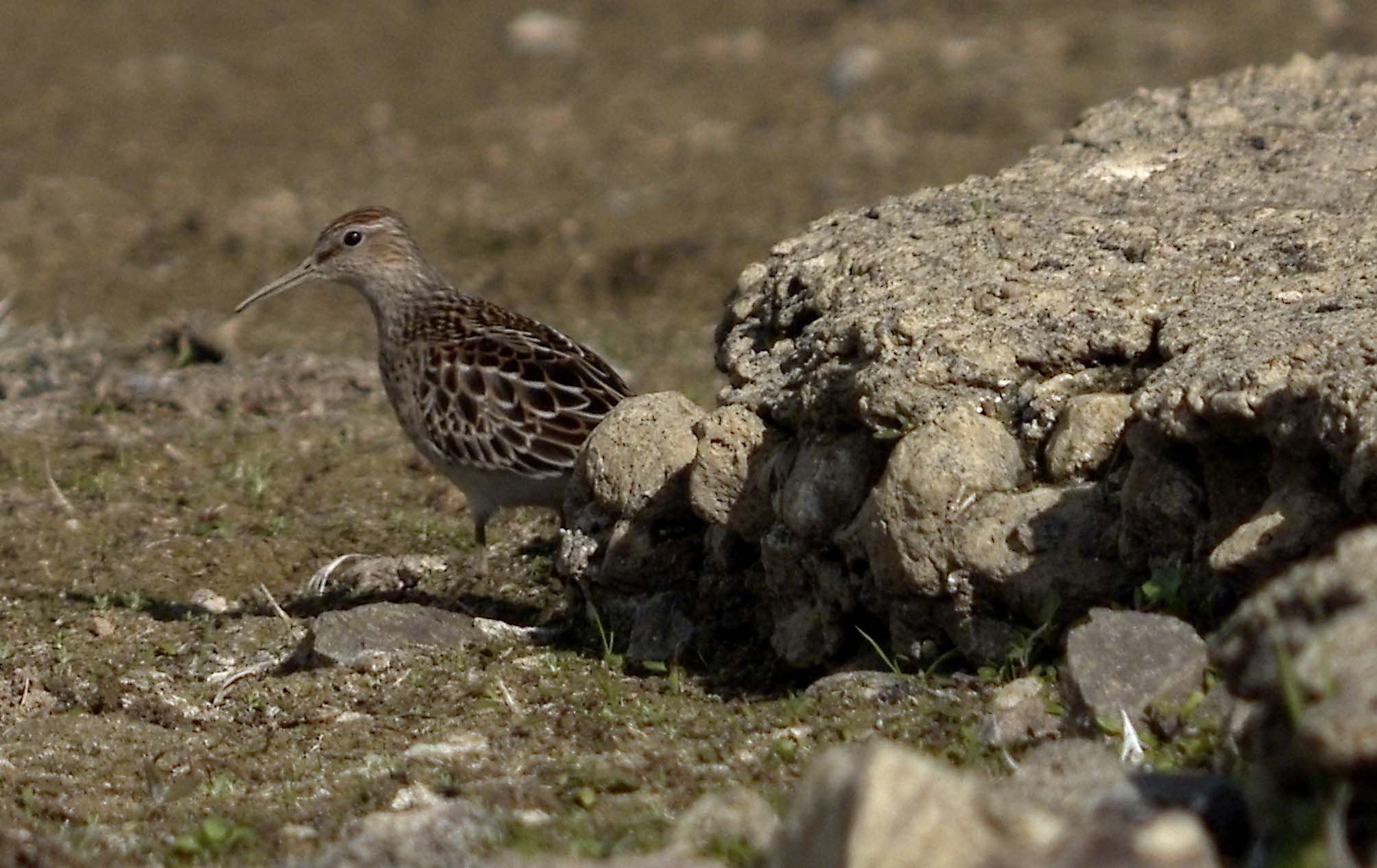
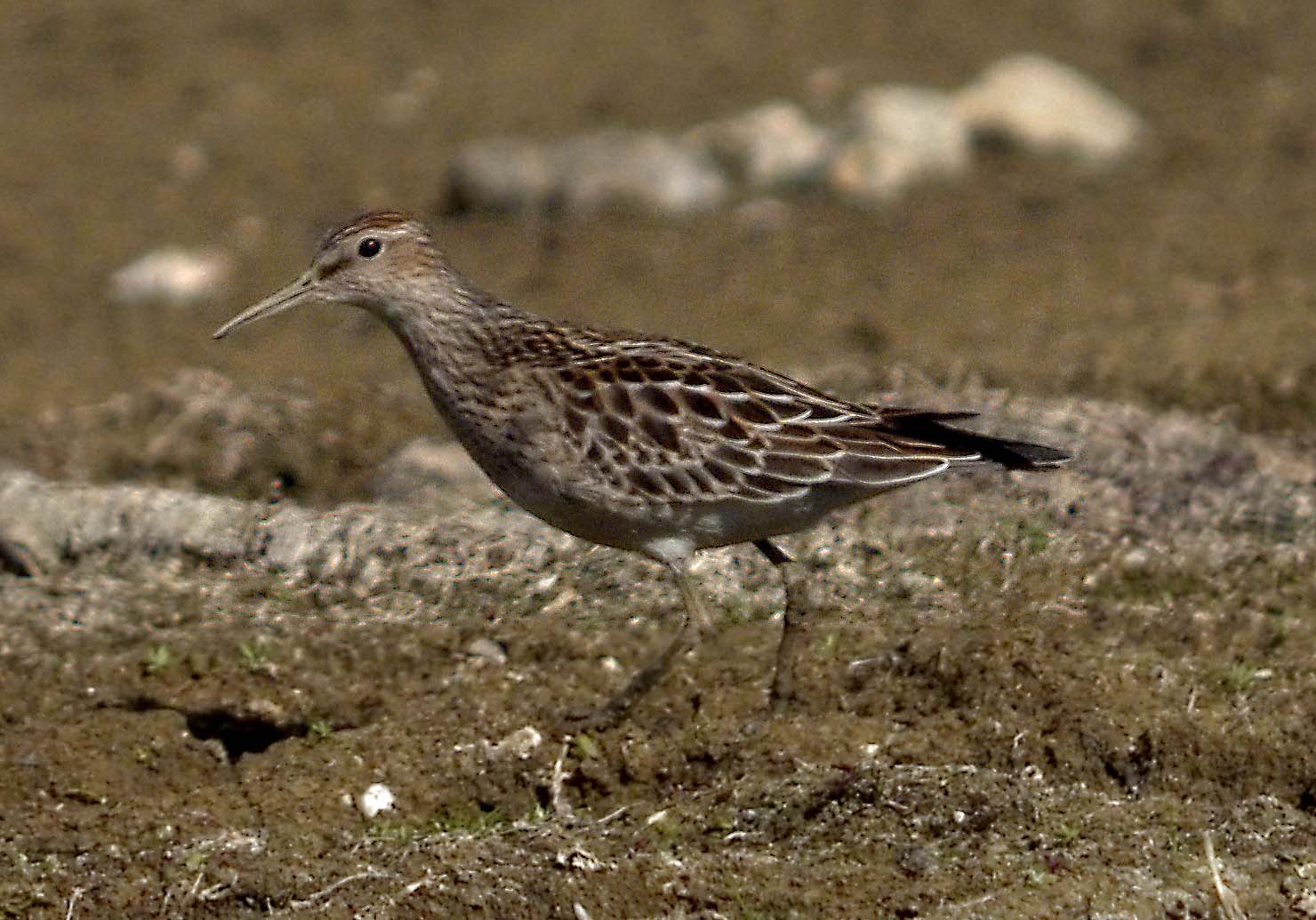
The juvenile Pectoral Sandpiper, present at Pitsford Reservoir for the last week, was showing well at the bottom of the old road, close to Maytrees Hide and the feeding station this afternoon. Although this species is the commonest American (or Siberian) ‘vagrant’ (actually it’s just a scare passage migrant) to our shores, this one is easy to see and well worth a look if you haven’t seen it yet. Pectoral Sandpipers are now annual visitors to Northants and, since the first one in 1940, there have been more than 40 records. At 36, Bob Bullock holds the record for the person to see the highest number of individuals of this species in the County – 36 birds, that is, not Bob – he’s a lot older than that!
When not feeding out in the open, Pectoral Sandpipers often like to hide – either amongst emergent vegetation, old tree stumps or general littoral debris. On this occasion this bird chose to hunker down in the crumbling edges of the old road, which disappears into the reservoir near the feeding station and emerges again on the opposite bank, near the mouth of the Walgrave Bay. I managed to get a few photos.
Autumn waders start to appear at local reservoirs and gravel pits from July, although some (e.g. Green Sandpiper, Common Sandpiper) are as early as mid-June. These are returning adults but from about mid-August the first juveniles start to appear. Here are a couple of waders which were at Hollowell Reservoir this evening. Dunlin and Ringed Plover are common enough but how hard do we look at them? These two individuals are clearly
Juveniles of Dunlin and Ringed Plover, Hollowell Res, 19th August 2011 (Mike Alibone)
juveniles. The Dunlin has many fresh, broad, pale fringes to the upper parts – including a white mantle ‘V’ – and coverts but already there are two plain grey scapulars, with a dark shaft streak, of first winter plumage clearly visible. The Ringed Plover, as well as having a partly broken brown breast band, also has neat pale fringes to the mantle and coverts and I’m guessing it’s a nominate hiaticula race as it’s fairly pale, the supercilium behind the eye is quite broad and the bill appears quite thick, even though it’s collected a lot of mud. Other waders at Hollowell this evening were five move Ringed Plovers, three Green Sandpipers, two Common Sandpipers and four Greenshank. The water level continues to drop and it’s looking good for autumn …
I found a flock of thirteen Ringed Plovers (with five Dunlin and a Little Ringed Plover thrown in for good measure) at Hollowell Reservoir this afternoon. The Ringed Plovers all seemed to be Tundra Ringed Plovers appearing relatively small and neat with quite dark mantles and, for those in the vicinity, only a ‘half size up’ from the Little Ringed Plover. But look at the contrast between the two birds pictured here. One is clearly
a male (black ear coverts, apparently wholly black breast band and sharp demarcation between the orange bill base and the black tip) and the other presumably is a female,
with dull brownish ear coverts and a narrower breast band as well as a narrower black band on the forehead. Unlike nominate race hiaticula Ringed Plovers, tundrae undergoes a late winter moult to summer plumage and so should always appear fresh in spring. I always get the impression that the breast band on tundrae is perhaps slightly narrower and more even in width than that on hiaticula but that’s just a personal perception – I haven’t seen it in the literature and I could be wrong. The two races intergrade and individuals with intermediate morphometrics and moult patterns have been recorded. To make matters worse, tundrae becomes larger again, further east in Siberia. Ringed Plovers are anything but simple!
Let’s face it, 1st May 2011 provided a great start to the new birding month – if you were at Summer Leys, that is. At 6.35 AM a Spoonbill flew west but was seen only by local photographer, Ben Harrold, who has very kindly agreed to my using one of his splendid flight shots here. Arriving at 6.40, as I did, I was clearly too late for the Spoonbill but from
First-summer Spoonbill, Summer Leys (Ben Harrold)
Pioneer Hide I shortly located a stint feeding among the sparse vegetation on the recently exposed mud of the scrape. Against the bright, early morning sunlight it appeared dark-legged, grey and looked for all the world like a winter-plumaged Little Stint but its crouching gait and creeping feeding action had subconsciously sowed the seeds of doubt in the minds of some of the observers in the hide and should have set alarm bells ringing. Viewing conditions from the Paul Britten Hide were far better in terms of lighting, however, and it became immediately obvious that this was actually a Temminck’s Stint, sporting dull, olive-green legs and the rather drab, subdued upperparts characteristic of this species in summer. The stint soon transfered to ‘the slips’, where it was joined briefly by a Turnstone in almost full summer plumage, a Greenshank and, a few moments later, by 20 Siberian Bar-tailed Godwits, which came in low over the reserve from the south-west before dropping in for an hour or so, allowing the assembled birders to appreciate the variation in size, bill length and plumage. The slightly larger, longer-billed females, which rarely approach the males in terms of rufous-chestnut summer plumage, were readily apparent and one in particular almost towered above nearby males,
Siberian Bar-tailed Godwits on 'the slips' (Mike Alibone)
with the difference in bill length being clearly evident. All the Bar-tailed Godwits passing through Northants at this time are of the Siberian race taymyrensis, which winters in equatorial west Africa, leaving there in late April to undertake the approximately 7000 km flight to breeding grounds far to the north-east. Satellite telemetry has proven this species capable of undertaking long, non-stop flights which cover around 1000 km per day. The record is held by a female, which flew non-stop from Alaska to New Zealand – a distance of 11,400 km – in just 11 days. Amazing to think that just three days previously, these 20 birds would have been in Mauretania, Guinea-Bissau – or somewhere in between – before their appearance at Summer Leys!







 Northants birds