It doesn’t say much for your birding day when the best bird on the tally is an escape. But today it was. I have not seen a Ross’s Goose in Northants before. Norfolk with thousands of Pinkfeet, in the winter, yes. This one was with Greylags in the north-east corner of the main lake at Stanwick Gravel Pits.
The species is said to be widely kept in captivity and, despite a recent increase in records in Europe mirroring significant population increases in North America, it is still a BOU category D species, i.e. not (yet) on the official British List.
Ross’s Goose, Stanwick GP, 11th August 2013 (Mike Alibone)
Compact, neat, dinky goose – a really nice bird and arguably not a candidate for the Gruesome Goose Gallery! Differences from Snow Goose include smaller size, shorter neck and smaller, shorter more triangular bill, lacking the ‘grinning patch’ (black borders to the cutting edges of upper and lower mandibles) which is obvious on the bill of a Snow Goose. The bill also has a bluish base, which can develop into caruncles (bluish warty bumps) with age. I thought the bill on this bird looked fractionally too large, which made me wonder if it was a 100% pure Ross’s Goose …
I found this first-winter drake Scaup on the Fishing Lake at Ditchford Gravel Pits this morning. It was still present at midday. Difficult to see on the video below, surprisingly it was already showing a greenish sheen to the otherwise brown head and adult vermiculated grey scapulars were just beginning to appear.
Scaup is a scarce visitor to Northants with about half a dozen records per year, the vast majority of which relate to single birds although small flocks have occasionally occurred in the past.
The discovery of a female Blue-winged Teal at Daventry Country Park yesterday morning looked set to initiate a local twitch as well as attracting more birders from further afield. Initially located at the south-eastern end of the reservoir it eventually moved toward the dam, where it remained for the rest of the day, favouring the small Lovell’s Bay directly opposite the ranger’s office.
With the arrival of more birders, however, it became apparent that some observers were not entirely convinced that this individual was, in fact, a ‘pure’ Blue-winged Teal. With the bird showing well – at times down to around fifty metres – a feather-by-feather analysis was soon being undertaken as this individual’s parentage was thrown into question.
The feature which cast the most doubt on the birds ‘purity’ was the structure of the bill. It appeared too long and too broad and spatulate for a Blue-winged Teal, recalling that of a Shoveler, a species with which Blue-winged Teal is known to occasionally hybridise.
Suddenly the ‘H’ word was being bandied about and a number of birders formed the opinion that this bird must, therefore, be a Blue-winged Teal x Shoveler hybrid.
This speculation was further fuelled by other features which were believed to be anomalous, i.e. a dull yellowish base to the underside of the lower mandible and, just visible (when blown up) in the photographs above, some yellow/ochre pigmentation at the base of the upper mandible. The legs and feet, too, were thought to be a shade too ‘orangey’ for Blue-winged Teal. Apart from these apparent bare part anomalies, however, there was nothing else radically wrong with the bird.
It appeared to be an adult (juveniles/first-winters have dull, greyish legs) and the thin white border behind the blue coverts, along with the dull green/blackish speculum, indicated it was a female. The remainder of the plumage (loral spot intensity, supercilium and eyestripe extent and prominence) and the dark iris colour were spot-on for Blue-winged Teal, as was the overall cold plumage tone, suggesting an absence of Cinnamon Teal genes in this individual.
I trawled through a number of images on the internet and found some which were good matches for leg colour (it is nowhere near as orange as that of a Shoveler – see the video below for comparison) and it would appear that, according to BWP, the bill colour is not ‘wrong’ for Blue-winged Teal at all. So, is it really a hybrid or is it conceivably a Blue-winged Teal with an abnormally large bill? Did some Shoveler genes get in there somewhere a few generations back? It surely cannot be a first-generation hybrid with so few Shoveler-type characteristics evident. The internet search also revealed a variation in bill size (drake Blue-winged Teals are known to have larger bills than females) although, admittedly, nothing quite as large as the bill on the Daventry bird … Images of a presumed Blue-winged Teal x Shoveler hybrid can be found here while a gallery of pure Blue-winged Teal images can be viewed here. When I was watching the bird in the early evening it was feeding constantly, either alone or with one or two Shovelers. Both the teal and the Shovelers engaged in a ‘hostile pumping’ display when they got too close to each other, i.e. a feeding territorial display (see video), which is said to be common behaviour among ‘blue-winged’ ducks. Despite rumours to the contrary it was fully-winged as is illustrated in the accompanying images.
VIDEO Blue-winged Teal ‘with presumed Shoveler genes’, Daventry CP, 17th September 2012 (Mike Alibone)
This very interesting and instructive individual is worth seeing if you get the chance.
It is also worth pointing out that Blue-winged Teal remains a true rarity in Northants with three records comprising an adult drake at Ditchford GP on 13th April 1979, a female or eclipse drake at Thrapston GP from 25th August to 14th September 1985 and an adult drake at Earls Barton GP from 25th February until 1st March 2001.
Many thanks to Bob Bullock and Allan Maybury for supplying the stills used to accompany this post.
Escapes, ferals and hybrids. No group of birds epitomises this stigmatised category more than geese … although ducks come a close second. When encountered, examples from this embattled group customarily receive short shrift from birders, who are all too ready to write them off. Having said that, they can provide an interesting distraction during quieter birding moments, giving rise to debate and speculation on origins and parentage.
I’ve been collecting a few photos of ‘dodgy’ geese which have recently been at large here in Northants. Some are relatively straightforward in terms of identification, while others are not so … Here’s a nice easy one.
Hybrid Canada x Greylag Goose, Earls Barton GP, May 2012 (Doug McFarlane)
This is a Canada x Greylag hybrid showing, as expected, mixed features of both species. Hybrids between these two species are remarkably consistent in appearance, with the dark neck and pale cheek patch derived from Canada Goose and the predominantly pale bill and legs and largely grey-brown body from Greylag Goose. I am intrigued by the pale eye-ring since neither Canada nor Greylag has this feature!
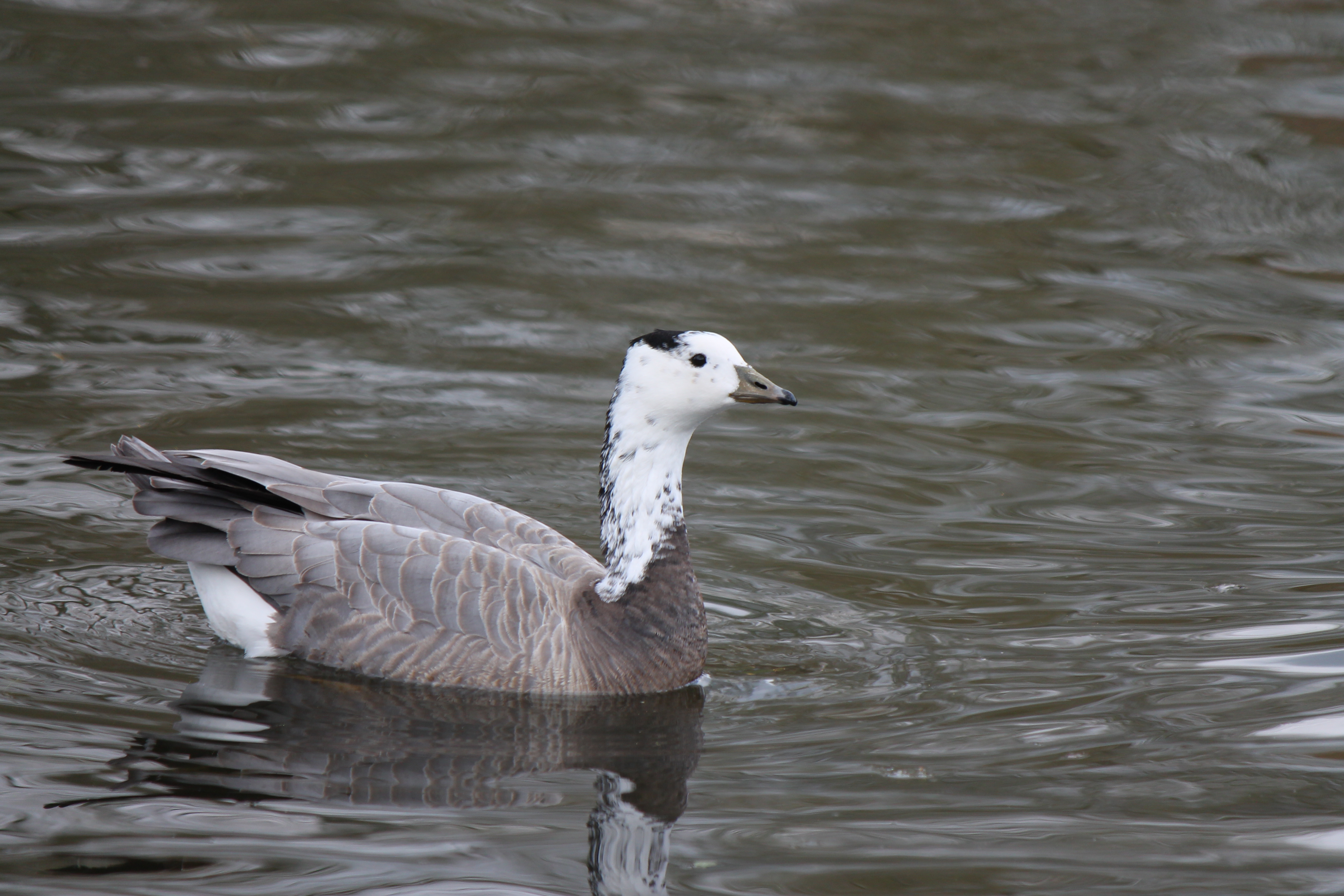
The next one is less easy. Although superficially resembling a blue morph Snow Goose there are obvious anomalies.
Hybrid blue morph Snow Goose x Canada Goose, Shelfley’s Lake, April 2012 (Danny O’Sullivan)
The bill shape and colour are clearly wrong for that species, there is a sharply demarcated dark breast and a paler, largely grey, body. The elongated, white-fringed, dark-centred tertials and greater coverts of blue morph Snow Goose are absent on this bird and the combination of visible features make this a Canada x Snow hybrid. Such hybrids appear to be uncommon this side of the Atlantic but have been recorded before.
Another Snow Goose hybrid, photographed at Pitsford Reservoir, is depicted below. This individual resembles an intermediate morph Snow Goose (blue morph x white morph)
Hybrid white morph Snow Goose x unknown, Pitsford Res, January 2012 (Clive Bowley)
but such birds normally show the tertials and coverts of blue goose as described above. They are partly elongated on this bird but they remain white. Although there is ‘a lot’ of Snow Goose here I wouldn’t mind betting that a few Greylag genes have crept in somewhere along the way.
Also photographed at Pitsford, this gigantic specimen heads the cast of the gruesome list.
Hybrid ‘Chinese’ Goose x Greylag Goose, Pitsford Res, February 2012 (Clive Bowley)
Straightaway, the long neck with a dark line running the length of its rear and the hint of a knob at the base of the bill point to its ‘Chinese’ Goose parentage. ‘Chinese’ Goose is the domesticated form of Swan Goose, which does not have a basal bill knob. This bird looks like a classic domestic Greylag x ‘Chinese’ Goose hybrid. It also looks horribly menacing!
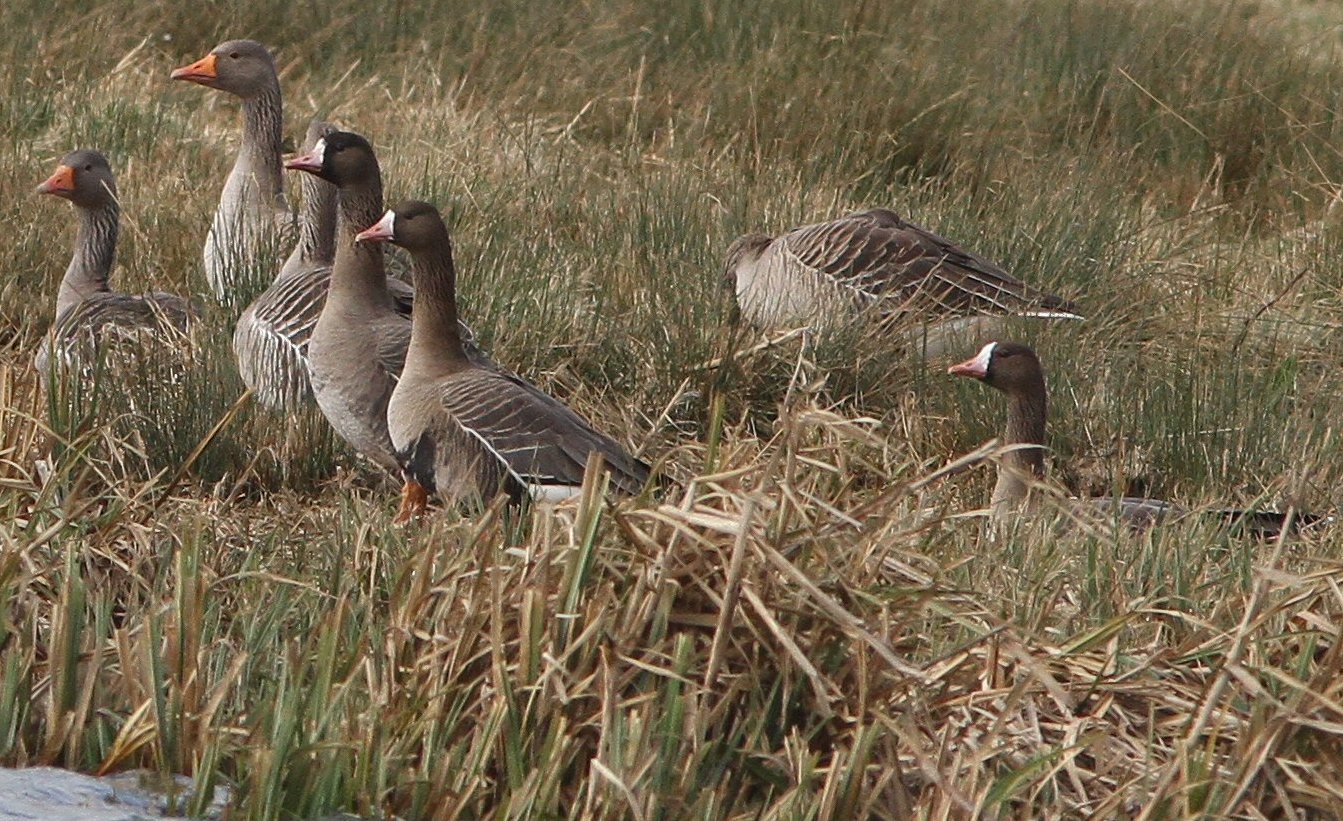
Although certainly not classified as ‘gruesome’ under the current definition, these three Eurasian White-fronted Geese appeared at Stanwick GP during March. One is unusual, however.
Eurasian White-fronted Geese, with Greylags, Stanwick GP, March 2012 (RW Bullock)
The bird on the right has rather large white blaze extending to the crown. This appears to be within the range of variation for Eurasian White-fronted Goose but it is rare and it is also a feature of Gambel’s White-fronted Goose, which breeds in northern Canada. That race, however, has a slightly longer bill as well as a thin yellowish-ochre eye-ring, neither of which is present on this individual.
Thanks are due to Clive Bowley, Bob Bullock, Doug McFarlane and Danny O’Sullivan for supplying the images.
That’s the question being asked by a number of birders after at least a couple of locals have voiced their opinion to the effect that the Ditchford Gravel Pits individual, currently present on Wilson’s Pit, is not a 100% pure Scaup. It has been there since its discovery on 16th January and I caught up with it last weekend (22nd) before going to see it again this morning.
The anomalies being cited are a) ‘small’ size, b) lack of prominent pale ear-covert patch, c) black on the bill tip not restricted to the nail and d) a pale subterminal band to the bill.
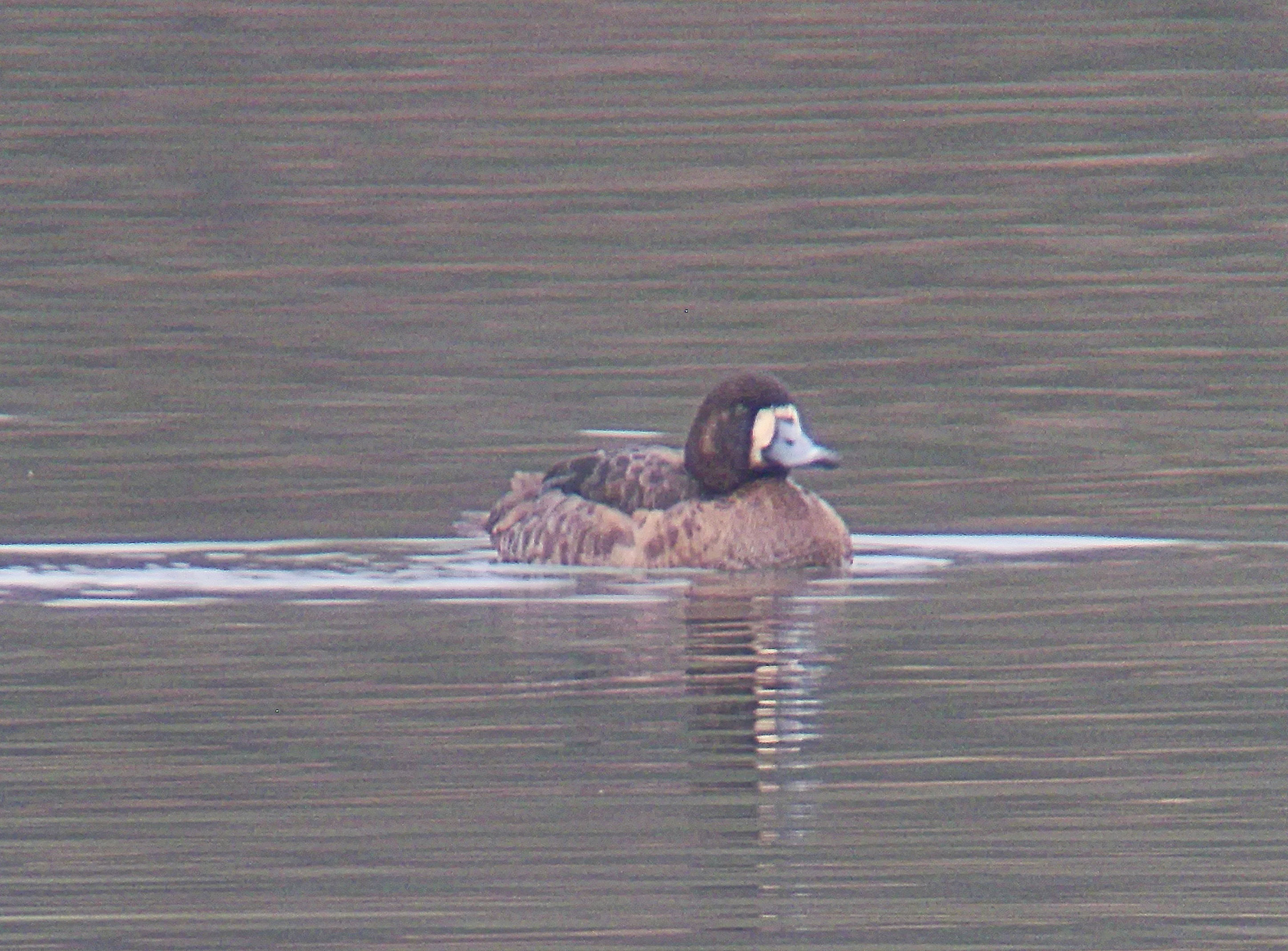
Have a look at the best of a bad bunch of digiscoped photos, below. With regard to the size it’s a little larger than a Tufted Duck, with a larger head and slightly bulkier body but it’s fractionally smaller than most Pochard present. The pale ear-covert patch, which develops in late winter and is variable, is present but not prominent (see first photo).
First-winter female Scaup, Ditchford GP, 30th January 2012 (Mike Alibone)
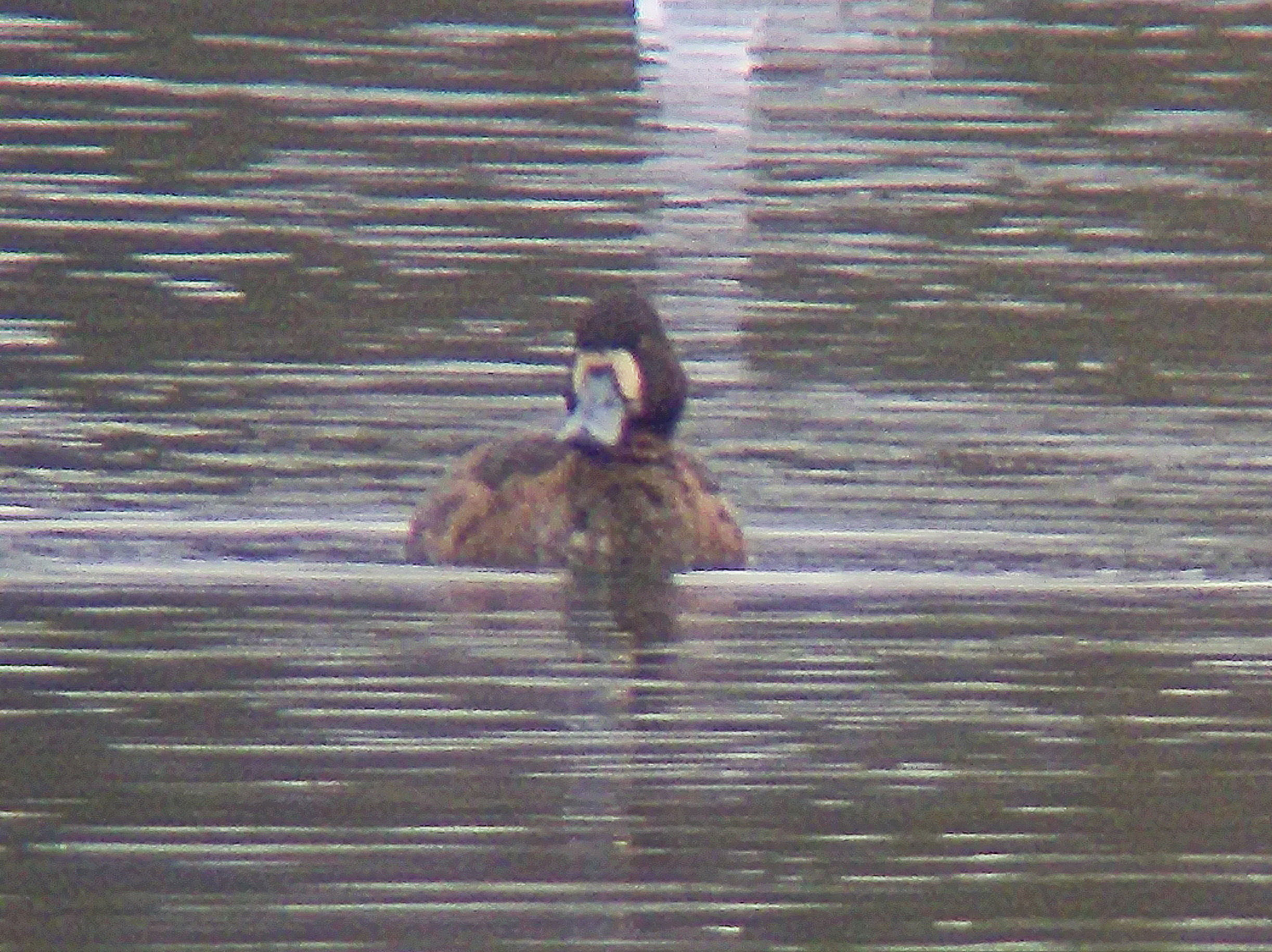
Let’s see if it becomes more obvious with time (assuming the bird stays, of course!). With regard to the pale subterminal bill band, it’s actually quite narrow, diffuse and slightly lighter than the overall bill colour and it’s not too uncommon for Scaup to show this contrast against the black nail. The latter colour also extends on to the bill tip, fanning out either side of the nail, but it is restricted to a small area (see second photo).
First-winter female Scaup, Ditchford GP, 30th January 2012 (Mike Alibone)
Presence of this feature – when more extensive – is often quoted as an indication of hybridisation but it is normal for first-winters to show a variable, though small, amount of black in this area. The white feathering around the base of the bill is tinged brownish and not particularly extensive.
These last two features point to immaturity and I think this bird is a first-winter female (first-year male would be expected to show some upperpart vermiculations and a darkening of the head and breast by now). All other features (overall shape, proportions and especially head shape) are fine for Scaup. So I don’t have any problem with this being a perfectly normal first-year female Scaup … but I’m willing to listen to any other arguments against this to learn in the event that I am wrong 🙂
The arrival in late autumn of Goosanders locally is a sure sign winter is on the way and the adult drakes, with their combination of red bills, glossy green-black heads and glowing, salmon-pink underparts are easy to identify and surely make this species one of the most attractive ducks on the British list.
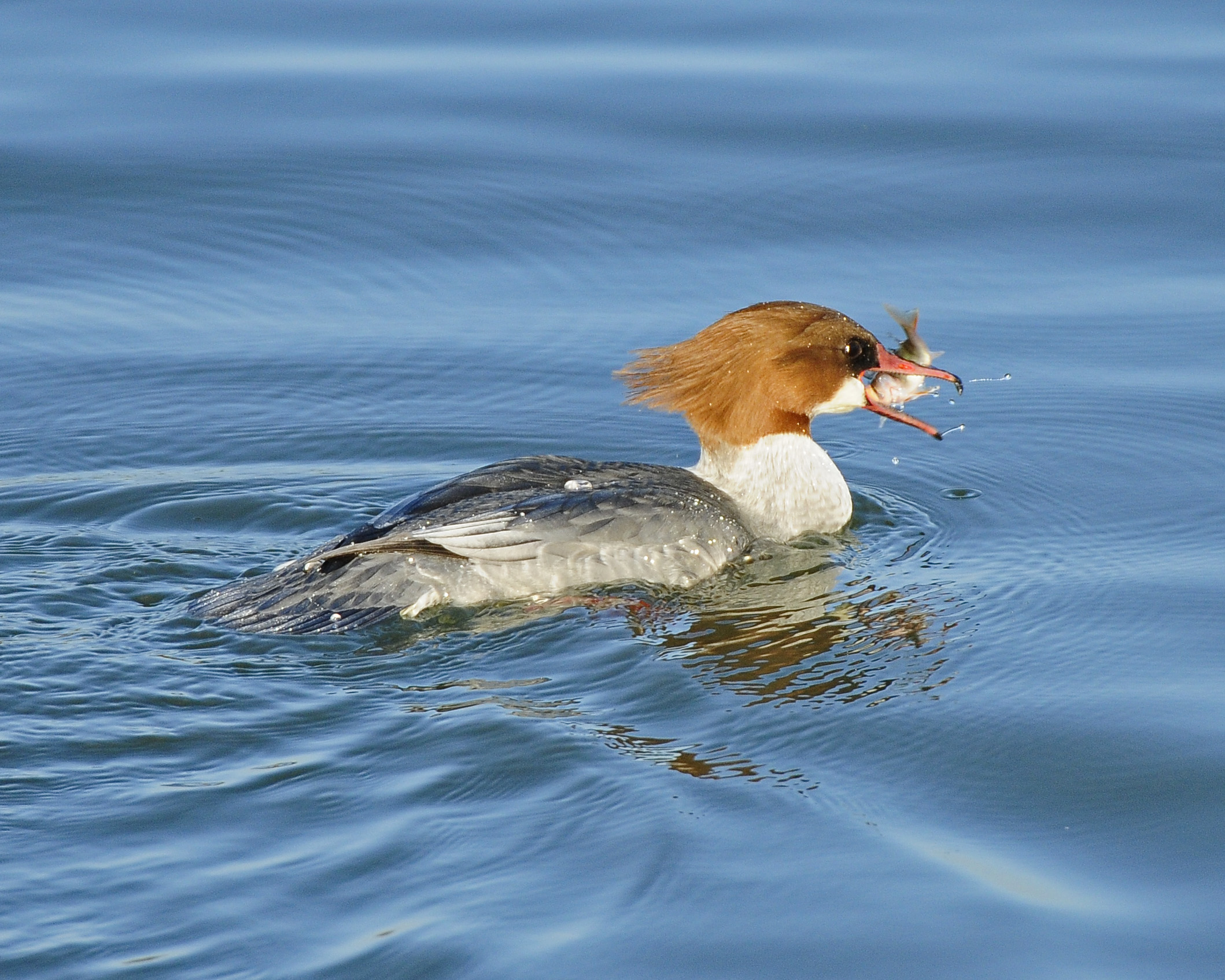
With the drakes stealing all the limelight, little attention is paid, however, to ‘redheads’, the term used to describe adult females and first-year birds of both sexes. Given reasonable views, in many instances it is possible to age and sex certain individuals. Two photos of ‘redheads’, both taken locally yesterday and kindly sent to me by the photographers, prompted a bit of research and illustrate this nicely. The first was taken by Clive Bowley at Pitsford Reservoir. The clean white, extensive and sharply demarcated chin and throat, along with the darker lores and dark iris, make this an adult female.
Adult female Goosander, Pitsford Res, 22nd December 2011 (Clive Bowley)
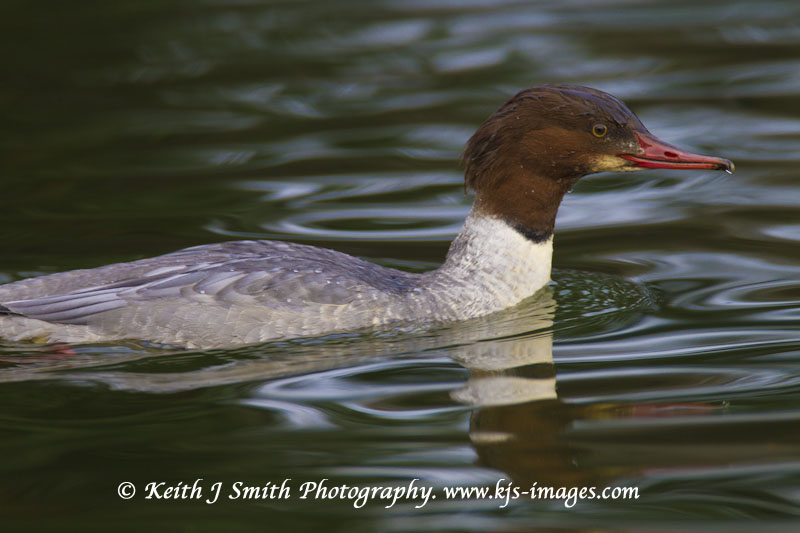
Compare this with the one below, which was photographed at Abington Park Lake, Northampton by Keith J Smith www.kjs-images.com. This individual has a much more diffuse area of white restricted mainly to the chin, there are a few small blackish feathers beginning to appear on the throat (difficult to see) and there is a blackish half-collar at the base of the chestnut on the side of the neck which clinches this as a first-winter male. The outer part of the iris is pale which is also a feature of juveniles and many males.
First-winter male Goosander, Abington Park Lake, 22nd December 2011 (Keith J Smith)
Clive’s image also shows the serrated edges of the mandibles, which gives the genus Mergus the collective name of ‘sawbills’.
Thanks are due to Keith and Clive for allowing the use of their images.
A Dark-bellied Brent Goose has been present with the goose flock on the main barrage lake at Clifford Hill Gravel Pits since Wednesday 2nd November, when it was found by Pete User. A first-winter (white-fringed secondaries and greater coverts and lacking the adult’s white neck patch), this is the only record so far this year of a species which produces just one or two records annually in the County. Late October to early November is the peak time. All previous records are of the dark-bellied race bernicla which breeds in northern Russia and winters on the east and south coasts of Britain. According to Mark Williams, who saw it on Sunday, it appears to have a bit of damage to its right eye and walks with a slight limp so it may stick around for some time yet. Some of my digiscoped pics below.
First-winter Dark-bellied Brent Goose, Clifford Hill GP, November 2011 (Mike Alibone)
There are apparently no local records of the pale-bellied race hrota which breeds in Franz Josef Land, Svalbard, Greenland and northeastern Canada, wintering in northeast England
First-winter Dark-bellied Brent Goose, Clifford Hill GP, November 2011 (Mike Alibone)
and Ireland and considered to be a separate species by a number of authorities. I would love to find one in Northants!






 Northants birds