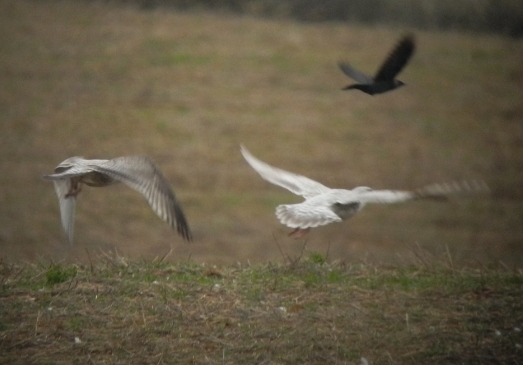
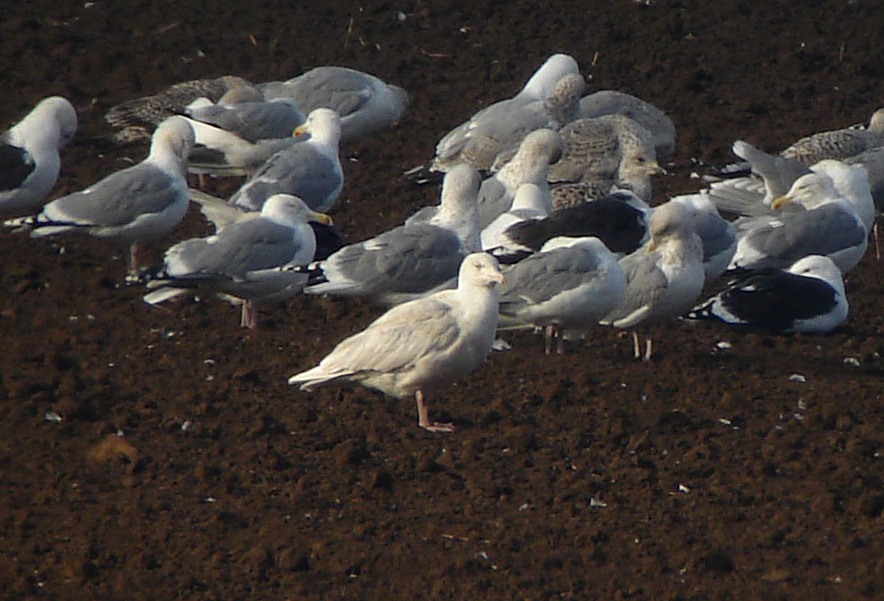
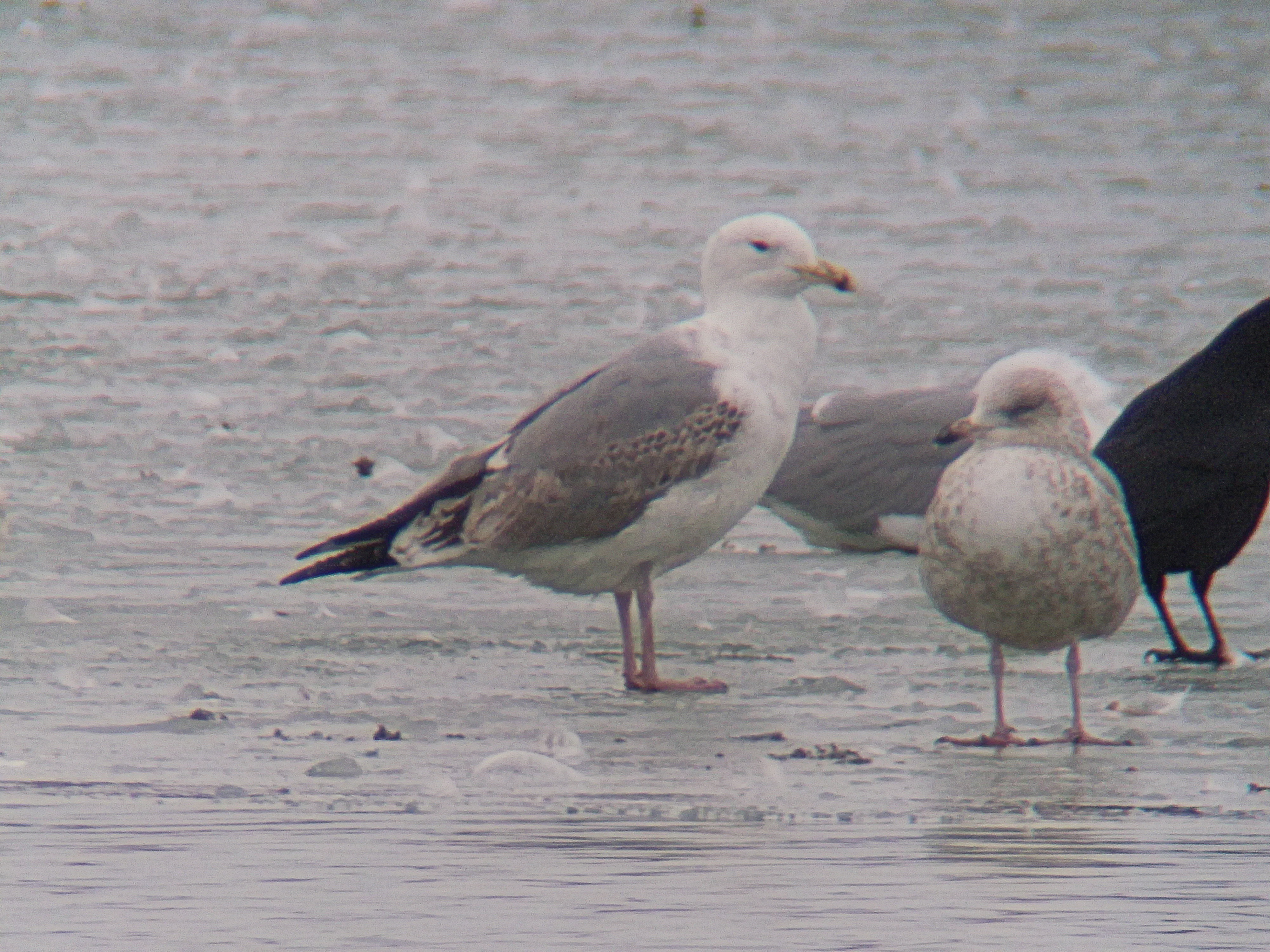
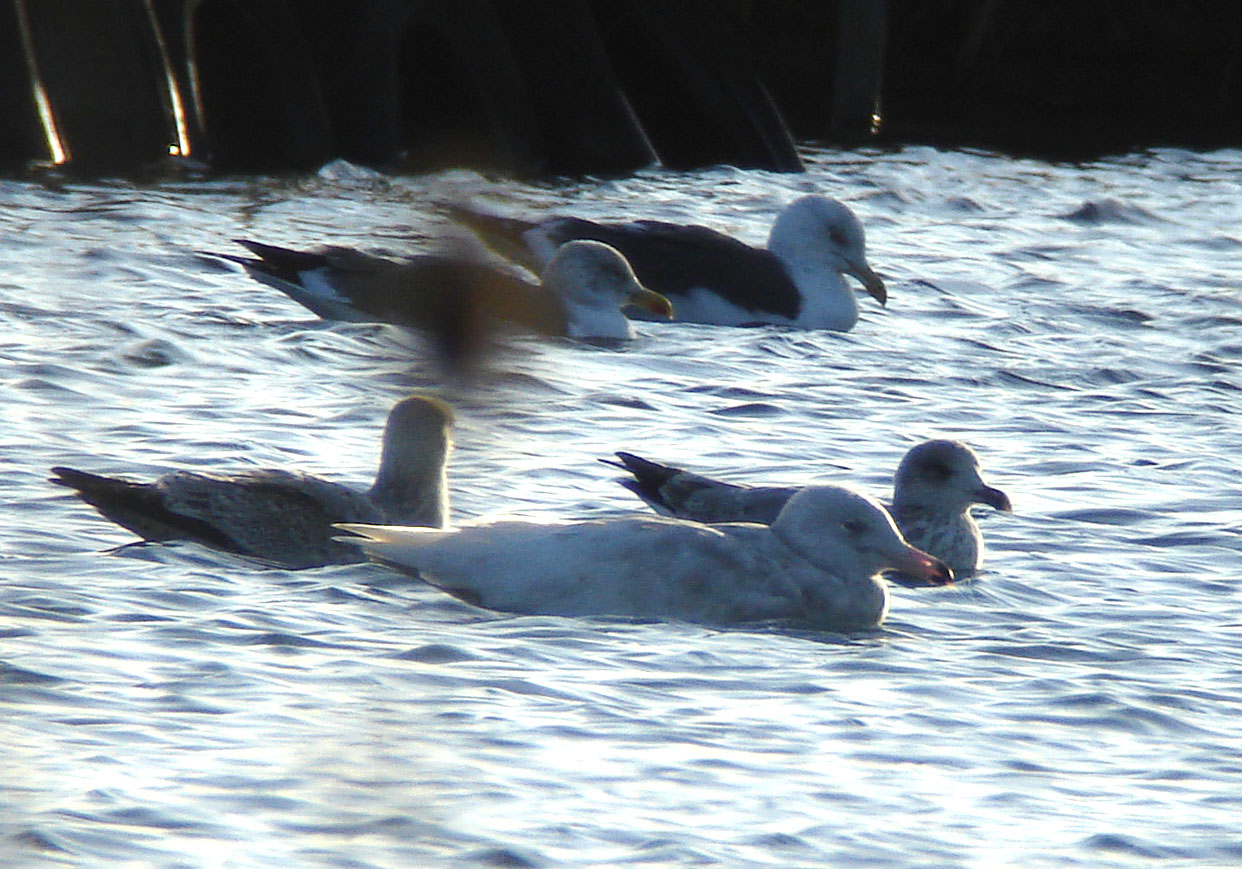
Mike Baron digiscoped this interesting-looking large gull at Sidegate Landfill yesterday.
Herring Gull or hybrid, Sidegate Landfill, 21st February 2012 (Mike Baron)
In flight over the tip it bore a strong resemblance to a first-winter Glaucous Gull but upon closer examination, however, it clearly shows features more closely associated with Herring Gull.
Herring Gull or hybrid, Sidegate Landfill 21st February 2012 (Mike Baron)
Although it may be a Glaucous Gull x Herring Gull hybrid I think it more likely to be a leucistic Herring Gull as its head shape does not seem to fit Glaucous, it doesn’t appear to have Glaucous’s beady eye and, as well as the ghosted subterminal tail band, it has an indistinct secondary bar. It is larger, however, than any of the Herring Gulls present!
Herring Gull or hybrid, Sidegate Landfill, 21st February 2012 (Mike Baron)
It does not show a typical striking Glaucous Gull x Herring Gull hybrid bill pattern, which is often virtually identical to first-winter Glaucous but it is not too far adrift from this. Compared with the Herring Gull in the photos, the primaries and tertials are much paler. A pitfall for the unwary Glaucous Gull seeker!
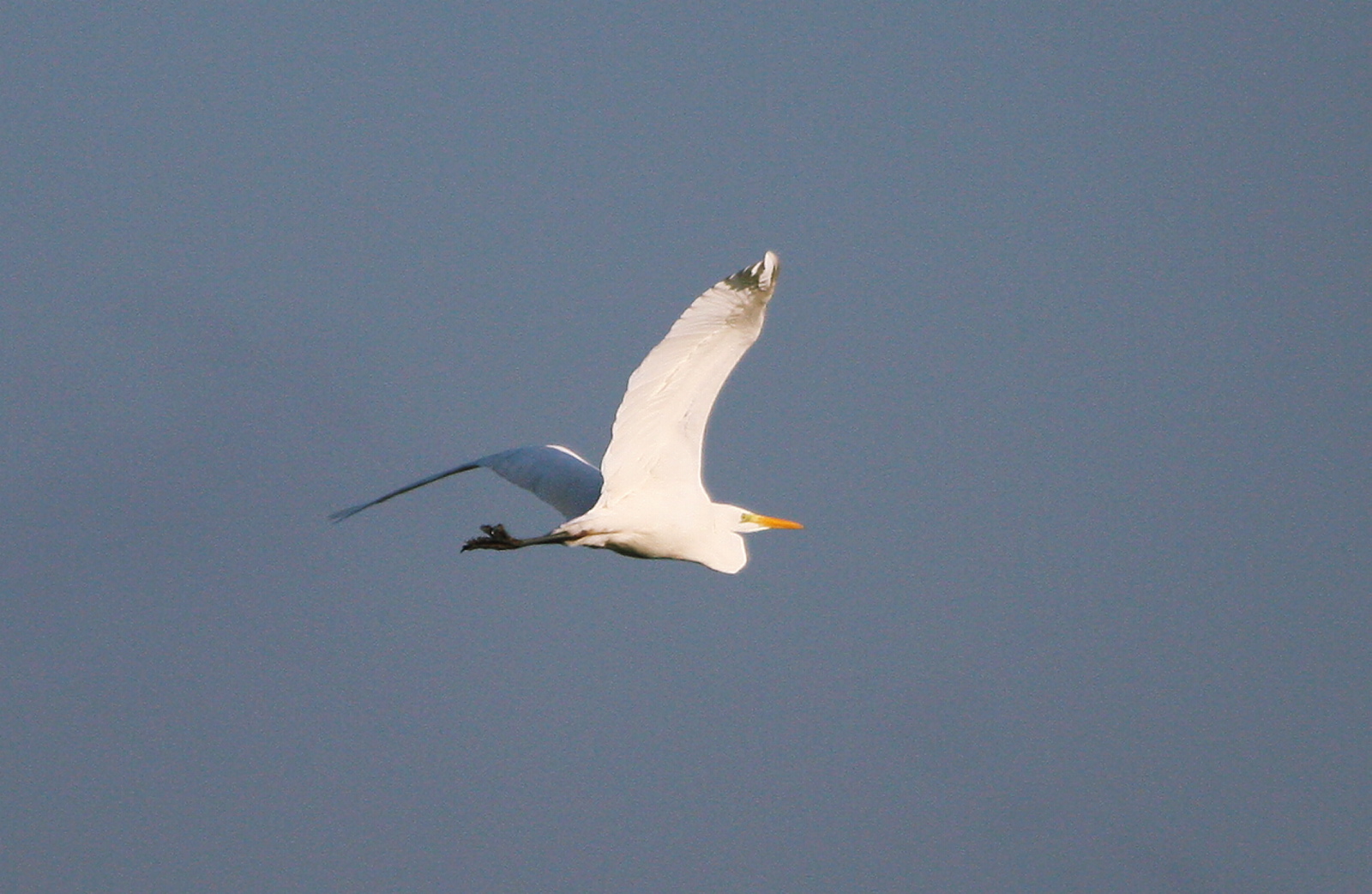
Great White Egrets are now almost annual visitors to the County, even staying to winter in recent years, but the last two or three have paid fleeting visits and they have been difficult to catch up with as a consequence. Conforming to this recent trend, the latest one to occur was found at Kislingbury Gravel Pits on 1st February by Colin Adams.
Great White Egret, Kislingbury GP, 1st February 2012 (Colin Adams)
It was present for only ten minutes after its discovery before being flushed by a dog-walker and flying off east.
Great White Egret, Kislingbury GP, 1st February 2012 (Colin Adams)
This bird no doubt accounted for the report five days later of one flying north-east over Denford. Where had it been during the intervening period?
The first 10 days of February have seen additional scarce gulls arriving at Ditchford GP. In addition to those mentioned in the previous summary a new second-winter Iceland Gull was discovered on 3rd, an adult Mediterranean Gull put in an appearance on 7th and Caspian Gulls were also seen intermittently, with adults there on 1st and 7th, a second-winter on 4th and a different second-winter there on 8th.
Interestingly there might have been a new Glaucous Gull there, too. Dave Warner’s photo, below, taken at nearby Sidegate Landfill on 28th January, appears to show a third-winter with an apparent patchy grey mantle and the dark subterminal band on the bill much reduced in comparison to those of the two ‘regular’ second-winters which have been visiting the site. But maybe long distance, light and camera have conspired to distort reality …
One of the Iceland Gulls was showing distantly on the ice when I was there on Wednesday. In this plumage it sticks out like a sore thumb among the many other large gulls and its small size and delicate proportions are obvious compared, for instance, to the nearby Herring Gull.
Second-winter Iceland Gull, Ditchford GP, 8 February 2012 (Mike Alibone)
Also interesting was this advanced second-winter Caspian Gull, well on its way to second-summer with a reasonably bright bill and very clean neck and breast (just a few small spots at the base of the neck).
Second-winter Caspian Gull, Ditchford GP, 8 February 2012 (Mike Alibone)
This is a fairly typical individual with small head, dark iris, tapered, parallel-sided (though
Second-winter Caspian Gull, Ditchford GP, 8 February 2012 (Mike Alibone)
a little short) bill and a small white mirror on P10, the latter not present on Yellow-legged Gull or argenteus Herring Gull and only on some argentatus Herring Gulls of this age. Second-winter Caspian Gulls are highly variable, some closely resembling first-winters while others can appear much more adult-like.
It’s been a record year for Glaucous Gulls at Ditchford already and we’re only at the end of January. With the discovery there in December of a juvenile, followed by a second-winter in early January, there has been a total of five Glaucous and two Iceland Gulls at this site, all birds commuting between the gravel pits and nearby Sidegate Landfill. The records so far can be summarised as follows:
Glaucous Gull juvenile: 14th to 28th December; second-winter (#1): 10th December to 28th January; second-winter (#2): 27th to 30th January fourth-winter: 15th and 23rd January adult: 7th to 27th January
Iceland Gull second-winter: 16th to 30th January adult: 12th to 21st January
I was lucky enough to find the fourth-winter Glaucous Gull there on 15th January and to catch up with both the second-winters but the juvenile and the adult have (so far) managed to elude me. The most recently discovered second-winter was on show yesterday, distantly in the field opposite the entrance to Sidegate Landfill (see below).
Second-winter Glaucous Gull, Sidegate Landfill, 30 January 2012 (Mike Alibone)
It’s a different individual to the original one which is still present, being ‘whiter’, i.e. less brown in the plumage, and with a different bill pattern – the pale tip being a little more prominent and the black subterminal band being a different shape.
Second-winter Glaucous Gull, Sidegate Landfill, 30 January 2012 (Mike Alibone) showing deep pink legs and short primary projection
Hopefully more white-winged gulls will appear here before the winter is out. March is a recognised passage month for Iceland Gull and there’s always the outside chance of Ring-billed Gull – long overdue at this site, which hosted the first County record of this species in March 1984.
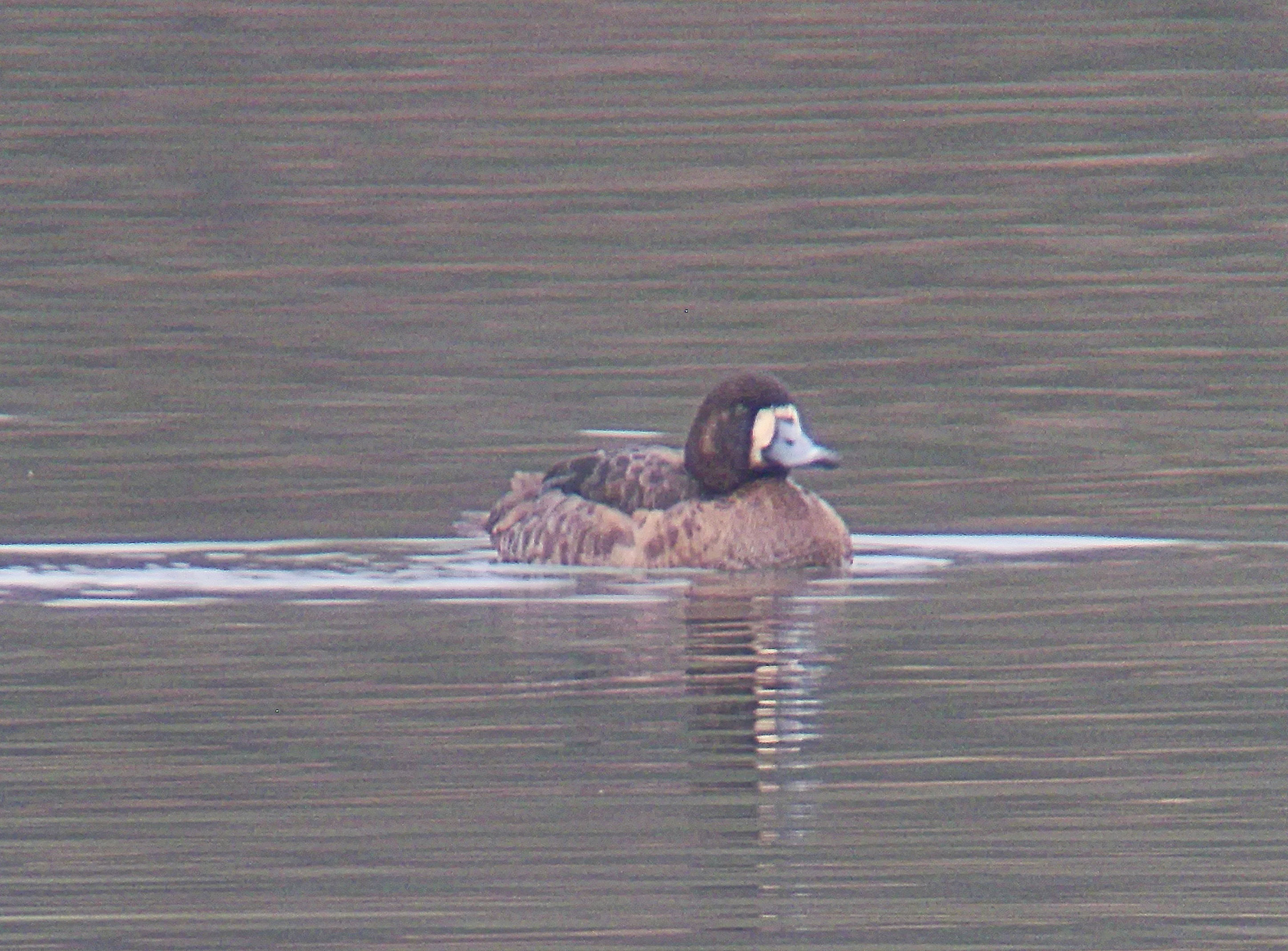
That’s the question being asked by a number of birders after at least a couple of locals have voiced their opinion to the effect that the Ditchford Gravel Pits individual, currently present on Wilson’s Pit, is not a 100% pure Scaup. It has been there since its discovery on 16th January and I caught up with it last weekend (22nd) before going to see it again this morning.
The anomalies being cited are a) ‘small’ size, b) lack of prominent pale ear-covert patch, c) black on the bill tip not restricted to the nail and d) a pale subterminal band to the bill.
Have a look at the best of a bad bunch of digiscoped photos, below. With regard to the size it’s a little larger than a Tufted Duck, with a larger head and slightly bulkier body but it’s fractionally smaller than most Pochard present. The pale ear-covert patch, which develops in late winter and is variable, is present but not prominent (see first photo).
First-winter female Scaup, Ditchford GP, 30th January 2012 (Mike Alibone)
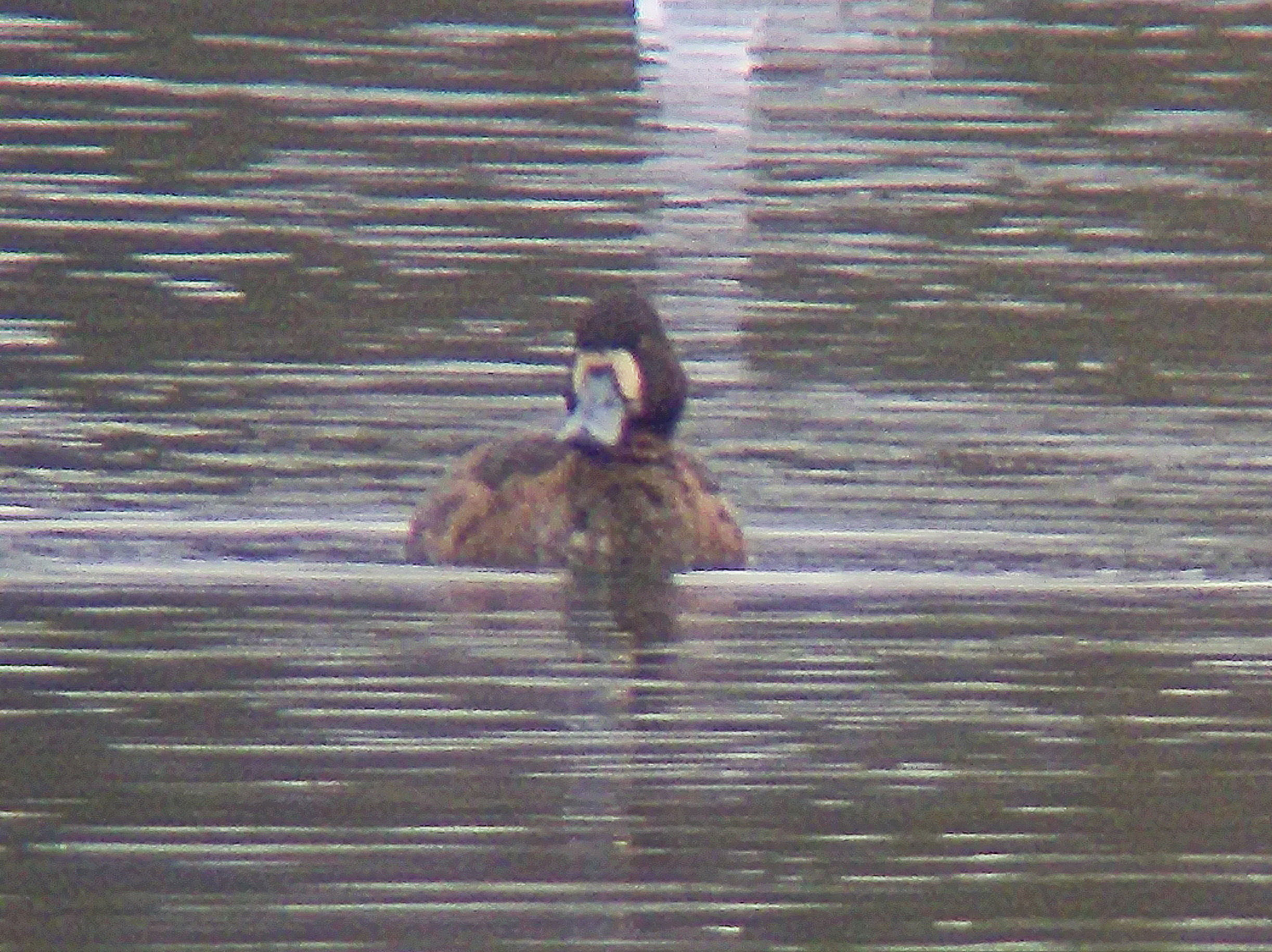
Let’s see if it becomes more obvious with time (assuming the bird stays, of course!). With regard to the pale subterminal bill band, it’s actually quite narrow, diffuse and slightly lighter than the overall bill colour and it’s not too uncommon for Scaup to show this contrast against the black nail. The latter colour also extends on to the bill tip, fanning out either side of the nail, but it is restricted to a small area (see second photo).
First-winter female Scaup, Ditchford GP, 30th January 2012 (Mike Alibone)
Presence of this feature – when more extensive – is often quoted as an indication of hybridisation but it is normal for first-winters to show a variable, though small, amount of black in this area. The white feathering around the base of the bill is tinged brownish and not particularly extensive.
These last two features point to immaturity and I think this bird is a first-winter female (first-year male would be expected to show some upperpart vermiculations and a darkening of the head and breast by now). All other features (overall shape, proportions and especially head shape) are fine for Scaup. So I don’t have any problem with this being a perfectly normal first-year female Scaup … but I’m willing to listen to any other arguments against this to learn in the event that I am wrong 🙂
Since 10th December last year up to two Glaucous Gulls, a juvenile and a second-winter, have been present at Ditchford Gravel Pits, normally frequenting the fishing lake immediately west of Ditchford Lane. They have also been seen on the adjacent ‘viaduct pit’ and on the nearby water ski pit. Dave Warner’s photo of the second-winter, below, illustrates the key ID features: thick, pink bill with sharply demarcated black tip (almost to the very end), sloping forehead with flat crown plus bulky appearance and relatively short wings. The pale iris indicates it is at least a second year as opposed to a pale variant (eastern) first-winter.
Second-winter Glaucous Gull, Ditchford GP, 2nd January 2012 (Dave Warner)
Up to fourteen have been recorded in the Midlands to date this winter and these two are the only ones to have been found in Northants so far. Ditchford Gravel Pits is the site to find one locally, having produced approximately 50% of all Northamptonshire’s Glaucous Gulls in the last 10 years, principally as a result of the close proximity of the Sidegate Landfill. Located about 2 km to the north of the pits, this site, visible in part from the road, attracts hundreds – sometimes thousands – of large gulls and, since the demise of tips at Welford and Wootton and the inaccessibility of Weldon, is now the only gull-rich landfill in the County. When not visiting Ditchford to roost and bathe, gulls from the tip are often to be found on adjacent fields and locating a large loafing flock provides the best chance of being able to watch a Glaucous Gull in good light (as opposed to grappling with poor views in fading light at a reservoir roost!).
With last year now behind us, and the 2010 Northamptonshire Bird Report recently published, now is the time to get your 2011 records in. The bird report committee would be pleased to receive any currently unsubmitted records as soon as possible – and in any case by the end of January.
The preferred method of submission is the use of the standard recording sheet (a pre-formatted excel file, see below), which automatically populates the fields for species number and grid reference as you type. It’s very easy to use!
If you are fortunate to discover a species uncommon enough to require the submission of a written description (see the list of requirements in the 2010 report) then please use the description form illustrated below. Both forms are available by email from me northantsbirds@ntlworld.com or from Bob Bullock robertbullock25@hotmail.com and can be completed and returned by email to either of us. So get cracking!
The arrival in late autumn of Goosanders locally is a sure sign winter is on the way and the adult drakes, with their combination of red bills, glossy green-black heads and glowing, salmon-pink underparts are easy to identify and surely make this species one of the most attractive ducks on the British list.
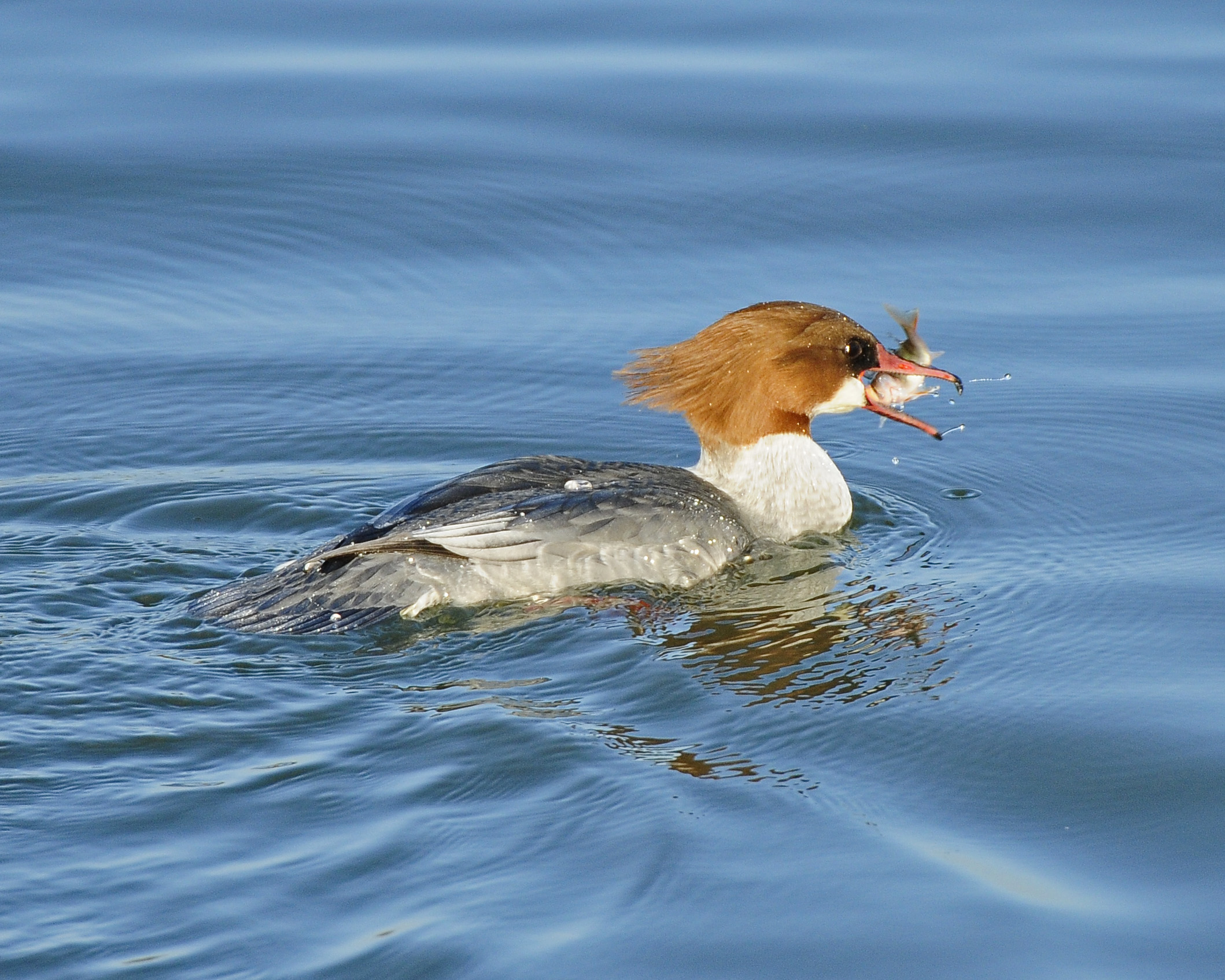
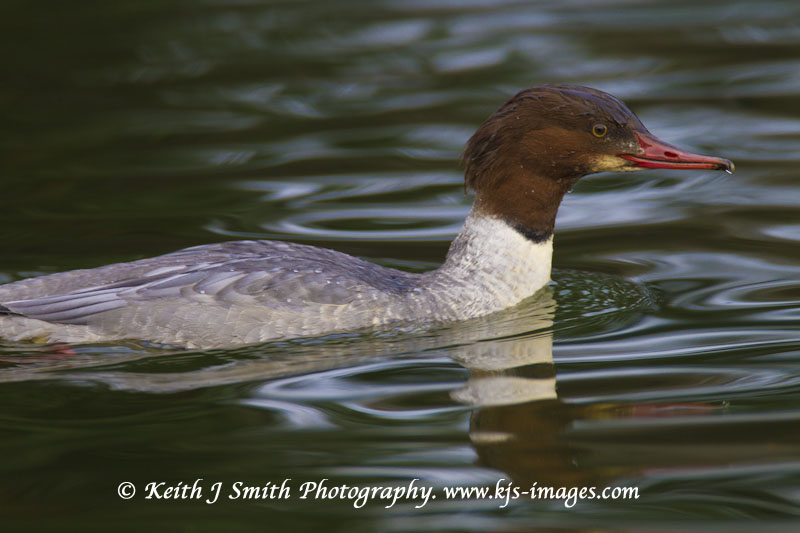
With the drakes stealing all the limelight, little attention is paid, however, to ‘redheads’, the term used to describe adult females and first-year birds of both sexes. Given reasonable views, in many instances it is possible to age and sex certain individuals. Two photos of ‘redheads’, both taken locally yesterday and kindly sent to me by the photographers, prompted a bit of research and illustrate this nicely. The first was taken by Clive Bowley at Pitsford Reservoir. The clean white, extensive and sharply demarcated chin and throat, along with the darker lores and dark iris, make this an adult female.
Adult female Goosander, Pitsford Res, 22nd December 2011 (Clive Bowley)
Compare this with the one below, which was photographed at Abington Park Lake, Northampton by Keith J Smith www.kjs-images.com. This individual has a much more diffuse area of white restricted mainly to the chin, there are a few small blackish feathers beginning to appear on the throat (difficult to see) and there is a blackish half-collar at the base of the chestnut on the side of the neck which clinches this as a first-winter male. The outer part of the iris is pale which is also a feature of juveniles and many males.
First-winter male Goosander, Abington Park Lake, 22nd December 2011 (Keith J Smith)
Clive’s image also shows the serrated edges of the mandibles, which gives the genus Mergus the collective name of ‘sawbills’.
Thanks are due to Keith and Clive for allowing the use of their images.
The latest Northamptonshire Bird Report, with records for 2010, is now available.
Contents include full Systematic List, sections on Escapes and Ferals, Corrections and Additions from previous years, East Midlands Red Kite Report, Stanford Ringing Group Report, Pitsford Reservoir Report, checklist of species recorded in Northants, tables of Summer and Winter Arrivals and Departures and an updated County Site Map. The number of contributors has risen dramatically and there is also a list of unaccepted records.
Copies and back issues from:
R W Bullock, 81 Cavendish Drive, Northampton NN3 3HL
One might be forgiven for becoming somewhat blasé about Slavonian Grebes occurring in the County this year. After all, there was the long-stayer which first appeared at Earls Barton GP in late May, quickly relocating to Pitsford Reservoir for a protracted stay north of the causeway into early autumn. This individual was in stunning summer plumage when it arrived but it had moulted into the characteristic black, white and grey plumage of winter by the end of August, shortly after which it disappeared, last being seen there on 11th September.
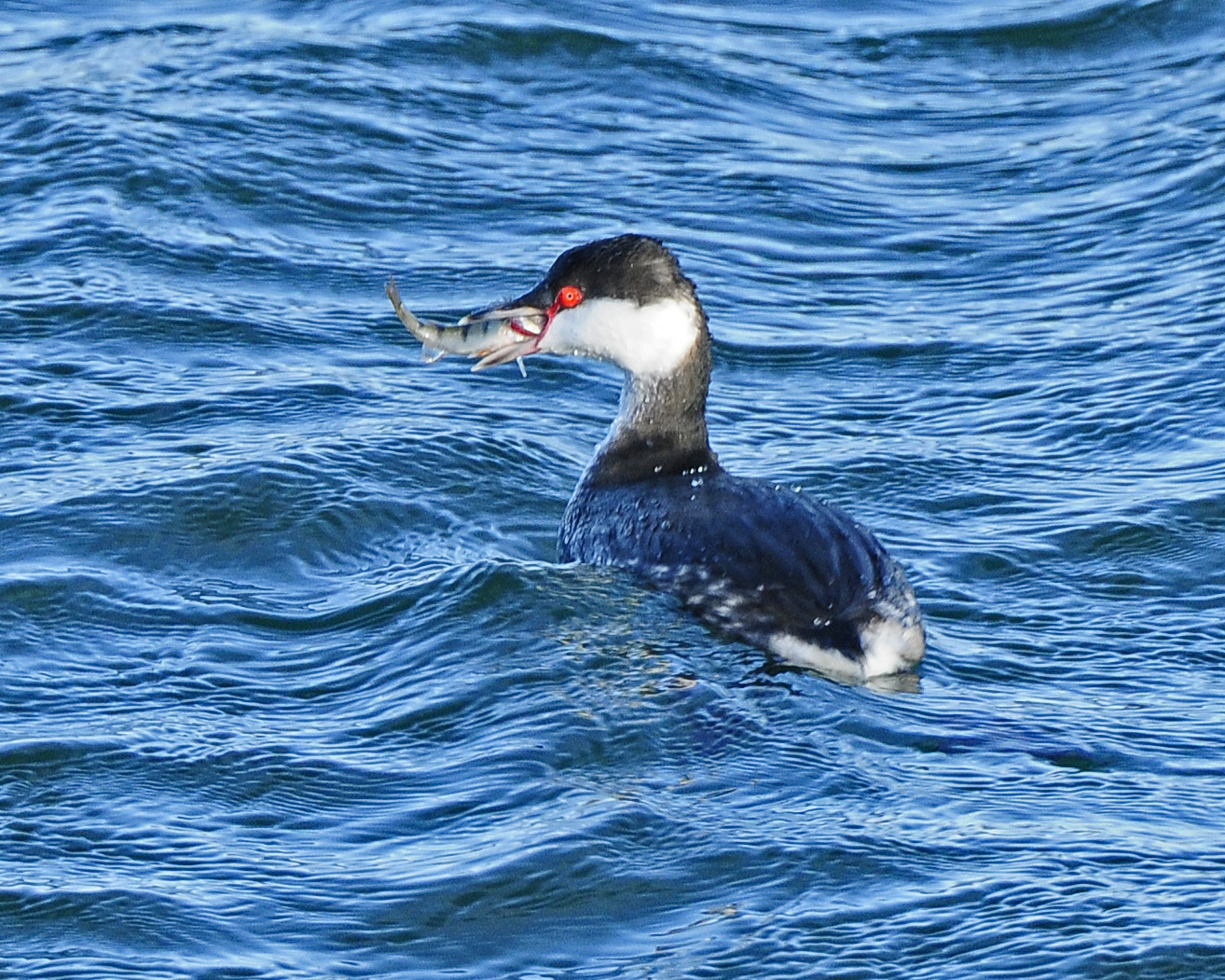
It, or another, then (re)appeared at Pitsford on 29th October – this time on the ‘big side’, south of the causeway, close to the dam. It was still off the dam at midday today when Clive Bowley captured this super image of it catching and swallowing a Perch.
Slavonian Grebe, Pitsford Res, 25th November 2011 (Clive Bowley)
I don’t envy it having to contend with that über-sharp, spiky dorsal fin! Look at that super-bright, red orbital skin around the eye, a feature which it shares with Black-necked Grebe but which is lacking in winter-plumaged Red-necked Grebe.
Another Slavonian Grebe is currently in residence at Hollowell Reservoir, having been present there since 17th November.