The Long Buckby Lanius and its capricious taxonomic history
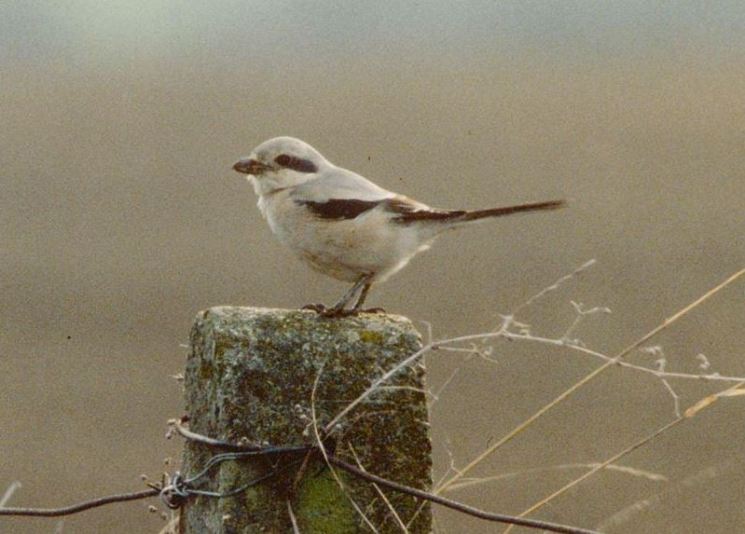
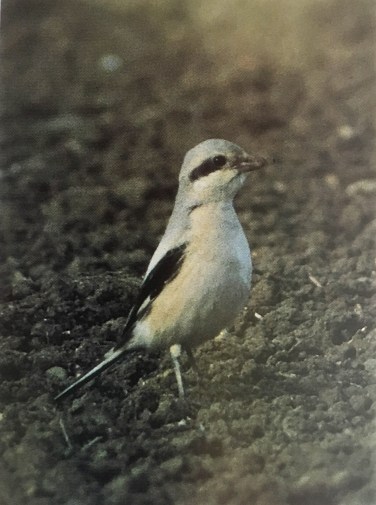
On 3rd November 1997, Nick Roberts was driving between Long Buckby and West Haddon when he came across a shrike on a roadside fence post. The bird quickly dropped to the ground, where it remained for a short period. It was still there a few minutes later when Nick returned with Peter Spokes and together they watched it, subsequently identifying it as a Steppe Grey Shrike.
First-winter Steppe Grey Shrike, Long Buckby, November 1997 (Graham Soden). This bird spent a considerable amount of its time feeding on the ground, ‘hopping around’ like a wheatear. As a consequence, its bill, legs and underparts frequently became stained with soil.
Local birders were duly notified and many arrived the same day to see it. It remained in the vicinity the following day, by which time it had attracted a growing number of observers, many of whom had travelled from different parts of the UK.
The record was submitted to, and accepted by, the British Birds Rarities Committee as the 12th for Britain. There have been fourteen subsequent accepted British records.
First-winter Steppe Grey Shrike, Long Buckby, November 1997 (Graham Soden).
Back in the day, Steppe Grey Shrike was almost whatever you wanted it to be, depending on your choice of taxonomic authority – floating around between being races of Great Grey Shrike, the more recently split (from Great Grey Shrike) Southern Grey Shrike complex, and a full species in its own right. At the time of record acceptance in Northamptonshire it had already been lumped with Southern Grey Shrike (e.g. *Clements 2017) and so constituted a ‘first’ for the county.
However, it was generally recognised as a full species by several authorities (King 1997, Hernández et al. 2004, Panov 2011 – cited by the International Ornithological Congress (IOC)) and has remained as such until this year, being on the IOC World List, which is now followed by the UK in defining what is on (or off) the British list. Unfortunately, because there has never been a true consensus on the definitive taxonomy of this species, last month, the IOC decided to (re)lump Steppe Grey Shrike with Great Grey (see here) ‘pending’, as they say ‘full resolution of this complex.’
It would seem to make better sense to leave it in full species status until the evidence to lump it with Great Grey Shrike is available and undisputed – and in this respect, surely this is a step in the wrong direction.
The above move by the IOC will no doubt prove unpopular – not only with us in Northants but also across the UK as a species is effectively dropped from the British list.
*Clements, J. F., T. S. Schulenberg, M. J. Iliff, D. Roberson, T. A. Fredericks, B. L. Sullivan, and C. L. Wood. 2017. The eBird/Clements checklist of birds of the world: v2017, with updates to August 2017.
References cited above by the IOC
Hernández, MA, F Campos, F Gutiérrez-Corchero & A Amezcua. 2004. Identification of Lanius species and subspecies using tandem repeats in the mitochondrial DNA control region. Ibis 146:227-230
King BF. 1997. Checklist of the Birds of Eurasia Ibis Publishing Company. Vista, CA.
Panov E. 2011. The true shrikes (Laniidae) of the world. Ecology, Behavior and Evolution. Pensoft Publ.
The first week of winter and some may say, the end of anything new turning up, or was it? The Atlantic airstream brought predominantly south-westerly winds and rain and unseasonally high temperatures, peaking at 13ºC on both 3rd and 6th. Wildfowl were still the number one quarry for local birders in a week when persistent reservoir-watching paid dividends.
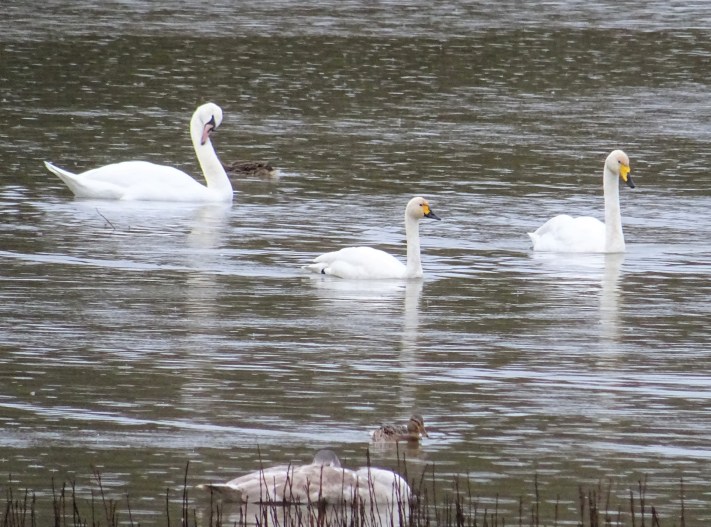
After last week’s Bewick’s Swans’ brief dalliance with Thrapston GP, another was found in Scaldwell Bay at Pitsford Res on 5th, remaining until the end of the week.
Bewick’s Swan, Pitsford Res, 5th December 2018 (Bob Bullock)Bewick’s and Whooper Swans, Pitsford Res, 6th December 2018 (Doug Goddard)Bewick’s and Whooper Swans, Pitsford Res, 6th December 2018 (Doug Goddard)Mute, Bewick’s and Whooper Swans, Pitsford Res, 7th December 2018 (Richard How)
Overshadowing the eleven on-site Whooper Swans with its newly acquired celebrity status – Bewick’s have become really quite uncommon in Northants over the last decade or more – it attracted a steady stream of admirers, many of whom were willing to brave the rain for an optics-sodden glimpse in miserable conditions. Only one more Whooper was seen, the young bird now looking settled for the winter at Thrapston GP, where it remained all week. In the Nene Valley, the Pink-footed Goose was again seen at Stanwick GP on 5th and 6th and last week’s five White-fronted Geese, which had previously flown west over Ditchford GP on 25th, had clearly circled back and were also located at Stanwick on 5th, while another White-front was off the dam at Sywell CP on 7th.
White-fronted Goose, Sywell CP, 7th December 2018 (Alan Francis)
Back at Stanwick, the Barnacle Goose was still present until at least 6th. The mobile female Ruddy Shelduck ventured north of the causeway at Pitsford Res, where it was seen on 4th and 6th. Meanwhile, at Ravensthorpe, the drake American Wigeon x Eurasian Wigeon hybrid failed to elicit any interest until at least 1st and the female Ferruginous Duck x Pochard hybrid was again seen at Pitsford on 3rd, where the week’s highest site total of Red-crested Pochards was fourteen on 6th. Elsewhere, last week’s two were still at Stanford Res until 3rd and the drake remained at Hollowell Res until 4th, while the first-winter Scaup also remained at Thrapston GP until at least 3rd and a female was found at Ditchford GP, remaining there until the week’s end. Apparently missing for most of last week, the drake Ring-necked Duck in Pitsford’s Scaldwell Bay reappeared on 1st, after which it was seen intermittently until 6th, although it remained elusive for a great deal of the time.
Ring-necked Duck, Pitsford Res, 2nd December 2018 (Mark Williams)Ring-necked Duck, Pitsford Res, 2nd December 2018 (Mark Williams)
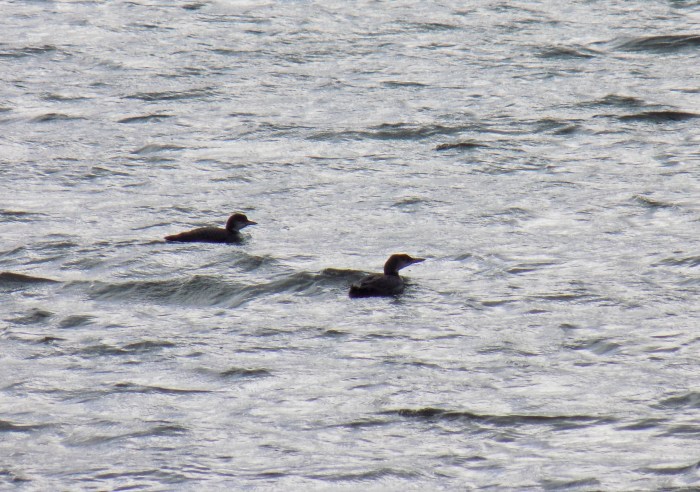
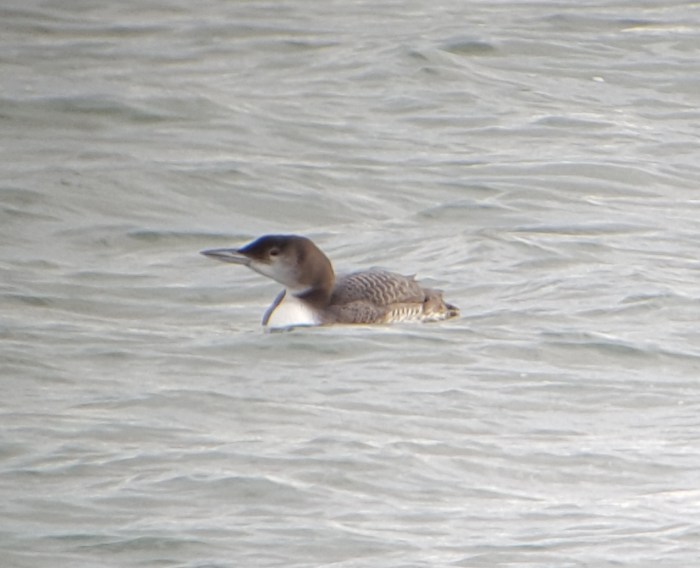
Another first for the winter, a juvenile Great Northern Diver, was discovered off the dam at Pitsford on 1st before promptly being joined by another there on 2nd. Although both were seen together on the latter date, only one has been reported subsequently, right through to the end of the period.
Great Northern Divers, Pitsford Res, 2nd December 2018 (Peter Grimbley)Juvenile Great Northern Diver, Pitsford Res, 2nd December 2018 (Adrian Borley)Juvenile Great Northern Diver, Pitsford Res, 2nd December 2018 (Adrian Borley)Juvenile Great Northern Diver, Pitsford Res, 2nd December 2018 (Adrian Borley). This bird is a different individual to the one in the above two photographs.
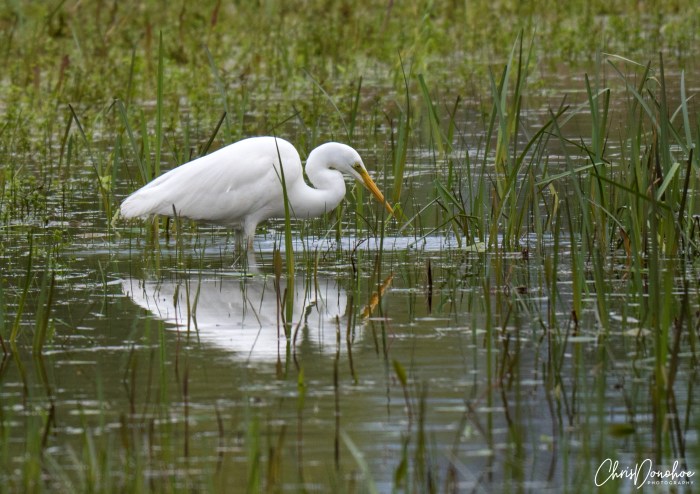
There was little change on the egret front, with the two Cattle Egrets still at the north-east end of the Stanwick GP complex on 6th, while up to two Great White Egrets continued to be seen there, with the same number at Hollowell Res, Ravensthorpe Res, Stanford Res and Thrapston GP, with three at Pitsford and one at Ditchford GP. Some of these will no doubt be duplicates where records from nearby localities are concerned.
Great White Egret, Pitsford Res, 5th December 2018 (Chris Donohoe)
The only raptor of note this week was a fine male Hen Harrier which flew west at Stanwick GP on 4th.
Pitsford continued to host the first-winter Black-tailed Godwit until at least 1st, along with the Ruff all week. There were also two Yellow-legged Gulls there on 5th, while another was logged at Hollowell Res the day before.
The Borough Hill Short-eared Owl remained until at least 1st, another was seen again at Harrington AF on 3rd and the Firecrest discovered near the feeding station at Pitsford Res on 29th was heard calling there again on 3rd. On the latter date, two Bearded Tits were discovered on land with no public access and eleven Crossbills were at Fineshade Wood on 4th.
And so it continues – almost wall-to-wall sunshine and no sign of any rain. Water levels are indeed falling and some of the more outlying and lesser watched sites have begun to attract waders. Both Cransley and Welford Reservoirs produced Common Sandpipers and Dunlins appeared on pools at Priors Hall, while the autumn’s first Greenshank was found at Irthlingborough Lakes & Meadows on 30th June. Things can only get better …
The Summer Leys drake Garganey was joined by a female from 30th to 2nd, with only the female remaining until 3rd but the only other wildfowl of note were two drake Red-crested Pochards at Pitsford Res on 2nd.
Garganeys, Summer Leys LNR, 1st July 2018 (Bob Bullock)
Also doubling up, at Thrapston GP’s Titchmarsh LNR, the hide-and-seek Great White Egret was joined by a second individual on 12th, with both still present the following day. Stretching the doubles theme perhaps a bit too much, a singing male Quail was heard between Billing GP and Cogenhoe on 13th, constituting only the second record for the county this year.
Two Marsh Harriers were also found – one at Pitsford Res between 30th and 4th, while the other was seen flying east at Summer Leys LNR on 2nd but the only other species of raptor to be recorded during the period was, unsurprisingly, Osprey. Singles were at Thrapston GP on 2nd, flying over the A605 nearby on 3rd, at Stanford Res on 7th and 8th and in flight over the A605 near Oundle on the latter date, while two flew high south over Corby on 4th.
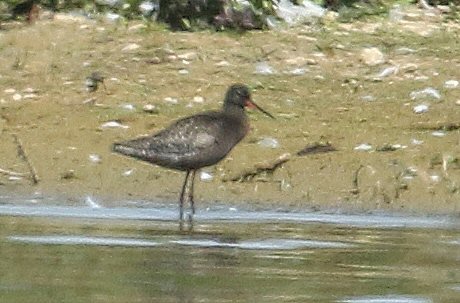
Spotted Redshank, Summer Leys LNR, 1st July 2018 (Bob Bullock)
If football isn’t coming home, then waders certainly are. Against a backcloth of small numbers of commoner species, more Black-tailed Godwits were found, with seven at Earls Barton GP on 5th, three at Stanwick GP on 6th and the same number at Summer Leys the following day but the highlight of the early autumn wader passage, so far, is the fine, summer-plumaged Spotted Redshank, which graced Summer Leys for a full five days from 1st before moving on. And if waders are on their way back so too, it seems, are gulls. July is the month when Yellow-legged Gulls begin to reappear and, following one at Pitsford Res on 6th, two were at Stanwick GP on 10th and 13th.
Yellow-legged Gull, Pitsford Res, 6th July 2018 (Richard How)Yellow-legged Gull, Stanwick GP, 10th July 2018 (Steve Fisher)
Meanwhile, on the passerine front, the same two species featured in the last round-up again make an appearance in this one. The singing male Firecrest was still at Badby Wood on 3rd and a lone Crossbill flew over Wellingborough’s Westminster Estate on 10th.
The spring’s unseasonally bitter weather continued into this week with the first two days of the period being largely wet with strong, cold, north-easterly winds making the daytime temperatures feel lower than the 6°C they actually were. Birders resorted to wearing gloves which, on the penultimate day of April, must have been a ‘first’ for many. Northants escaped the heavy rain and gales experienced by East Anglia and the south-east on the final day of the month, after which winds turned westerly and calmer, drier weather ensued, with temperatures up to the seasonal norm. The effect on migration was pronounced, with a number of grounded waders on 28th, as well as large concentrations of hirundines, followed by a big push of Arctic Terns through the county on 2nd.
Last week’s Summer Leys Garganey duo remained throughout the period and another drake was found at Thrapston GP on 3rd, while the male and female Red-crested Pochards were still at Kislingbury GP on 30th.
Female Garganey, Summer Leys LNR, 29th April 2018 (Alan Coles)Drake Garganey, Summer Leys LNR, 30th April 2018 (Martin Swannell)
Single Great White Egrets were seen at Clifford Hill GP on 28th-29th, Earls Barton GP and Summer Leys on 29th and Billing GP on 30th, although all records could conceivably relate to just one Nene Valley wanderer.
Great White Egret, Clifford Hill GP, 28th April 2018 (Mike Alibone)Great White Egret, Summer Leys LNR, 29th April 2018 (Chris Donohoe)
At Pitsford Res, the summer-plumaged Black-necked Grebe discovered last week on 24th, remained until 3rd, frequently showing very well off the gorse bushes south of the causeway.
Black-necked Grebe, Pitsford Res, 29th April 2018 (Angus Molyneux)Black-necked Grebe, Pitsford Res, 29th April 2018 (Angus Molyneux)
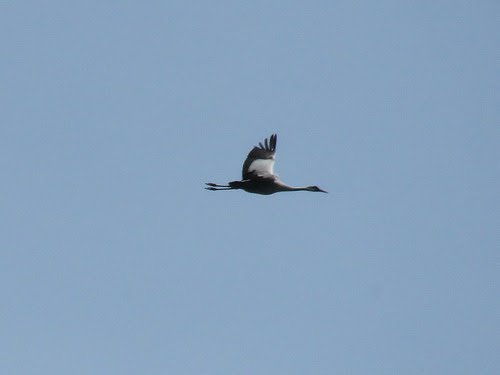
On the raptor front, there was a notable arrival of Hobbies this week, while single Ospreys were seen flying north between Barnwell CP and Oundle on 1st and at Hollowell Res on the same date. ‘Bird of the week’, however, was the Common Crane which flew high south-west over Wadenhoe during the afternoon of 3rd. This is approximately the 24th record for Northamptonshire.
Common Crane, Wadenhoe, 3rd May 2018 (Alan Francis)Common Crane, Wadenhoe, 3rd May 2018 (Alan Francis)
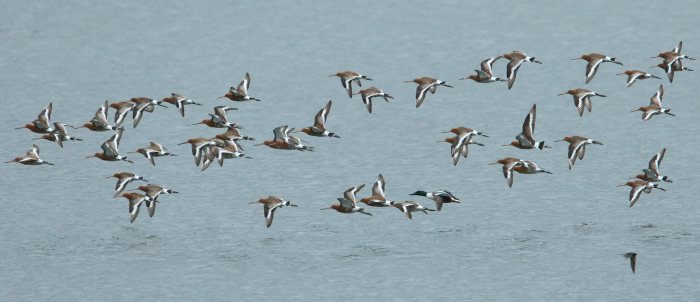
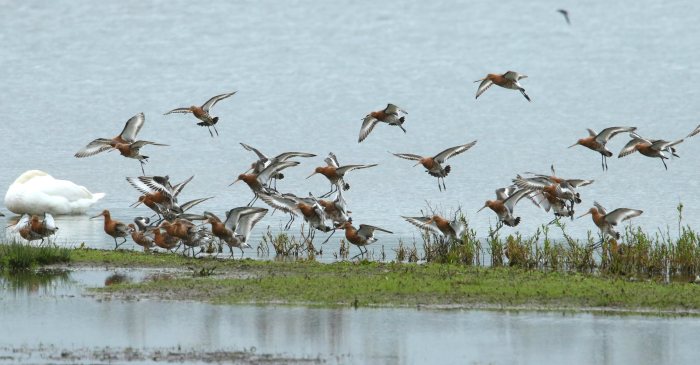
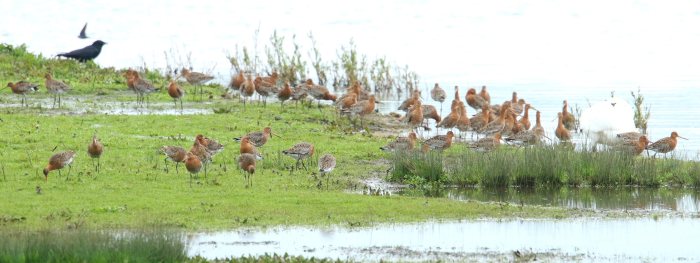
On 28th, after two Whimbrels in flight over Thrapston GP, birders this week were given a taste of more of those eagerly awaited spring passage waders. A Bar-tailed Godwit flew east at Summer Leys and sixty-three Black-tailed Godwits made landfall at Clifford Hill GP during the adverse weather conditions on that date.
Black-tailed Godwits, Clifford Hill GP, 28th April 2018 (Bob Bullock)Black-tailed Godwits, Clifford Hill GP, 28th April 2018 (Bob Bullock)Black-tailed Godwits, Clifford Hill GP, 28th April 2018 (Bob Bullock)Black-tailed Godwit, Summer Leys LNR, 29th April 2018 (Ricky Sinfield)
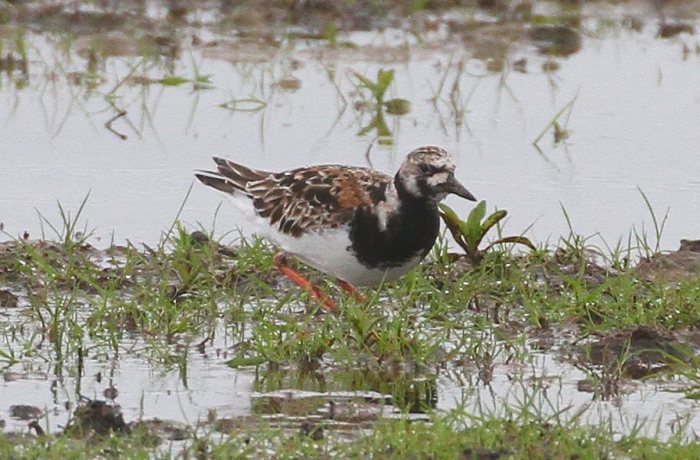
Three more visited Summer Leys on the following day and another stayed there for three days on 2nd-4th. Clifford Hill GP also attracted a Turnstone on 28th, while a Sanderling on the dam at Pitsford Res on 2nd was a classic early May visitor.
Turnstone, Clifford Hill GP, 28th April 2018 (Bob Bullock)Sanderling, Pitsford Res, 2nd May 2018 (Doug Goddard)
Some short-lived, adverse weather on 2nd produced dramatic numbers of Arctic Terns, with flocks of at least eighty-four at Clifford Hill GP, eighty at Pitsford Res and fifty-five at Hollowell Res. In the run up to this, smaller numbers included at least four at Clifford Hill GP on 28th, with sixteen there the following day; Pitsford had singles on 28th and 29th, eight on 30th and six on 1st; Hollowell produced one on 28th, when there were also two at Boddington Res; eleven visited Stanford Res on 29th, when there was also one at Stanwick, while he following day saw at least nine at Earls Barton GP and one at Daventry CP. Somewhat overshadowed by the above, the two mobile adult Mediterranean Gulls again visited Summer Leys on 29th.
The most unexpected bird of the week was the Wryneck discovered on the northern side of Thrapston GP during the last couple of hours of daylight on 4th, although it remained elusive in cover for most of the time. Almost annual, this species is recorded less frequently in spring than in autumn, so this was a nice find and a treat for the handful of birders who quickly managed to connect with it. The old railway track on the southern side of the same site produced a singing male Firecrest on 28th.
Wryneck, Thrapston GP, 4th May 2018 (Bob Bullock)
Chats and their ilk featured more weightily this week, although Common Redstarts were still unusually thin on the ground. Three, all males, included one-day birds at Harrington AF on 28th, Earls Barton GP on 2nd and Daventry CP on 3rd. Following the first last week, Whinchats appeared at two localities, with Clifford Hill GP producing one, possibly two, between 1st and 4th, while another was found near Long Buckby on the latter date and a rather late Stonechat was discovered near Cotterstock on 3rd.
Female Whinchat, Clifford Hill GP, 1st May 2018 (Mike Alibone)
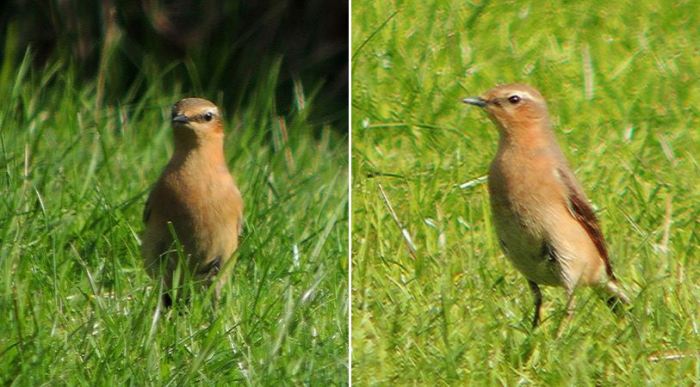
Larger numbers of Northern Wheatears turned up this week with many, if not all, showing characteristics of the Greenland race leucorhoa (‘Greenland Wheatear’) which predominates in May. Singles were at Barnwell on 29th, Pitsford Res on 29th-30th and Summer Leys on 2nd, four were at Clifford Hill GP on 30th, two at Upper Benefield on 1st and two at Earls Barton GP on 3rd, nine were near Long Buckby on 4th and Clifford Hill GP enjoyed a run of up to twelve between 1st and 4th and four were at Fawsley Park on 3rd.
Female Greenland Wheatear, Hemington, 4th May 2018 (Mike Alibone)Female Greenland Wheatear, Hemington, 4th May 2018 (Mike Alibone)White Wagtail, Pitsford Res, 28th April 2018 (Richard How)
A male ‘Channel’ Wagtail (Blue-headed x Yellow hybrid) was found alongside Barnwell Brook, south of Barnwell on 29th and Clifford Hill GP produced the lion’s share of White Wagtails, with singles on 28th and 3rd and at least ten on 1st, while another was at Pitsford Res on 28th.
What follows below is published at the request of the Wildlife Trust to draw attention to the above proposal and to provide the opportunity for questions and comments. The publication here of this proposal in no way represents an endorsement of the proposal nor an opposition to it by Northants Birds.
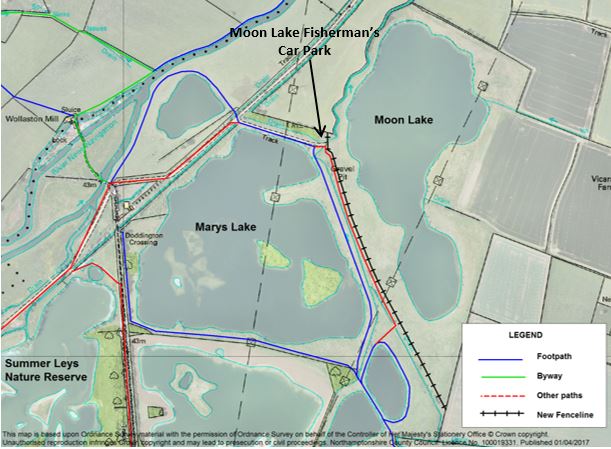
Mary’s Lake and Moon Lake form part of the Upper Nene Valley Gravel Pits, a series of pits that are of international importance for overwintering waterbirds, and which has been designated as a Special Protection Area (SPA). Mary’s Lake and Moon Lake, along with Summer Leys Nature Reserve, sit within one of the most publicly-accessed units of the SPA, with a good network of Rights of Way, permitted paths and informal access. The lakes are regularly visited by good numbers of overwintering birds such as Gadwall, Wigeon, Pochard and Tufted Duck. Public disturbance and lack of management have been identified as the main threats to the wildlife of the sites.Moon Lake is the least-visited of the lakes in this area, as there are no Rights of Way around the lake and access is not possible all the way around. There is a large area of grassland around the lake which has been covered in scrub in recent years, meaning it is less-suitable as grazing habitat for the waterbirds using the lake. The Wildlife Trust is working with Natural England, Wellingborough Council and the landowner to address the disturbance and management issues on the site. The aim is toallow management, through scrub clearance and grazing, and provide an undisturbed area of open water at Moon Lake. It is therefore proposed to construct a fenceline, as shown below, to create a grazing unit around Moon Lake and create an undisturbed area for birds. The fence line will not impact on any of the current Rights of Way and access will be possible along the western edge as shown. If you have any comments or questions about this proposal please contact the Wider Countryside Team at The Wildlife Trust on 01604 405285 or email Northamptonshire@wildlifebcn.org We will also be on-site to explain the project and answer any questions on Thursday 22/03/18, between 9-30am and 12-30pm, and again on Monday 09/04/18, between 1 and 4pm, at the Moon Lake Fisherman’s car park ( see above for location ).We are also aware that the Angling Club is considering putting an otter fence around Mary’s Lake itself. Whilst this is their own project we will be liaising with them to ensure that no Rights of Way are affected and that signage and footpath surfaces are improved around that lake.
Found exhausted in Duston yesterday, a Manx Shearwater was picked up and taken to the local vets. Not knowing the best course of action to take, they contacted Jim Murray who, in turn contacted Dave James for further advice. An initial plan to release it in Northants was quickly deemed inappropriate and subsequently ditched.
Manx Shearwater, in care, Northamptonshire 15th September 2017 (Jim Murray)
Fortunately, it survived overnight and JM today set out to take it took it to the Pembrokeshire coast, where the plan was to meet up with the Pembrokeshire Sea Bird Rescue Society to pass it over to them for further care prior to a hopefully successful release. On the way over, PSBRS recommended taking it to a specialist wild bird hospital near Swansea, which then became the revised destination.
After its admission to the hospital the prognosis appears good, with the hospital confident of the bird’s continued survival with a release planned after a few days. Apparently, Northants is the furthest point away the hospital has ever received a seabird from. Further good news is eagerly awaited.
This individual was not alone in its finding itself inland, presumably as a result of Storm Aileen’s big westerly blow on 12th-13th September. Other Manx Shearwaters were found in inland counties, e.g. Cambridgeshire, London area and up to wrecked birds 300 are being treated and released in Somerset http://bbc.in/2y5HeN5
Many thanks to Dave James and Jim Murray for providing details.
A timely Editorial in the British Birds e-Newsletter
With little more than a month to go before my ‘retirement’ as County Recorder, the following Editorial appeared in the BB e-Newsletter, reproduced here by kind permission of BB Editor, Roger Riddington. The post remains vacant …
Recently, I was talking to Ben, the BB web designer. He had done some work on our website, including the page of current county recorders. He expressed some surprise when I told him I’d be making changes to the content of that page on a regular, probably monthly, basis. I think he’d assumed that county recorders, once appointed, were likely to remain in post for a very long time, possibly forever. There are a few long-term stalwarts, of course, but nationally, there is a good deal of turnover. It’s perhaps not surprising – the volume of work can be significant and for most recorders, that work equates to spare time not spent in the field. I suspect that most recorders would say that the bulk of the records come in with little effort, it’s chasing up the (hopefully small) minority of difficult species and recalcitrant observers that takes such a lot of time. Yet the county recorder network is a foundation for a huge amount of amateur ornithology and citizen science in Britain, and it plays a key part of the main reports in BB, including the Rarities, Scarce Migrants and Rare Breeding Birds reports. We acknowledge this in an admittedly small way by giving current county recorders a 50% discount on their annual subscription to BB. But by and large, county recorders are unsung heroes. So to all you past and present recorders and bird report editors: we salute you, thanks for your efforts. And to anyone thinking of putting their hand up for a vacant position – go on, give it a try; it need not be forever, and you will be making a really key contribution.
After about ten years (it feels like more) I have decided to relinquish my post as Northamptonshire County Bird Recorder and I hereby give notice that I will no longer be doing the ‘job’ after 31st March 2017.
If anyone would like to step forward to take on this role then please feel free to contact me. If there are no volunteers prior to the above date then the county will be recorderless from 1st April.
I will not pretend the job is glamorous. There are hours of data input every week, supply of information to various organisations and journals, meetings to attend (which I don’t) and the rewards are meagre. With a more than full time job and other birding interests to juggle I simply don’t have the time to do the job justice.
I intend to continue with the Northantsbirds site and I will continue posting local bird news but the recorder’s job is better served by someone young, energetic and feisty with lots of energy or someone old, wise and wizened with lots of time. At present I fall into neither category.
I would like to take this opportunity to thank everyone for their support and record submissions over the last decade.
I had a very interesting and enlightening meeting with Anglian Water at lunchtime today, part of the purpose of which was to discover the rationale behind their recent closure of the parking pull-ins on Pitsford causeway. The other part was to explore ways in which the decision might be reversed. Don’t hold your breath. It isn’t going to happen any time soon.
So let’s look at some facts. Pitsford causeway is part-owned by the local council and part-owned by AW. The council owns, maintains and is generally responsible for the road itself. AW owns, maintains and is generally responsible for the two pull-ins, the grass verges and of course, being part of the reservoir, the concrete slab structure over which the road runs.
AW told me there were two reasons for the closure. First and foremost, with the increased use of the pull-ins, AW had recently chalked up a number of ‘near misses’ relating to potential road collisions involving both pedestrians and cars pulling out. Secondly, the pull-ins have fallen into a poor state of repair, their surfaces having become uneven and pot-holed. AW obtained quotations to resurface the pull-ins and the cost was deemed prohibitive at approximately £20,000. So, if any incident takes place on AW’s property they are potentially liable.
OK, so it’s principally a safety issue and I get that. However, it’s like squeezing a bag of sealed air, the suppression of one risk gives rise to a new one popping up elsewhere to replace it. Now that both sides of the causeway are fully stumped off, there is nowhere for the police speed camera van to park up, so with its future absence, coupled with increased visibility for motorists (remember, no parked cars from behind which anyone can run out), it seems inevitable that motorists will ramp up the speed. This, I pointed out, is an added new danger for pedestrians crossing the causeway – even more so for those who have taken to parking their cars on the verge, just beyond where the stumps finish.
And therein lies another story. The causeway road is a clearway and it’s technically illegal to park on the verge, I’m informed by AW. They also told me the Brixworth police were already on to it and will place warning notices on windscreens of offenders, duly noting registration numbers so that repeat offenders will ultimately be issued with parking fines. So, if you don’t want to be nobbled by the local rozzers, don’t park on the verge.
I then floated the idea of AW approaching the council with a request that they install traffic-calming measures (road humps to you and me) on the causeway and, if this was implemented and a mystery donor came up with £20k, would they consider reopening the pull-ins? “Maybe,” was the reply but the chances of these two things happening are nigh on negligible – unless, of course, one of us wins the lottery or a kindly benefactor steps forward with the requisite amount of cash.
The idea of allowing 15 minutes free parking on the causeway, after which people paid using the P&D machine in the car park along with another P&D machine at the fishing lodge end of the causeway, ultimately using the extra revenue generated to fund resurfacing the pull-ins, didn’t fly either. This, of course, was again down to cost. There would be the cost of regular patrolling, each machine costs approximately £5000 and the machines are vulnerable to theft and damage. In fact, the one in the car park at the Brixworth end of the causeway was stolen just recently and AW are waiting for a new one. I’m just waiting for someone to pin it on me as a result of my previous post on this subject!
I also asked the question: “Would AW be prepared to allow members of the Wildlife Trust free use of the existing P&D car park on the causeway?” The answer went along the lines of “No, it gets too busy [with people who buy tickets taking the spaces] and the car park at the fishing lodge is already free to park in for day permit holders and Wildlife Trust members.” The words in square-brackets were not actually spoken but it was immediately apparent (to me) as implied.
So there you have it. I’ve tried and frankly I’m stumped. No more parking on the causeway. Period. I was open-minded to begin with but, let’s face it, it is all about money – cost-saving or revenue-generating, or both. Good old unyielding, uncompromising AW. I salute you!




 Another first for the winter, a juvenile Great Northern Diver, was discovered off the dam at Pitsford on 1st before promptly being joined by another there on 2nd. Although both were seen together on the latter date, only one has been reported subsequently, right through to the end of the period.














 Recently, I was talking to Ben, the BB web designer. He had done some work on our website, including
  I had a very interesting and enlightening meeting with Anglian Water at lunchtime today, part of the purpose of which was to discover the rationale behind their recent closure of the parking pull-ins on Pitsford causeway. The other part was to explore ways in which the decision might be reversed. Don’t hold your breath. It isn’t going to happen any time soon.
 Northants birds