It’s been thirty-three years since I last saw a Brϋnnich’s Guillemot. The towering cliffs looking out over the cobalt-blue Barents Sea at the mouth of Varangerfjord – wild, windswept and bustling with breeding seabirds – was the location with that ‘standing on the edge of the world’ feeling. Time to get reacquainted.
It took less than three and a half hours for Gary Pullan, Frank Smith and myself to arrive at Portland Harbour, where a couple of hundred birders had already assembled.
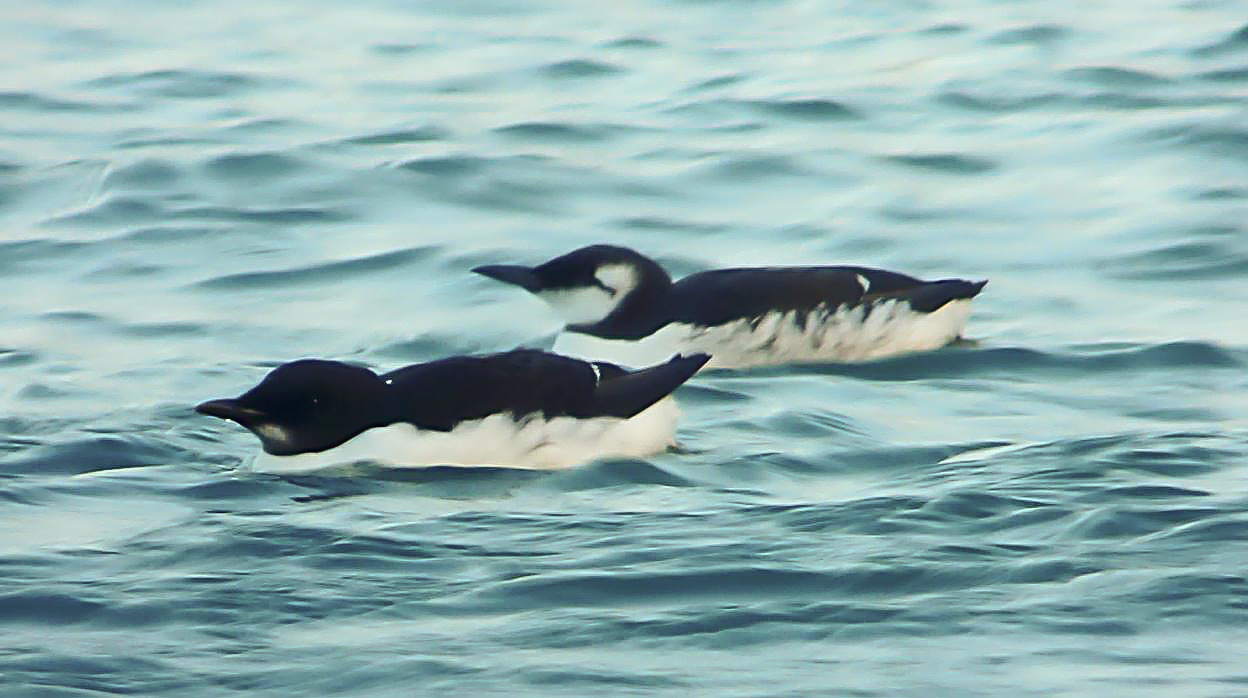
And there it was, just bobbing about like a black and white cork, sheltering in the lee of a moored boat from the rather strong, blustery wind and rain which started lashing the area as soon as we got out of the car. At fairly close range the identification was straightforward. Aside from the obvious diagnostic features, this bird appeared to have a noticeably longer primary projection than the accompanying Common Guillemot, which shows well in the photos below.
[click on the cogwheel and change resolution to 720 HD for marginally better definition]
After a while, it moved very rapidly to another part of the harbour, where it seemed settled and continued to attract a steady stream of admirers.
Other interesting species in the harbour at the same time were Great Northern and Black-throated Divers, Red-breasted Mergansers, Shag, Razorbill and Black Guillemot – all nice to see.
On the way home we swung by Radipole Park Drive, where a Glossy Ibis has been feeding on a flooded football pitch for the past couple of days.
A cold, blustery day out with some excellent festive season birding!
Birders recently visiting Summer Leys in search of autumn migrants cannot have failed to notice a significant change in its appearance. Last week saw the completion of the reprofiling of the scrape there – a much welcomed move designed to improve this important habitat for both breeding and passage waders.
This short project, which was completed in little more than a week, was specified and managed by Steve Brayshaw on behalf of the Wildlife Trust following the last major reprofiling there in October 2007. Additional works took place in September 2008 with perimeter banks being raised and a new water control structure installed to ensure all the scrape islands could be completely flooded in the winter. This proved to be extremely worthwhile as 2009 was an excellent season for breeding waders, with at least three or four pairs of Little Ringed Plovers, eleven to twelve pairs of Lapwings and two pairs of Redshanks all raising young. Since then, however, breeding numbers have declined with, for instance, just three to four pairs of Lapwings breeding there this year.
At the time of the 2008 reprofiling the scrape was also found to be suffering from an infestation of Crassula helmsii (otherwise known as New Zealand Pygmyweed or Australian Swamp Stonecrop). This invasive non-native species is virtually impossible to control effectively and still remains a problem.
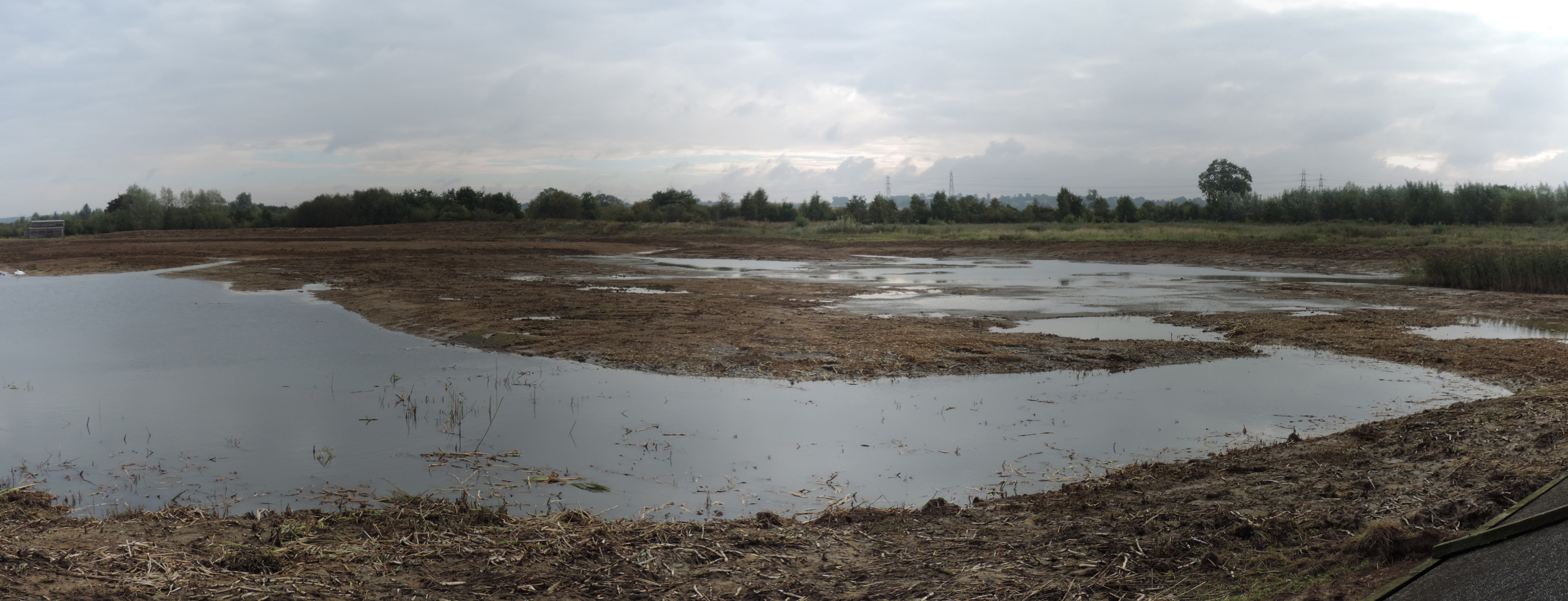
Summer Leys scrape: the view from Pioneer Hide before reprofiling (Steve Brayshaw)Summer Leys scrape: view from hide after reprofiling (Steve Brayshaw)
The primary purpose of the recent works was to restore the scrape to the 2008 profile – to improve habitat for breeding waders and to raise the potential for passage waders. All the vegetation (including Crassula) on the scrape islands and the majority of the margins has been scraped back to bare earth and willow saplings have been removed. Great care has been taken to ensure that Crassula does not spread outside the scrape, including cleaning down the machinery before it was moved to the next site.
Two small reedbeds have been retained but the reedbed in front of the Pioneer hide has been removed to restore the view! The water level at the time of the works was approximately thirty centimetres lower than it was when reprofiling was completed in 2008, so the channels between the islands have also be deepened slightly to increase the extent of wet margins. Heavy rain since the works were complete is already washing sand and silt out of the reprofiled soils to reveal areas of bare gravel.
Subject to the completion of other habitat management elsewhere on the reserve, including the removal of vegetation on Gull, Hawthorn, Round and Rotary Islands, the water level in the scrape will be raised by around 30cm over the next month to increase the extent of mud and shallows before the scrape is completely flooded again over the winter to suppress further vegetation growth.
Hopefully we can look forward to record numbers of breeding waders in 2014 and an excellent wader passage, with the added bonus of a rare vagrant or two. A pair of Black-winged Stilts turned up in May 2008 following the last round of reprofiling so watch this space!
Many thanks to Steve Brayshaw for the current and historical details used in the above post
The latest Northamptonshire Bird Report, with records for 2011, is now available. Contents include full Systematic List compiled using records from more than 250 local observers, sections on Escapes and Ferals and Corrections and Additions from previous years, as well as many photos and illustrations. There is also the East Midlands Red Kite Report and data from the Stanford Reservoir Ringing Group as well as the full list of the species ever recorded in Northants, tables of arrival and departure dates for summer and winter visitors and a County Site Map.
Copies and back issues from:
R W Bullock, 81 Cavendish Drive, Northampton NN3 3HL
Price £8.10 each, including postage. Cheques payable to ‘Northamptonshire Bird Report’
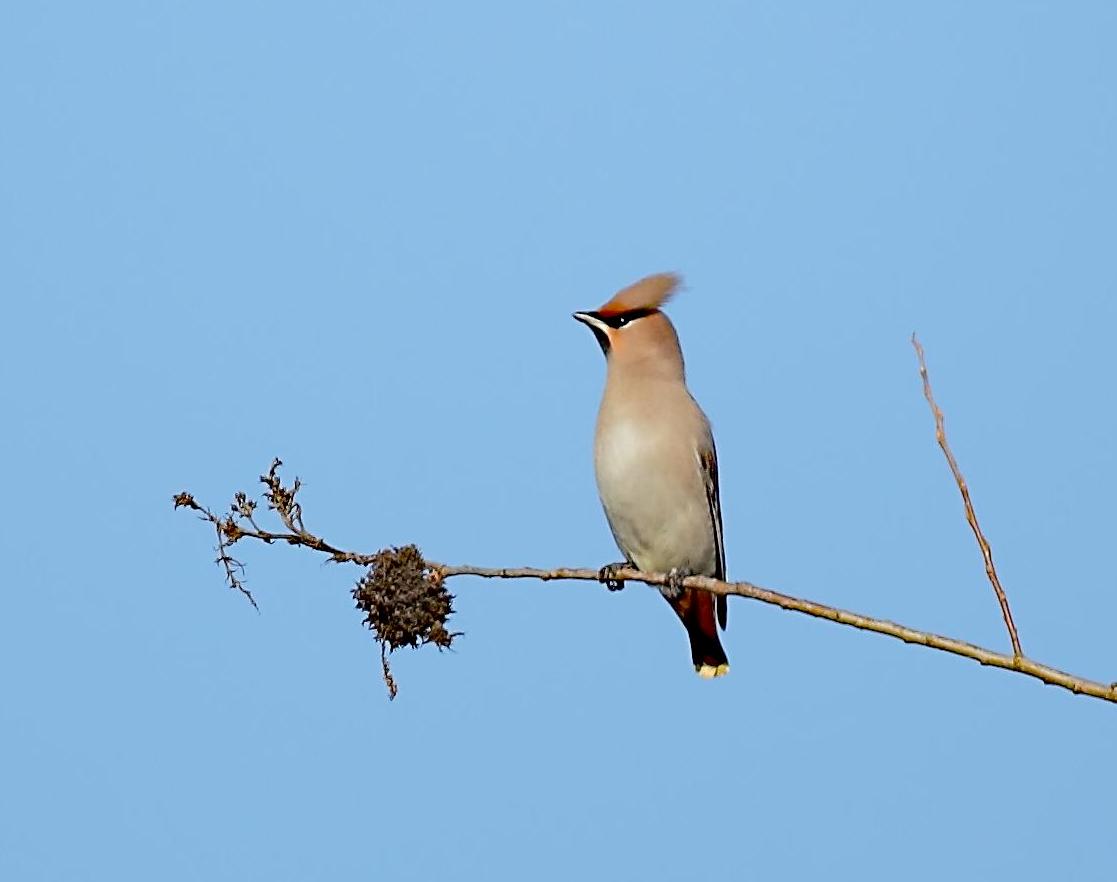
After a small flock of up to eleven Waxwings was discovered visiting the Rowan trees in the car park at Homebase, Sixfields from 14th to 16th, another fourteen were found at nearby Sixfields Lake on the latter date and at least ten were still present there yesterday. Today, twenty-five have been present – though highly mobile – around the SixfieldsLake area, suggesting that the two flocks have now combined. Being flighty, they have not been easy to catch up with, giving many birders the run-around. Jonathan Philpot was fortunate in capturing the below images after most of us had given up this morning …
Waxwing, Sixfields Lake, Stortons GP, 18th November 2012 (Jonathan Philpot)
Waxwing, Sixfields Lake, Stortons GP, 18th November 2012 (Jonathan Philpot)
An added bonus came in the form of this unusually showy Cetti’s Warbler
Cetti’s Warbler, Sixfields Lake, Stortons GP, 18th November 2012 (Jonathan Philpot)
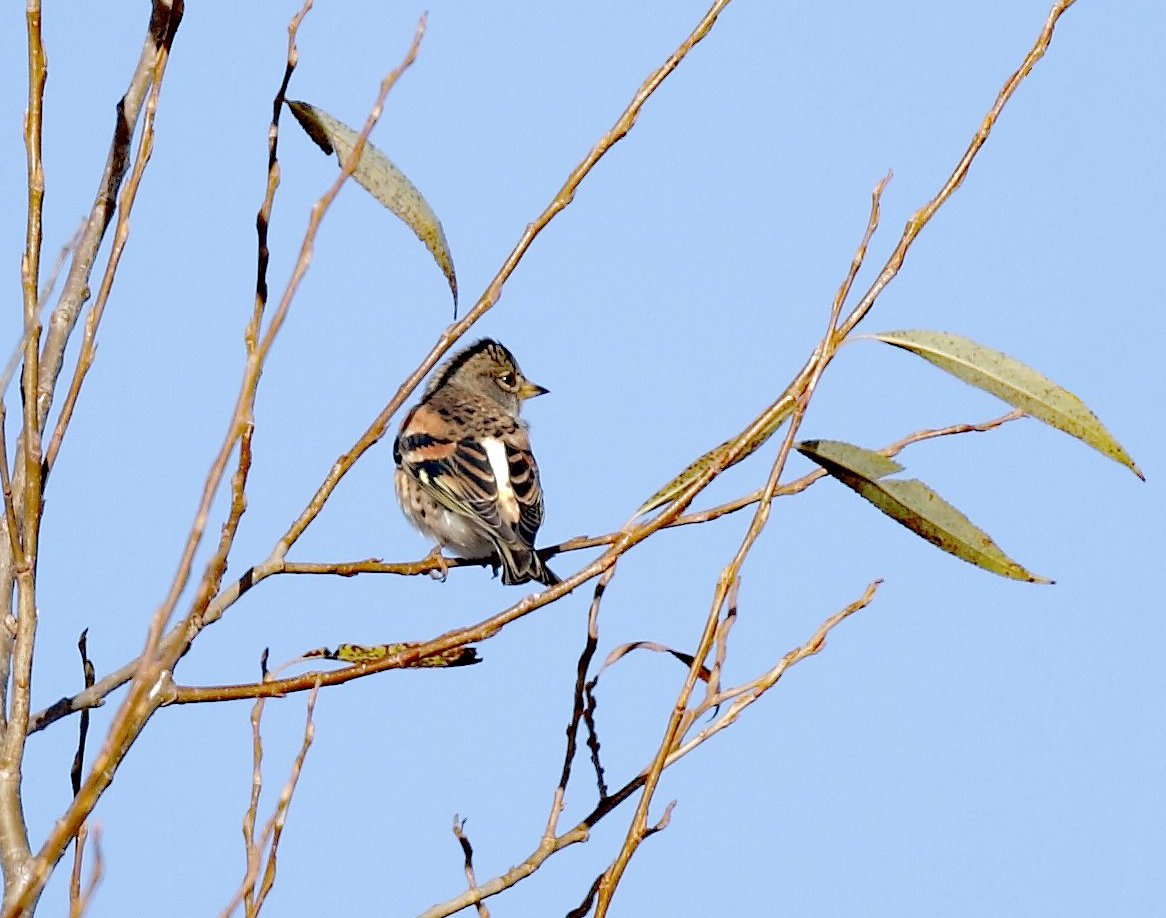
and a Brambling also put in an appearance. This species has appeared in reasonably good numbers this autumn.
Brambling, Sixfields Lake, Stortons GP, 18th November 2012 (Jonathan Philpot)
Some important news concerning the receipt of email and text alerts from Northantsbirds has emerged today. For those using ifttt.com as a conduit for receiving news from Twitter by email or SMS this organisation has announced that, from 27th September 2012, it will no longer offer this service as a result of Twitter policy changes that will affect how applications can interact with Twitter’s data. As a result of these changes, ifttt.com will be removing all Twitter ‘triggers’, disabling the ability to receive tweets by email and SMS. In short, anyone who has elected to use this service, by creating ‘recipes’ using the #Northantsbirds hashtag, will no longer be able to receive latest reports from Northantsbirds by this method.
This does not affect anyone who is receiving text alerts direct from Twitter (i.e. not via ifttt.com). So, from 27th September, the only method of receiving immediate Northantsbirds news will be by SMS text alert, directly from Twitter, to a mobile phone – and this can’t be a bad thing! To receive these alerts simply follow @bonxie on Twitter, register your mobile phone details on your Twitter account and then select ‘turn on mobile communications’ from the dropdown menu next to the ‘following’ button on the @bonxie profile page.
For those interested, a full explanation of ifttt.com’s changes to the way it will be operating with regard to Twitter can be found at tinyurl.com/bn4resq
With last year now behind us, and the 2010 Northamptonshire Bird Report recently published, now is the time to get your 2011 records in. The bird report committee would be pleased to receive any currently unsubmitted records as soon as possible – and in any case by the end of January.
The preferred method of submission is the use of the standard recording sheet (a pre-formatted excel file, see below), which automatically populates the fields for species number and grid reference as you type. It’s very easy to use!
If you are fortunate to discover a species uncommon enough to require the submission of a written description (see the list of requirements in the 2010 report) then please use the description form illustrated below. Both forms are available by email from me northantsbirds@ntlworld.com or from Bob Bullock robertbullock25@hotmail.com and can be completed and returned by email to either of us. So get cracking!
The latest Northamptonshire Bird Report, with records for 2010, is now available.
Contents include full Systematic List, sections on Escapes and Ferals, Corrections and Additions from previous years, East Midlands Red Kite Report, Stanford Ringing Group Report, Pitsford Reservoir Report, checklist of species recorded in Northants, tables of Summer and Winter Arrivals and Departures and an updated County Site Map. The number of contributors has risen dramatically and there is also a list of unaccepted records.
Copies and back issues from:
R W Bullock, 81 Cavendish Drive, Northampton NN3 3HL
 And there it was, just bobbing about like a black and white cork, sheltering in the lee of a moored boat from the rather strong, blustery wind and rain which started lashing the area as soon as we got out of the car. At fairly close range the identification was straightforward. Aside from the obvious diagnostic features, this bird appeared to have a noticeably longer primary projection than the accompanying Common Guillemot, which shows well in the photos below.



 Other interesting species in the harbour at the same time were Great Northern and Black-throated Divers, Red-breasted Mergansers, Shag, Razorbill and Black Guillemot – all nice to see.





 Northants birds