The Week in Focus, 9th to 15th July 2016

There was little change in either the weather or the birds from last week. West to south-westerly winds, sunny spells and lower than hoped-for temperatures continue to be the hallmarks of a generally lacklustre summer. Waders continued to trickle through in small numbers while the seasonal build-up of Yellow-legged Gulls at Stanwick GP continued.

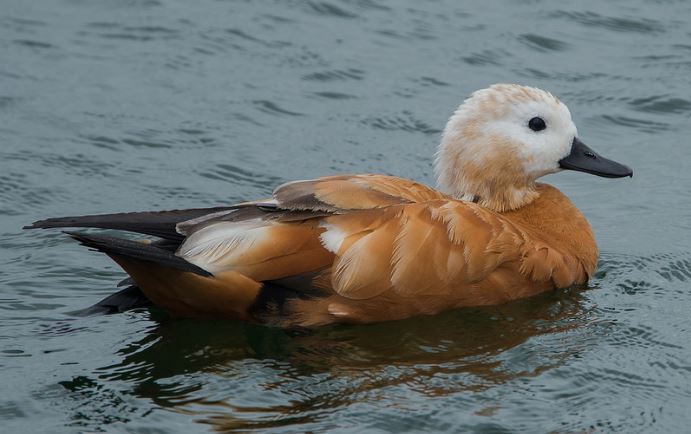
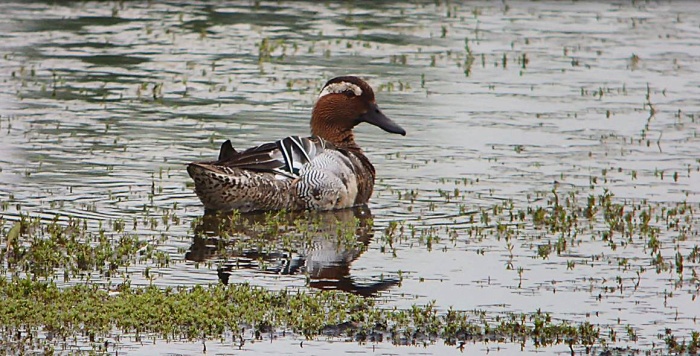
Both the escaped – presumed taverneriCackling Goose and the injured Ruddy Shelduck were both still at Pitsford Res on 10th, as was a Red-crested Pochard on the same date. At Stanwick GP, the Garganey remained until at least 14th and two Common Scoters dropped on to the A45 Lay-by Pit, also on 14th – while a Marsh Harrier flew east on 10th and it, or another, was hunting over the reedbed there two days later. The only other raptor of note was a Peregrine at Thrapston GP on 9th.

Female and eclipse drake Common Scoters, Stanwick GP, 14th July 2016 (Steve Fisher)

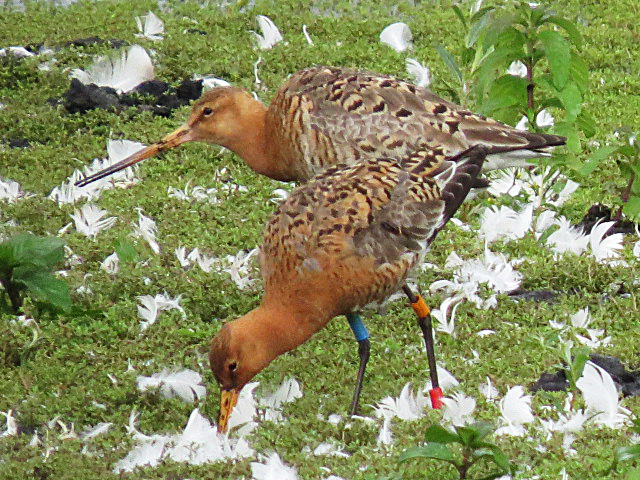
Four Little Ringed Plovers were at Summer Leys LNR on 10th and two, along with a Dunlin, were at Stanwick GP on 12th. Stanwick also produced three Ruff on 14th and Summer Leys saw a run of Black-tailed Godwits, with two on 12th, an unconfirmed report of forty the following day and between eleven and fourteen on 14th. Numbers of Common Sandpipers rose from two at Stanwick GP on 10th to four there on 15th, while two were also at Summer Leys on 10th and ten were counted at Pitsford Res on the same date with just one there on 14th. The only Green Sandpipers were singles at Stanford Res on 9th and at Pitsford Res on 9th-10th, while two Greenshanks were at Stanwick GP on 13th dropping to one the following day and Summer Leys produced two adult Redshanks with at least two chicks during the period.

The annual late summer build-up of Yellow-legged Gulls at Stanwick GP continued with numbers there exceeding fifty by the week’s end and there were also four at Pitsford Res on 10th. More Caspian Gulls accompanied the Stanwick Yellow-leggeds and included at least two first-summers and a second-summer between 11th and 15th.

First-summer Caspian Gull, Stanwick GP, 13th July 2016 (Steve Fisher)

A Turtle Dove was seen at Finedon on 9th and two were ‘purring’ in Lady Wood the following day, while a single male Crossbill was at Bucknell Wood on 14th.

The Week in Focus, 2nd to 8th July 2016

Despite the continued westerly airstream, the weather remained largely dry with temperatures around average at best. Few new migrants were reported during the period.

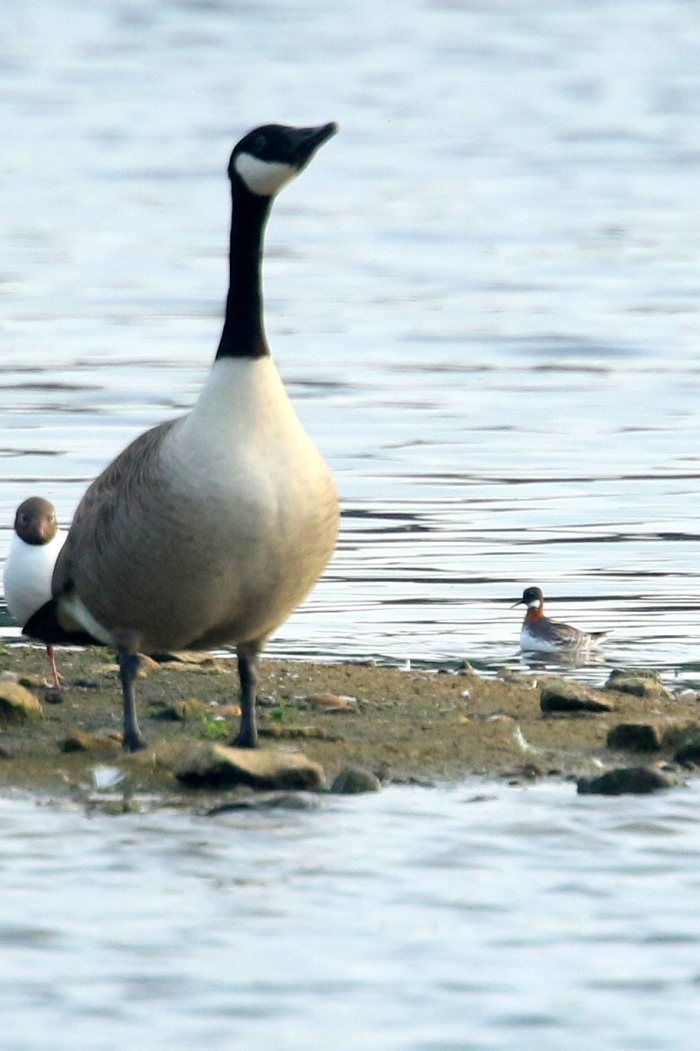
The presumed escaped Pitsford Res Cackling Goose, showing characteristics of the race taverneri, was still among the Canadas there on 4th, as was the injured Ruddy Shelduck on 6th. The only other wildfowl of note were a Garganey at Stanwick GP on 8th and a Red-crested Pochard at Thrapston GP on 2nd and it was a quiet week for raptors with just a Marsh Harrier at Earls Barton GP on the same date.

Up to three Little Ringed Plovers were at Summer Leys LNR on 2nd-3rd, a Black-tailed Godwit was there on 4th, followed by four more at Stanwick GP on 7th and a Dunlin was at Earls Barton GP on 7th. Numbers of Common Sandpipers remained stable with four at Pitsford Res and one at Summer Leys on 3rd and two at Stanwick GP on 7th. Both of these sites held at least two Redshanks during the period.

Further down the Nene valley, two Yellow-legged Gulls were found at Thrapston GP on 2nd, while numbers of this species continued to build at Stanwick GP, where there were seventeen on 4th and twenty-seven on 6th, accompanied by a second-summer Caspian Gull on the latter date.

Male Firecrest, Northamptonshire, June 2016

Quality, not quantity, was the order of the week for passerines as four male Firecrests continued to sing at the same site as in June, although song had considerably diminished during the last week, while two Crossbills were seen at Fineshade Wood on 2nd.

The Week in Focus, 25th June to 1st July 2016

More Atlantic weather systems produced largely overcast skies and frequent showers on the back of a westerly airstream, while traditional ‘summer’ weather has yet to emerge. Finding anything new proved hard graft for most, although a certain high flying raptor constituted manna from heaven for one observer, while others made do with a steady trickle of migrant waders serving as a reminder that birds were on the move.

At Pitsford Res a Cackling Goose, showing characteristics of the race taverneri, was discovered among the Canadas there on 30th, although its chances of being wild are, of course, pretty much zero – nevertheless it’s an interesting bird to see.

Cackling Goose, probably Taverner's, Pitsford Res, 30th June 2016 (Jacob Spinks)
Cackling Goose, probably Taverner’s, Pitsford Res, 30th June 2016 (Jacob Spinks)

The drake Goldeneye was also still there on 25th and so was the Stanford Res bird on 26th – the latter thought to be flightless and so not the same individual as the Pitsford bird as surmised in last week’s report.

This week’s ‘bird of the week’ appeared in the north-east of the county on 25th. While James Underwood was photographing Red Kites and Common Buzzards over his garden, in Corby Old Village, a Honey Buzzard came into view, drifting high west. The moment was captured and the species swiftly added to the garden list, hot on the heels of the White Stork which circled over there less than three weeks previously, on 6th June!

Honey Buzzard, Corby Old Village, 25th June 2016 (James Underwood). Moulted inner primaries indicate this is a female as males undergo primary moult much later in the season.

The only other raptors of note were an Osprey at Welford Res briefly on 28th and single Peregrines at Northampton on 25th and at Thrapston GP the following day.

Some recent news on last week’s colour-ringed Black-tailed Godwit at Summer Leys concerns its being seen four days later at Creek Common, North Hayling, Langstone Harbour, Havant, Hampshire on 30th. Who says birds aren’t site-faithful! On the wader front, four Little Ringed Plovers were at Stanwick GP on 27th and two Ringed Plovers were there the next day, while a Curlew flew over Stanford Res on 25th and one visited Summer Leys LNR briefly on 29th.  More Common Sandpipers appeared this week, with singles at Stanford Res on 26th and 29th, one at Stanwick GP on 28th plus two there on 30th and three at Welford Res on 28th, a Green Sandpiper was at Stanwick GP on 27th with a Redshank there on the same date.

Stanwick also produced the week’s only Yellow-legged Gulls, which included seven on 27th, three on 30th and eight on 1st, along with a second-summer Caspian Gull on the latter date. Beyond that, a Turtle Dove still at Harrington AF on 27th and one at Stanwick GP on 1st was all the week could muster.

On Tour: a Godwit with ‘Previous’

Barely is spring over and autumn wader passage has begun. June usually sees the first Icelandic Black-tailed Godwits moving south through the county and the group of three found by Kim Taylor at Summer Leys on Friday included one particularly interesting individual, images here by Adrian Borley.

Female and two male Icelandic Black-tailed Godwits, Summer Leys LNR, 24th June 2016 (Adrian Borley)

Interesting because it was colour-ringed and the combination of colours, along with the position of the rings, enabled some of this bird’s history to be traced and its movements to be revealed. It was, as they say in some quarters, a godwit with ‘previous.’

Icelandic Black-tailed Godwits, Summer Leys LNR, 24th June 2016 (Adrian Borley)

While I’m not a big fan of gaudy ‘bling’ (it looks so unnatural!), I have to acknowledge its use as a tool in providing valuable information which furthers our knowledge of a species and which can be particularly useful in, among other things, future conservation initiatives through the identification of key wintering and breeding areas.

This godwit, a male, was ringed in Hampshire on 5th September 2010. It has been well-travelled during the subsequent six years as the table below – kindly provided by the ringer, Pete Potts – clearly illustrates. Black-tailed Godwit, Summer Leys LNR, 24th June History                                                                                                                           Anyone lucky enough to find a colour-ringed Black-tailed Godwit can check the colour combination against a detailed key to race, origin and ringing group which can be downloaded from here and observers are encouraged to contact the ringer with details of their observations.

Female Icelandic Black-tailed Godwit, Summer Leys LNR, 24th June 2016 (Adrian Borley)


Male Icelandic Black-tailed Godwit, Summer Leys LNR, 24th June 2016 (Adrian Borley)

Found in the morning and still present late afternoon, the godwit trio had departed by the next day. Had this male not been ringed it would have slipped by anonymously, giving no clue as to its age, travel history or possible destination.

Two Weeks in Focus, 11th to 24th June 2016

The past two weeks have been influenced by weather systems from the Atlantic, with predominantly overcast conditions, heavy showers and thunderstorms accompanying hot air from Europe at the end of the period. Southbound waders at several localities were clear indications that ‘ornithological autumn’ was well underway.

Usually in the vicinity of the sailing club grounds, the injured Ruddy Shelduck was reported from Pitsford Res all week and a female Garganey was seen at Stanwick GP on 13th.

Ruddy Shelduck, Pitsford Res, 22nd June 2016 (John Nicholls)

As wildfowl numbers began to build at some of the larger bodies of water, ducks on the move included a drake Red-crested Pochard at Thrapston GP from 16th to 19th, one at Pitsford Res on 17th and two there on 21st, while a drake Goldeneye at Stanford Res earlier in the month was likely to have been the same individual present at Pitsford Res from 18th.

Red-crested Pochards, Pitsford Res 21st June 2016 (Jacob Spinks). The extensive and sharply defined white under tail coverts along with the pale occipital border of the female suggests hybridisation, as does the lack of any pink in the bill, although the latter may be a sign of immaturity.
Red-crested Pochards, Pitsford Res 21st June 2016 (Jacob Spinks). The extensive and sharply defined white under tail coverts and white throat along with the pale occipital border of the female suggests hybridisation, as does the lack of any pink in the bill, although the latter may be a sign of immaturity.
Red-crested Pochards, Pitsford Res 21st June 2016 (Jacob Spinks)

Just one Quail was reported during the period – a male singing in set-aside west of Everdon on the evenings of 21st and 22nd. Ospreys continued to be seen, with one over Borough Hill and two at Welford Res on 11th and singles at Hollowell Res on 19th, Pitsford Res on 22nd and over Welford on 23rd, while single Peregrines visited Clifford Hill GP on 11th, Summer Leys LNR on 20th and Thrapston GP the next day.

Already autumn has begun. Waders were noted moving south and, aside from two young Little Ringed Plovers at Summer Leys, a fully-fledged juvenile appeared at Stanwick GP on 13th and seven new arrivals were counted there on 24th. Stanwick also produced two Ringed Plovers on 13th when two – perhaps the same – also visited Summer Leys. Curlews made news this week. Aside from wandering individuals at Clifford Hill GP on 11th, Lilbourne on 14th and Stanford Res on 21st, a pair with three young was discovered at a new breeding site, which is good news for a species over which national concern has been highlighted this year. A Black-tailed Godwit paid a brief visit to Summer Leys on 13th and three more – one of them colour-ringed – were there on 24th. The colour-ringed individual was ringed at Farlington Marshes, Hampshire on 5th September 2010.

Icelandic Black-tailed Godwits, Summer Leys LNR, 24th June 2016 (Adrian Borley)

Common Sandpipers returned right on cue with one at Pitsford Res on 22nd, followed by two there the next day, a Green Sandpiper was at Stanwick GP on 21st and Greenshanks were earlier than normal with singles at Stanwick on 11th and Pitsford on 17th. Just one Redshank was seen at Stanwick on 24th.

For the gullers, the expected annual build up in numbers of Yellow-legged Gull got underway at Stanwick GP with an adult there on 13th, followed by a second-summer on 20th and six were present by 24th.

Yellow-legged Gull, Stanwick GP, 24th June 2016 (Steve Fisher)

Black Terns paid a surprise visit to Earls Barton GP on 11th when three were found on Mary’s Lake, while the dearth of Turtle Doves continues with up to two at Harrington sporadically between throughout the period and singles at Grafton Park Wood on 17th and Twywell Hills & Dales on 21st. A juvenile Siskin on a garden feeder at Orlingbury on 14th was unusual and is suggestive of a local origin.

The Week in Focus 4th to 10th June 2016

A pretty mixed bag of weather conditions saw temperatures reaching the high twenties under a continental influence at the start of the week, sparking thunderstorms and heavy showers in some areas. Atlantic weather systems ensured a return to average temperatures by the week’s end as the winds took on a more westerly direction prior to the onset of more unsettled conditions.

The injured Ruddy Shelduck continued to be reported from Pitsford Res until 8th and another drake Garganey was discovered – this time on the scrape at Summer Leys LNR on 4th.

Drake Garganey, Summer Leys LNR, 4th June 2016 (Mike Alibone)

The same also date produced a Great White Egret in flight over Northampton, while a White Stork was watched circling above Old Corby village on 6th before heading off high north-west. The only raptors reported this week were three Ospreys – one west over Pitsford Res on 5th, another over Brampton Lane, Northampton the next day and one drifting over Guilsborough on 8th.

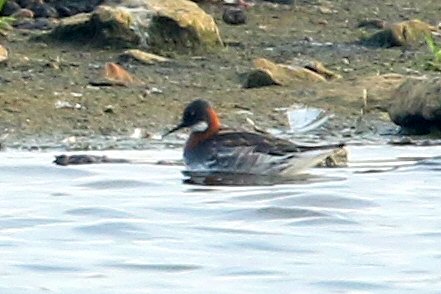
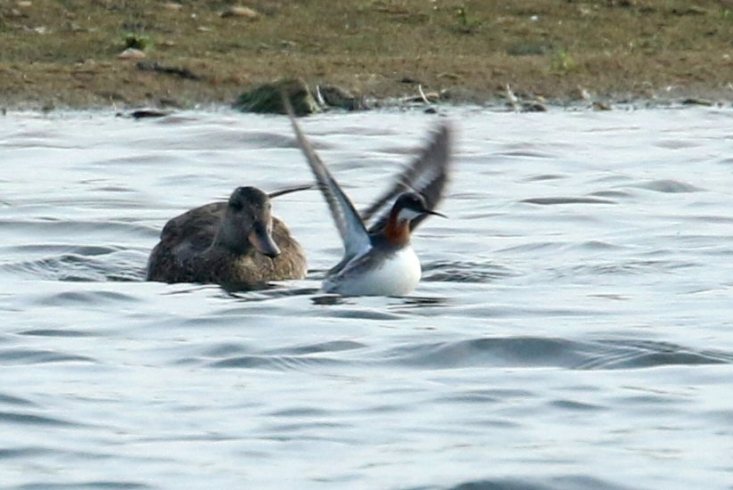
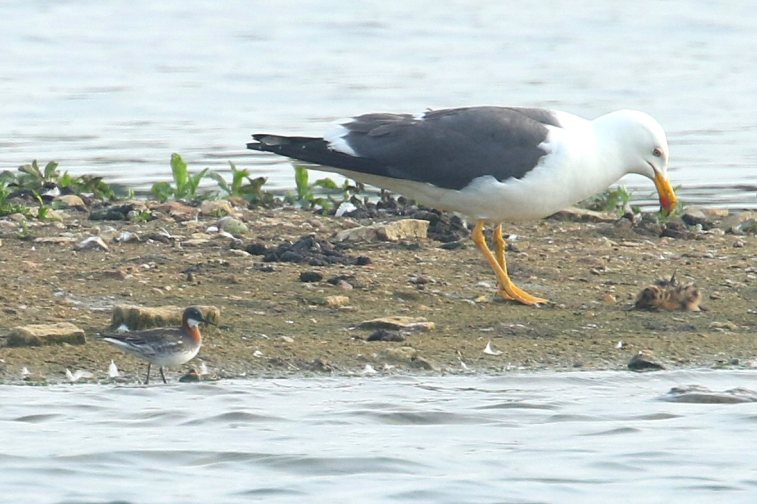
An ephemeral flame from the dying embers of spring – and the undoubted highlight of the week – was the rather smart female Red-necked Phalarope which was discovered at Stanwick GP on the evening of 4th, when it was present around the islands in the A45 Lay-by Pit. Sadly, it had departed by the next morning.

Female Red-necked Phalarope, Stanwick GP, 4th June 2016 (Bob Bullock)

Perhaps confusingly, however, we were dealt a taste of autumn when a Green Sandpiper appeared at Stanwick GP on 7th. This species normally returns toward the end of the month so the early appearance of this individual suggests a failed breeder.

Stumping up the cash part 2: the AW angle

Stump2I had a very interesting and enlightening meeting with Anglian Water at lunchtime today, part of the purpose of which was to discover the rationale behind their recent closure of the parking pull-ins on Pitsford causeway. The other part was to explore ways in which the decision might be reversed. Don’t hold your breath. It isn’t going to happen any time soon.

So let’s look at some facts. Pitsford causeway is part-owned by the local council and part-owned by AW. The council owns, maintains and is generally responsible for the road itself. AW owns, maintains and is generally responsible for the two pull-ins, the grass verges and of course, being part of the reservoir, the concrete slab structure over which the road runs.

AW told me there were two reasons for the closure. First and foremost, with the increased use of the pull-ins, AW had recently chalked up a number of ‘near misses’ relating to potential road collisions involving both pedestrians and cars pulling out. Secondly, the pull-ins have fallen into a poor state of repair, their surfaces having become uneven and pot-holed. AW obtained quotations to resurface the pull-ins and the cost was deemed prohibitive at approximately £20,000. So, if any incident takes place on AW’s property they are potentially liable.

OK, so it’s principally a safety issue and I get that. However, it’s like squeezing a bag of sealed air, the suppression of one risk gives rise to a new one popping up elsewhere to replace it. Now that both sides of the causeway are fully stumped off, there is nowhere for the police speed camera van to park up, so with its future absence, coupled with increased visibility for motorists (remember, no parked cars from behind which anyone can run out), it seems inevitable that motorists will ramp up the speed. This, I pointed out, is an added new danger for pedestrians crossing the causeway – even more so for those who have taken to parking their cars on the verge, just beyond where the stumps finish.

And therein lies another story. The causeway road is a clearway and it’s technically illegal to park on the verge, I’m informed by AW. They also told me the Brixworth police were already on to it and will place warning notices on windscreens of offenders, duly noting registration numbers so that repeat offenders will ultimately be issued with parking fines. So, if you don’t want to be nobbled by the local rozzers, don’t park on the verge.

I then floated the idea of AW approaching the council with a request that they install traffic-calming measures (road humps to you and me) on the causeway and, if this was implemented and a mystery donor came up with £20k, would they consider reopening the pull-ins? “Maybe,” was the reply but the chances of these two things happening are nigh on negligible – unless, of course, one of us wins the lottery or a kindly benefactor steps forward with the requisite amount of cash.

The idea of allowing 15 minutes free parking on the causeway, after which people paid using the P&D machine in the car park along with another P&D machine at the fishing lodge end of the causeway, ultimately using the extra revenue generated to fund resurfacing the pull-ins, didn’t fly either. This, of course, was again down to cost. There would be the cost of regular patrolling, each machine costs approximately £5000 and the machines are vulnerable to theft and damage. In fact, the one in the car park at the Brixworth end of the causeway was stolen just recently and AW are waiting for a new one. I’m just waiting for someone to pin it on me as a result of my previous post on this subject!

I also asked the question: “Would AW be prepared to allow members of the Wildlife Trust free use of the existing P&D car park on the causeway?” The answer went along the lines of “No, it gets too busy [with people who buy tickets taking the spaces] and the car park at the fishing lodge is already free to park in for day permit holders and Wildlife Trust members.” The words in square-brackets were not actually spoken but it was immediately apparent (to me) as implied.

So there you have it. I’ve tried and frankly I’m stumped. No more parking on the causeway. Period. I was open-minded to begin with but, let’s face it, it is all about money – cost-saving or revenue-generating, or both. Good old unyielding, uncompromising AW. I salute you!

The Stanwick Red-necked Phalarope

A first for Stanwick

Northamptonshire’s 20th Red-necked Phalarope chose Stanwick GP as a stopover on its way north yesterday. Found by Steve Fisher on the A45 Lay-by Pit early in the evening, this first for Stanwick gave ample opportunity for local birders to catch up with a species which has been difficult to come by in the county in recent years.

Red-necked Phalarope, Stanwick GP, 4th June 2016 (Bob Bullock)
Female Red-necked Phalarope, Stanwick GP, 4th June 2016 (Bob Bullock)

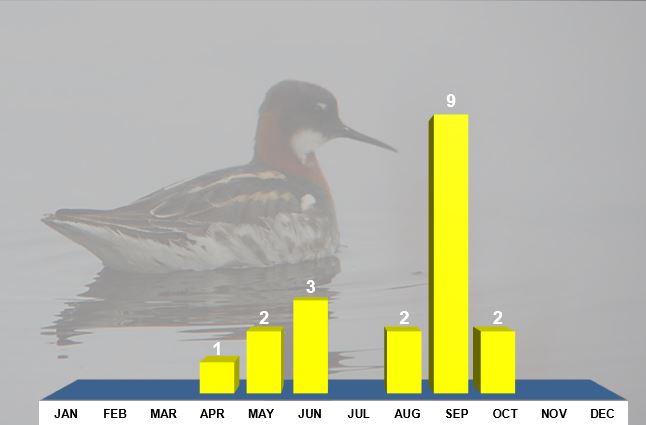
The last was in 2010 and the one prior to that was in 2002. The majority of the previous records have been of autumn juveniles – only six adults have appeared in spring with 50% of these in June.

Red-necked Phalaropes, Northamptonshire, all records. Background image, female Red-necked Phalarope, Norway, June 2015 (Mike Alibone)
Female Red-necked Phalarope, Stanwick GP, 4th June 2016 (Bob Bullock)

Spring birds are normally one-day wonders while those in autumn usually stay a day or two. Eight of the previous 19 have been at Pitsford Reservoir.

The Week in Focus 28th May to 3rd June 2016

Cool, unseasonal weather continued throughout a week which was dominated by often strong north-easterlies, depressing temperatures, birds and birders alike. With migration all but dried up there were slim pickings – assuming anyone was out looking, of course. In this respect, on the occasions I visited Summer Leys it was devoid of weekend birders. With hides creaking and shutters banging in the wind, the only things missing were the tumbleweeds. While the end of May can deliver exceptional rarities, this year there was none – the hallowed 29th (Sooty Tern 1980, Bridled Tern 1993) passing without incident.

The injured Ruddy Shelduck had little choice but to remain at Pitsford Res, where it was present in the vicinity of the sailing club. One of the two which probably originated from the feral population on continent and overshot the established Dutch summer moulting grounds, it is unlikely ever to make it back. Aside from this, Stanwick’s drake Garganey, still present on the A45 Lay-by Pit on 29th, was the sole representative of scarce wildfowl during the period.

Video Caption

Two Ospreys were seen on 2nd – one flying over Pitsford dam toward Holcot, the other over Earls Barton GP toward Great Doddington. This week’s Peregrines were one at Earls Barton GP on 29th, two there on 2nd and one over Broadholme STW at Ditchford GP on 31st while, sadly, last week’s escaped male Barbary Falcon x Gyrfalcon hybrid was found dead at Felmersham in Bedfordshire.

Osprey and Peregrine, Earls Barton GP, 2nd June 2016 (Alan Coles)

Numbers of passage waders were understandably low with, aside from local breeders, just one Dunlin at Summer Leys on 29th, four Redshanks flying east over Stanford Res on 2nd and a Common Sandpiper at Ditchford GP on 29th-30th.

On the passerine front, the exciting discovery of three singing male Firecrests was made at an undisclosed locality on 28th and the singing male Common Redstart remained in Badby Wood on the same date.

Stumping up the cash: a barrier to birding at Pitsford?

It was never the intention that Northantsbirds should become a platform for protest but this is the first of two pieces I intend to write in this vein. I am not a seasoned campaigner, nor have I really jumped on the ornithopolitical bandwagon from which a number of birders appear to have launched their own personal crusades. But when changes are made which have an impact on the way we bird locally then I feel I can’t just sit back without comment.

I have been birding at Pitsford Reservoir – or to call it by its more recent, public-popular name, Pitsford Water – since I was a young lad in the late 1960s. Hardly a week goes by when I don’t visit. I do sometimes walk round and I’ve also used the cycle track on several occasions, although the majority of my visits take the form of a quick drop in at the dam end or a stopover on the causeway on my way to, or from, a work-related destination. I have been doing this for many years and it’s a great way to quickly see what migrants are around when I’m too short of time to take a longer walk round and engage in some more leisurely birding.

The causeway is (was) also a great place to park up and sit in wet and windy weather, providing views across the water during howling gales and lashing rain, conditions which have delivered many a seabird along with the other, more common species which pass through.

Great surprise and considerable annoyance ensued, therefore, when I was forwarded at the end of last week an email from a somewhat dismayed birder who, while travelling across the causeway, had witnessed a workman closing off the roadside car park opposite the entrance to the Anglian Water car park by installing yet more wooden stumps. Along with this email I have received further snippets of related information from others who share in this dismay – although I will not name them here without permission.
 
Stump1 

This is clearly being done in order to prevent vehicle owners and drivers from parking legitimately without charge, as I suspect AW are losing a considerable amount of potential revenue from runners, cyclists, dog-walkers and, of course, birders who use the parking bays at either end of the causeway. As I write, the pull-in at the Holcot end is in the process of being ‘stumped’ and will no doubt become fully closed off when work resumes immediately after today’s bank holiday.
 
Stump2 

If we ask why this is being done, then I’ve no doubt the authority will play the H&S card on the back of the over-the-top health and safety epidemic which has been sweeping this country over recent years. But there has been no issue over the last 60-plus years. Granted the bays are a little worn and uneven and may need resurfacing at some point but come on …

If AW are so keen to increase their revenue, then why not install pay and display parking meters in the pull-ins (although the meter in the main car park could cover the one at the Brixworth end) and operate the meters on a timed tariff so that if people want to stop for just fifteen minutes then they pay accordingly and not the full whack that AW are currently charging.

Unless this ridiculous decision to stump off the bays is reversed then it will truly be the end of an era for birding at Pitsford – so, come on AW, let’s have a sensible approach to this. And, while you’re at it, why not show your green credentials and grant free parking for Wildlife Trust members – or is that asking too much … ?