Mealy Redpolls at Summer Leys

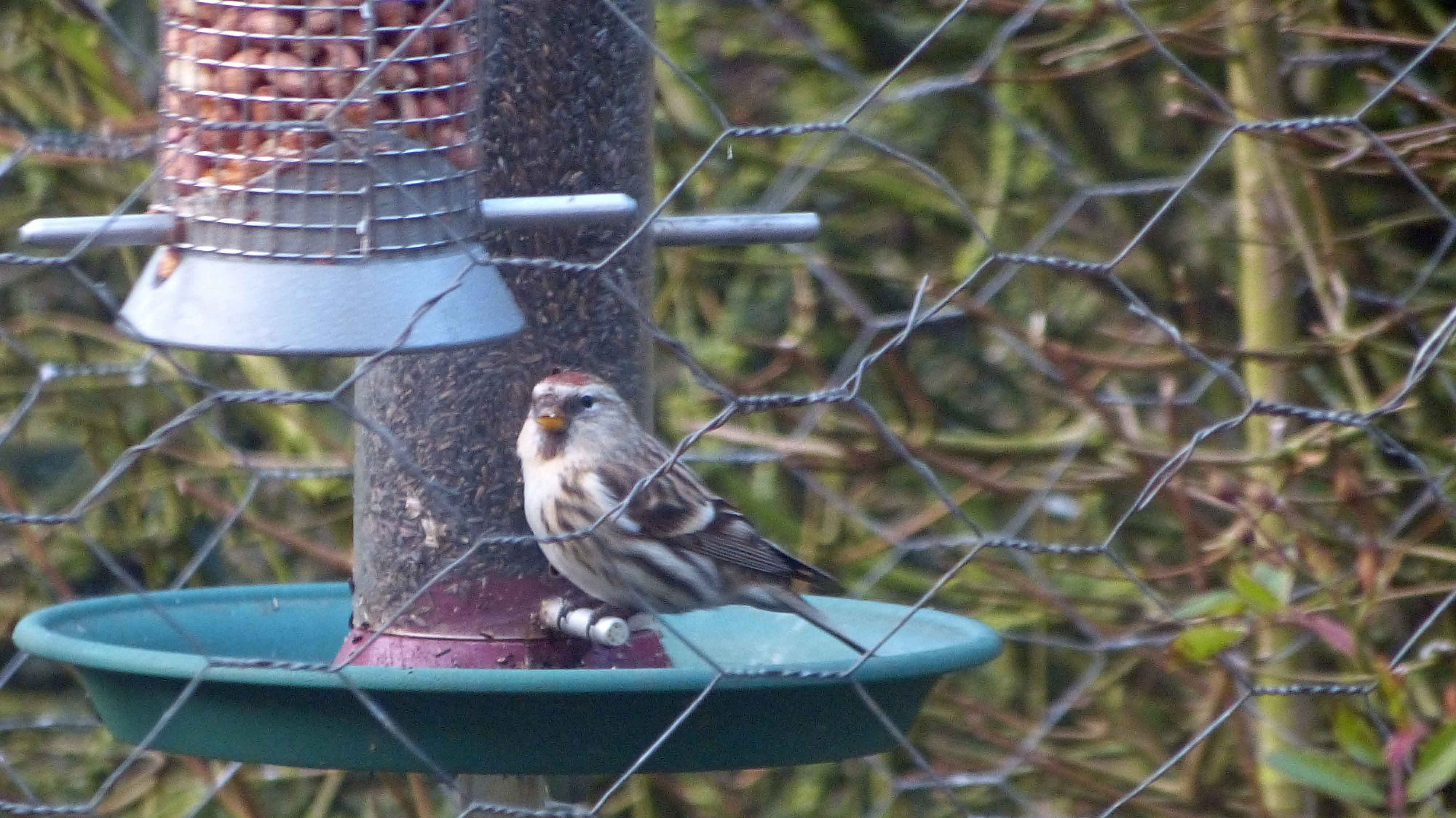
Earlier this week, Doug Goddard captured images of two Mealy Redpolls feeding on seed heads close to Mary’s Lake, adjacent to Summer Leys LNR. This species can often be tricky to identify as both Lesser and Mealy Redpolls can vary considerably in appearance according to age, sex, moult and feather wear, with some practically defying identification altogether. Most Mealies first attract attention as a result of their being rather pallid and colder toned compared to Lesser Redpoll but this isn’t always the case as some Mealies can be quite dark while, conversely, some Lessers can also take on a rather bright and cold-toned appearance.

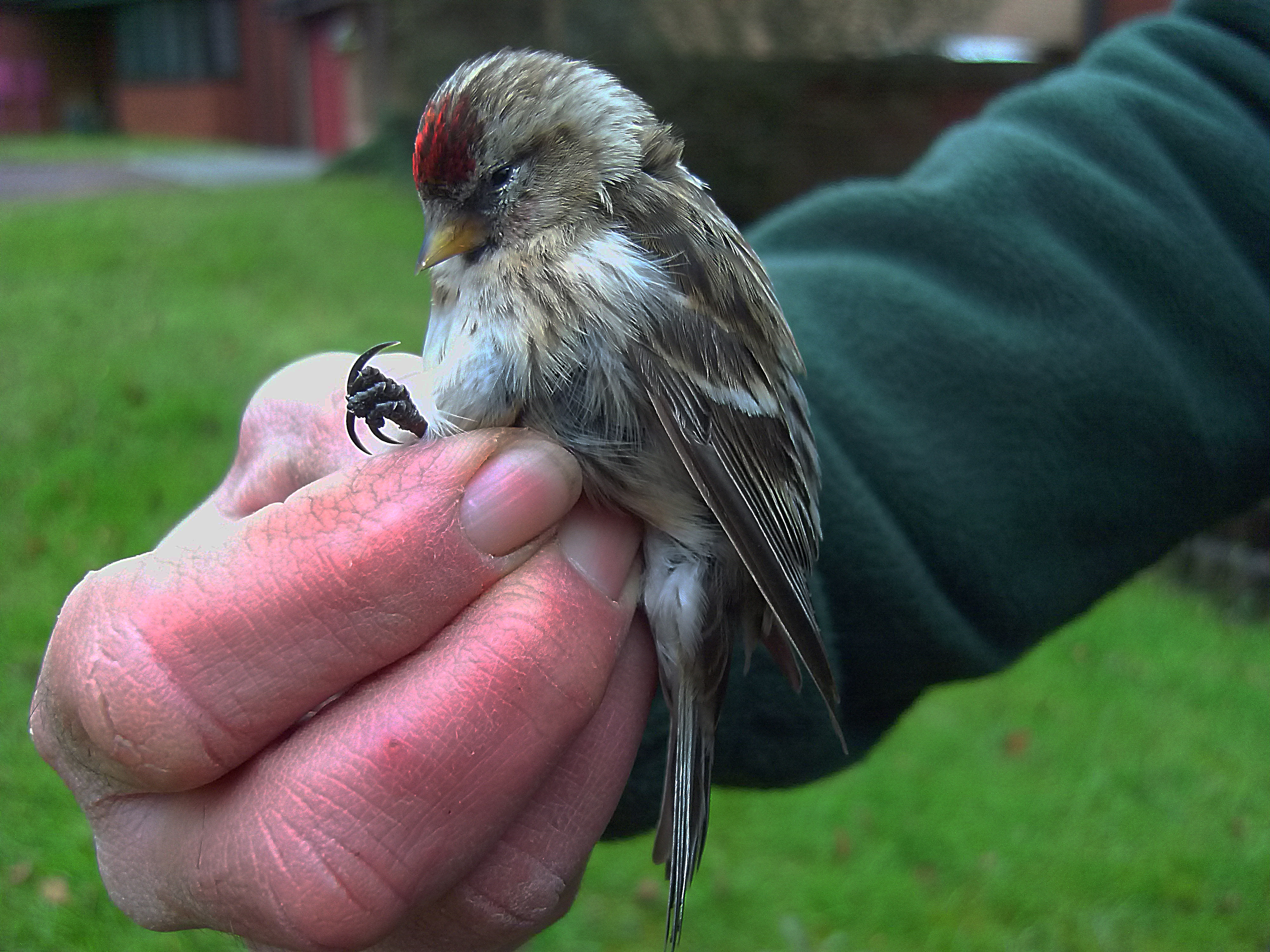
First-winter Mealy Redpoll, Summer Leys LNR, 5th November 2012 (Douglas Goddard)

Good views of a suite or ‘checklist’ of characteristics is normally required before a safe identification can be made. This individual appears to tick all the boxes: wholly white ground colour to under parts (no sign of Lesser’s strong buffish wash to flanks and breast sides); broad white (not buff) supercilium; large white spot below eye and whitish ear-coverts with darker streaking; white ‘tramlines’ on mantle (although Lesser can show these); strong white (not buff) tips to the greater coverts, median coverts, tertials and primaries. The tips to the outer couple of greater coverts are buffish, indicating unmoulted juvenile feathers indicating it is a first-winter and this is further supported by patchy/restricted amount of black on the throat and around the bill base which will become more extensive with feather wear. Compare the above with a typical Lesser Redpoll, also at Summer Leys.

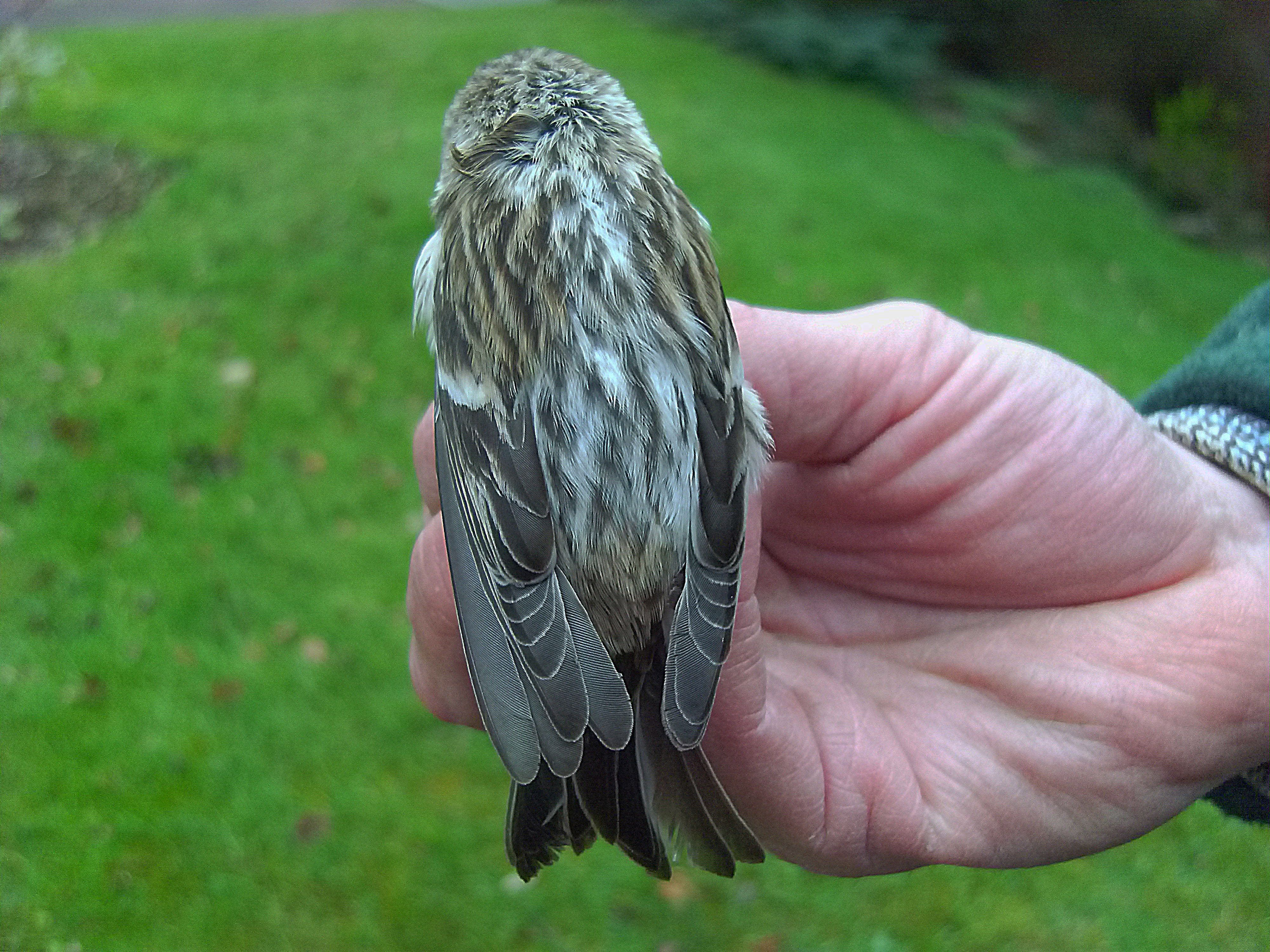
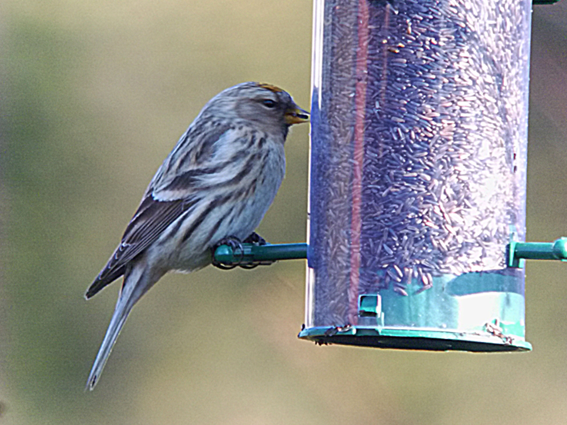
Lesser Redpoll, Summer Leys LNR, 6th November 2012 (Douglas Goddard)

First-winter Lesser Redpoll never shows such clean white wing bars so early in the autumn (i.e. before wear). The red ‘poll’ of the Mealy is also rather pale, almost orange, which is a characteristic frequently shown by first-winter and female redpolls but ‘poll’ colour can vary greatly across the board, even becoming yellow in some instances (see here).

Finally, here’s the other redpoll which was accompanying the above Mealy.

Mealy Redpoll, Summer Leys LNR, 5th November 2012 (Douglas Goddard)

Again, this appears to be another Mealy Redpoll and gives the impression of being large, long and big-billed – which they are …

For more on redpoll identification see Andy Warr’s excellent online guide.

Black-throated Diver at Stanford Reservoir

Late yesterday morning Mark Piper discovered a juvenile Black-throated Diver at the feeder stream end of Stanford Reservoir. It remained quite elusive, diving for long periods of time until it was flushed by a fisherman at 11.35 after which it flew off at tree-top height toward the dam. Subsequent searching failed to relocate it. This morning it was present again close to the Leicestershire side of the reservoir, where Chris Hubbard took the photo below.

Black-throated Diver, Stanford Res, 3rd November 2012 (Chris Hubbard)

It then moved again to the small feeder pool on the opposite side of the road to the reservoir before flying again to the main body of water, remaining in the vicinity of the raft during the early-mid afternoon.

Black-throated Diver, Stanford Res, 03 November 2012 (Chris Hubbard)

The white flank patch, visible just above the water, rules out Great Northern Diver (as does the relatively narrow bill, absence of both neck patches and bulging forehead) and vagrant Pacific Diver (as does the large bill and absence of chin strap or vent strap).

Black-throated Diver, Stanford Res, 3rd November 2012 (Paul Riddle)

This is only the nineteenth record for Northants, the last being one at Thrapston GP on 18th November 2001. Ten of the previous eighteen have been at Pitsford Reservoir. It is also the 40th for Leicestershire/Rutland, with most between November and February and 60% of records from Rutland Water, since it was constructed, (Steve Lister in litt).

Boddington bags Bonaparte’s!

I was driving through Newnham, already on my way to the gull roost at Boddington Reservoir, when Gary Pullan – god bless him – phoned me with a message of just two words: “It’s here!” he said. Having visited the site twice yesterday and spent the last two hours of daylight shivering in the falling temperatures without it showing, it was comforting to know the adult Bonaparte’s Gull was there and on view.

While Gary continued to spread the word I stepped up a gear, unashamedly broke the speed limit, and arrived shortly afterward to find just a handful of birders watching it. It was with about two hundred Black-headed Gulls. A cracking little gull (or should I say small gull), the proportions of which can be appreciated when compared with the accompanying Black-headed Gulls, numbers of which had built to well over 1000 by dusk.

Adult Bonaparte’s Gull, Boddington Res, 3rd November 2012 (RW Bullock)

It spent most of its time at rest, flying only a short distance on a couple of occasions. It may be something or nothing but most of the time it held its bill in a horizontal, or slightly raised, position compared to the Black-headed Gulls, which (most of the time) held their bills pointing down, below the horizontal. I don’t know if this might be a useful way of picking it out among Black-headed Gulls at a large gathering such as the Boddington roost – this needs testing.

Adult Bonaparte’s Gull , Boddington Res, 3rd November 2012 (RW Bullock)

There are about 180 records of this North American species for the UK but they are rare inland and this is the first for Northamptonshire, although the neighbouring counties of Warwickshire and Oxfordshire have had two and three records respectively. Well done Gary for finding it on Thursday and thanks are due to Bob Bullock for the accompanying images – which are better than my digiscoped stills – but I did manage to get the videoscope footage below.

What the … ??!!! The answer.

Referring to What the … !!!?? posted on 29th October. When I first saw the image below I was initially intrigued. It looked kind of familiar, of course, but the pink upper breast and light streaking reminded me of Linnet, which it clearly wasn’t.

The second image – the one in the original post – depicted a largely brownish finch with yellow outer edges to the primaries. It was now looking distinctly Greenfinch-like but it still had a pinkish breast and, although the bill looked large, was it really as large as that of a Greenfinch? My initial thinking was that it could be a Linnet x Greenfinch hybrid but the final image, sent subsequently by the photographer, poured cold water on everything: yellow in the outer tail and on the rump made this a Greenfinch beyond any shadow of a doubt and you would have identified the bird as such from this one photograph alone. But what about the abnormally coloured breast? It could be pigmentation but closer scrutiny shows a diffuse and uneven distribution of pink on the breast, which suggests that this has been acquired by feeding on fruit of some kind, possibly blackberries as suggested by Bob Bullock, whose analysis appears to be spot-on. Take away the pink breast colouration and the bird is a typical female Greenfinch, possibly a first-winter, and it was photographed in Walgrave by Pete Gilbert on 28th October 2012. Thanks to everyone who commented on the original post. This was just a bit of fun but it just goes to show how one anomalous feature, combined with restricted views, can conspire to fire the imagination in any number of different ways!

Firecrest sets dull Tuesday ablaze!

A Firecrest is guaranteed to brighten the most dismal of days and the dank, drizzly conditions of Tuesday, 23rd October was one such miserable day in an extended period of late autumn gloom. Happily for Mick Townsend of the Stanford Ringing Group, this cracking little sprite found its way into one of the SRG’s nets from which Mick extracted it before ringing it and taking the below photographs yesterday morning. This is the only Firecrest to have been found in Northants this year. In a standard year there are, on average, 1-2 records (13 in the last 10 years) with the highest likelihood of a chance encounter with one in January or November.                                                                           The obviously spiky tips to the tail feathers suggest this is a first-year. Many thanks to Mick for his images.

Under the spotlight: the Pitsford ‘Caspian Gull’

Hanging out on boats, buoys and just about anything which provides a suitable loafing site, since late August a fourth-winter large, white-headed gull has been almost resident at Pitsford Reservoir’s yacht club. Identified by some as a Caspian Gull, it exhibits a suite of features which are not fully consistent with that species and which hint strongly at mixed parentage. It can be safely aged as a fourth-winter as it closely resembles an adult but it has retained extensive black in the primary coverts and alula while the rather liberally ‘messy’ appearance of the bill, with a yellow tip divided from a pale, washed out base by a diffuse, dark subterminal band, is also a pointer to its not being fully mature.

Presumed Caspian Gull hybrid, Pitsford Res, October 2012 (Mike Alibone)

Pro-Caspian features exhibited by this individual include the rather elongated body with a high-chested appearance and attenuated, sloping rear end, long, thinnish legs, largely white head (although there is a dark ‘eyebrow’ with some fine streaking on the ear coverts) with a restricted shawl of dark streaks on the hind neck, ‘Common Gull grey’ mantle and a washed out, green-tinged, yellow bill.

Conversely, anti-Caspian features are the absence of a long white tip to the upperside of the 10th primary (instead P10 has a very small white tip), absence of a long white tongue on the underside of P10 (where there is a single mirror set into an otherwise black distal end to the primary), broad – as opposed to fine – rear neck streaks, a rather deep, powerful-looking bill with a strong gonydeal angle and a sharply-angled and hooked culmen, a pronounced pale straw-coloured iris and a relatively large, ‘full’ head, lacking Caspian’s long, sloping forehead and ‘snouty’ appearance.

While pale eyes do not rule out Caspian Gull (a minority exhibit pale irises) and variation in wing tip pattern can be considerable, bill structure, head shape and jizz normally remain consistent and combine to lend a more ‘gentle’ appearance far removed from what we are seeing here. This individual appears to have a head shape, bill structure and a general ‘mean’ character much closer to Herring Gull or Yellow-legged Gull than to Caspian Gull.

Presumed Caspian Gull hybrid, Pitsford Reservoir, October 2012 (Mike Alibone). From a distance. The image on the left was obtained in overcast conditions, the others in sunlight, accounting for the apparent difference in mantle colour. The long legs are clearly evident, particularly in the middle photograph.

However, the wing tip pattern is very similar to a known 4th year male Caspian Gull from Poland (see here) although the Pitsford individual has larger white primary tips. Interestingly, in threatening behaviour toward other gulls, this bird calls with its wings partly open, the bill pointing down initially before raising it to 45 degrees as it delivers a very convincing Caspian-like laughing call and posture.

Presumed Caspian Gull hybrid, Pitsford Reservoir, October 2012 (Mike Alibone) showing primary pattern.

It is easy to speculate but difficult to draw any firm conclusions but I would guess this individual comes from the East European hybrid zone where mixed pairs of Caspian Gulls and Herring Gulls of the ‘Scandinavian’ race argentatus are known to occur. Hybrid Caspian Gull x Herring Gull from this zone has occurred in the UK before see, for example, here .  However, it can also appear quite square-headed and sometimes takes on the appearance of Yellow-legged Gull, although structure and jizz are not quite right for that species. It is an interesting individual but it is certainly not a pure Caspian Gull. Watch the video below. What do you think? Comments welcomed.

From the long grass … Richard’s Pipit at Borough Hill

I received a text from Gary Pullan, late this morning, advising that Mark Spirito had just seen a large pipit with a ‘sparrow-like call’ to the right of the concrete track, which runs north-south along the top of Borough Hill. With Richard’s mooted in the text I sent a few texts and put the news out via Twitter before setting off to see if I could locate it, phoning Mark on the way in order to get further details. Although he was no longer on site, he subsequently advised that he had picked it up in flight after hearing a distinctive, though unfamiliar, call and that the bird had landed at the golf course end of the hill where, after another brief flight view, he had been unable to relocate it.

Upon arrival at Borough Hill I joined Chris Coe and Allan Maybury who were already on the concrete track. After a briefly watching a nearby Stonechat, we decided to split up to make a sweep of the general area. With Borough Hill summit currently ungrazed and overgrown the going was not easy underfoot. We covered the area to the right of the track as well as to the immediate left of the track, right down to the golf course perimeter fence and then back again to the compound. Chris and Allan departed and I was about to do the same when Mark phoned to say he had listened to online examples of the call of Richard’s Pipit and he was now confident that the Borough Hill pipit was a Richard’s Pipit.

I changed my mind about leaving and decided to have another go at trying to relocate the bird, this time concentrating well to the left of the track. After a while I reached the hedge which crosses the hill before the golf course, having put up a few Skylarks and Meadow Pipits on the way. I was about to turn back when a large pipit came up from the grass about 25 metres away and, remaining silent, it flew little more than 100 metres to alight in full view on top of the hedge which runs alongside the western perimeter track.

Brief ‘scope views revealed a lanky, large-billed, long-legged, long-tailed pipit which exhibited all the usual features of Richard’s. It was looking good! Viewing was rapidly curtailed, however, by two passing dog-walkers who flushed the bird over the hedge and I watched as it disappeared out of site. Quickly crossing to the hedge I entered the area beyond it via a small stile and unintentionally flushed the bird from the top of a low bush nearby. Fortunately if flew no more than 50 metres, uttering a single rasping “schreeep” as it did so. It was indeed a Richard’s Pipit! It pitched down in a rough area close to an Oak tree and I made no further attempt to pursue it.

I made a few phone calls before being rejoined on site by Chris Coe, who was just in time to see the bird as it broke cover, calling, having been flushed by another dog-walker. Unfortunately this is an occupational hazard at this site which is popular with other members of the public! The Richard’s Pipit flew back toward the main hill summit but it remained in the general area where it was seen again by several other birders, including Dave James and Graham Martin, until at least 15.45, when it was seen flying toward the main car park.

This is only the 8th County record, the previous records were in 1883 (2), 1966, 1968, 1994 (2) and 1995 – the latter having also been at Borough Hill on 10th October.

Full marks to Mark Spirito for finding this bird! An excellent county record! If anyone is able to obtain any photographs I would be pleased to receive them … but it is always going to be difficult in the long, long grass of Borough Hill.

Header image: Richard’s Pipit, India (JM Garg) Wikimedia Commons

The Pitsford Black-necked Grebe

This Black-necked Grebe has been present at Pitsford Reservoir since I first found it on 14th September. Black-necked Grebe has been thin on the ground in Northants this year and it’s only the second one to be discovered in the County in 2012. I took some rather poor video footage today while the bird was off the dam. My attempts at videoscoping can only get better … 🙂