Latest Reports: email and text alerts

Some important news concerning the receipt of email and text alerts from Northantsbirds has emerged today. For those using ifttt.com as a conduit for receiving news from Twitter by email or SMS this organisation has announced that, from 27th September 2012, it will no longer offer this service as a result of Twitter policy changes that will affect how applications can interact with Twitter’s data. As a result of these changes, ifttt.com will be removing all Twitter ‘triggers’, disabling the ability to receive tweets by email and SMS. In short, anyone who has elected to use this service, by creating ‘recipes’ using the #Northantsbirds hashtag, will no longer be able to receive latest reports from Northantsbirds by this method.

This does not affect anyone who is receiving text alerts direct from Twitter (i.e. not via ifttt.com). So, from 27th September, the only method of receiving immediate Northantsbirds news will be by SMS text alert, directly from Twitter, to a mobile phone – and this can’t be a bad thing! To receive these alerts simply follow @bonxie on Twitter, register your mobile phone details on your Twitter account and then select ‘turn on mobile communications’ from the dropdown menu next to the ‘following’ button on the @bonxie profile page.

For those interested, a full explanation of ifttt.com’s changes to the way it will be operating with regard to Twitter can be found at tinyurl.com/bn4resq 

The Daventry ‘Blue-winged Teal’

The discovery of a female Blue-winged Teal at Daventry Country Park yesterday morning looked set to initiate a local twitch as well as attracting more birders from further afield. Initially located at the south-eastern end of the reservoir it eventually moved toward the dam, where it remained for the rest of the day, favouring the small Lovell’s Bay directly opposite the ranger’s office.

With the arrival of more birders, however, it became apparent that some observers were not entirely convinced that this individual was, in fact, a ‘pure’ Blue-winged Teal. With the bird showing well – at times down to around fifty metres – a feather-by-feather analysis was soon being undertaken as this individual’s parentage was thrown into question.

Blue-winged Teal ‘with presumed Shoveler genes’, Daventry CP, 17th September 2012 (Allan Maybury)

The feature which cast the most doubt on the birds ‘purity’ was the structure of the bill. It appeared too long and too broad and spatulate for a Blue-winged Teal, recalling that of a Shoveler, a species with which Blue-winged Teal is known to occasionally hybridise.

Blue-winged Teal ‘with presumed Shoveler genes’, Daventry CP, 17th September 2012 (RW Bullock)

Suddenly the ‘H’ word was being bandied about and a number of birders formed the opinion that this bird must, therefore, be a Blue-winged Teal x Shoveler hybrid.

Blue-winged Teal ‘with presumed Shoveler genes’, Daventry CP, 17th September 2012 (RW Bullock)

This speculation was further fuelled by other features which were believed to be anomalous, i.e. a dull yellowish base to the underside of the lower mandible and, just visible (when blown up) in the photographs above, some yellow/ochre pigmentation at the base of the upper mandible. The legs and feet, too, were thought to be a shade too ‘orangey’ for Blue-winged Teal. Apart from these apparent bare part anomalies, however, there was nothing else radically wrong with the bird.

It appeared to be an adult (juveniles/first-winters have dull, greyish legs) and the thin white border behind the blue coverts, along with the dull green/blackish speculum, indicated it was a female. The remainder of the plumage (loral spot intensity, supercilium and eyestripe extent and prominence) and the dark iris colour were spot-on for Blue-winged Teal, as was the overall cold plumage tone, suggesting an absence of Cinnamon Teal genes in this individual.

Blue-winged Teal ‘with presumed Shoveler genes’, Daventry CP, 17th September 2012 (RW Bullock)

I trawled through a number of  images on the internet and found some which were good matches for leg colour (it is nowhere near as orange as that of a Shoveler – see the video below for comparison) and it would appear that, according to BWP, the bill colour is not ‘wrong’ for Blue-winged Teal at all. So, is it really a hybrid or is it conceivably a Blue-winged Teal with an abnormally large bill? Did some Shoveler genes get in there somewhere a few generations back? It surely cannot be a first-generation hybrid with so few Shoveler-type characteristics evident. The internet search also revealed a variation in bill size (drake Blue-winged Teals are known to have larger bills than females) although, admittedly, nothing quite as large as the bill on the Daventry bird … Images of a presumed Blue-winged Teal x Shoveler hybrid can be found here while a gallery of pure Blue-winged Teal images can be viewed here. When I was watching the bird in the early evening it was feeding constantly, either alone or with one or two Shovelers. Both the teal and the Shovelers engaged in a ‘hostile pumping’ display when they got too close to each other, i.e. a feeding territorial display (see video), which is said to be common behaviour among ‘blue-winged’ ducks. Despite rumours to the contrary it was fully-winged as is illustrated in the accompanying images.

VIDEO Blue-winged Teal ‘with presumed Shoveler genes’, Daventry CP, 17th September 2012 (Mike Alibone) 

This very interesting and instructive individual is worth seeing if you get the chance.

It is also worth pointing out that Blue-winged Teal remains a true rarity in Northants with three records comprising an adult drake at Ditchford GP on 13th April 1979, a female or eclipse drake at Thrapston GP from 25th August to 14th September 1985 and an adult drake at Earls Barton GP from 25th February until 1st March 2001.

Many thanks to Bob Bullock and Allan Maybury for supplying the stills used to accompany this post.

Phylloscopy

This morning I spent some time at Stanford Reservoir with the Stanford Ringing Group. With summer all but over, the number of birds trapped was relatively low with 48 new birds of 13 species ringed (25% of which were Swallows) and 18 retraps of 11 species.

When not singing or calling, two of these species, Chiffchaff and Willow Warbler, present perennial ID difficulties for many birders in the field but not, of course, in the hand where biometrics and key features not obviously visible to field observers make separation easy. However, one of these features – namely wing structure – can be used in the field, if the bird stays still long enough for it to be assessed! Willow Warbler has longer wings than Chiffchaff, which is illustrated well in the below set of photos of two of the individuals trapped at Stanford this morning.

Wing comparison Willow Warbler (left) and Chiffchaff, Stanford Res, 1st September 2012 (Mike Alibone)


These two photos show the diagnostic emarginated 6th primary of Chiffchaff and its absence in Willow Warbler – not visible in the field, of course – but in the image of Chiffchaff the short first primary is tucked away and not visible and the second primary is barely visible behind P3.

Willow Warbler (left) and Chiffchaff folded wing structure, Stanford Res, 1st September 2012 (Mike Alibone)

The above two show the difference in length of primary projection: in the Chiffchaff it is little more than half the length of the visible tertials while Willow Warbler has a much longer primary projection – often the same length as the tertials and at least three quarters the length in the shortest instance (click on image to enlarge).

Now have a go and apply this to the bird below, recently photographed by Doug McFarlane in Moulton.  See here for the correct answer!
The final image is a bright juvenile Willow Warbler which, with its vivid yellow upper breast and whitish belly, is a pitfall for the unwary, sometimes accounting for erroneous reports of Wood Warblers in autumn …

Juvenile Willow Warbler, Stanford Res, 1st September 2012 (Mike Alibone)

Many thanks to John, Mick, Adam and Dawn for putting up with me and allowing me to photograph ‘their’ birds at Stanford this morning!

Black-necked Grebe: postscript

Ha! Having said the Clifford Hill Black-necked Grebe looks like it might be a moulting adult, I had closer views in better light late this afternoon and clearly I was wrong. It’s a juvenile with a considerable brown suffusion to the upperparts and neck, the latter with a faded, almost broken front. Just goes to show that photographs can be deceptive with regard to assessing true colour tones and extent!

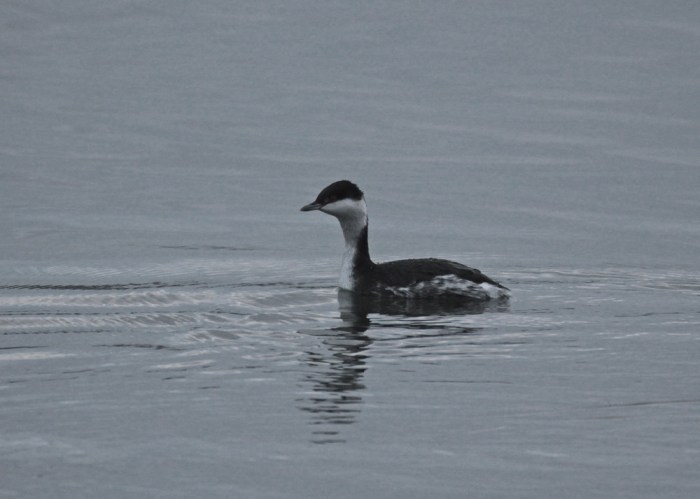
Black-necked Grebe

Last Friday evening, Dave James and I found a Black-necked Grebe on the main barrage lake at Clifford Hill Gravel Pits and it is still present there today. This appears to be the only one to have been recorded in the County so far this year. We can normally expect up to half a dozen records annually, with Scaldwell Bay at Pitsford Reservoir being the place to find one as, in recent years, it has consistently produced one or two from late August into September.

Black-necked Grebe, Clifford Hill GP, 19th August 2012 (Jonathan Philpot)

The solid black crown and intensively dark fore-neck suggest this one is an adult in moult to winter plumage. Compare this with the full summer plumaged adult at Pitsford last August. Thanks are due to Jonathan Philpot, who appears to have managed a much closer approach to obtain images than I have been able to!

Turning turtle?

The decline of the Turtle Dove as a summer visitor to Britain has been well documented and it is believed to be at real risk of disappearing as a breeding species here within the decade. This is mirrored in Northamptonshire, where it has been recorded at only eight sites this year compared with thirty-six just ten years ago. Many of the records refer only to migrants and falling squarely into this category is this one at Stortons Gravel Pits yesterday morning.

Adult Turtle Dove, Stortons GP, 20th August 2012 (Douglas McFarlane)

Doug McFarlane managed to capture a few images before it was flushed by a dog-walker and not subsequently relocated. This individual is a smart adult. Let’s hope they don’t ‘turn turtle’ and disappear as a breeding bird altogether. For the latest news see www.operationturtledove.org 

Two-harrier day

While some of us were sweltering under canvas at Birdfair others were out in the field, finding good birds. Harrington Airfield was clearly the place to be as, at 08.30, Neil Underwood had a Marsh Harrier between the concrete track and the conifer belt. We’ve now had several in the County this autumn and no doubt there will be more to come. Later in the day, at around 17.15, however, Jonathan Philpot was lucky enough to discover a ‘ringtail’ Hen Harrier hunting over the fields between the concrete track and the first bunker.

Hen Harrier, Harrington AF, 18th August 2012 (Jonathan Philpot)

Despite the rather pale underparts, lacking ochre tones, and the reasonably well-marked secondaries, I’m guessing it is probably a juvenile as its primaries are not strongly barred and, from above the secondaries are solidly dark, the primaries are paler but unbarred and there are pale fringes to the primary and secondary coverts.

Hen Harrier, Harrington AF, 18th August 2012 (Jonathan Philpot)

Whatever its age, it’s a nice bird!

Juvenile Mediterranean Gull

While scanning through the assembled Black-headed Gulls at Summer Leys late this afternoon I came across this smart juvenile Mediterranean Gull.

Juvenile Mediterranean Gull, Summer Leys LNR, 14th August 2012 (Mike Alibone)

It has already begun its moult to first-winter plumage with most of the scapulars and many mantle feathers now light grey but it has not yet developed the dark mask of a full first-winter. In this respect it’s a very distinctive bird compared to the accompanying Black-headed Gulls, lacking the latter’s well defined, isolated dark ear covert spot but already showing white ‘eye-lids’, a much heavier, dark, blunt-ended, slightly drooping bill and dark legs.

Juvenile Mediterranean Gull, Summer Leys LNR, 14th August 2012 (Mike Alibone)

So far this autumn there have been two juveniles at Stanwick GP on 28th July, and singles at Pitsford Res on 1st, 2nd and 12th August. Hopefully we can look forward to more arriving over the next few weeks …

The last Cuckoo: postscript

The last Cuckoo to be recorded in Northants in 2011 was on 26th August at Earls Barton GP – perhaps the individual below, which was photographed there on 14th August. Compare this rufous morph juvenile with yesterday’s grey morph at Crick. The white tips to the scapulars, wing coverts and tertials, along with the barred rump, rule out the rare ‘hepatic’ morph adult female.

Juvenile Cuckoo, Summer Leys LNR, 14th August 2011 (Clive Bowley)

Thanks to Clive Bowley for supplying the image.

The last Cuckoo?

This juvenile Cuckoo was present yesterday and again today at Foxholes Fisheries, near Crick, where it spent some time feeding from a fence post. It is a grey morph individual – many are also rufous, resembling the so called ‘hepatic’ form of adult females – and shows the white nape-spot characteristic of juveniles.

Juvenile Cuckoo, Crick, 10th August 2012 (Joan Chaplin)

According to the BTO, Cuckoos have declined by 63% in England over the past 25 years and the now famous BTO satellite-tracking project has revealed that adult Cuckoos can leave the UK as early as the first week in June and be back in Africa by July. Juveniles are obviously later leaving but you won’t see many around from now on. There is a wide variation in the dates for recording the last ones in Northamptonshire, year on year. The latest record during the history of the Northamptonshire Bird Report (since 1969) was of a very late individual at Kettering on 17th October 1972 in contrast to the last one in 2010, at Earls Barton GP, on 4th July! There appear to be few local photos of Cuckoos and thanks are due to Joan Chaplin for supplying the images above.