This week was largely dry but the winds varied between north-westerly and south-westerly – hardly conducive to migrants from the continent. Lingering ducks and egrets, a continual stream of godwits and news that Northamptonshire’s 11th Night Heron had been present in the county for well over a week, under the dreaded ‘locality withheld’ caveat, did little to lift local spirits.
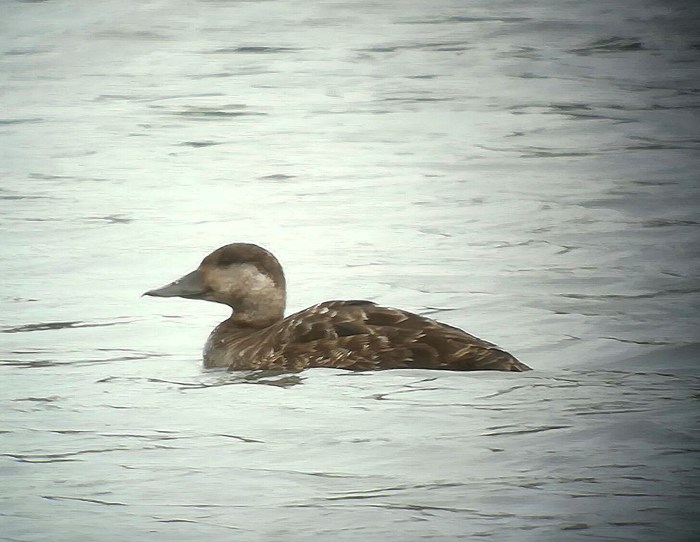
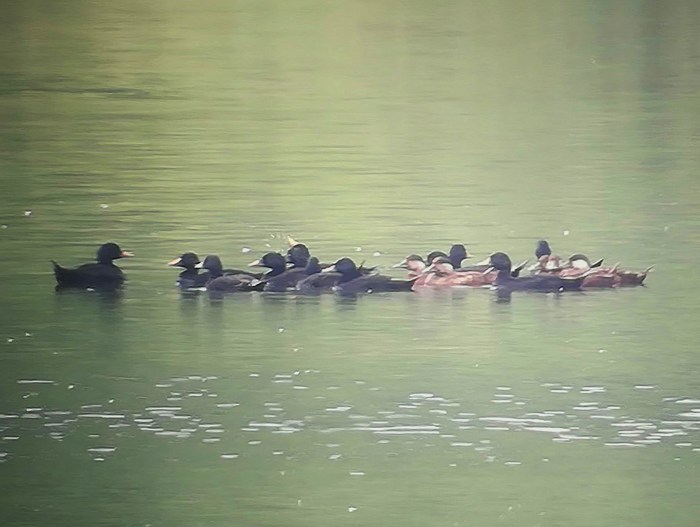
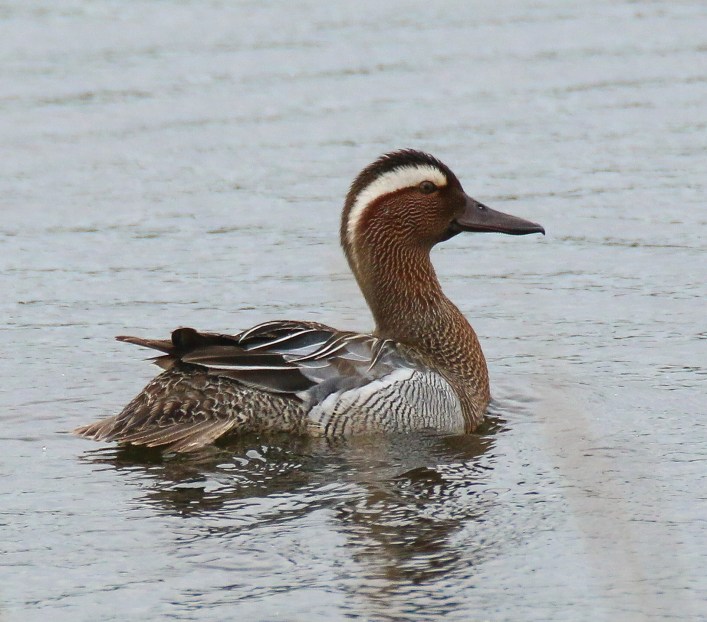
Two Garganeys were again in Scaldwell Bay at Pitsford Res on 12th, while last week’s female Common Scoter remained at Daventry CP until 14th and the escaped, metal-ringed female Bufflehead reappeared at Clifford Hill GP on 13th. A singing male Quail was a bonus for ringers at Harrington AF between 01.30 and 02.00 on 16th. Insomnia clearly has its plus points.
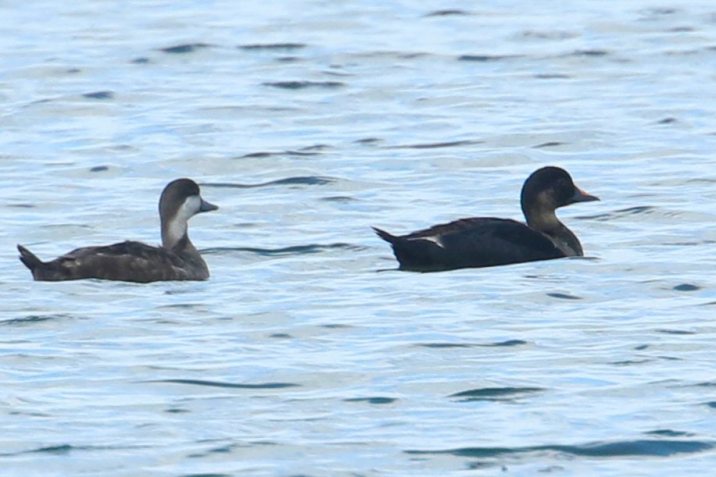
Female Common Scoter, Daventry CP, 14th August 2017 (Gary Pullan)
The shock revelation, this week, that a juvenile Night Heron had been present and photographed in the vicinity of a garden pond in Blisworth, from late July to at least 7th August, will have come as a blow to many. Attempts made to persuade the landowners to ‘let people in’ had apparently failed. Even the promise of flashing the cash reportedly cut no ice. Clearly, then, if you’re lucky enough to have a pond in your garden you don’t need the extra dosh to get by … Oh well, there’s always Great White Egret to fall back on, with the now seemingly settled Pitsford individual – joined by a second until 13th – offering unrestricted viewing all week. Tongue, cheek and all that.
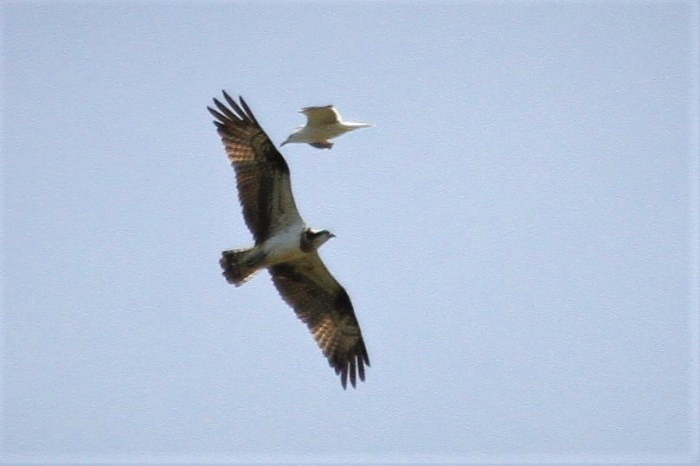
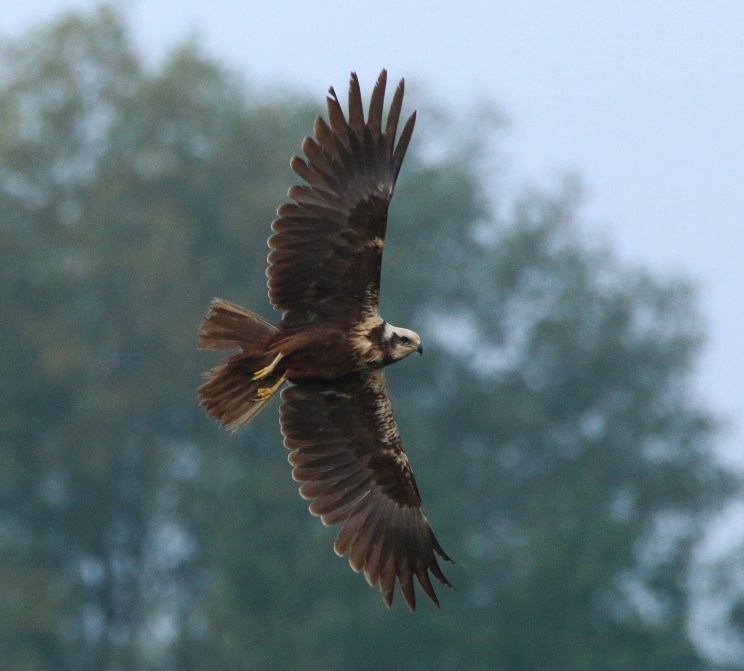
Raptors were rationed during the period, with a juvenile Marsh Harrier flying west over fields north of Great Brington on 18th, an Osprey visiting Hollowell Res on 13th and 14th and one flying high over Pitsford, without stopping, on 16th.
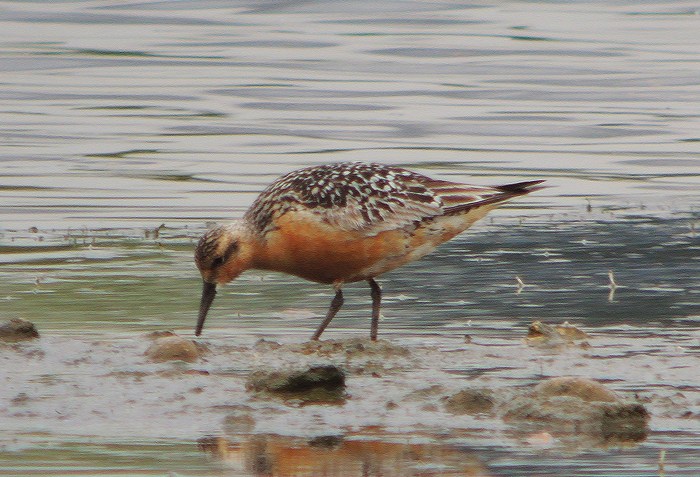
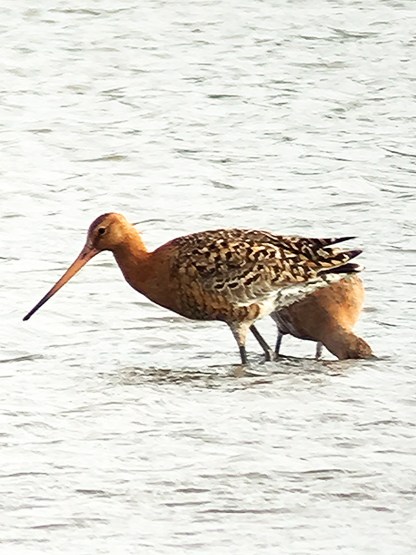
The week’s highest count of Icelandic Black-tailed Godwits was made at Pitsford Res, where twenty-nine arrived on 12th, six were there from 13th to 15th and three until the week’s end. The only other site visited by this species during the period was Stanford Res, where one remained from 13th to 15th and two more appeared on 18th. Hanging on into the new week was Stanwick GP’s adult Knot, still on the Visitor Centre Pit until 12th.
Adult Knot, Stanwick GP, 12th August 2017 (Mike Alibone)Adult Knot, Stanwick GP, 12th August 2017 (Mike Alibone)
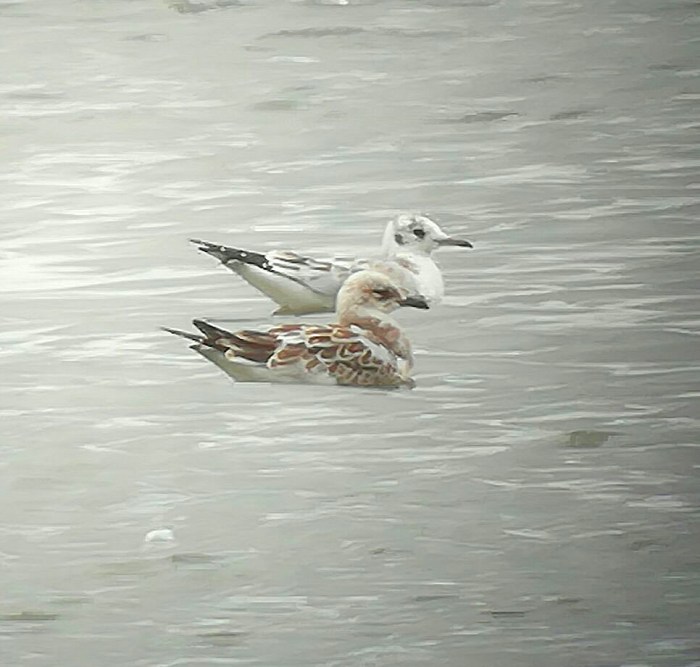
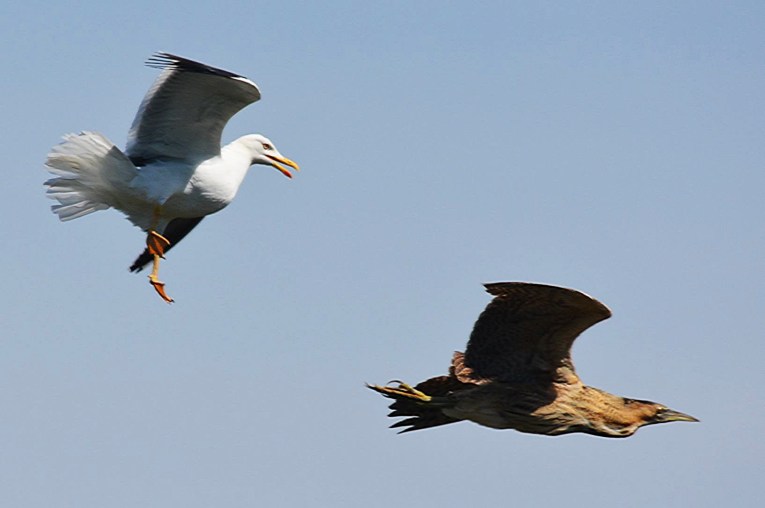
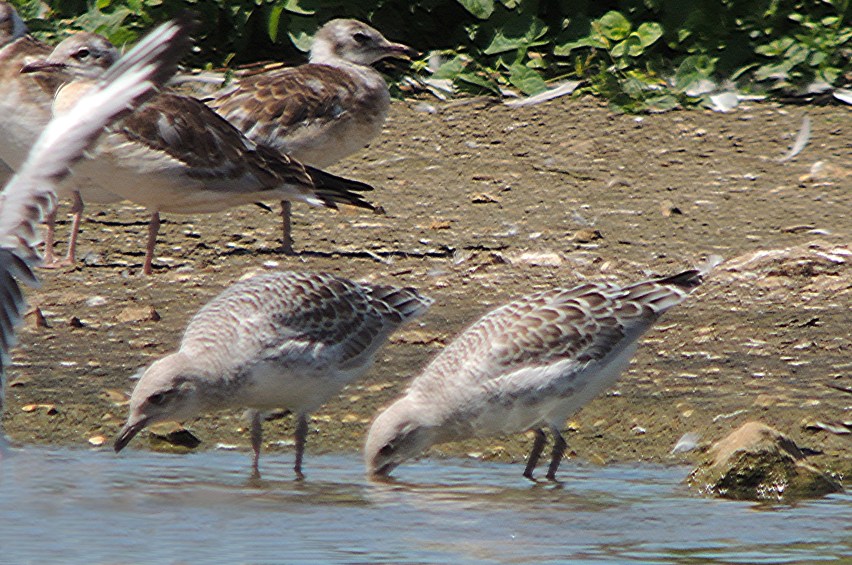
The only Mediterranean Gull was a juvenile at Boddington Res on 12th, similarly the only Caspian Gull was one at Clifford Hill GP the following day, while between one and two Yellow-legged Gulls occurred at Pitsford Bes, Boddington Res, Stanford Res, Daventry CP and Clifford Hill.
Adult female Common Redstart, Stanford Res, 14th August 2017 (Peter N)
Common Redstarts were more in evidence this week, with 13th producing four at Fawsley Park, two at Clifford Hill GP and a female, initially ringed as a nestling at Ripon in Yorkshire in June, controlled at Harrington AF. Another female was trapped and ringed at Stanford Res the following day. A very early juvenile Stonechat was found at Clifford Hill GP on 13th and the same date produced nine migrant Tree Pipits at Harrington AF.
This week’s weather was largely a repetition of last week’s, with Atlantic lows sweeping across the country, although continual heavy rain accompanied more northerly winds on 8th-9th. No coincidence, then, that these two days produced some new and scarce arrivals, some of which lingered … while others didn’t.
Duck of the week was the female Common Scoter, which turned up at Daventry CP during the poor weather of 9th and was still present on 11th, while last week’s Great White Egret remained at Pitsford Res until at least 7th.
Female Common Scoter, Daventry CP, 9th August 2017 (Gary Pullan)
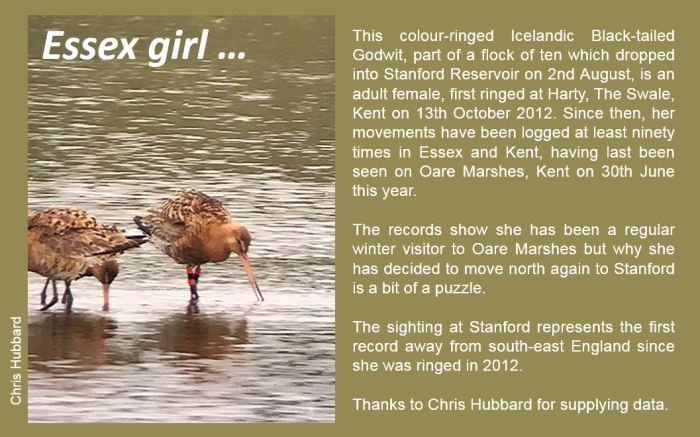
Just one Whimbrel was seen – at Stanwick GP on 9th – in contrast to last week’s double-figure flocks, while Icelandic Black-tailed Godwits continued to appear in reasonable numbers. On 5th there were three at Stanford Res and singles at Pitsford Res, Hollowell Res and Daventry CP, the following day there were five at Pitsford and one at Stanford, the 7th saw sixteen at Stanford and one at Daventry. Stanford also held four on 8th-9th and one thereafter on 10th-11th and one was at Stanwick GP on 9th.
Icelandic Black-tailed Godwits, Stanford Res, 7th August 2017 (Chris Hubbard)
The latter locality also produced an adult Knot, showing well on the Visitor Centre Pit from 8th to 11th, while another autumn Sanderling made landfall at Hollowell Res during the poor weather on 8th. The autumn’s second Wood Sandpiper was found at Stanford on 9th, remaining there until 11th.
Adult Knot, Stanwick GP, 9th August 2017 (Mike Alibone)
Three Arctic Terns flew east at Stanwick GP during the rain on 8th, as did an adult Little Gull and a first-summer Little Gull was discovered on the Visitor Centre Pit there later the same day. The only Mediterranean Gulls this week were single juveniles at Daventry CP on 8th and Boddington Res on 11th, while Daventry produced an adult and a
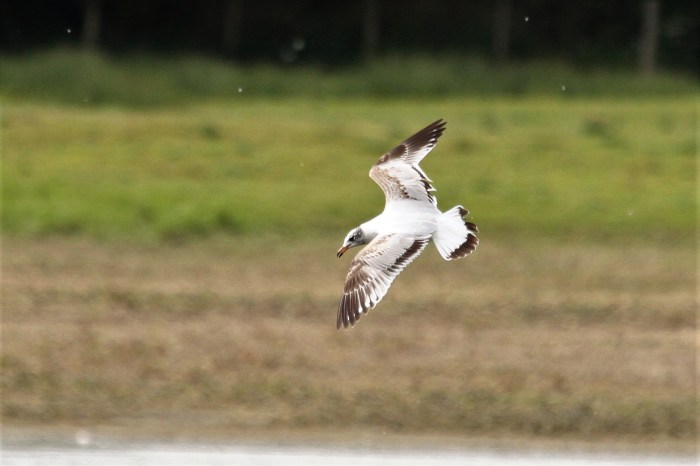
Juvenile Mediterranean Gull, Boddington Res, 11th August 2017 (Gary Pullan)
second-summer Caspian Gull on 5th and a juvenile two days later, on 7th. A third-summer Caspian Gull was also at Stanwick GP on 7th along with at least thirty Yellow-legged Gulls. Between one and four Yellow-legged Gulls were seen at each of Daventry CP, Boddington Res, Hollowell Res and Pitsford Res throughout the week.
Adult Yellow-legged Gull, Pitsford Res, 7th August 2017 (Alan Francis)Juvenile Black Redstart, East Hunsbury, Northampton, 9th August 2017 (Paul Howes)
A juvenile Black Redstart was seen on houses and garage roofs in East Hunsbury (Northampton) on 9th but could not be relocated the following day while a male Common Redstart was discovered in hedgerow at Twywell Hills and Dales on 11th and a Northern Wheatear visited Pitsford Res on 7th.
The unsettled weather continued throughout the week – the product of a series of Atlantic lows which brought largely south-westerly winds and intermittent rain. The month of August got off to a tremendous start from day one, with the discovery of an adult Baird’s Sandpiper – the third for Northants and the first for more than twenty years – at Stanford Reservoir. After this, everything else seemed incidental …
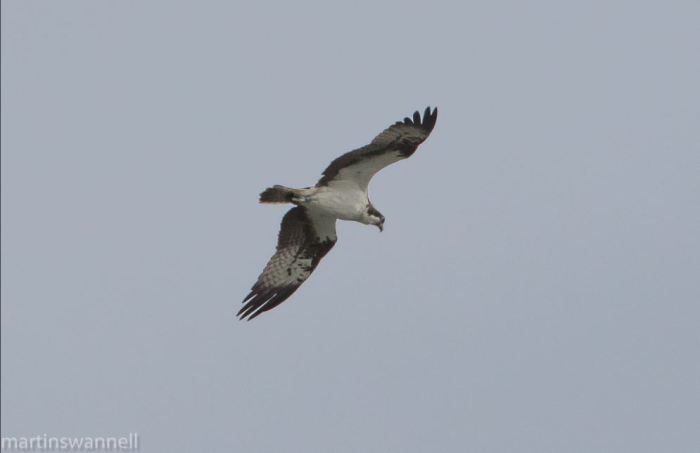
The two juvenile Garganeys at Pitsford Res remained in Scaldwell Bay until at least 1st, while last week’s Great White Egret appeared settled there between 30th and 2nd and an Osprey visited on 1st. Another Osprey, a male, was seen at Hollowell Res on consecutive evenings of 31st and 1st – at around 18.30 on both occasions – while the first Marsh Harrier of the autumn arrived on cue at Summer Leys LNR on 2nd. Well, it is August …
Osprey, Hollowell Res, 31st July 2017 (Martin Swannell)
Two double-figure flocks of Whimbrels, eighteen and nineteen, flew south, non-stop, over Pitsford Res on 29th and 31st respectively and this locality and Stanford Res between them produced all this week’s Icelandic Black-tailed Godwits. Pitsford held seven on 30th and 3rd, one on 1st and six on 2nd, while Stanford produced six on 30th, ten on 2nd, three on 3rd and eleven on 4th.
Icelandic Black-tailed Godwits, Stanford Res, 4th August 2017 (Chris Hubbard)Turnstone, Stanford Res, 29th July 2017 (Chris Hubbard)Adult Baird’s Sandpiper, Stanford Res, 1st August 2017 (Chris Hubbard)
The latter locality also delivered two Turnstones, one on 29th-30th and the other, a flythrough, on 2nd. This week saw another autumn Sanderling – this time at Daventry CP, all day on 2nd but undoubtedly what may yet prove to be the autumn’s rarest visitor, an adult Baird’s Sandpiper, was found at Stanford on the evening of 1st. Frustratingly skittish, it was up and away within a few minutes of its discovery, much to the chagrin of local birders, many of whom were left contemplating the prospect of a twenty-year wait for the next one. Lacking in limelight, Summer Leys rustled up a short-staying Wood Sandpiper on the evening of 30th but this locality’s track record for delivering the goods in autumn is far from enviable.
Back to the reservoirs, then, and Daventry CP produced two juvenile Mediterranean Gulls on 29th and one the next day, while Pitsford held an adult on 1st and a juvenile on 3rd. Master gullers also identified a fourth-summer Caspian Gull at Daventry CP on 1st, with a juvenile and a third-summer there on 2nd and a juvenile and third-summer were also at Stanwick GP on 1st along with thirty-seven Yellow-legged Gulls – a marked return to the form of previous weeks after last week’s poor showing there. Smaller numbers of Yellow-legged Gulls included two at Pitsford Res on 30th and 3rd and three at Daventry CP on 1st with eight there on 2nd.
Juvenile Caspian Gull, Daventry CP, 2nd August 2017 (Gary Pullan)
Passerine migrants were, as expected, low in numbers. Two Common Redstarts were north of Braunston on 30th, a Northern Wheatear visited Pitsford Res on 31st and a Whinchat was there the following day.
Another unsettled week with frequent, heavy showers and a strong, north-westerly to south-westerly airstream. Autumn wader passage continued to deliver new, short-staying arrivals alongside exceptionally high numbers of Common Sandpipers, including twenty at Pitsford and sixteen at Stanford.
Last week’s eclipse drake Garganey was replaced by two juveniles at Pitsford Res, in Scaldwell Bay, where they remained from 23rd until the end of the week, while the two Red-crested Pochards appeared there again on 27th.The summering Bittern remained at Summer Leys all week and a Great White Egret was also there on 26th and 27th, with presumably the same bird visiting Pitsford Res on 23rd, 25th and 28th.
Great White Egret, Summer Leys LNR, 27th July 2017 (Alan Coles)Great White Egret, Summer Leys LNR, 27th July 2017 (Alan Coles)Bittern, Summer Leys LNR, 28th July 2017 (Alan Coles)
The week’s focus was on waders, commencing with four Whimbrels flying south over Pitsford Res on 22nd and one ‘on the deck’ there, in Scaldwell Bay, later the same day, while small numbers of Icelandic Black-tailed Godwits continued to trickle through. Two were at Stanford Res on 23rd but 28th produced two at Summer Leys, three at Hollowell Res and eight at Daventry CP. A Sanderling – scarce in autumn – visited Stanford Res on 25th, the same site producing a Turnstone on 27th-28th, heralding a small flurry which included one at Daventry CP on 27th and two more at Pitsford Res on 28th.
Turnstone, Daventry CP, 27th July 2017 (Mike Alibone)Adult Yellow-legged Gull, Pitsford Res, 22nd July 2017 (Mike Alibone)
An adult Arctic Tern – the first of the autumn – appeared at Pitsford Res on 27th and was still present on 28th. For those indulging in the black art of gull identification, a second-summer Caspian Gull was present at Daventry CP on 26th but Yellow-legged Gull numbers were dramatically down on last week with Daventry CP attracting up to four between 26th and 28th, Hollowell Res holding one on 26th and Pitsford Res producing up to three throughout the week.
The week was unsettled and frequently cloudy, with a series of Atlantic lows bringing sporadic rain on westerly, south-westerly and – as they crossed the country – easterly winds. Wader passage continued and gull numbers increased as water levels at local reservoirs continued to fall …
Last week’s eclipse drake Garganey remained close to the causeway car park at Pitsford Res until at least 16th, two Red-crested Pochards appeared in Walgrave Bay at the same location on 17th and the escaped, metal-ringed female Bufflehead resurfaced at Clifford Hill GP on 15th. However, it has probably remained there since its initial discovery, having elicited little interest since its captive origin was revealed.
Eclipse drake Garganey, Pitsford Res, 16th July 2017 (Mike Alibone)
The summering Bittern continued to be seen daily at Summer Leys until at least 19th, the same site producing a Great White Egret – arguably the first of the autumn – on 20th.
Great White Egret, Summer Leys LNR, 20th July 2017 (John Nicholls)
Ospreys were again fishing at Stanford Res on 16th and 18th and one wandering individual visited Summer Leys, appearing over the scrape there on 17th.
Osprey, Summer Leys LNR, 17th July 2017 (Alan Coles)
Fresh waders in this week included single Whimbrels in flight over Pitsford Res and Stanford Res on 17th, while numbers of Icelandic Black-tailed Godwits were substantially lower than last week with one at Summer Leys on 16th being followed by six there the next day and two visiting Stanford Res on 18th.
Icelandic Black-tailed Godwits, Stanford Res, 18th July 2017 (Chris Hubbard)
A Turnstone was found on the main lake at Stanwick GP on 19th before it moved to the islands in the A45 Lay-by Pit the following day, while a Curlew Sandpiper in flight north of Pitsford’s causeway on 17th was unfortunately not relocated.
At Daventry CP, an adult Mediterranean Gull appeared on 15th, following the adult there on 8th, which turns out had been ringed only a month before, on 6th June at Berendrecht, Antwerp, Belgium. Over in the Nene Valley at Stanwick GP, a juvenile was seen on 15th and an adult plus a juvenile were there on 17th. Stanwick also produced a first-summer Caspian Gull on 17th and a third-summer three days later, on 20th, while the maximum count of Yellow-legged Gulls there was thirty-four on 17th. Stealing Stanwick’s thunder – at least as far as this species is concerned – was, however, Priors Hall, where some newly created pools attracted at least one hundred on 18th – an astonishing number away from the Nene Valley. Pitsford Res was the only other locality from which Yellow-legged Gulls were reported, with one on 18th, three on 20th and two on 21st.
Third-summer Caspian Gull, Stanwick GP, 20th July 2017 (Steve Fisher)
The only passerines reported this week were a Pied Flycatcher and a Common Redstart in the hedge along the entrance road to Brixworth CP on the evening of 20th, both of which vanished immediately after their discovery.
A cooler week than the last, with temperatures ranging between the high teens and low twenties and, other than a hefty downpour on 11th, remaining dry. Winds varied between westerly and north-westerly, aiding the migration of Icelandic Black-tailed Godwits, which continued to arrive in appreciable numbers.
We are clearly experiencing the usual mid-summer lull, as far as ducks are concerned. Two Garganeys were the sole entry for the week – a juvenile at Stanford Res on 10th and an eclipse drake by the causeway at Pitsford Res on 10th and again on 13th-14th.
Eclipse drake Garganey, Pitsford Res, 10th July 2017 (Jacob Spinks)
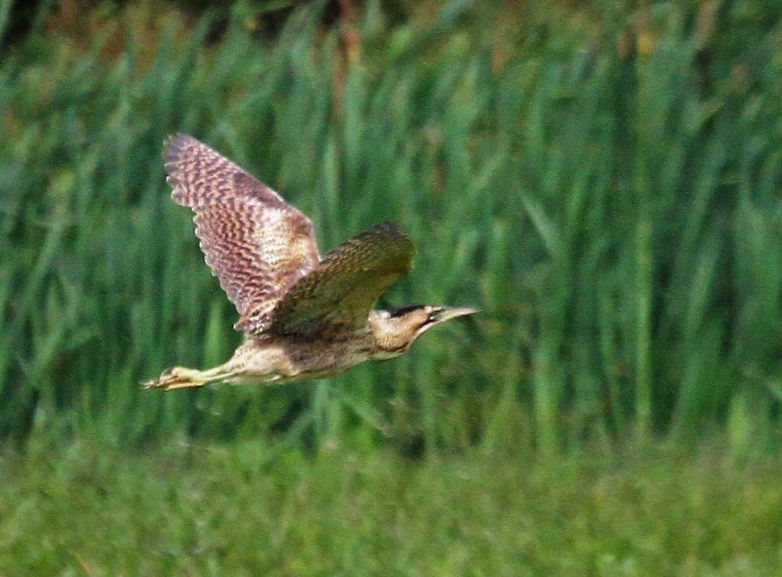
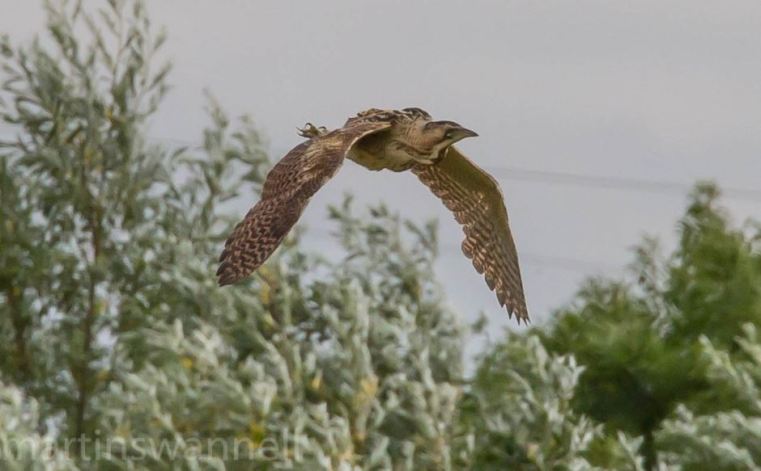
The intriguing run of summer Bittern records continued at Summer Leys with daily sightings, in flight over the scrape and the car park, throughout the week.
Bittern, Summer Leys LNR, 8th July 2017 (Wayne Weedon)Bittern, Summer Leys LNR, 10th July 2017 (Alan Coles)Bittern, Summer Leys LNR, 12th July 2017 (Alan Coles)Bittern, Summer Leys LNR, 14th July 2017 (Martin Swannell)
With the low water level it must be like shooting rats in a barrel for Ospreys visiting their now fondly favour’d site of Stanford Res, which drew one on 10th and two on 13th, while also continuing to attract Icelandic Black-tailed Godwits. Two were there on 9th, followed by twenty the next day and one from 11th to 13th. Elsewhere, thirteen arrived at Summer Leys on 9th with just two there the following day, two visited Pitsford Res on 8th, rising to three the next day, before falling to one on 10th and singles were at Stanwick GP on 8th and 10th and at Clifford Hill GP on 9th.
Icelandic Black-tailed Godwit, Stanwick GP, 8th July 2017 (Mike Alibone)
From one extreme to another, after last week’s one-day, Nene Valley ‘giant’, a Little Tern was picked up heading north over the causeway at Pitsford Res on 9th – however, it appeared not to be sticking around. The Mediterranean Gull family was still in residence in the Black-headed Gull colony at Stanwick GP this week. The two juveniles are now fully fledged and able to fly.
Juvenile Mediterranean Gulls, Stanwick GP, 8th July 2017 (Mike Alibone)
Elsewhere, an adult and an apparently unrelated juvenile visited Daventry CP on 11th and a juvenile was there on 14th. One size up, Caspian Gulls were also found at Stanwick, including an adult on 10th, a second-summer on 10th-11th and a first-summer on 13th. An adult also visited Pitsford Res on 10th. Yellow-legged Gull numbers increased dramatically this week with Stanwick GP accumulating a maximum of forty-two on 13th.
Second-summer Yellow-legged Gull, Pitsford Res, 9th July (Mike Alibone)
Away from here, a second-summer was at Pitsford Res on 8th-9th, a first-summer was there on 10th along with the autumn’s first juvenile on 12th and four on 14th. Elsewhere, an adult and a second-summer visited Daventry CP on 11th.
A juvenile Common Redstart was trapped and ringed at Stanford Res on 8th. It was a very young bird which appears, at first sight, not to have travelled far.
Juvenile Common Redstart, Stanford Res, 8th July 2017 (Adam Homer)
There is a possibility it fledged locally as this species once bred in some numbers in the grounds of Stanford Hall and a female with an active brood patch was also trapped at Stanford on 9th July 2015 so, who knows … Another young chat, a juvenile Northern Wheatear, was discovered at Pitsford Res on 13th – the first of the autumn and on a relatively early date for this species.
A largely dry week, during which temperatures nudged 30ºC under the influence of a light south-westerly airstream, saw the continued arrival southbound passage waders, the discovery of an immense tern and the surprise rediscovery of breeding Mediterranean Gulls.
A drake Red-crested Pochard visited Summer Leys LNR on 4th, with presumably the same bird relocating to Stanwick GP the following day, while the metal-ringed, escaped female Bufflehead was still present at Clifford Hill GP on 1st. Rare herons were limited to last week’s Bittern again at Summer Leys on 7th.
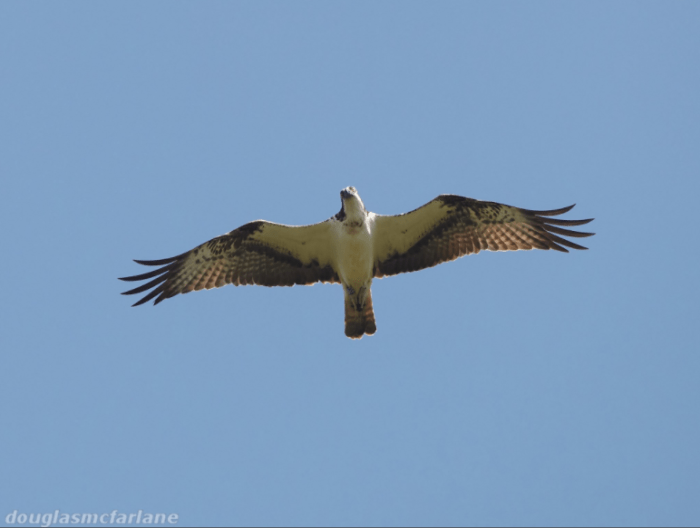
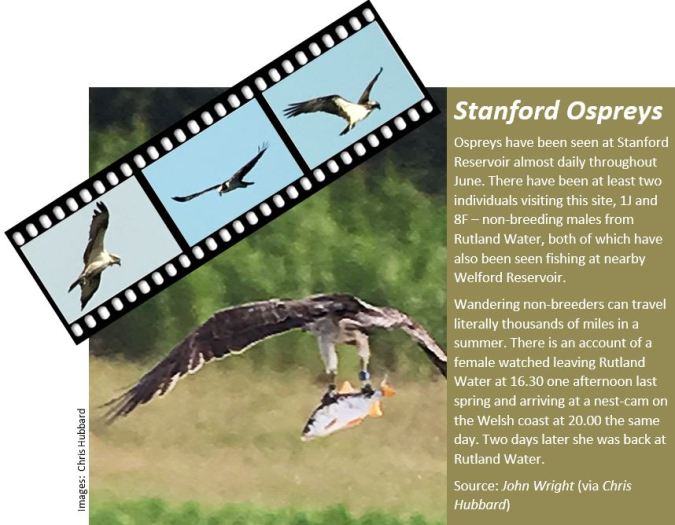
A female Honey Buzzard was an unexpected bonus for one observer as it drifted south-west over Sywell on 2nd, while there were reports of three Ospreys this week with two on 2nd, including one at Pitsford Res and one at Welford Res. Interestingly enough, the latter, a male, was ringed and proved to be a different individual to either of the two regularly visiting Stanford and Welford Reservoirs which were highlighted in last week’s feature.
Male Osprey, Welford Res, 2nd July 2017 (Douglas McFarlane)
The third was watched flying south-west over Thrapston GP on 3rd.The flow of southbound Icelandic Black-tailed Godwits continued with singles at Stanford Res on 1st, 2nd and 6th, three at Thrapston GP on 3rd, two at Pitsford Res on 4th with three there the following day and one on 7th, two at Stanwick GP plus six at Summer Leys on 5th and one again at Stanwick on 7th.
Icelandic Black-tailed Godwit, Stanford Res, 6th July 2017 (Chris Hubbard)
Local birders were caught completely off guard by the totally unexpected arrival of Northamptonshire’s fifth Caspian Tern, a smart adult, located at Summer Leys on 1st. This dagger-billed colossus pitched down on ‘The Slips’ and was viewable from the Screen Hide for 80 minutes, before disappearing off down the Nene Valley, only to return again 90 minutes later – this time for 40 minutes – before heading off west. Clifford Hill GP was the next stop, where it was on view for nearly 3 hours in the early evening, after which it flew high west toward the sunset and was gone. It bore a red ring on its left leg, which enabled it to be confidently identified as the individual that had been frequenting the National Wetlands Centre, Carmarthenshire until 29th June. After leaving Northants, it was located briefly the following day at Chew Valley Lake, Somerset, before returning bizarrely to the Wetlands Centre in Carmarthenshire on 3rd. But this is what Caspian Terns do! Proof, if ever there was, that Caspian Terns are really quite mad …
Caspian Tern, Summer Leys LNR, 1st July 2017 (Mike Alibone)
Another happy event was the surprise rediscovery of the breeding Mediterranean Gulls at Stanwick GP on 3rd. After a ‘missing, presumed dead’ status had been pronounced last month, there they were – bold as brass – in the middle of the Black-headed Gull colony again this week, the adults feeding two well-grown young. The local Lesser Black-backs are off the hook … for now. Elsewhere, single adults were seen at Ditchford GP’s Irthlingborough Lakes & Meadows reserve on 2nd and hawking insects over Daventry on 5th, again on 6th and one on 7th, while four adults visited the scrape at Summer Leys briefly on 3rd. July is the month when Yellow-legged Gull numbers begin to build and after one at Stanwick on 3rd, four were present there on 5th plus seven on 7th, four were at Pitsford Res and one at Daventry CP on 5th and a different individual visited the latter site the following day.
The male Common Redstart was still at Clifford Hill GP on 1st, otherwise the week was light in terms of migrant passerines.
A mini heatwave, with temperatures hitting the low thirties during the penultimate week, sees spring merge with autumn as the first southbound Black-tailed Godwits and Greenshank arrive in the county and a small, brown duck causes a stir.
Continuing its reluctance to depart, the first-summer Eurasian White-fronted Goose moved from Stanford Res back to Pitsford, where it remained until 11th, while single drake Garganeys appeared again at Summer Leys LNR on 3rd and Stanwick GP on 15th. A drake Red-crested Pochard, now in eclipse, loitered at Ditchford GP’s Irthlingborough Lakes & Meadows LNR until at least 12th but the surprise discovery of a female with one young duckling at Thrapston GP, mid-month, turned out to be the first breeding of this species in Northamptonshire.
Eclipse drake Red-crested Pochard, Ditchford GP, 12th June 2017 (Simon Hales)Female Red-crested Pochard with young, Thrapston GP, 16th June 2017 (Adrian Borley)
The origins of our Red-crested Pochards have never really been known for certain but the above discovery must surely be a case of feral breeding. The last day of the month produced seventeen Common Scoters at Daventry CP – the first decent-sized flock we’ve have locally for a long time and part of a large national overland movement taking place at this time.
Common Scoters, Daventry CP, 30th June 2017 (Gary Pullan)
Nice though they were, they did not attract anything like as much attention as a certain diminutive diving duck, which appeared at Clifford Hill GP on 24th – a potential first for Northamptonshire in the form of a female Bufflehead. Not the best time of year but there has been a series of June occurrences, coupled with a cluster of previous Midlands records, so hopes ran high as local, and some not so local, birders descended on this Nene Valley site on the edge of suburbia. It quickly transpired our girl was wearing a ring – albeit a metal one – and the rot began to set in. With more than 22,500 Buffleheads historically having been ‘banded’ in Canada and the USA, the presence of a ring was still not necessarily a problem but the ring detail was far from clear until, that is, she upped and went to Daventry CP on 27th. It was there and then that she was snapped in close-up, the ring detail scrutinised and any potential credential immediately dismissed as she was duly pronounced an escape. Oh well, it was good while it lasted.
It has been a very poor spring for Quail, with just two singing males reported – both of which appeared to be one-day wonders. One was near the railway close to Kings Sutton on 9th and the other in a flax field near Burton Latimer on 18th. Summer Leys produced both of the period’s rare herons, which included a Great White Egret on the scrape on 14th and a Bittern in flight over the car park on 20th and again on the scrape the following day.
Bittern, Summer Leys LNR, 21st June 2017 (Alan Coles)
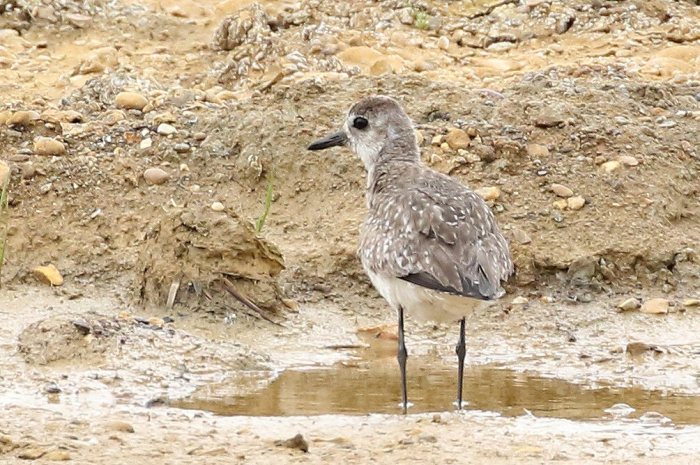
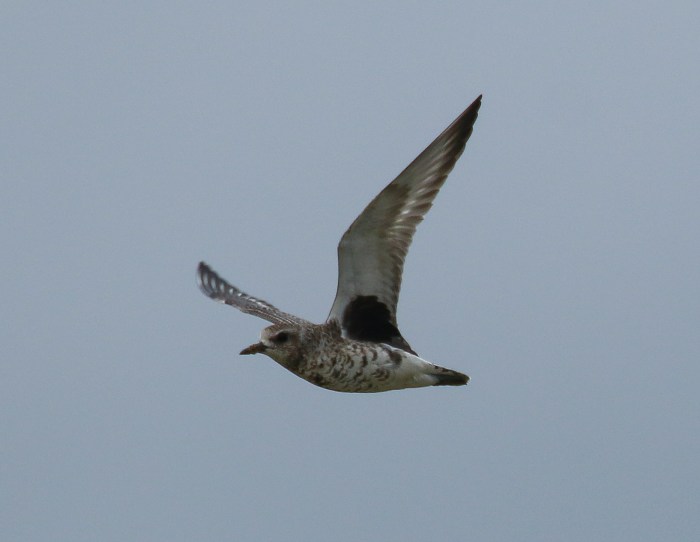
Wandering Ospreys featured at four localities during the month, including Welford Res on 3rd, 8th and 13th, three flew over Bulwick on the latter date and one visited Blatherwycke Lake on 16th but Stanford Res claimed the lion’s share. Stanford’s low water level continued to attract waders, including an Avocet for two days on 25th-26th, a late spring Grey Plover on 3rd and a presumably non-breeding first-summer Icelandic Black-tailed Godwit on 11th ahead of the first southbound Black-taileds – a nice flock of twenty-seven – on 25th.
Icelandic Black-tailed Godwits, Stanford Res, 25th June 2017 (Chris Hubbard). Part of a flock of twenty-seven.
One of these wore an Icelandic ring indicating it was a twelve-year old male and, thanks to Chris Hubbard’s research, its movement history is charted below. Clearly there was a Black-tailed Godwit movement taking place on 25th with further records of at least twenty-five at Summer Leys and one over St James, Northampton. More had arrived by the month’s end with 30th producing at least nine more at Stanford and singles at both Stanwick and Summer Leys. The autumn’s first Greenshank arrived at Stanford on 28th, lingering until the month’s end but further south, at Daventry CP, it was still spring when
five Sanderlings flew west on 6th.There was no avoiding Stanford’s pull for two Little Terns which arrived there on 28th but Pitsford – at which the water level is now looking enticingly low – attracted a Sandwich Tern to Scaldwell Bay on 19th. Both species are rarely recorded in the county in summer.
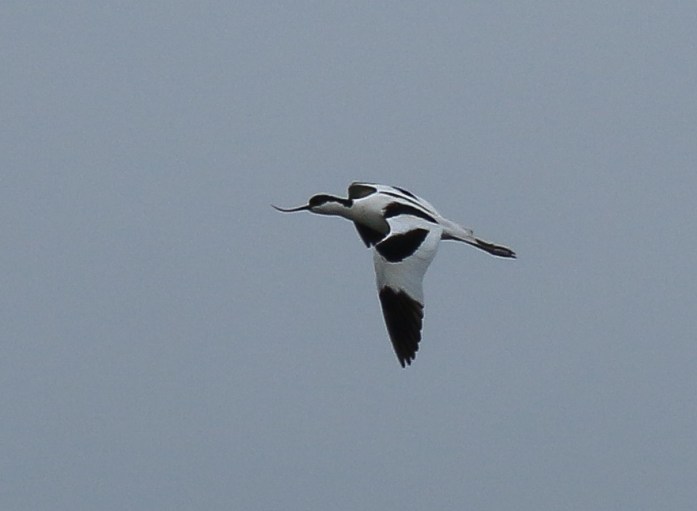
Avocet, Stanford Res, 25th June 2017 (Chris Hubbard)
Following the breeding of Mediterranean Gulls at Stanwick earlier this year, another adult visited the Black-headed Gull colony there on 19th and two adults flew over Byfield the following day. June records of Yellow-legged Gulls are few and far between but the month saw two at Stanford on 17th, one at Daventry CP on 26th and one at Boddington Res on 30th – all of which were immatures. We also had our first June records of Caspian Gull, with Pitsford Res producing a second-summer on 10th, two second-summers the following day and one on 18th, while a first-summer appeared at Daventry CP on 27th.
Common Redstart, Spratton, June 2017 (David Arden)
Finally, the only passerine migrants found anywhere this month presumably belonged to autumn and they were all Common Redstarts. A female was at Clifford Hill GP on 25th-26th followed by a male there on 30th and a male visited a garden in Spratton on 26th.
The calm after the storm. After some sporadic heavy rain during the first forty-eight hours, warmer weather set in as winds swung between west and south-east and temperatures edged momentarily into the high twenties. As May turned into June, the northward flow of wetland migrants enjoyed by all in the preceding weeks almost dried up and we entered a quiet period, enlivened for some at least by the brief appearance of an Arctic Skua on 2nd.
At Stanford Res the first-summer Eurasian White-fronted Goose visited again on 30th but was not alone in being the only winter visitor lingering ludicrously late at this site. A drake Garganey continued a run of intermittent appearances at Summer Leys, showing there on 28th, 1st and 2nd, while two – presumably a pair – were at Stanwick GP on 29th. The only other wildfowl during the period were Red-crested Pochards, which included a drake and a hybrid female at Pitsford Res on 27th and two drakes bouncing back and forth between Ditchford GP’s Irthlingborough Lakes & Meadows LNR and Stanwick GP between 27th and 31st.
The latter site produced another late spring Bittern, which flew on to the A45 Lay-by Pit on 29th. On 2nd June, a Honey Buzzard was reported circling above Oundle before flying south-west, a Marsh Harrier flew east at Summer Leys on 27th, while an Osprey fishing at Stanford Res on 29th-30 and again on 2nd was perhaps not entirely unexpected, given the small number of breeding pairs in the region.
Grey Plover, Stanford Res, 2nd June 2017 (Chris Hubbard)
Above average numbers of Avocets have occurred this spring and more appeared this week, with two at Stanwick GP on the evening of 28th, although they were nowhere to be seen the following day. The trickle of waders continued with two more Grey Plovers – one at Pitsford Res on 29th and the other at Stanford Res between 31st and 2nd, while a Turnstone visited Pitsford Res on 27th, followed by two more there on 31st. Hollowell Res produced the week’s only Greenshank, on 28th, while last week’s potentially record-breakingly late Jack Snipe proved officially to be just that, remaining there until at least 1st.
Turnstone, Pitsford Res, 31st May 2017 (Stuart Mundy). One of two present at this site on the same date.Jack Snipe, Stanford Res, 31st May 2017 (Chris Hubbard)
Bird of the week, however, was the light morph adult Arctic Skua, which circled high above Daventry CP, late in the morning of 2nd, before drifting off north-west. Spring records are not unprecedented but even a stayer in autumn would be kinda nice …
After the full-on spring passage of Black Terns there was just one, at Pitsford Res, on 30th, when two Yellow-legged Gulls were at the same site. More unusual was the fly-over of two Hawfinches at Harrington AF on 29th – probably the first record for the site.
‘Tundra’ Ringed Plovers, Sanderlings and Dunlins, Stanford Res, 17th May 2017 (Chris Hubbard)
With most of the common summer visitors having arrived by the end of the period, the focus was clearly on wetland migrants in what has undoubtedly become the best spring, locally, for many years. More specifically, the period produced waders and terns in numbers, the likes of which we have not seen for a good few years, including a few potentially broken records. The main contributory factors were, firstly, the weather – particularly in the second week – when low cloud and rain combined with a prolonged period of easterlies to ‘down’ migrants across the county. Secondly, we have been blessed with lower than usual water levels at our reservoirs, following a rather dry winter. The draw-down at Stanford has also been a major influencer, providing the ideal habitat to attract migrant waders, twenty-five species of which have been recorded there so far this spring. Aside from all this, the county notched up Glossy Ibis, Black-winged Stilt (again) and Red-rumped Swallow during this fast-moving five-week period.
Two winter visitors which have lingered or appeared later than the norm, giving rise to speculation, in some quarters, that their origins may be somewhat suspect, are the Whooper Swan at Stanford Res from 5th to 8th May and the long-staying – though mobile – first-summer Eurasian White-fronted Goose.
Whooper Swan, Stanford Res, 7th May 2017 (Chris Hubbard)
From Pitsford to Daventry to Hollowell to Stanford, this individual has engaged in a reservoir round-robin. It was last seen at the latter site on 23rd May and, having appeared during a good winter for this species locally, it is likely to be a non-breeder in no hurry to depart, and perhaps deserves the benefit of the doubt. Back to things more seasonal and Summer Leys LNR was the principal location for Garganey, with probably three different birds over the period 6th to 23rd May, including two showy drakes on the scrape. Single drakes also visited Stanwick GP on 10th and 20th May and Clifford Hill GP on 18th May. Red-crested Pochards were still popping up here and there, with two at Thrapston GP on 30th April – one remaining until at least 13th May – one at Pitsford Res on 1st May and singles at Ditchford GP between 9th and 20th May, two there on 26th May and one at Stanwick GP on 20th-22nd May. The latter site held on to its long-staying female Scaup – believed by some to be not 100% genetically pure – until 18th May and another(?) female turned up at Daventry CP the following day, remaining there until 22nd May.
Garganey, Summer Leys LNR, 20th May 2017 (Ricky Sinfield)
Stanford’s similarly long-staying first-year drake Long-tailed Duck remained there until 29th April, seemingly breaking all records for length of stay for this species locally, while another drake north of the dam at Pitsford Res added spice to a local bird race on 13th, remaining there until the following morning. Both of these reservoirs were clearly destined to deliver more sea ducks before the period was out, with two Common Scoters at Pitsford on 23rd April and one at Stanford on 12th May.
Common Scoters, Pitsford Res, 23rd April 2017 (Bob Bullock)
In keeping with the maritime theme, a chance Saturday evening visit by one birder to Pitsford, on 6th May, produced the first Black-throated Diver for five years. Those intent on catching up with this fine summer-plumaged Gavia had to move quickly – it was airborne and off north at 05.20 the next morning …
Black-throated Diver, Pitsford Res, 6th May 2017 (Bob Bullock)
Many have been wondering how long it will be before Bitterns breed in the county as they edge ever closer, as well as being seen with increasing frequency outside the traditional winter season. Hopes were raised and dashed as one was seen at Summer Leys on 28th and 29th April but it disappeared thereafter. Next year, perhaps, unless Great White Egrets beat them to it. This may not be as unlikely as it sounds, as this is another species pushing the winter envelope and appearing increasingly later in spring – frequently in summer dress. Three during the period included one flying north over Clifford Hill GP on 28th April and singles at Summer Leys on 1st, 6th 9th and 10th May and at Pitsford Res on 2nd, 6th and 7th May.
Great White Egret, Summer Leys LNR, 9th May 2017 (Mike Alibone)
We can forget breeding, though, for one species which continues to tease and tantalise as far is its appearances in the county are concerned: Glossy Ibis. Itchy feet does not even begin to describe the condition afflicting all five individuals which have now visited Northants since the species was first recorded here in 2002. So, the one discovered at Summer Leys at 11.30 on 23rd May duly conformed and was up, up and away at 13.35, never to be seen again – or was it? Three days later, an early morning scan across the pools immediately south of Irthlingborough, west of the A6 bridge and … there it was! Within minutes, however, it had flitted further west, ending up on an island in one of the lakes off Greenway before quickly, and mysteriously, melting away …
Glossy Ibis, Summer Leys LNR, 23rd May 2017 (Alan Coles)
Migrating raptors, it could be argued, are also difficult to catch up with. The period’s best included a male Honey Buzzard west over Great Brington on 16th May, single May Marsh Harriers at Summer Leys on 7th, over Billing GP on 8th, Stanford Res on 13th, Stanwick GP on 22nd and Boddington Res on 23rd, while a male Hen Harrier flew west between Irchester and Wollaston on 12th May.
Marsh Harrier, Summer Leys LNR, 7th May 2017 (Ricky Sinfield)
Meanwhile, Ospreys continued to drift around north Northants, with singles on several dates at Pitsford Res, Naseby Res and Harrington AF, while two Rutland-ringed individuals visited Welford Res on 21st May.
Topping the bill of the wader listing, the Black-winged Stilts returned for an encore at Stanford Res on 23rd April. Photographs suggested they were two of the three present three days previously, on 20th April but perhaps they were not.
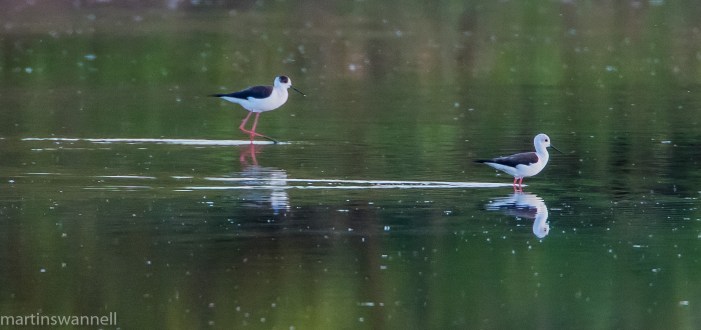
Black-winged Stilts, Stanford Res, 23rd April 2017 (Martin Swannell)
Stranger things have happened. The same site produced an Avocet briefly on 18th May, following one at Summer Leys on 6th May and two there on 10th. And so started a remarkable run of waders at the reservoirs and in the River Nene Valley.
Avocet, Summer Leys LNR, 6th May 2017 (Ricky Sinfield)
The first Grey Plovers appeared on 30th April, when three were at Clifford Hill GP and two arrived at Pitsford Res – the exposed mud between the dam and the mouth of Moulton Grange Bay subsequently proving a popular draw for a number of waders during the period. Stanford managed at least four – possibly six – between 1st and 7th May and singles were at Clifford Hill GP on 1st, Earls Barton GP on 5th and 6th, Stanwick GP on 5th and 12th (with two there on 9th), five were at Summer Leys on 6th – four of which departed east and were seen shortly afterward over Ditchford GP – and two were at Ditchford GP on 9th May.
Grey Plover, Pitsford Res, 30th April 2017 (Mike Alibone)Grey Plover, Earls Barton GP, 6th May 2017 (Bob Bullock)Grey Plover, Summer Leys LNR, 6th May 2017 (Ricky Sinfield)
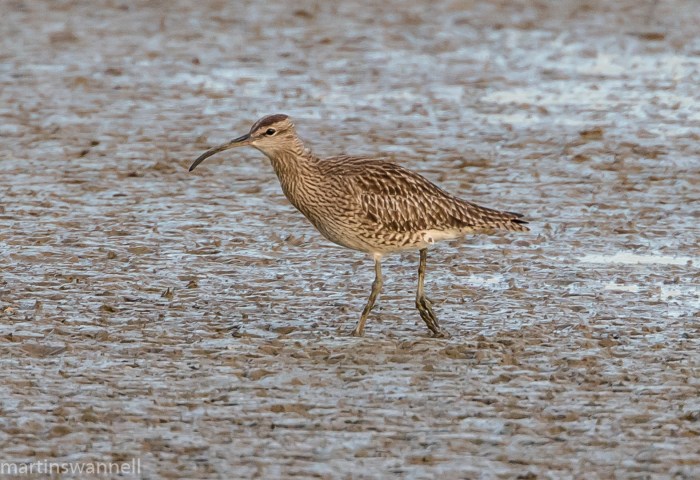
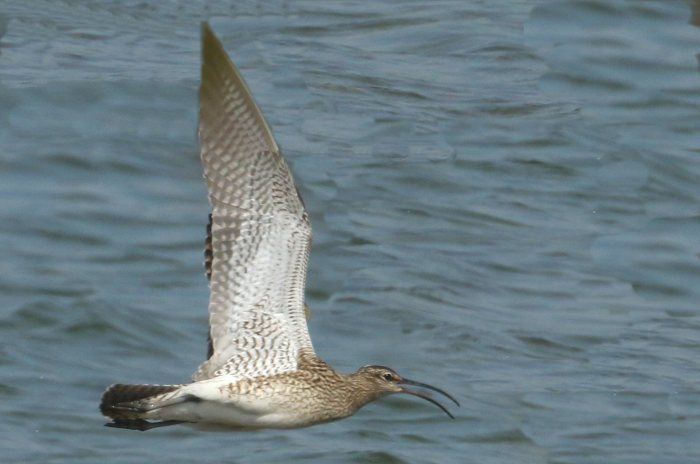
Back on the border with Leicestershire, Stanford was continuing to do well, producing the highest spring count of ‘Tundra’ Ringed Plovers (twenty-seven on 17th May), while five localities between them produced a total of thirty-five Whimbrels between 22nd April and 14th May, with a maximum of seven at Pitsford Res on 30th April.
Whimbrel, Stanford Res, 23rd April 2017 (Martin Swannell)Whimbrel, Pitsford Res, 30th April 2017 (Bob Bullock)Whimbrel, Pitsford Res, 30th April 2017 (Bob Bullock)
What Black-tailed Godwits lacked in number of records they made up for in numbers of birds. Apart from singles at Stanford on 24th April and Ditchford GP on 7th May, a flock exceeding three hundred flew north-west near Scaldwell on 28th April while, not on quite the same scale, Bar-tailed Godwits also appeared in respectable numbers. The largest flock comprised at least thirty-two in flight over Summer Leys on 5th May in addition to five on the ground there on the same date.
Bar-tailed Godwits, Summer Leys LNR, 5th May 2017 (Alan Coles)Bar-tailed Godwits, Stanford Res, 30th April 2017 (Chris Hubbard)Bar-tailed Godwits, Clifford Hill GP, 1st May 2017 (Mike Alibone)
Stanford produced singles on 22nd and 24th April, at least eight there on 30th April, followed by two on 5th-6th May and three the following day. Elsewhere, Clifford Hill GP enjoyed a run of two on 30th April, three on 1st May, followed by seven on 5th May and singles visited Hollowell Res on 1st-2nd May, Summer Leys on 3rd May, Daventry CP on 5th May and Ditchford GP on 9th-10th May.Respectable numbers of Turnstones also appeared during May, with three at Stanford on 5th followed by two there on 16th, singles at Ditchford GP on 5th, Summer Leys on 8th and Stanwick GP on 12th, two at Daventry CP on 19th and one at Pitsford Res on 25th-26th.
Turnstone, Stanford Res, 16th May 2017 (Chris Hubbard)
Much scarcer, however, was Knot, of which there were three, including one colour-ringed individual on the mud at the mouth Pitsford’s Moulton Grange Bay on 30th April followed, uncannily, by a different, unringed bird in exactly the same place the next day. Proof, if ever there was, that the ‘two-bird’ theory should sometimes be given more credence than it actually is! The third was found at Summer Leys on the evening of 5th May, remaining only until the early morning of 6th. Ruffs were scarcer than might have been expected under the circumstances. One remained at Summer Leys between 22nd and 24th April, further singles visited Ditchford GP on 29th April and Clifford Hill GP on 5th May and four were at Stanford Res on 3rd May.
Knot, Pitsford Res, 30th April 2017 (Bob Bullock)Ruff, Stanford Res, 3rd May 2017 (Chris Hubbard)
Early evening on 9th May marked the discovery of a Temminck’s Stint just south of the causeway at Pitsford Res. It was the first in the county since May 2013 and it obligingly remained there through the following morning. Pitsford also produced the spring’s only Little Stint – again on the Moulton Grange mud – on 14th May. The ‘magic month’ continued with a far stronger Sanderling passage than is usual, with all records falling within the first twenty days. On 1st, there was one on that hallowed mud at Pitsford and two at Clifford Hill GP, one of which remained the following day. Two appeared at Stanford on 6th, followed by singles at Pitsford and Hollowell Reservoirs on 8th and 10th respectively, while the 12th saw two more at Stanford, another at Pitsford and three on the new diggings at the western end of Earls Barton GP. The 17th, however, was the species’ big day, with three at Stanwick GP and a massive thirteen at Stanford – the latter likely to be a record-breaker, at least in recent history – and a lingering bird at Pitsford on 19th-20th is likely to have been the last one for this spring.
Temminck’s Stint, Pitsford Res, 10th May 2017 (Bob Bullock)Temminck’s Stint, Pitsford Res, 10th May 2017 (Bob Bullock)Temminck’s Stint and Common Sandpiper, Pitsford Res, 10th May 2017 (Bob Bullock)Little Stint, Pitsford Res, 14th May 2017 (Bob Bullock)Sanderling, Clifford Hill GP, 1st May 2017 (Bob Bullock)
Among the many Dunlins passing through – the maximum being eighteen at Stanford on 17th – came the county’s second and third ‘Greenland’ Dunlins – one with the aforementioned Stanford flock and the other at Hollowell Res on 23rd May. This diminutive arctica race must surely occur more here frequently but it is less than straightforward to identify.
Spotted Redshank, Stanford Res, 5th May 2017 (Bob Bullock)
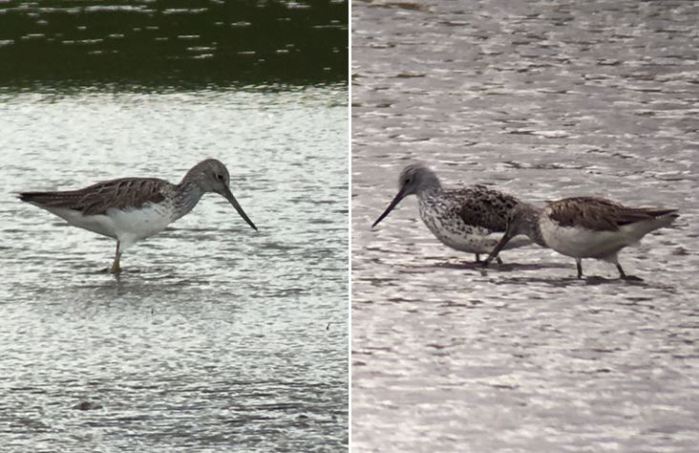
Surprisingly, with all that beckoning mud, there was only one record of Spotted Redshank during the period – two at Stanford Res on 5th May but it was not wasted on Greenshanks, numbers of which were almost on a par with those we expect to see in autumn. In summary, eight localities produced more than thirty individuals between them, including the maximum count of nine at Stanford Res from 5th to 9th May.
Greenshanks, Stanford Res, 25th and 29th April 2017 (Chris Hubbard)
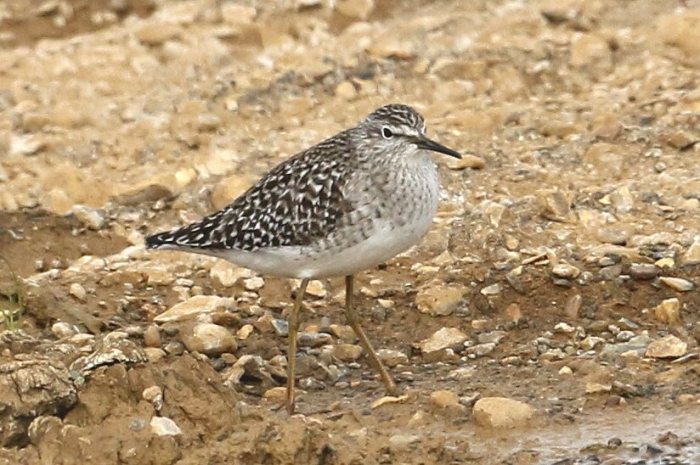
Wood Sandpipers appeared in marginally above average numbers, though, with the first at Earls Barton GP on 29th-30th April moving to nearby Summer Leys on the latter date, where numbers varied between one and three from 6th to 9th May.
Wood Sandpiper, Earls Barton GP, 30th April 2017 (Bob Bullock)Wood Sandpiper, Stanford Res, 1st May 2017 (Chris Hubbard)
Stanford of course produced its own, with singles in May on 1st-2nd and 5th and a potentially record-breakingly late Jack Snipe also remained there throughout the period. Frequently to be found feeding well out in the open on the Leicestershire bank, it crossed the line when it flew and entered Northants airspace on 15th May.
Jack Snipe, Stanford Res, 16th May 2017 (Chris Hubbard)
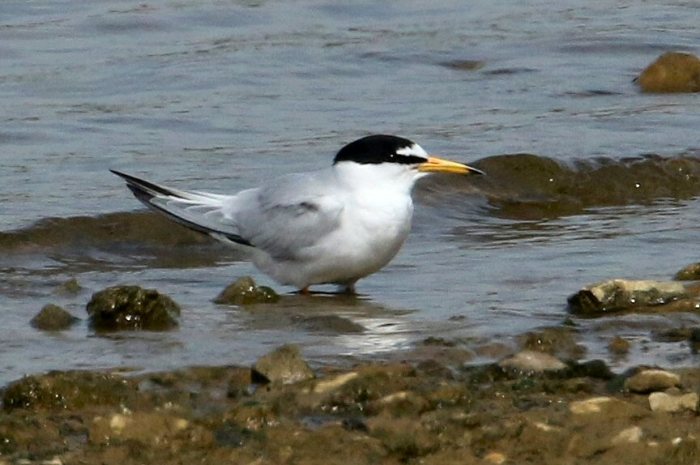
But enough of waders. The county enjoyed its best spring for Little Terns for a good many years as seven made their way through during the seven-day period, 29th April to 5th May. The first was at Summer Leys on 29th, followed by singles at Pitsford Res, Stanford Res and Daventry CP the next day. Further singles appeared at Summer Leys on 1st, Stanford on 3rd and Pitsford on 5th. There was also a half-decent Black Tern passage between 23rd April and 14th May, during which between ninety and a hundred were recorded from a total of nine localities. Double-figure counts – all on 30th April – came from Pitsford Res, with two flocks of twelve and twenty-three, and Thrapston GP, where there were eleven on Aldwincle Lake. Following earlier records, the spring was not yet done with Sandwich Terns, one spending just five minutes at Hollowell Res on 30th April and two less than half an hour at Stanwick GP on 19th May, while Arctic Terns appeared in good numbers between 22nd April and 20th May. The big day for this species was undoubtedly 27th April, when at least one hundred and ten were at Stanford Res and one hundred and twelve Sterna terns – the majority Arctics – were at Thrapston GP. In summary, records came from a further five localities, with sizeable flocks of approximately fifty-five at Pitsford and between thirty and thirty-five at Boddington Res – both on 30th April.
Little Tern, Pitsford Res, 30th April 2017 (Bob Bullock)Little Tern, Pitsford Res, 30th April 2017 (Bob Bullock)Black Tern, Summer Leys LNR, 26th April 2017 (Alan Coles)Black Tern, Earls Barton GP, 10th May 2017 (Bob Bullock)
In comparison to terns, Little Gulls were in surprisingly short supply. On 29th April, an adult visited Mary’s Lake at Earls Barton GP, followed the next day by another adult at Pitsford Res. On 1st May, an adult and a first-summer were at Clifford Hill GP and on 11th May seven – all first-summers – visited Stanford Res, where one remained the following day. Single adults were also found at both Daventry CP and Summer Leys on 19th May.
Adult Little Gull, Earls Barton GP, 29th April 2017 (Bob Bullock)Adult Little Gull, Summer Leys LNR, 19th May 2017 (Ricky Sinfield)
Two adult Mediterranean Gulls appeared at Stanwick GP on 24th April and then caused a stir at Summer Leys between 3rd and 5th May, when it looked as if they might be taking up residence in the Black-headed Gull colony there. However, it was not to be and they were subsequently back at Stanwick on 6th. One of these, or another, was seen flying west along the River Nene at Wellingborough Embankment on 10th and then came a run of first-summers – involving at least two different birds – from Stanwick on 12th May and daily there from 18th to 22nd May with one also appearing at Summer Leys on 13th May.
Adult Mediterranean Gull, Stanwick GP, 6th May 2017 (Bob Bullock)First-summer Mediterranean Gull, Summer Leys LNR, 13th May 2017 (Alan Coles)
Not to left out, larger scarce gulls were slimly represented by a Yellow-legged Gull at Pitsford Res on 22nd April and a first-summer Caspian Gull at Daventry CP on 11th May.
With all the wetland action, passerines and anything not exclusively associated with water have seemingly taken a back seat. Or have they? As if to redress the balance, Northamptonshire’s fourth-ever Red-rumped Swallow appeared with an influx of House Martins at Daventry CP on 15th May. Present from mid-afternoon until at least 18.30, it remained highly mobile, distant and would disappear for lengthy periods. Three out of the county’s four have now been at Daventry CP – and they’ve all been found there by Gary Pullan! The first was at Ditchford GP in September 1984 and the subsequent two at Daventry were in April 1999 and May 2009. We can surely expect more to come …
Just one Wood Warbler appeared this spring – a singing male at Pitsford Res on 29th April, which became increasingly difficult to see as the day progressed, similarly only one Pied Flycatcher was reported, via Birdtrack, at Hinton-in-the-Hedges on 6th May.
A Black Redstart was present on buildings in Wellingborough town centre on 23rd May – again, another poor spring for this species as well as for Common Redstart with singles only at Pitsford Res on 29th April and Clifford Hill GP the following day, although a singing male has been present in a suitable breeding area in the west of the county for the past four weeks. It’s been the same sorry story for Whinchats in what surely must be the worst spring for many years for this species – just two, one at Earls Barton GP on 29th April and one the following day at Clifford Hill GP.
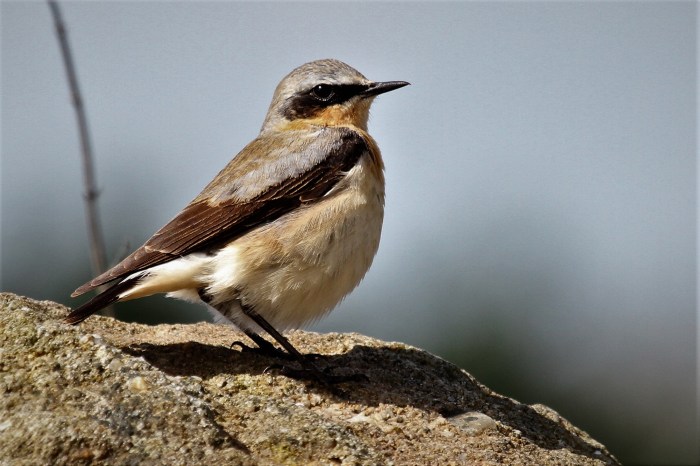
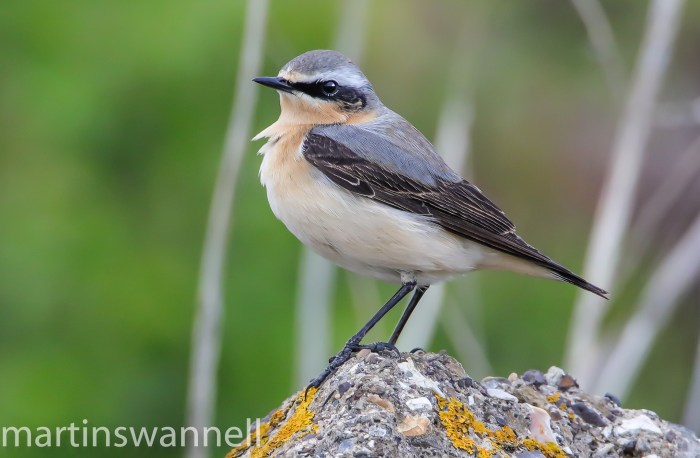
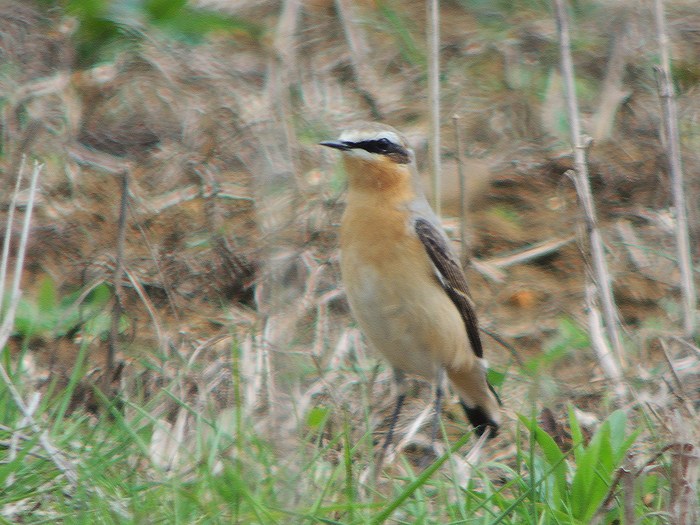
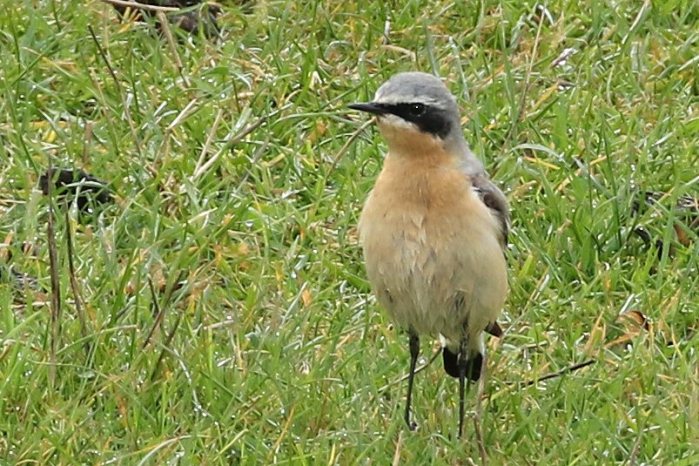
In contrast, there were still plenty of Northern Wheatears coming through, including some identified as ‘Greenland’ Wheatears, although most – if not all – are likely to be of this race in late spring. In April, Harrington AF held up to five between 23rd and 28th, two were at Earls Barton GP from 23rd to 29th, two also visited Priors Haw on 24th and singles were at Ditchford GP on 26th, Desborough Airfield on 28th and Clifford Hill GP on 30th, followed by six at the latter site the following day and one was at Gretton on 11th May.
Northern Wheatears, Harrington AF, 23rd April 2017 (Alan Coles)Northern Wheatear, Harrington AF, 23rd April 2017 (Alan Coles)Northern Wheatear, Harrington AF, 25th April 2017 (Martin Swannell)Male Greenland Wheatear, Earls Barton GP, 23rd April 2017 (Mike Alibone)Male Greenland Wheatear, Clifford Hill GP, 1st May 2017 (Bob Bullock)
Continuing a run of records, another male ‘Channel’ Wagtail paid a brief visit to Stanford Res on 3rd May and single female-type Blue-headed Wagtails were at Pitsford Res on 1st May and at Hollowell Res on 12th May. And, after a fantastic showing of White Wagtails earlier this spring, numbers dwindled to four at Stanford Res on 24th and, on 30th, one was present there, one was at Pitsford Res and three visited Earls Barton GP.






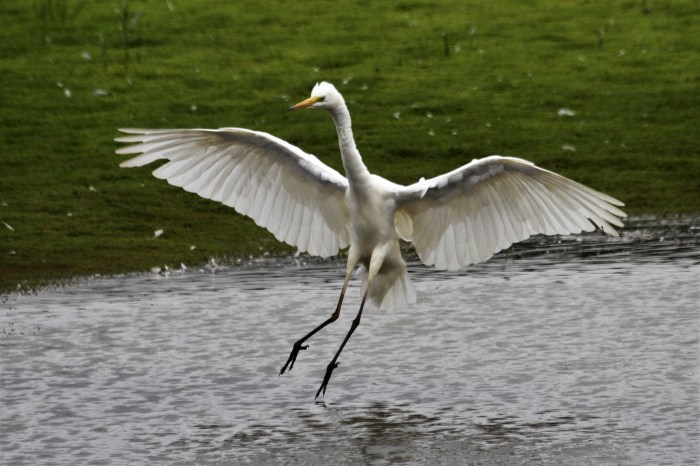

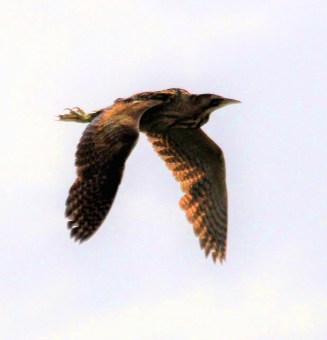



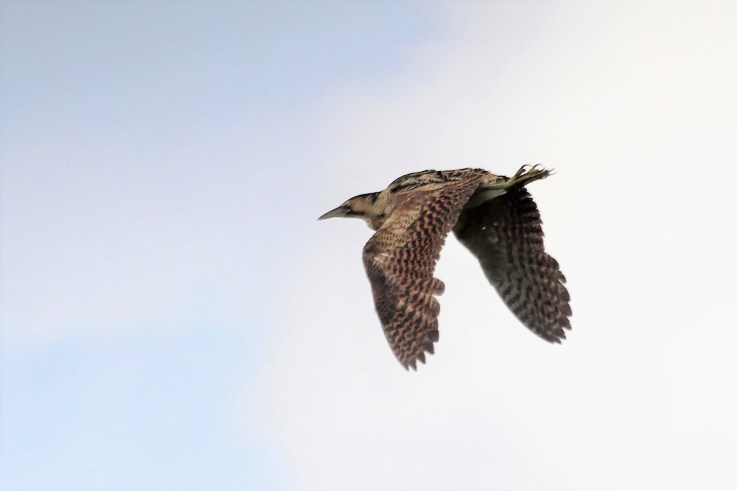
 The summering Bittern continued to be seen daily at Summer Leys until at least 19th, the same site producing a Great White Egret – arguably the first of the autumn – on 20th.










 It has been a very poor spring for Quail, with just two singing males reported – both of which appeared to be one-day wonders. One was near the railway close to Kings Sutton on 9th and the other in a flax field near Burton Latimer on 18th. Summer Leys produced both of the period’s rare herons, which included a Great White Egret on the scrape on 14th and a Bittern in flight over the car park on 20th and again on the scrape the following day.
 Stanford’s low water level continued to attract waders, including an Avocet for two days on 25th-26th, a late spring Grey Plover on 3rd and a presumably non-breeding first-summer Icelandic Black-tailed Godwit on 11th ahead of the first southbound Black-taileds – a nice flock of twenty-seven – on 25th.
 Clearly there was a Black-tailed Godwit movement taking place on 25th with further records of at least twenty-five at Summer Leys and one over St James, Northampton. More had arrived by the month’s end with 30th producing at least nine more at Stanford and singles at both Stanwick and Summer Leys. The autumn’s first Greenshank arrived at Stanford on 28th, lingering until the month’s end but further south, at Daventry CP, it was still spring when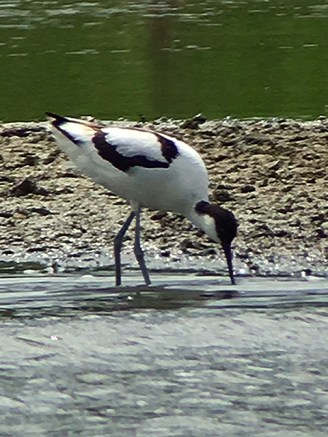












 Northants birds