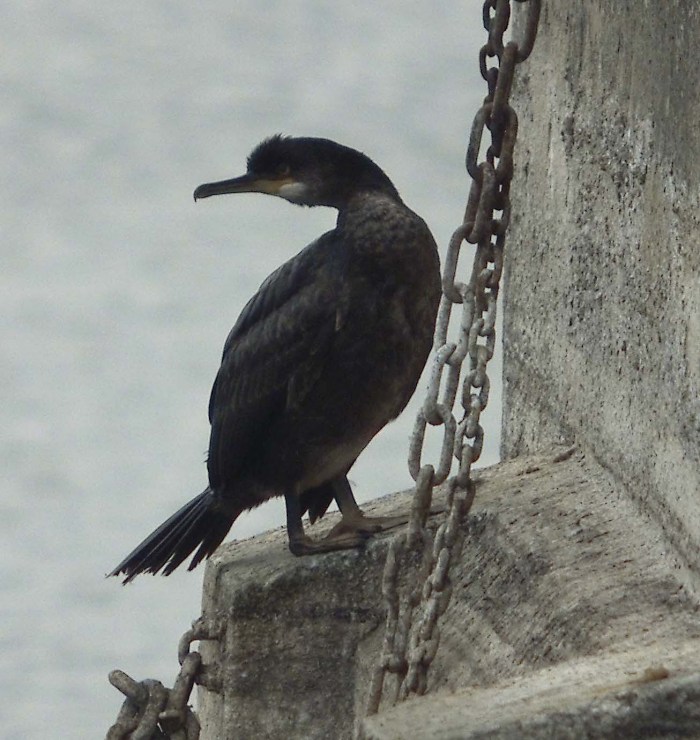
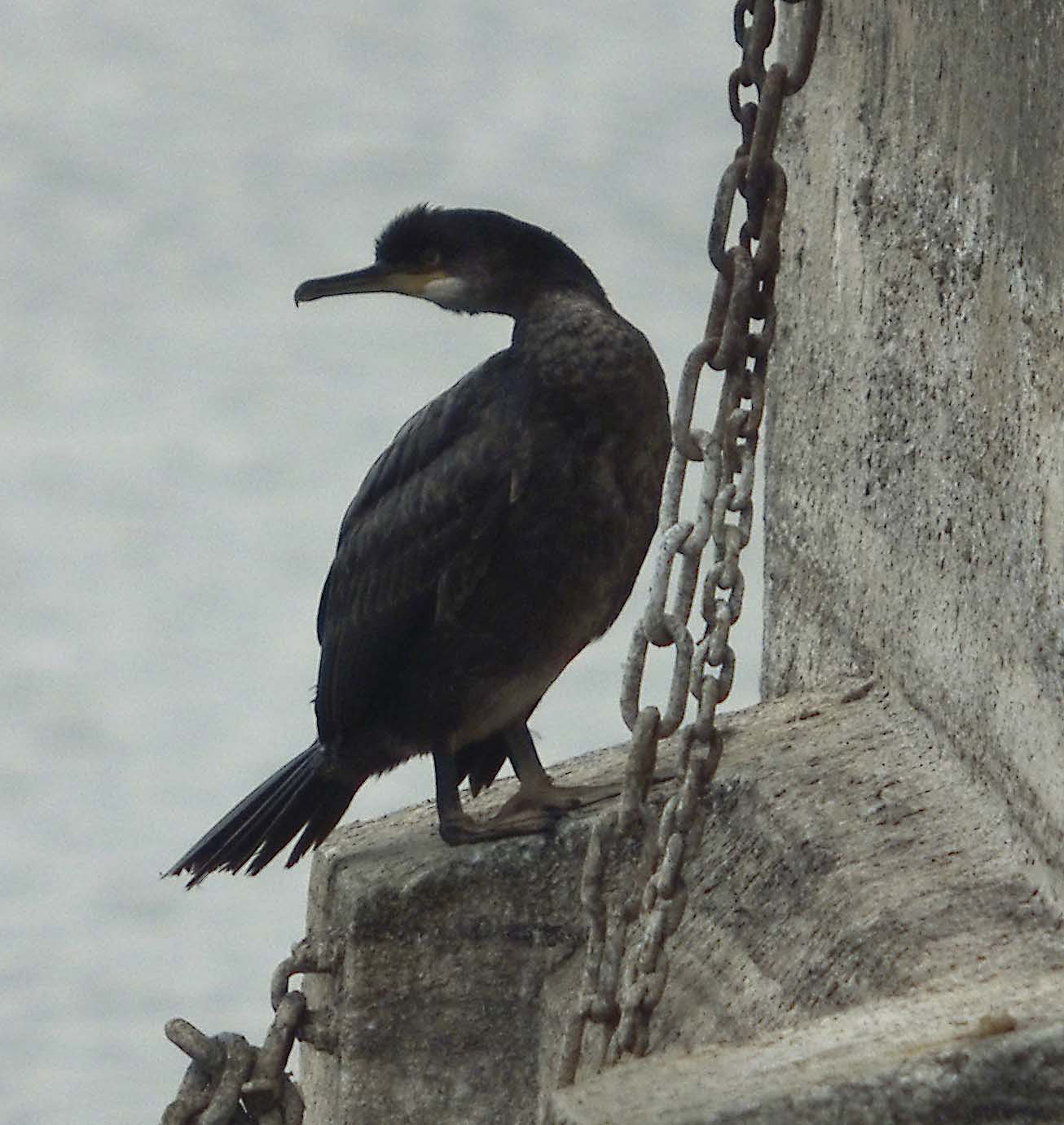
Yesterday, in the early evening murk, Neil McMahon found a juvenile Shag on the valve tower off the dam at Pitsford Reservoir. This is, so far, the only record in Northants this year. Shag is virtually an annual visitor to the County. The vast majority are juveniles and most occur during autumn and winter. Sometimes there are multiple arrivals and ten at Pitsford in autumn 1996 was noteworthy. In the last two weeks Shags have also visited Oxfordshire, Staffordshire and Warwickshire. Probably the most ‘famous’ Shag in recent years was the long-staying and approachable individual at the unlikely location of Abington Park Lake, Northampton, between December 2006 and February 2007. The Pitsford bird was still present this morning. Here is the best of a bad bunch of photos I took in poor light at around 07.30.
Juvenile Shag, Pitsford Res, 21st September 2011 (Mike Alibone)
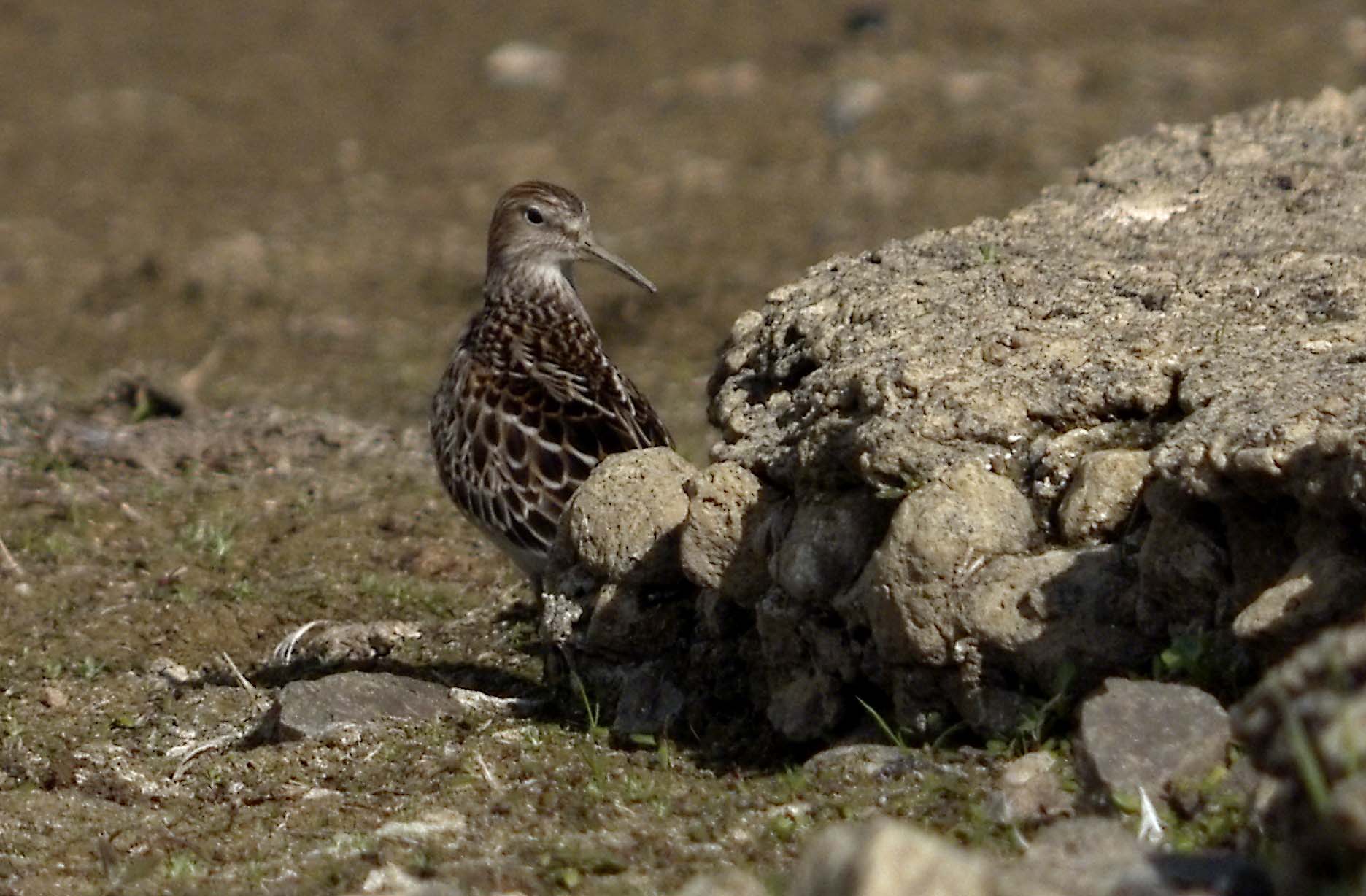
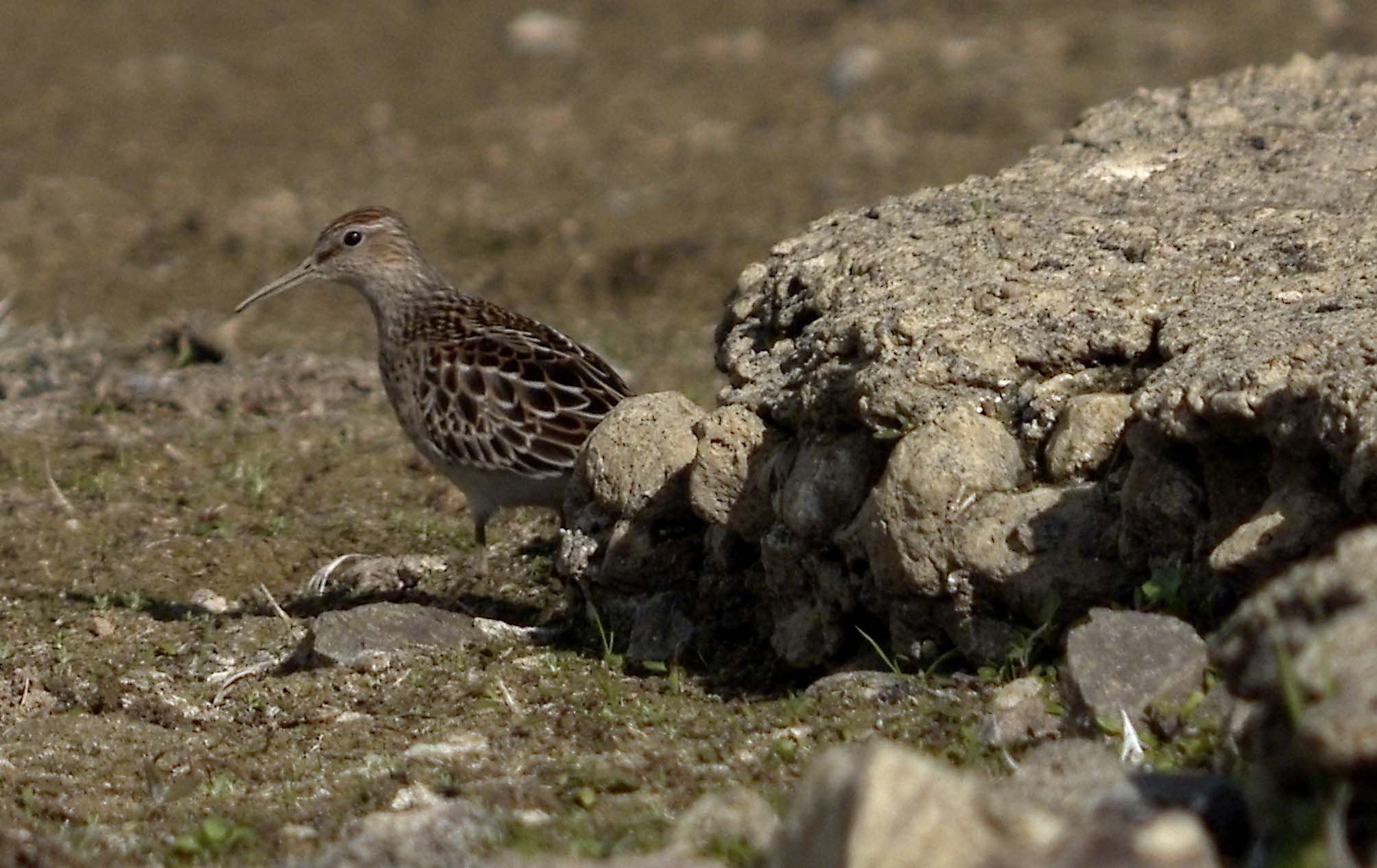
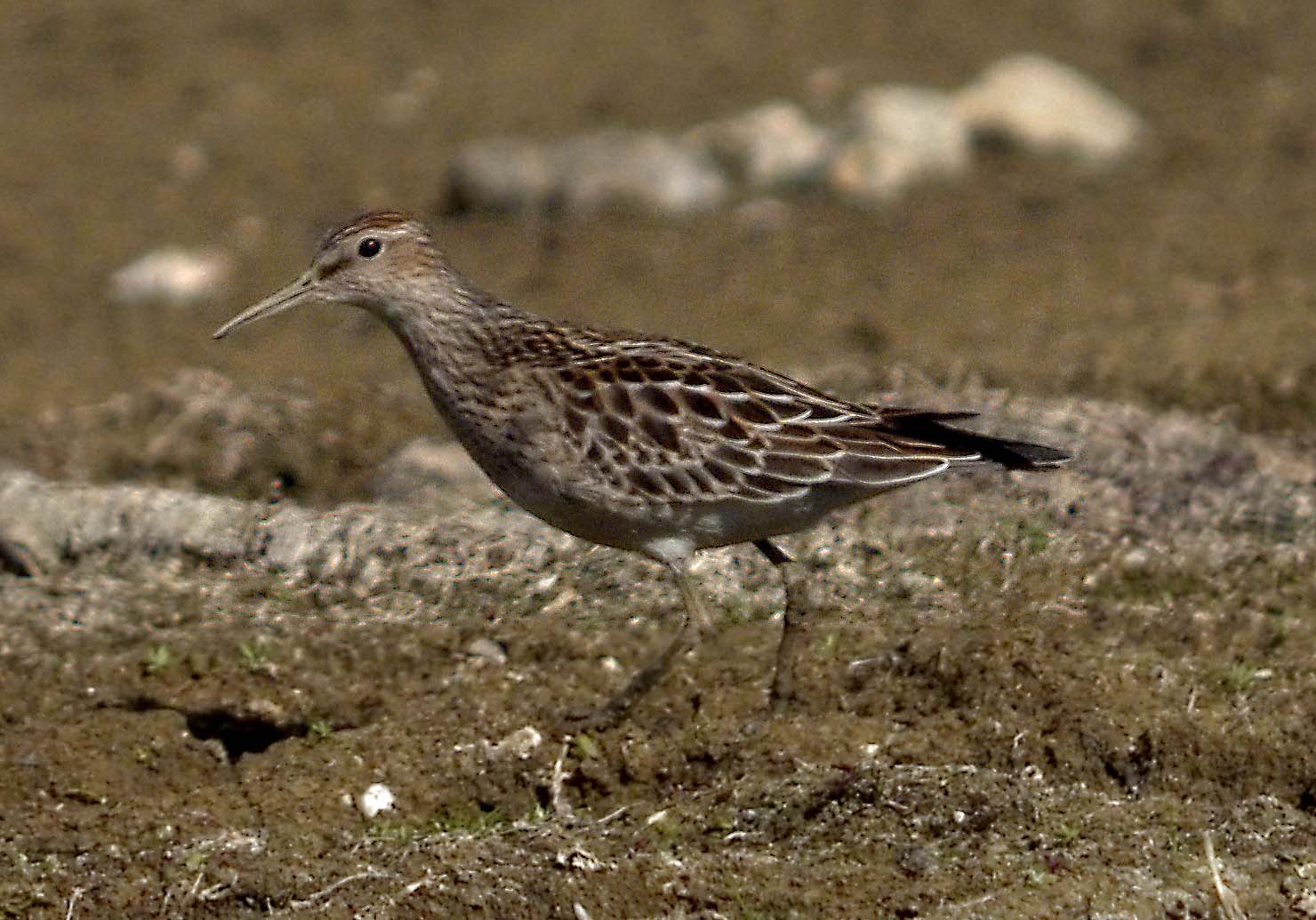
The juvenile Pectoral Sandpiper, present at Pitsford Reservoir for the last week, was showing well at the bottom of the old road, close to Maytrees Hide and the feeding station this afternoon. Although this species is the commonest American (or Siberian) ‘vagrant’ (actually it’s just a scare passage migrant) to our shores, this one is easy to see and well worth a look if you haven’t seen it yet. Pectoral Sandpipers are now annual visitors to Northants and, since the first one in 1940, there have been more than 40 records. At 36, Bob Bullock holds the record for the person to see the highest number of individuals of this species in the County – 36 birds, that is, not Bob – he’s a lot older than that!
When not feeding out in the open, Pectoral Sandpipers often like to hide – either amongst emergent vegetation, old tree stumps or general littoral debris. On this occasion this bird chose to hunker down in the crumbling edges of the old road, which disappears into the reservoir near the feeding station and emerges again on the opposite bank, near the mouth of the Walgrave Bay. I managed to get a few photos.
An early morning visit to Daventry Country Park paid off for Allan Maybury when he picked up this Great White Egret dropping in at around 07.30. However, a considerable number of gulls took umbrage and made this bird feel most unwelcome at the site, causing it to think twice about landing and, ultimately, it headed off west.
Great White Egret, Daventry CP, 1st September 2011 (Allan Maybury)
Since the first County record at Stanford Reservoir in July 1992, there have been at least ten subsequent records, including three together in October 2002, as the breeding population of this species has increased on the near continent. Great White Egret has also started to winter regularly in the UK and the last two winters have seen long staying individuals at Pitsford Reservoir. Two arrived together there on 10th October last year, with one staying into the New Year. Can we look forward to more this winter?
Phil Tizzard raised the question of ageing Northern Wheatears in the UK in autumn. This is far from easy in the field, particularly with females. I’ve always thought that adult (winter)males exhibited a plainer, darker wing with less obvious feather fringing than juvenile/first-winter males, which is why I would have been inclined to have aged the Stanford individual as a juvenile/first-winter had I seen it in the field. It appears, however, that this is far from clear cut. According to Svensson (Identification Guide to European Passerines), the only infallible criterion for ageing these birds is the colour of the inside of the upper mandible, which is yellow in juveniles/first-winters as opposed to grey-black in adults. This means that attempting to age autumn Northern Wheatears in the field could be very tricky! The Stanford individual had a yellow inside upper mandible and so could be aged confidently as a first-winter (or, if you like, ‘older juvenile’). Here is another photo of it with its wings closed. Note how the upperparts appear greyer here than in the image in the previous post.
Juvenile/first-winter male Northern Wheatear, Stanford Res, 27 August 2011 (Mike Alibone)
I like a challenge so I will be paying a lot closer attention to autumn Northern Wheatears in future … Thanks to Phil for bringing this up and to John Cranfield for helpful comments.
At the moment Stanford Reservoir is looking good. Very good. I spent this morning there with the Stanford Ringing Group, during which time 104 birds were trapped – although 28 of these were local retraps. As well as local breeders, many of those caught were autumn migrants with Blackcaps and Common Whitethroats predominating, although there were reasonable numbers of Willow Warblers, a few Chiffchaffs and a couple of Lesser Whitethroats and Reed Warblers. From next week just about all of the warblers trapped will be migrants. Two Treecreepers provided a great opportunity for close, in-hand scrutiny of their intricate plumage detail, which also enabled them to be confidently aged. The best bird trapped, however, was a Northern Wheatear, which is only the second ever to be ringed at Stanford (the other was on 5th September 1982) and, as
Juvenile Northern Wheatear, Stanford Res, 27th August 2011 (Mike Alibone)
such, caused a not undue amount of excitement among the members of the SRG! This individual was a juvenile and the black lesser and median coverts – along with some grey just visibly appearing on the scapulars – sex this as a male. It’s worth mentioning that the SRG will, for a small donation, organise ‘demo days’ in order to raise funds now that their previous funding has recently been withdrawn. By the way, rings now cost 20p each and the group is responsible for its own finances. With mist-nets costing in the region of £100 each ringing is not an inexpensive activity!
The water level at the reservoir itself is very low, almost resembling a small estuary, and the habitat there is proving a massive draw for waders. Among today’s haul were Knot, Spotted Redshank – initially found by Mark Piper – 7 Greenshanks, 11 Ringed Plovers, 2 Dunlin, Black-tailed Godwit and, together with Dave Warner, I counted a total of 18 Ruff – a tremendous figure for Northamptonshire in recent years.
My thanks to SRG’s John Cranfield, Mike Townsend, Adam Homer, Ed Tyler and Debbie for their jovial and instructive company this morning.
Autumn waders start to appear at local reservoirs and gravel pits from July, although some (e.g. Green Sandpiper, Common Sandpiper) are as early as mid-June. These are returning adults but from about mid-August the first juveniles start to appear. Here are a couple of waders which were at Hollowell Reservoir this evening. Dunlin and Ringed Plover are common enough but how hard do we look at them? These two individuals are clearly
Juveniles of Dunlin and Ringed Plover, Hollowell Res, 19th August 2011 (Mike Alibone)
juveniles. The Dunlin has many fresh, broad, pale fringes to the upper parts – including a white mantle ‘V’ – and coverts but already there are two plain grey scapulars, with a dark shaft streak, of first winter plumage clearly visible. The Ringed Plover, as well as having a partly broken brown breast band, also has neat pale fringes to the mantle and coverts and I’m guessing it’s a nominate hiaticula race as it’s fairly pale, the supercilium behind the eye is quite broad and the bill appears quite thick, even though it’s collected a lot of mud. Other waders at Hollowell this evening were five move Ringed Plovers, three Green Sandpipers, two Common Sandpipers and four Greenshank. The water level continues to drop and it’s looking good for autumn …
Found late yesterday at Pitsford Reservoir and, despite its best attempts to outwit and elude this morning’s would-be observers (including me!), this fine summer-plumaged Black-necked Grebe finally gave itself up to those who entered Maytrees Hide and found it hugging the shoreline behind the reeds, where it remained invisible to birders looking from the perimeter path.
Black-necked Grebe, Pitsford Res, 14th August 2011 (Robin Gossage)
Only a few Black-necks are found in the County annually and many of these are juveniles in early-mid autumn plus the odd one or two in winter. Summer-plumaged individuals are rarely encountered so this one provided a real treat to those who were fortunate to see it this afternoon.
A Red-backed Shrike was showing well in bushes by the river, opposite the hide on stilts at Thrapston GP’s Tichmarsh reserve late this afternoon. Alan Bull captured images of this splendid male, which is the first in the County since the last accepted record of a male at Hartwell on 24th May 2004. This species last bred in Northamptonshire in the 1960s.
Red-backed Shrike, Thrapston GP, 11th July 2011 (Alan Bull)
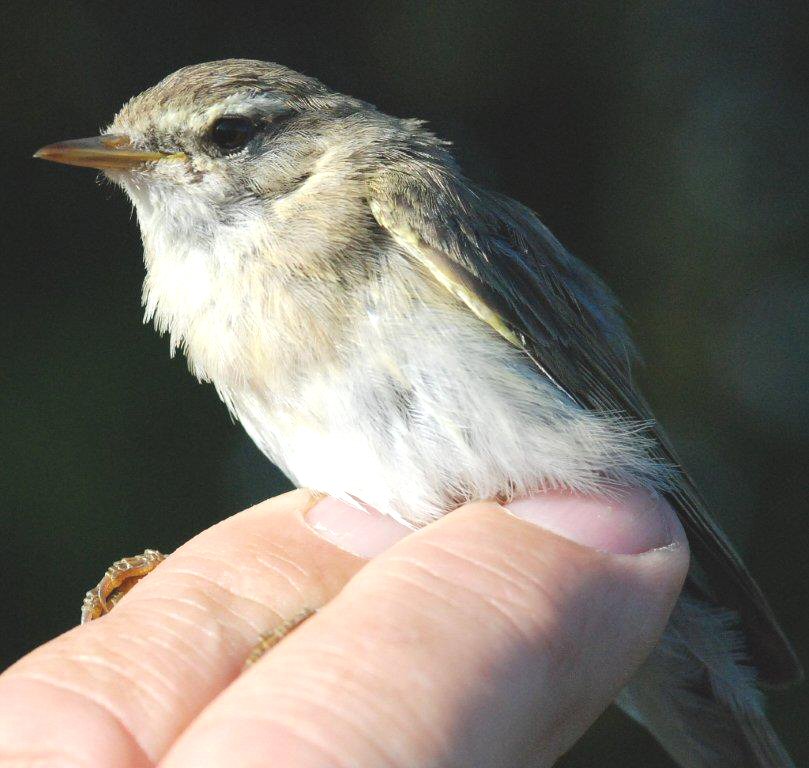
The Stanford Ringing Group has again been busy trapping rare warblers, having yesterday netted Northamptonshire’s second only Northern Willow Warbler. Identified on biometrics this race, acredula, which breeds as close as Norway, is regularly recorded on passage in the UK but what an odd time to find one inland in the Midlands!
Northern Willow Warbler, Stanford Res, 30th June 2011 (John Cranfield)
Normally Willow Warblers start moving south at the end of July. So where did it originate? It is a female with a brood patch growing over so maybe from Scotland (where this race is believed by some to breed) or maybe a Scandinavian breeder whose brood has failed and it decided to return south early? I would be pleased to receive comments on its possible origin. Interestingly, the only previous record of this race for Northamptonshire was also trapped by the SRG on 23rd August 2008.
It’s about time we had one this year and John Peacock was lucky enough to catch this individual as it passed over the footpath near the Screen Hide at Summer Leys this morning. Initially mobbed by a crow, it circled and quickly gained height before moving off north-west at about 08.15.
Honey Buzzard, Summer Leys LNR, 30th June 2011 (John Peacock)
Plumage characteristics, such as the slightly darker secondaries than primaries, with barring conspicuous and filling the space between the covert barring and the darker trailing edge – as well as the outer primary barring extending out toward the darker tips – point to this individual being an adult female. Honey Buzzard is a scarce annual passage migrant with, over the last ten years, 2-4 records per year. In 2000 a record 37 were recorded as part of a national autumn invasion but prior to that there had been only 12 records in the 20th century.



 Northants birds