The Week in Focus: 28th September to 4th October 2013

The UK was sandwiched between a low pressure system to the southwest and a high pressure system over Scandinavia, producing a steady southeasterly airflow across the country throughout much of the week, turning southwesterly toward the week’s end.

The Pitsford female Ruddy Shelduck was present on 29th and then went unreported until 4th, when it was joined by a drake.

Ruddy Shelducks, Pitsford Res, 4th October 2013 (John Moon)

Ruddy Shelducks, Pitsford Res, 4th October 2013 (Jim Dunkley)

Ruddy Shelducks, Pitsford Res, 4th October 2013 (Jim Dunkley)

Twelve Pintails were also present there on 29th with four there on 4th, three were at Stanwick GP on 30th with one there the following day, three visited Summer Leys on 1st and one was found at Hollowell Res on 4th. There were just two records of Garganey with two at Clifford Hill GP on 30th and one at Ravensthorpe Res on 4th, while diving ducks were represented by an eclipse drake Red-crested Pochard at Stanford Res on 28th, a short-staying juvenile Scaup at Boddington Res on 3rd and a Goldeneye at Stanford Res on 28th with two at Earls Barton GP on 1st.

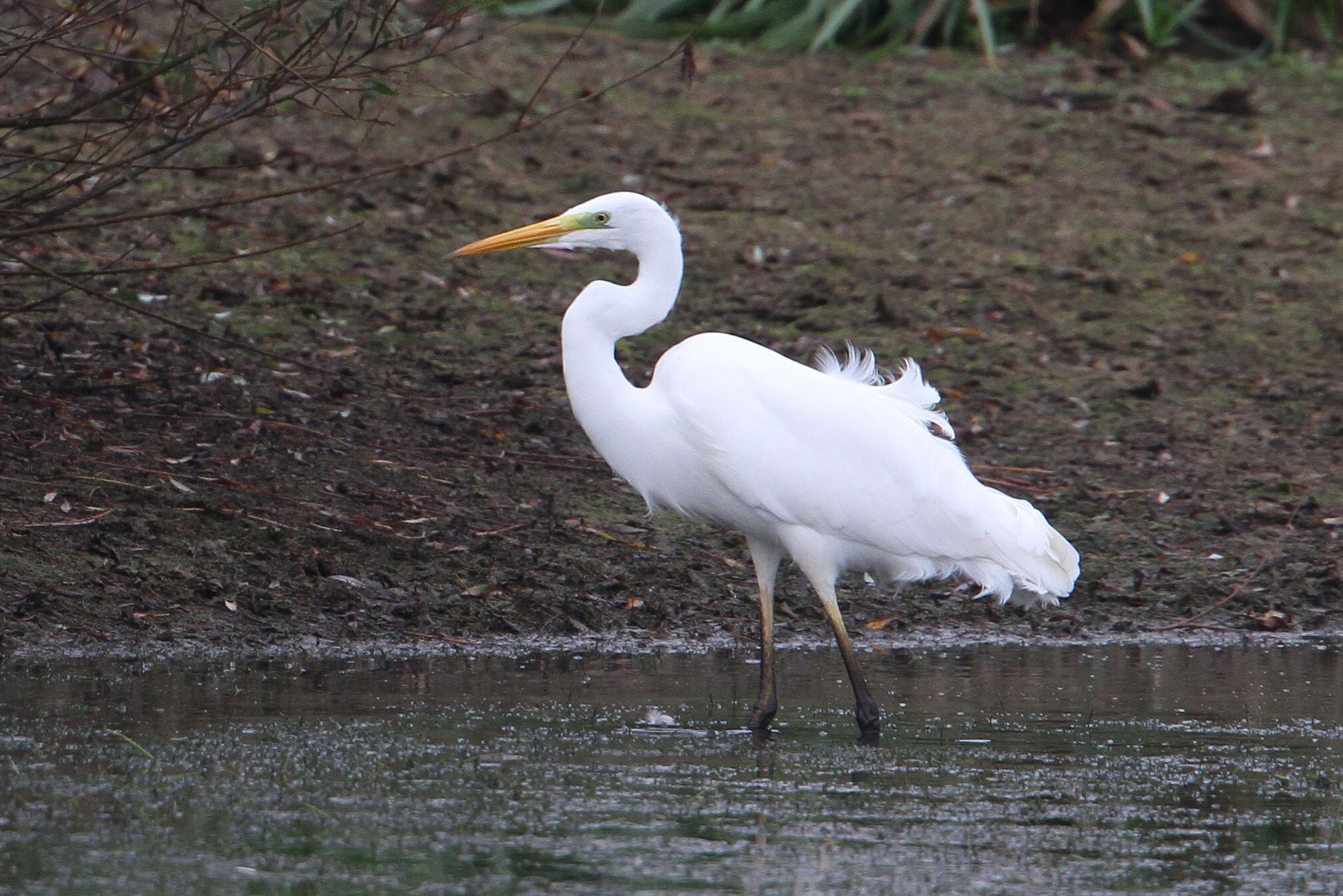
No longer a head-turner, a Great White Egret was found at Ditchford GP on 2nd, remaining until at least 14.00 the next day, while another arrived at Thrapston GP’s Barclaycard Pit during the morning of the same day. With an established North European population this species seems set to follow Little Egret in becoming a common sight in the UK. More welcome in the county, however, would be another Glossy Ibis, which has appeared only on two previous occasions (September 2002 at Ravensthorpe Res and September 2010 at Pitsford Res) each staying no more than twenty minutes. With western Britain currently enjoying another mini-invasion another is surely on the cards … On the raptor front a Marsh Harrier was again at Harrington AF on 30th and a Peregrine was at Summer Leys on 1st, while two were circling over Oundle on 3rd.

A few new waders arrived this week. A Little Ringed Plover was found at Pitsford Res on 4th, where eight Ringed Plovers were also present on 29th and 30th, dropping to four by 4th, while up to three were at Clifford Hill GP between 29th and 3rd. There was also a mini-influx of Grey Plovers, which included singles at Hollowell Res and Stanwick GP on 28th – the latter remaining all week – Pitsford Res on 29th and Daventry CP on 30th

Juvenile Grey Plover, Stanwick GP, 28th September 2013 (Bob Bullock)
Juvenile Grey Plover, Stanwick GP, 28th September 2013 (Mike Alibone)

and numbers of Golden Plovers started to build with forty-nine at Clifford Hill GP on 2nd and twenty-four at Stanwick GP on the same date. The latter locality also produced two Little Stints from 29th to 4th. Dunlins were found at four localities with site maxima of 4 at Daventry CP on 30th and the same number at Pitsford Res on 2nd, three at Clifford Hill GP on 28th and two at Stanwick GP on 3rd. The only Ruff this week were up to two at Clifford Hill GP between 28th and 3rd while the second Jack Snipe of the autumn was found at Daventry CP on 2nd and last week’s two Bar-tailed Godwits remained on the new scrapes at Thrapston GP until 29th. Just one Common Sandpiper was found – at Pitsford Res – on 29th when there were also three Green Sandpipers on the same date followed by singles at Daventry CP on 2nd and Ravensthorpe Res on 4th.

The only Mediterranean Gulls this week were at Boddington Res, where there were two first-winters on 2nd and one on 3rd. The same cannot be said for Yellow-legged Gulls, which maintained high numbers almost daily at Stanwick GP with a maximum of more than one hundred and ten there on 30th; elsewhere three were at Ravensthorpe Res on 4th, up to two were at Pitsford Res all week and singles visited Boddington Res on 3rd and Hollowell Res on 4th.

Adult Yellow-legged Gull, Pitsford Res, 4th October 2013 (Martin Dove)

Good numbers of Caspian Gulls were also recorded this week with one at Stanwick GP on 29th, five there on 30th, three on 1st, four on 3rd and four on 4th. Four were also at Ditchford GP on 28th and 30th.

Second-winter Caspian Gull, Stanwick GP, 1st October 2013 (Steve Fisher)

Winter came one step closer this week with the arrival of the first Redwing, which was trapped and ringed at Stanford Res on 28th, while a Whinchat remained at Clifford Hill GP on 28th and single Northern Wheatears were at Harrington AF on 28th and 30th and at Clifford Hill GP on the last of these dates.

First-winter Northern Wheatear, Harrington Airfield, 28th September 2013 (Doug McFarlane). The richly coloued underparts and relatively late date suggest this may be a bird of the Greenland race.
First-winter Northern Wheatear, Harrington Airfield, 28th September 2013 (Doug McFarlane). The richly coloured underparts and relatively late date suggest this may be a bird of the Greenland race.

The Stanwick Azorean Yellow-legged Gull

Atlantis is not just a myth … but there is some doubt as to whether or not ‘real’ Azorean Yellow-legged Gulls Larus michahellis atlantis are occurring in the UK. There have been several good candidates in recent years, including this one, but this distinctive subspecies is still not (yet) officially on the British list. And then there’s always the spectre of variants and hybrids …

Azorean Yellow-legged Gull, Stanwick GP, 27th September 2013 (Martin Elliott)

Although its vagrancy potential is not in doubt, its potential as a future split is. According to Philippe Dubois (2001), from a genetic perspective, no differences have been found in mitochondrial DNA between nominate michahellis and atlantis – even in the Azorean population. Using other forms of genetic analysis, however, some differences have been found between ‘Atlantic’ Yellow-legged Gulls from the continent (the wider range of atlantis beyond the Azores) and michahellis from the Mediterranean – so who knows!

Azorean Yellow-legged Gull, Stanwick GP, 27th September 2013 (Martin Elliott)

This one at Stanwick was found by UK gull aficionado Martin Elliott, an ex-Northants birder who also found the country’s first atlantis, in Cornwall, in 2008. The Stanwick bird was present for only a few minutes in the pre-roost on the main lake early in the evening of Friday 27th September before flying off east. Subsequent pre-roost vigils by a handful (surprisingly a very small handful!) of local birders over the following four consecutive evenings drew a blank.

Azorean Yellow-legged Gull, Stanwick GP, 27th September 2013 (Martin Elliott)

Looks good, the densely streaked, sharply demarcated hood is spot on and draws immediate attention. The mantle colour was said to be between Yellow-legged Gull and Lesser Black-backed Gull (although it does not appear so obvious in the images) and the main flight shot shows a mirror on primary P10 with no mirror on P9. Overall the bird appeared a little stockier than Yellow-legged Gull, of which a record 135+ were counted at the site during the same evening.

All three of Martin’s images reproduced here show a bird with a prominent, broad, dark grey band on the underside of the secondaries extending on to the primaries. Yellow-legged also shows this to some variable extent but can it ever be as prominent as on this individual? This was also a feature on the Oxfordshire bird of October 2009, for which see here, so maybe it’s a function of the darker upperparts or it may not be at all related – either way, is it a potentially useful ID feature for adults of this form?

This is an interesting bird which may well still be lurking among the thousands of gulls currently roaming around in the River Nene Valley. Sidegate Landfill and Ditchford GP may pay dividends if visited now rather than in winter, when local birders traditionally step up their efforts to find white-winged gulls.

Many thanks to Martin for finding a potential first for Northamptonshire and for the use of his images


The Week in Focus: 21st to 27th September 2013

A light westerly airstream dominated the first part of the week with a low pressure system in the eastern Atlantic bringing southwesterlies to the UK. This gave way to a Scandinavian high pressure system and a resultant easterly airstream out of Europe towards the week’s end.

The Pitsford Ruddy Shelduck remained throughout the week, continuing to fuel debate about its origins and the same site hosted the only Pintails of the week, three on 21st with a Garganey there on the same date. Single Garganeys were also at Clifford Hill GP on 20th and at Summer Leys on 21st with two there on 26th and one on 27th and the long-staying Goldeneye at Pitsford Res was joined by two more there on 21st.

Garganey, Summer Leys LNR, 27th September 2013 (Dave Jackson)

A juvenile Marsh Harrier was again at Blueberry Farm, Maidwell on 22nd, followed by an adult male at Harrington AF the next day, while an Osprey visited Thrapston GP on 22nd and another flew west over Hardingstone on 25th. A male Merlin was at Blueberry Farm, Maidwell on 22nd and single Peregrines were seen there on 21st and at Summer Leys on 26th – a juvenile female – and 27th (an adult).

Juvenile female Peregrine, Summer Leys, 26th September 2013 (Bob Bullock)
Adult Peregrine, Summer Leys LNR, 27th September (Doug McFarlane)
Adult Peregrine, Summer Leys, 27th September (Doug McFarlane)

A better selection of waders was evident this week, although numbers of each species were relatively low. Ringed Plovers were the exception, though, with eighteen at Pitsford Res on 21st comprising four on the ground and a separate flock of fourteen flying over. The four on the floor had increased to seven by 24th and then reduced to five from 25th to 27th. Elsewhere one was at Clifford Hill on 21st and five were at Summer Leys on the same date, dwindling to four on 23rd and one on 26th-27th. After flagging up last week the complete absence of Little Stints this year one promptly appeared at Clifford Hill GP on 21st, quickly followed by another at Pitsford Res on 27th.

Juvenile Little Stint, Clifford Hill GP, 21st September 2013 (Bob Bullock)
Juvenile Little Stint with Ringed Plover, Pitsford Res, 27th September 2013 (Martin Dove)

The Clifford Hill bird was accompanied by two Dunlins, another Dunlin was at Hollowell Res on 24th and, back at Clifford Hill, three were present on 27th, where there were also two Ruff on 21st and three on 27th, with further singles at Pitsford Res on 21st (two on 22nd), Wicksteed Park Lake on 25th and Summer Leys on 27th. The first Jack Snipe of the season was found at Bozeat GP on 26th, the same date that the week’s only Black-tailed Godwit was found at Summer Leys. Two Bar-tailed Godwits – unusual in the county in autumn – visited Thrapston GP on 21st and were still present there the next day and a Curlew flew over Pitsford Res on 27th. Common Sandpipers became scarce with just one at Pitsford Res on 21st and two at Daventry CP on 26th and the only Green Sandpiper of the week was one at Summer Leys on 27th. Another scarce visitor which is only just annual in the county was a Spotted Redshank on 21st at Pitsford Res where it joined up to two Greenshanks present until 25th and a Redshank was also there on 23rd.

Greenshank, Spotted Redshank and Ruff, Pitsford Res, 21st September 2013 (Bob Bullock)

Rare larids ramped up this week, producing potentially the rarest bird of the year so far. An adult Azorean Yellow-legged Gull appeared in the Stanwick GP main lake pre-roost around six o’clock on the evening on 27th before flying off toward the A45 Lay-by Pit shortly afterward. This race is not (yet) officially on the British list and reported occurrences here are always controversial and generate much debate. At least one hundred and thirty-five Yellow-legged Gulls were also present on the same date – a new Northamptonshire record count! Others included up to three at Pitsford Res between 23rd and 27th with one at Boddington Res on the latter date, while Stanwick produced three Caspian Gulls – also on 27th – and a juvenile was at Daventry CP on 26th with an adult there on the following date, when a first-winter Mediterranean Gull was also there.

A Short-eared Owl was again at Blueberry Farm, Maidwell on 21st as were up to six Whinchats until 24th. Two more Whinchats were at nearby Harrington AF from 21st to 23rd and another was found on the ‘chat fence’ behind the Premier Inn at Clifford Hill GP on 27th. A single Northern Wheatear at Harrington AF on 22nd and 23rd continued to mark a poor autumn for this species locally.

Ruddy Shelducks: postscript

Good news today from the Netherlands! I got an email from my old buddy René Pop in which he told me that, at last, the Dutch have this year radio-tagged ten Ruddies and colour-ringed some as well! Hopefully we will get some answers on their origin soon.

You can read a bit about it and see part of this year’s 700-strong flock here (in Dutch!) and some facts about the tracking program here (also in Dutch!) Google translate may come in handy …

Ruddy Shelducks in Northants

Think about it. If there is an established national pattern of occurrence of a species, which is reflected in Northants, then something must be going on. And it is … with Ruddy Shelduck.

This species occurs annually in the UK in late summer and early autumn and the origin of the individuals involved has been the subject of much debate over the years – see here, here and here for open discussions from Keith Vinicombe and Andrew Harrop, for example. Escapes and ferals certainly do not account for all the occurrences as there is no feral colony in the UK and you can’t tell me that, every summer, there is a mass escape of juveniles (and adults) from wildfowl collections across the UK!

Female Ruddy Shelduck, Pitsford Res, 18th September 2013 (Bob Bullock)

The birds we see here are believed to be from the moult gathering which occurs annually in the Netherlands and which involves any number of individuals between 500 and 1000. Either they overshoot in late summer or they disperse after moulting, resulting in records later in the autumn. The origin of these birds is unknown and may involve wild birds from southeast Europe but this is pure speculation and until the Dutch bother to ring or radio-tag some of them I guess we’ll never know.

Female Ruddy Shelduck, Pitsford Res, 18th September 2013 (Bob Bullock)

The records in Northants mirror those nationally and Ruddy Shelducks have occurred in the county in 20 out of the last 45 years (1969-2013), including this year with a female currently at Pitsford Reservoir.Ruddy Shelducks by Year The pattern of occurrence is consistent with the majority of the records in August and September (with a tail in October and some in November). Although many of the records relate to single birds, there have been small flocks – three together in 1989, 1992, 1999, 2005 and 2009 and four together at Hollowell Reservoir on 22nd August 1979 – adding weight to the belief they are not escapes. Ruddy Shelducks by MonthOther records in months earlier in the year are a puzzle and could partly be explained by escapees or by misidentification of the similar Cape Shelduck (South Africa), which also escapes from time to time and has occurred in the county on several occasions.

Cape Shelduck in captivity, Florida (Dick Daniels, Wikimedia Commons)

Ruddy Shelduck is on the British List but only in Category B, i.e. it has not been proven to have occurred here in a wild state since 1950. Hopefully its status will change for the better before too long so if you haven’t seen one then there’s still time to catch up with the Pitsford bird. Shouldn’t we be taking occurrences of this species more seriously?

Little Stint

Only hours after bemoaning the fact in Week In Focus that there had been no Little Stints in Northants this year, I did what any desperate birder would do – went out to my local patch and found one. Ok, so it may be pure coincidence but next weekend I’m going to try it again … with White-rumped Sandpiper 🙂

Juvenile Little Stint, Clifford Hill GP, 21st September 2013 (Mike Alibone). Click on the cogwheel to increase resolution to 720p to watch in HD.

 It’s a sad fact, though, that in recent years Little Stint has been relegated to (or promoted to, depending on your point of view) the status of very scarce passage migrant in the county.  In the ‘70s and ‘80s we all took them for granted. Small numbers would arrive on cue every September at Pitsford and the other reservoirs; unfortunately, however, this is no longer the case. A quick look at the records over the ten years 2002-2011 gives an average of just 4 per year compared to many more than this during the latter decades of the last century.

Fresh autumn juveniles are beautifully marked birds. Catch ’em while you can!

The Week in Focus: 14th to 20th September 2013

A fast-moving Atlantic depression crossed northern Britain at the beginning of the week, bringing strong southwesterlies to western Britain, although these had lost impetus by the time they reached the Midlands. Otherwise the largely westerly airflow continued and the weather remained largely dry.

Coinciding with fresh Icelandic arrivals in northern Britain this week, thirty-one Pink-footed Geese flew high west over Pitsford Res on 18th while 20th saw the return to the Nene Valley of ‘Wossy’, last month’s escaped Ross’s Goose – this time at Clifford Hill GP.

Ross's Goose, Clifford Hill GP, 20th September 2013 (Bob Bullock)
Ross’s Goose, Clifford Hill GP, 20th September 2013 (Bob Bullock)

Although with rather better credentials, another species which consistently receives short shrift from birders in the UK is Ruddy Shelduck and last week’s female remained south of the causeway at Pitsford Res all week; more on this later.

Ruddy Shelduck, Pitsford Res, 16th September 2013 (Martin Dove)

Two Pintails at Summer Leys LNR on 14th were the only ones this week, the same site hosting a Garganey throughout the period, although seven were there on 14th, one also visiting Clifford Hill GP the same day. A Goldeneye was found at Stanford Res also on 14th while the long-staying bird at Pitsford Res remained all week.

Eclipse drake Garganey, Summer Leys LNR, 19th September 2013 (Alan Coles)

Raptors were in short supply with single Merlins at Raunds on 13th-14th, Pitsford Res on 16th and at Harrington Res the following day while a female Peregrine was at Blueberry Farm, Maidwell on 15th, 16th and 19th and a juvenile visited Stanwick GP on the last of these dates.

Wader passage was lifted somewhat this week. Single Little Ringed Plovers visited Clifford Hill GP and Hollowell Res on 14th, the latter site along with nearby Stanford Res also hosting a Ringed Plover on the same date. At least three were at Clifford Hill GP – also on 14th with some still there on 16th when three were also at Summer Leys, increasing to five there on 20th.

Ringed Plover and Dunlin, Clifford Hill GP, 16th September 2013 (Bob Bullock)

A Golden Plover was seen at Harrington AF on 14th and fourteen flew over nearby Blueberry Farm, Maidwell on 18th. Wader of the week was the juvenile Curlew Sandpiper which appeared during drizzly conditions at Clifford Hill GP on 14th but there have still been no Little Stints so far this autumn and time is surely running out …

Juvenile Curlew Sandpiper, Clifford Hill GP, 14th September 2013 (Bob Bullock)

Up to seven Dunlins were present at Clifford Hill GP between 14th and 20th while singes visited Summer Leys on 16th and Stanwick GP the following day but only Ruff this week were two near the dam at Pitsford Res on 14th and 15th and one at Summer Leys on 14th.

Juvenile Ruff, Summer Leys LNR, 14th September 2013 (Bob Bullock)

Two juvenile Black-tailed Godwits visited the latter locality on 20th. Common Sandpipers were found at five localities with two at Boddington Res and one at Hollowell Res on 14th, three or four at Pitsford Res on 16th and singles at Welford Res and Ditchford GP on 20th. Green Sandpiper numbers remained low with two at Pitsford Res on 14th, one there on 17th and one at Ditchford GP on 20th, while a late Wood Sandpiper was discovered on the drained lake at Wicksteed Park on 19th. 13th with two there on 10th and one at Stanwick GP on 12th. The only Greenshanks during the period were at Pitsford Res, where there were up to two between 14th and 18th. There have been no American waders in the county so far this autumn but we are now approaching the last week of September, which has a great track record locally for producing the goods, so fingers crossed!

A first-winter Mediterranean Gull was found in the gull roost at Pitsford on 16th with five Yellow-legged Gulls there on 18th. Other Yellow-legged Gulls included singles at Hollowell Res on 14th and at Ditchford GP on 20th while seven were at Stanwick GP on 19th. With all the local breeding Common Terns now departed two were found at Hollowell Res on 14th along with a juvenile Arctic Tern.

Away from the wetlands, a Short-eared Owl was at Blueberry Farm, Maidwell on 14th and two were present there on 18th while a Common Redstart was found at nearby Harrington AF on the first of these two dates. Whinchat were rather more widespread this week with singles at Boddington Res and Borough Hill on 14th and Sywell CP on 16th, up to two at Pitsford Res between 14th and 18th and up to eight at Blueberry Farm, Maidwell between 14th and 19th. A single Northern Wheatear at Harrington AF on 14th-15th continued to mark a poor autumn for this species locally but a flock of approximately fifty Yellow Wagtails at Chelveston Airfield on 20th was a good local record for this species.

Lores like a Semi-p …

In the early part of the week Bob Bullock was photographing waders at Clifford Hill Gravel Pits when he came across this juvenile Ringed Plover with a rather Semipalmated Plover-like face pattern feeding with other Ringed Plovers and Dunlin on the north shore of the main barrage lake.

Juvenile Ringed Plover, Clifford Hill GP, 16th September 2013 (Bob Bullock)
Juvenile Ringed Plover, Clifford Hill GP, 16th September 2013 (Bob Bullock). Click image for larger version.

Enough to arouse interest as close examination reveals a) the dark band on the lores narrowing considerably where it joins the base of the bill and b) the join is clearly above the gape-line, the latter protruding into the white part of the lores. This loral arrangement is supposedly a key identification feature of Semipalmated Plover – Ringed Plover’s loral band normally broadens and joins the bill base at the gape line, which is clearly not the case with this individual.

However, other Semi-p supporting features are entirely absent: no trace of a narrow yellow eye-ring, lack of stubby bill, and the dark subterminal fringes on the coverts are too broad (many of the whitish terminal fringes have already worn/are wearing off).

Furthermore, closer inspection would reveal a lack of palmations between the middle and inner toes, as can be seen in the image below. Both Ringed and Semipalmated Plovers have palmations between the middle and outer toes but only Semi-p has them between all toes.

Juvenile Ringed Plover, Clifford Hill GP 16th September 2013 (Bob Bullock)
Juvenile Ringed Plover, Clifford Hill GP 16th September 2013 (Bob Bullock). Click image for larger version.

The excellent, detailed, close up images from Bob enable this level of scrutiny!

Habitat Improvement at Summer Leys

Birders recently visiting Summer Leys in search of autumn migrants cannot have failed to notice a significant change in its appearance.  Last week saw the completion of the reprofiling of the scrape there – a much welcomed move designed to improve this important habitat for both breeding and passage waders.

This short project, which was completed in little more than a week, was specified and managed by Steve Brayshaw on behalf of the Wildlife Trust following the last major reprofiling there in October 2007. Additional works took place in September 2008 with perimeter banks being raised and a new water control structure installed to ensure all the scrape islands could be completely flooded in the winter. This proved to be extremely worthwhile as 2009 was an excellent season for breeding waders, with at least three or four pairs of Little Ringed Plovers, eleven to twelve pairs of Lapwings and two pairs of Redshanks all raising young. Since then, however, breeding numbers have declined with, for instance, just three to four pairs of Lapwings breeding there this year.

At the time of the 2008 reprofiling the scrape was also found to be suffering from an infestation of Crassula helmsii (otherwise known as New Zealand Pygmyweed or Australian Swamp Stonecrop). This invasive non-native species is virtually impossible to control effectively and still remains a problem.

Summer Leys scrape: the view from Pioneer Hide before reprofiling (Steve Brayshaw)
Summer Leys scrape: view from hide after reprofiling (Steve Brayshaw)

The primary purpose of the recent works was to restore the scrape to the 2008 profile – to improve habitat for breeding waders and to raise the potential for passage waders. All the vegetation (including Crassula) on the scrape islands and the majority of the margins has been scraped back to bare earth and willow saplings have been removed.  Great care has been taken to ensure that Crassula does not spread outside the scrape, including cleaning down the machinery before it was moved to the next site.

Two small reedbeds have been retained but the reedbed in front of the Pioneer hide has been removed to restore the view! The water level at the time of the works was approximately thirty centimetres lower than it was when reprofiling was completed in 2008, so the channels between the islands have also be deepened slightly to increase the extent of wet margins. Heavy rain since the works were complete is already washing sand and silt out of the reprofiled soils to reveal areas of bare gravel.

Subject to the completion of other habitat management elsewhere on the reserve, including the removal of vegetation on Gull, Hawthorn, Round and Rotary Islands, the water level in the scrape will be raised by around 30cm over the next month to increase the extent of mud and shallows before the scrape is completely flooded again over the winter to suppress further vegetation growth.

Hopefully we can look forward to record numbers of breeding waders in 2014 and an excellent wader passage, with the added bonus of a rare vagrant or two. A pair of Black-winged Stilts turned up in May 2008 following the last round of reprofiling so watch this space!

Many thanks to Steve Brayshaw for the current and historical details used in the above post 

The Week in Focus: 7th to 13th September 2013

Average temperatures and a predominantly westerly airstream followed colder northerlies prior to the beginning of the period. While winter duck numbers were slowly on the rise, few new migrants were discovered locally but …

Early autumn normally produces a scattering of Ruddy Shelducks in the UK and one was found south of the causeway at Pitsford Res on 12th. This coincided with others in East Yorkshire, Essex, Gloucestershire, Hertfordshire, Kent and Sussex. They are likely to be from the summer moult gathering in The Netherlands and the origin of these birds is uncertain.  An eclipse drake Pintail was at Summer Leys LNR on 8th with two there and three at Pitsford Res on 13th, the former site hosting a Garganey on 7th-9th and five on 13th while Pitsford Res continued to hold a two Red-crested Pochards and a Goldeneye from 7th to at least 10th. A ‘female-type’ Common Scoter on the easternmost pit at Stanwick GP on 12th formed part of an inland ‘mini influx’ at the time.

A Bittern showed well for over an hour on the recently reprofiled scrape at Summer Leys LNR on the morning of 8th and was seen again in flight there later in the day.

Bittern, Summer Leys LNR, 8th September 2013 (Matthew Hazleton)

The long-staying Marsh Harrier continued to be seen in the Blueberry Farm area until at least 8th and again at nearby Harrington AF on 10th while another was over fields near Fotheringhay on 8th. An Osprey was again at Blueberry Farm on 7th and 9th, it or another visited Pitsford Res on 8th, the same day as one was tracked as it flew southwest over Stanwick GP and shortly afterward over Ditchford GP, while a male Merlin in the Brampton Valley on 9th was the first of the autumn/winter period.

Few new waders made landfall in the County this week. Two Little Ringed Plovers visited Hollowell Res and one was at Clifford Hill GP on 13th, where eight Ringed Plovers on 8th had dwindled to five by 12th and one on 13th, while one visited Stanwick GP on 9th and two were at Pitsford Res the following day. Two Golden Plovers were at Stanwick GP on 12th-13th. Up to three Dunlins were present at Summer Leys between 7th and 9th with one there on 13th but the only other site to host this species was Clifford Hill GP, which held six from 8th until 12th and 8 on 13th. Two Ruffs were at Pitsford Res on 10th with one there on 12th, another was at Summer Leys on 13th and nine Curlews visited Stanwick GP briefly on 11th, while 3 Common Sandpipers were found at Pitsford Res on 7th, with four or five there on 10th, Welford Res (two), Sulby Res (one) and nearby Naseby Res (one) – all on 7th – two were at Clifford Hill GP and one at Hollowell Res on 13th and, at Stanwick GP, there were two on 9th and three the following day. Green Sandpiper numbers were very low with three at Sulby Res on 7th, one at Pitsford Res on 8th and 13th with two there on 10th and one at Stanwick GP on 12th. The only Greenshanks during the period were at Pitsford Res, where there were up to three between 7th and 12th and eight Yellow-legged Gulls at Stanwick GP on 10th and one at Pitsford Res on 13th were also the only ones reported.

A Common Swift at Stanwick GP on 9th may have been the last one of the year, while a Whinchat was at Pitsford Res on 13th and up to six remained at Blueberry Farm,

Whinchat, Blueberry Farm, Maidwell, 11th September 2013 (Bob Bullock)

Maidwell all week, the same site hosting up to two Northern Wheatears between 8th and 12th. A Tree Pipit was found at Pitsford Res on 10th and four Crossbills flew over Stanwick GP on the same date.