A mixed bag of weather saw the country under the influence of a south-easterly airstream during the latter part of the week but, as far as new birds were concerned, it was, as they say, all quiet on the western front …
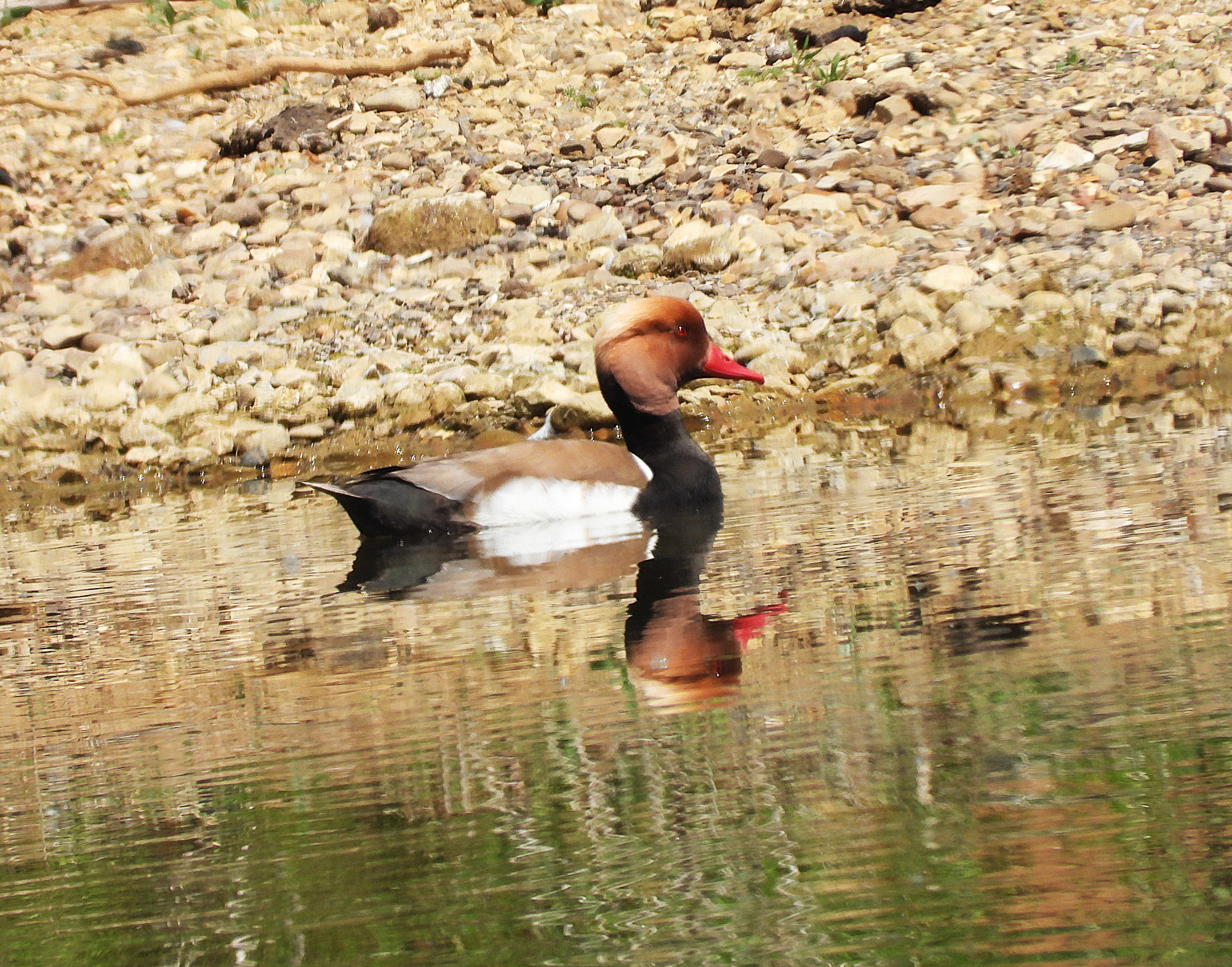
Predictably, the idling drake Red-crested Pochard remained at Earls Barton GP until at least 12th, while it – or another – paid a visit to Clifford Hill GP on 13th.
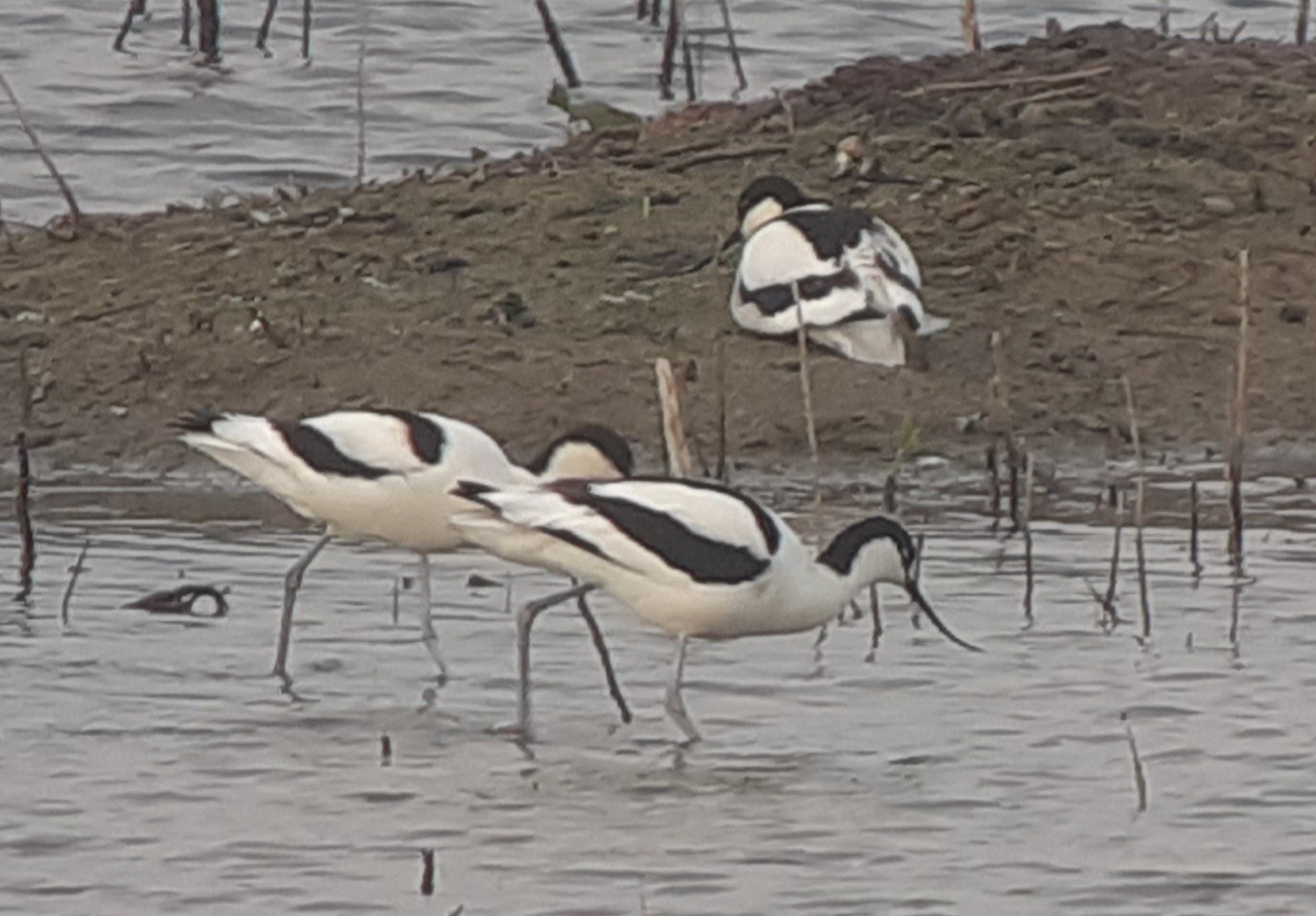
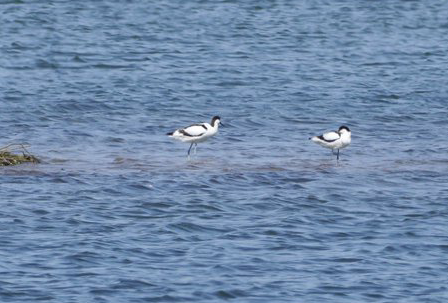
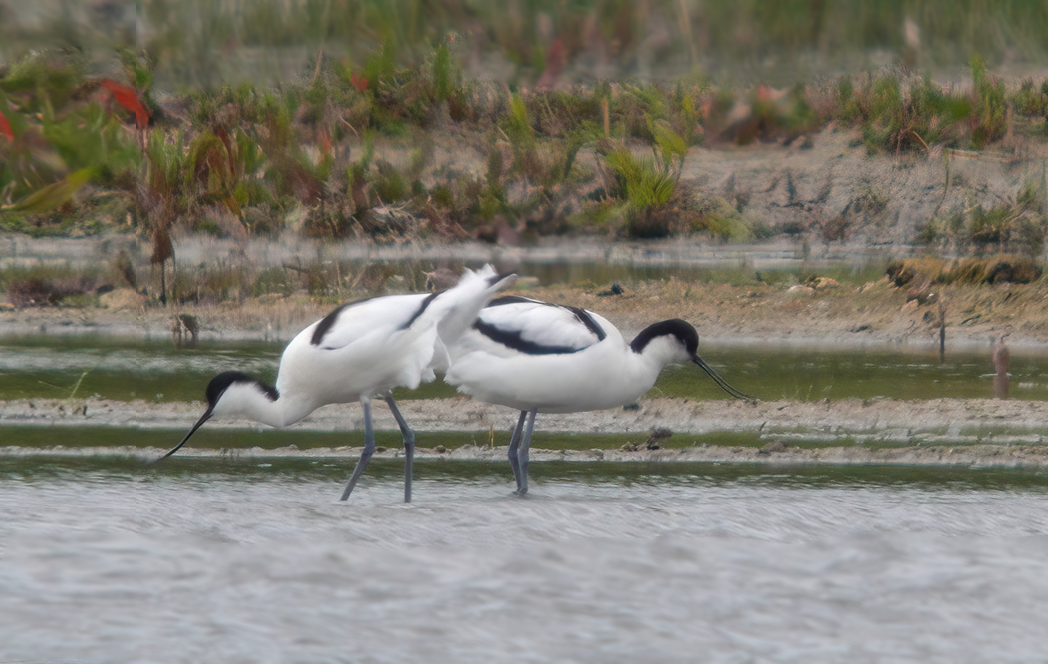
The week’s top waders were down to just three species, Avocets heading the cast with up to seven at Earls Barton throughout the period and one at Clifford Hill on 11th and 13th.
Avocet, Earls Barton GP, 9th June 2025 (Mike Alibone)Avocets, Earls Barton GP, 9th June 2025 (Pete Grimbley)
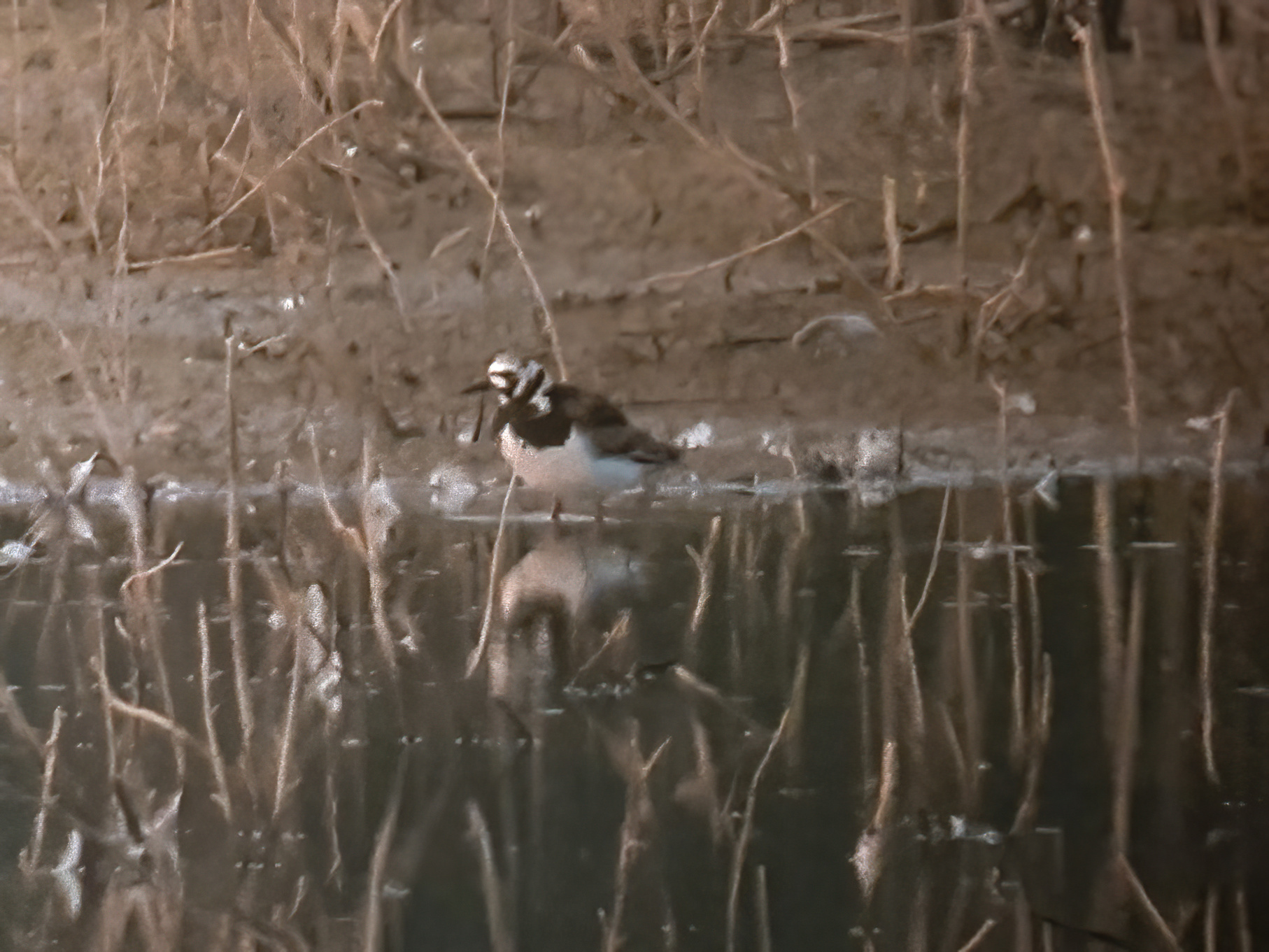
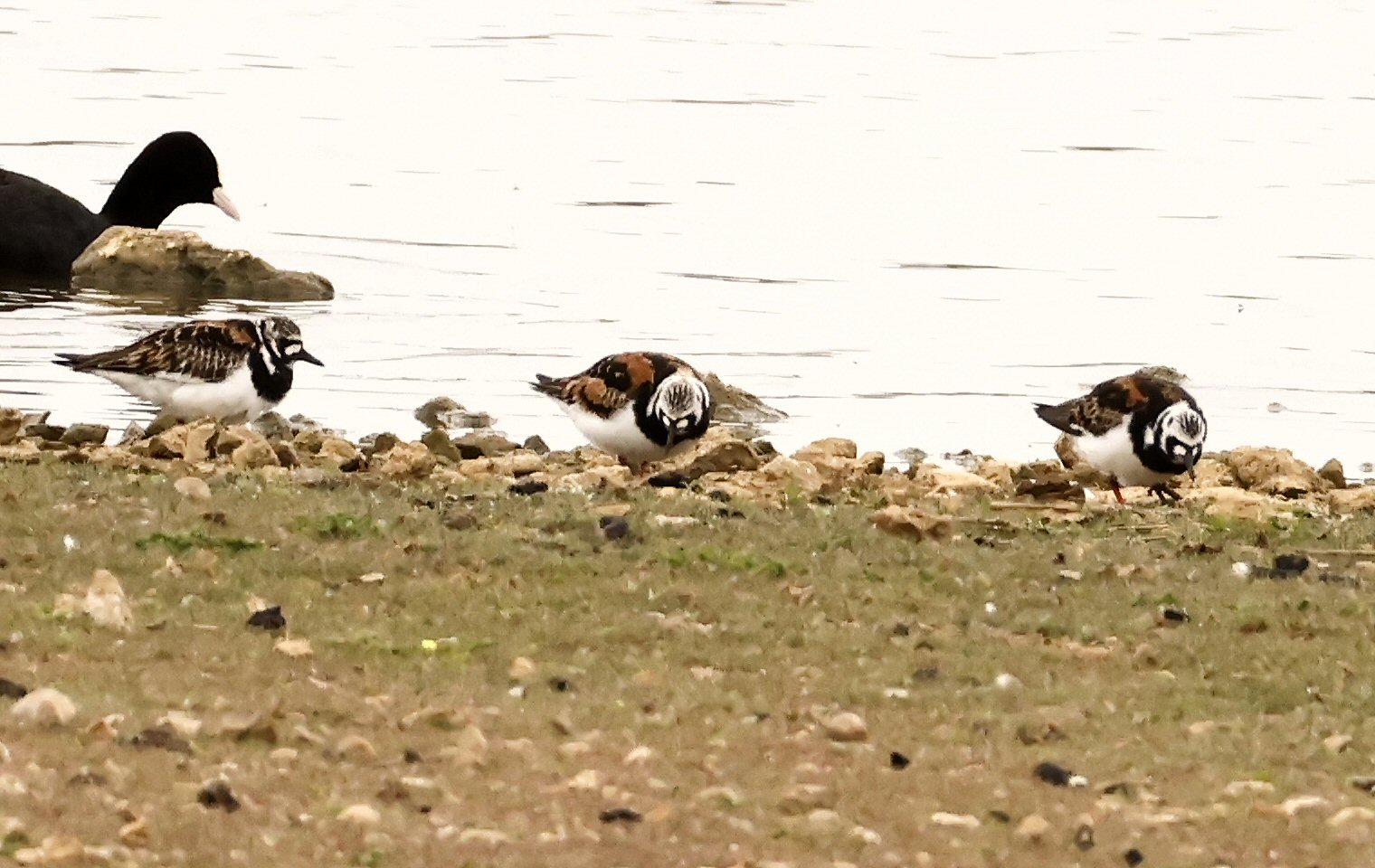
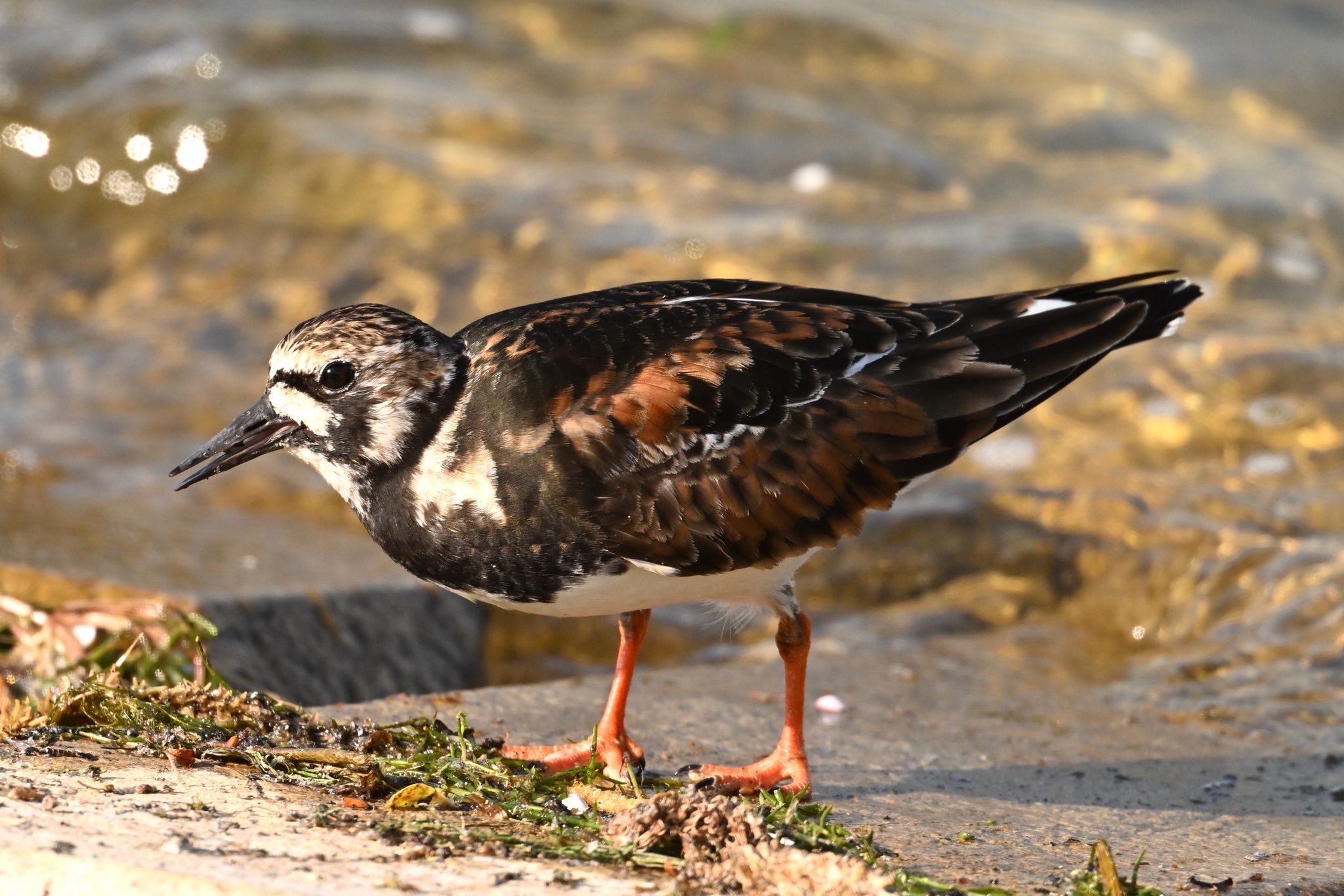
A late-running Turnstone visited Earls Barton for a short time on 9th and the week ended with a Wood Sandpiper at Lilbourne Meadows NR on the evening of 13th.
Turnstone, Earls Barton GP, 9th June 2025 (Pete Grimbley)
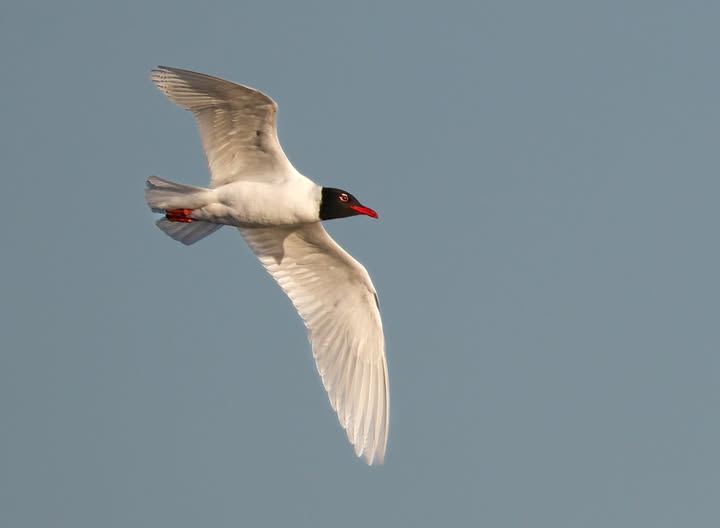
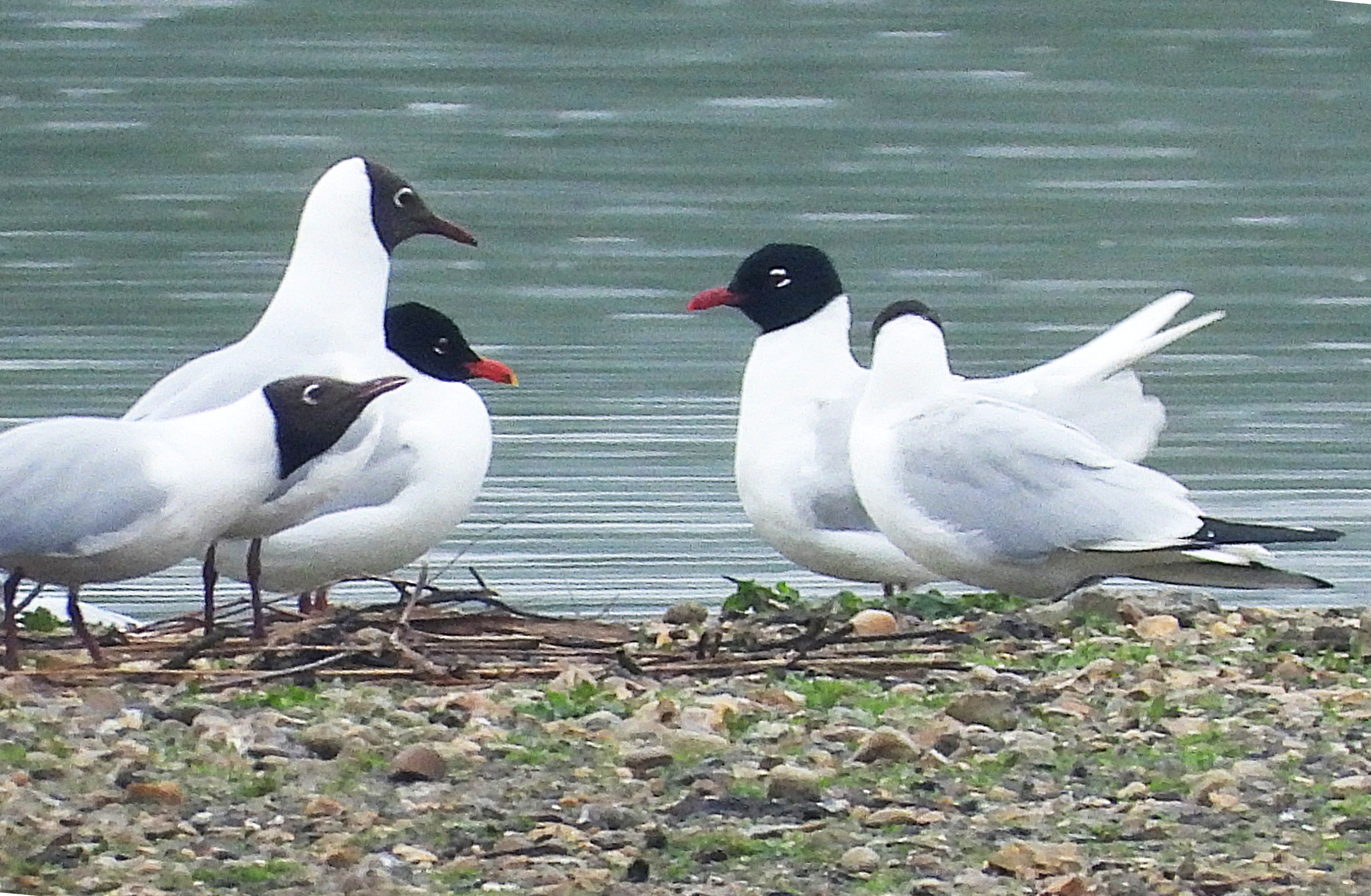
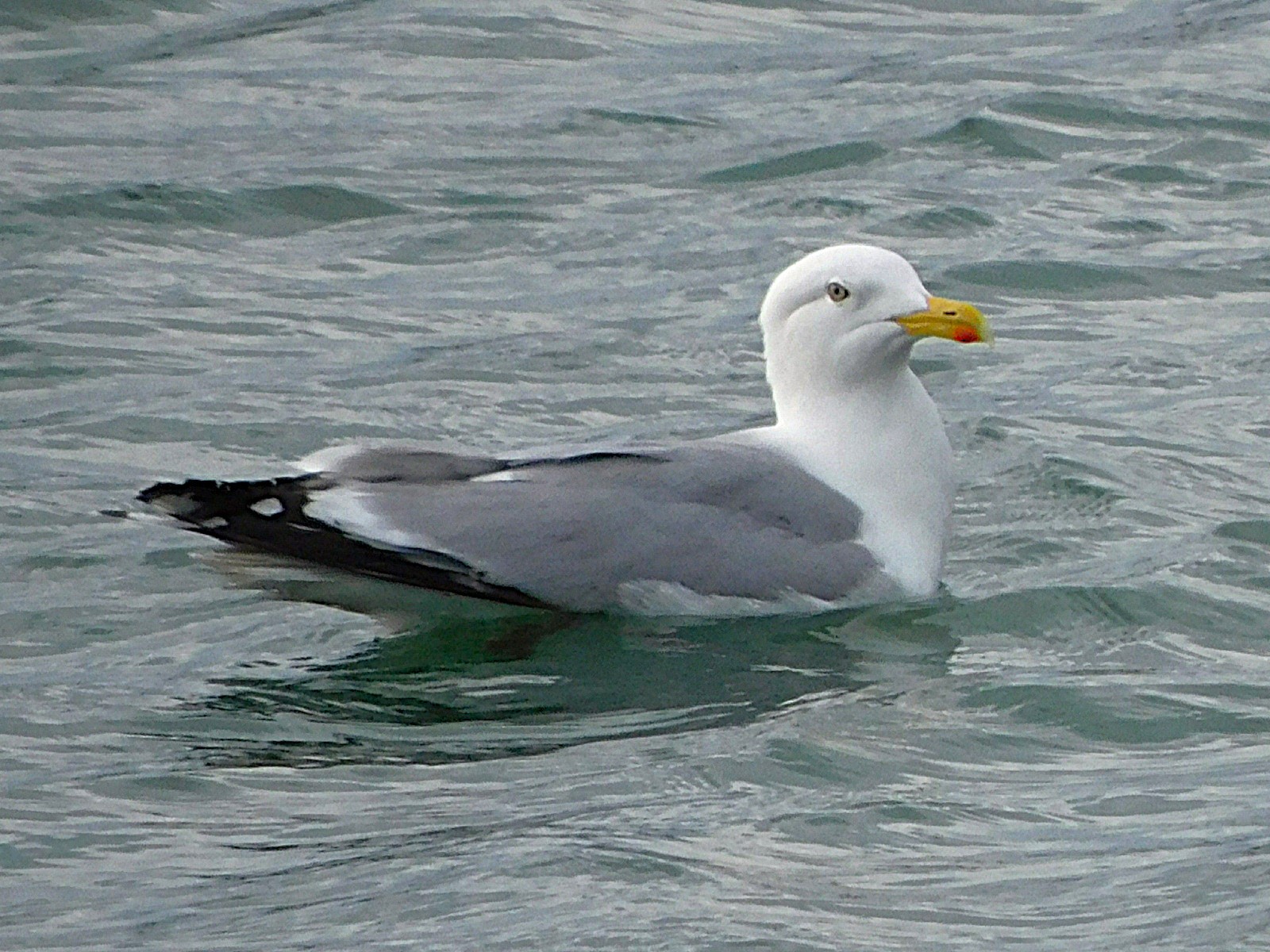
There was an upturn in gull numbers this week, which kicked off nicely with two, apparently prospecting, adult Mediterranean Gulls at Summer Leys LNR on 7th-8th and a second-summer Caspian Gull there on the first of these two dates, while an adult Yellow-legged Gull appeared at Clifford Hill at the period’s end.
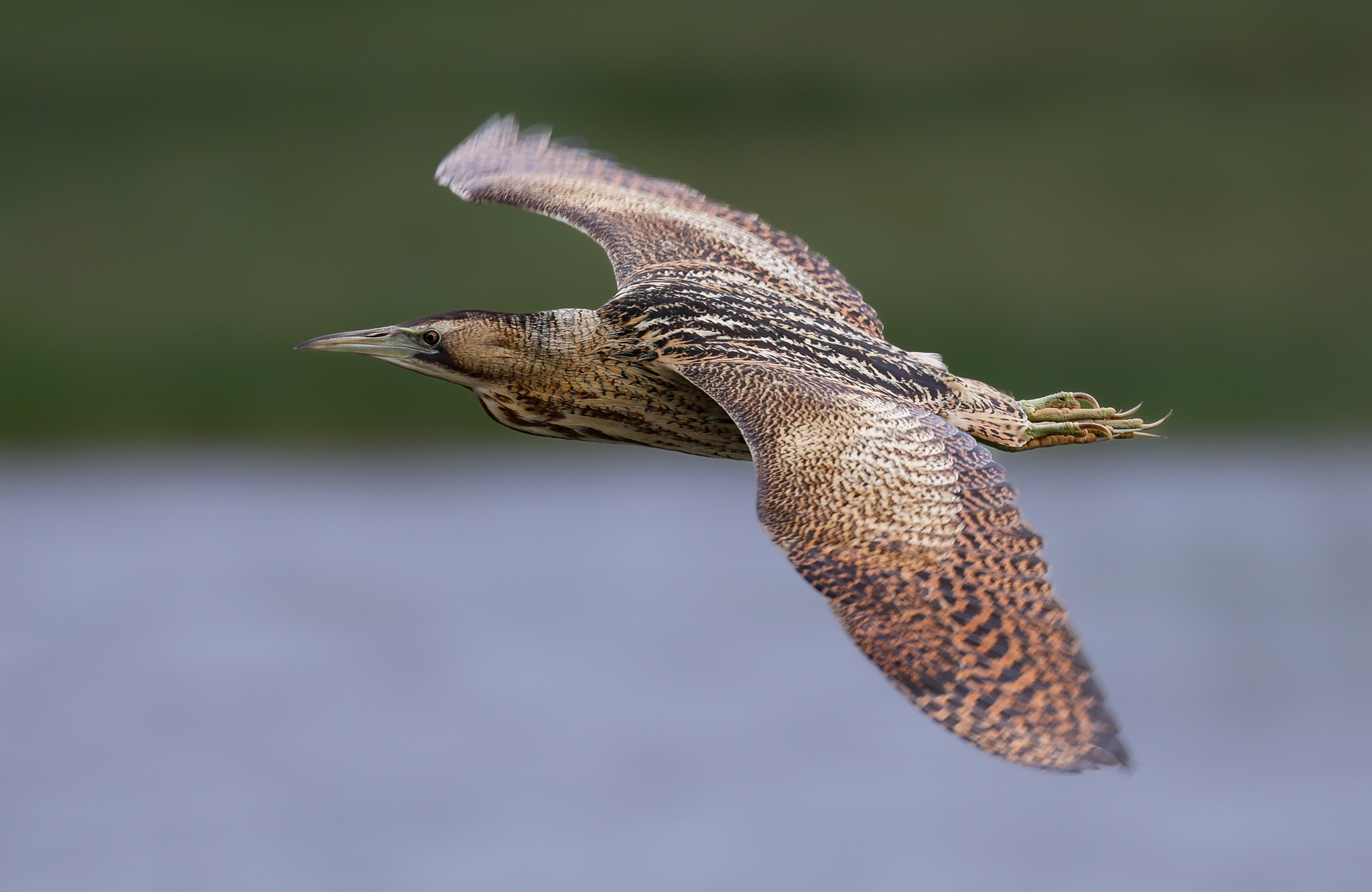
Keeping up weekly appearances, the period’s only Bittern was a decent record for Ravensthorpe Res on 12th, following a surprising lack of sightings from the Nene Valley.
A steady run of Osprey reports came from Pitsford Res, where singles were seen almost daily throughout.
And once again, following two flyovers last week, passerines were limited to Crossbills with a flock of fifteen flying south-east over the above site on 11th. Recent records from elsewhere in the UK suggest the beginnings of a southerly movement on a broad front so, wherever you’re birding, it’s eyes (and ears) to the skies for the foreseeable future …
A westerly airstream off the Atlantic remained in place for much of the period, bringing in numerous heavy showers along with largely below average temperatures and few new migrants. While what is likely to be the last of this year’s new summer visitors made it onto the clock, the week’s two potentially top birds fell into the unconfirmed bracket through hearsay, and all that …
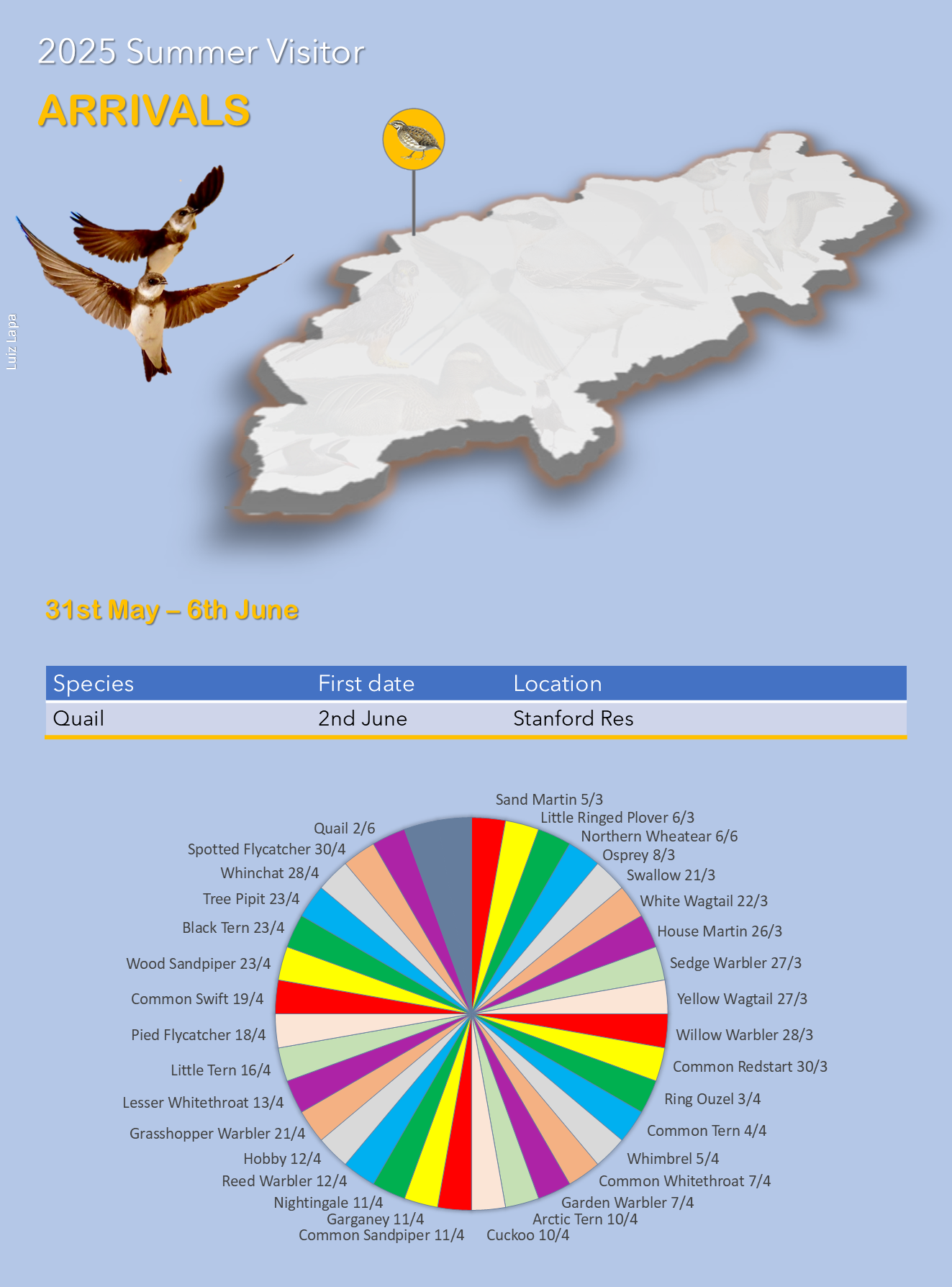
Never common, but even scarcer than they used to be, a male Quail – the year’s first – was singing in a field adjacent to Stanford Res from 2nd until 4th.
The sole representative of its tribe was, once again, the idling drake Red-crested Pochard at Earls Barton GP, remaining there until at least 4th.
Constituting the fifth report for 2025, six Common Cranes in flight over Earls Barton GP’s Grendon Lakes during the closing hours of the week remains just that until further details emerge …
On the ground, though, Avocets were still very much in evidence, with two at Summer Leys LNR on 3rd and up to eight in the wider environs of Earls Barton GP throughout the period.
Avocets, Earls Barton GP, 6th June 2025 (Pete Grimbley)
Although in short supply, other waders were available and a, or the, Tundra Ringed Plover was again at Lilbourne Meadows NR on 3rd, a colour-ringed Black-tailed Godwit paid a brief visit to Earls Barton GP’s New Workings (South) on 4th and a straggling Sanderling remained at Clifford Hill GP from 4th until 6th.
Sanderling, Clifford Hill GP, 4th June 2025 (Mike Alibone)
Gulls were few and far between with, once again, Pitsford producing the week’s Yellow-legged Gull sightings, which were down to single adults there on 2nd and 4th.
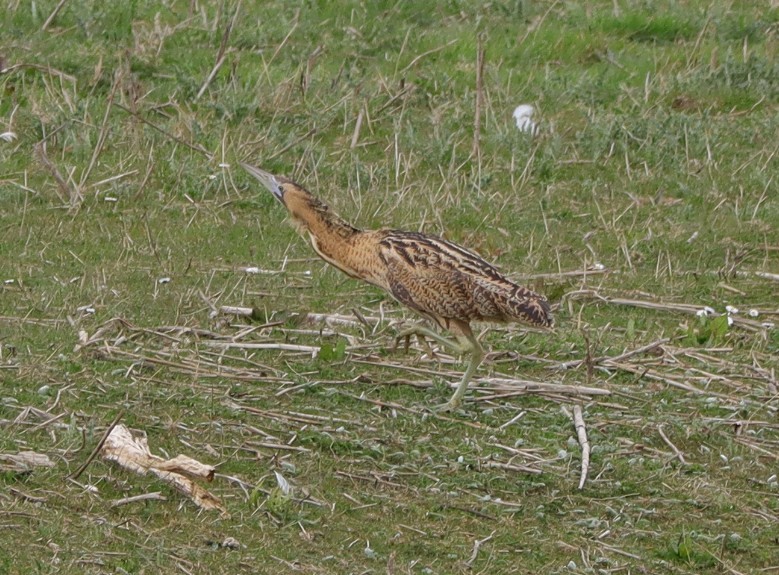
Still statistically rare, but no longer the pulse-raiser it once was, the report of a Glossy Ibis at Summer Leys on 31st passed without event, although at Bittern there on the same day was solidly caught on camera. Another Bittern was present at Thrapston GP’s Titchmarsh NR early on the same date.
Bittern, Summer Leys LNR, 31st May 2025 (Martin Faulkner)
The week’s only Cattle Egret was again at Stanwick GP on 5th.
And the reservoirs laid claim to the period’s Ospreys, with single birds at Pitsford on 31st and 3rd, Stanford on 4th and 6th and a blue-ringed (3AY) six-year-old male – clocked earlier in the year at Summer Leys and Hollowell – visited the latter site again, also on 6th.
Osprey, Stanford Res, 6th June 2025 (Chris Hubbard)
Passerines this week were limited to Crossbills being heard at Pitsford on 2nd and over Irthlingborough on 4th.
The period’s weather was dominated by a slow-moving low pressure system to the north of the UK, delivering west to south-westerly winds and showers throughout, resulting in a somewhat tepid week, birdwise. While it’s commonplace for migration to take a dive as spring fizzles out, the last week of May has, over the years, been known to produce the stuff of legend in the county. Etched into the memories of those of us of a certain age will be the hallowed 29th, which has delivered Bridled Tern, Sooty Tern and Buff-breasted Sandpiper – rarities of the highest eminence, the likes of which may never be seen locally again …
However, the week’s best birds were rather more down to earth, exemplified by the idling drake Red-crested Pochard still present throughout the period at Earls Barton GP.
Avocets were again well represented with nine at the above locality on 30th and twos at Lilbourne Meadows NR from 24th to 27th and at Clifford Hill GP on 27th-28th.
Avocets, Lilbourne Meadows NR, 25th May 2025 (Mike Alibone)
A Grey Pover spent the afternoon and evening at Summer Leys LNR on 29th, the same site having produced a Sanderling on 25th, when one also visited Lilbourne Meadows.
Grey Plover, Summer Leys LNR, 29th May 2025 (Aamir Aziz Mughal)Grey Plover, Summer Leys LNR, 29th May 2025 (Alan Coles)
Lilbourne Meadows also held on to a Tundra Ringed Plover until 27th, while a Greenshank at Pitsford Res on 24th is likely to be the last one for the spring which has seen an unusually good run of them throughout.
The same cannot be said for Kittiwake, an adult – and the first for 2025 – putting in a brief appearance at Thrapston GP’s Titchmarsh NR on 28th before heading off south. This year is fast shaping up to become possibly the worst in recent history for the species … A couple of late Caspian Gulls included one at Pitsford on 24th and a first-summer on floodwater at Braunston on 29th, while Pitsford produced the week’s Yellow-legged Gulls, with two there on 27th and one on 28th.
Bitterns continued to be seen at Summer Leys, where there were two on 25th and single birds on 26th and 30th. With Cattle Egrets up and down of late, five were at the highly favoured North Lake of Stanwick GP on 25th and one dropped in at Clifford Hill on 28th.
Bittern, Summer Leys LNR, 25th May 2025 (Ricky Sinfield)Bittern, Summer Leys LNR, 30th May 2025 (Tony Stanford)
Rounding off this week’s raptors and all, single Ospreys graced the skies over Earls Barton on 24th and Pitsford on 28th-29th.
A more northerly component to the airstream took hold during the period although, despite our having lost conditions conducive to migration, the first White-winged Black Tern for a decade dropped in and a decent wader movement continued – along with some eyebrow-raising reports which went under the radar of mainstream news channels …
Shaking off ‘winter’ wildfowl, it appears, is never done and dusted these days and so it was that a Pink-footed Goose dropping in at Stanford Res on 18th and 21st kept things going in this respect, although the late spring timing perhaps hints at a potentially suspect origin. Unblemished in this respect, however, was the drake Garganey found at Pitsford Res on 22nd, still present there the following day. Astonishingly, this is only the fourth record so far in 2025, so it’s shaping up to become the worst spring for this species in recent years. Having chalked up another week at Earls Barton GP’s New Workings (South), the regular drake Red-crested Pochard seems set to be in it for the long haul …
Never out of the week’s wader lineup these days, Avocets were again at Clifford Hill GP, where four were present on 20th and two on 22nd. For some time now it’s been pretty much an open secret that they have bred at one site in the Nene Valley, where three pairs produced an unknown quantity of young, the first hatching as recently as 17th, but all are now at a point in time where they are facing their highest risk of predation as the site undergoes drainage.
Clifford Hill continued its run of Grey Plovers with one there on 19th-20th and we’re now into the prime season for ‘Tundra’ Ringed Plovers, one of which appeared at Lilbourne Meadows on 20th, still being there on 23rd.
Grey Plover, Clifford Hill GP, 19th May 2025 (Bob Bullock)Grey Plover, Clifford Hill GP, 19th May 2025 (Tony Stanford)
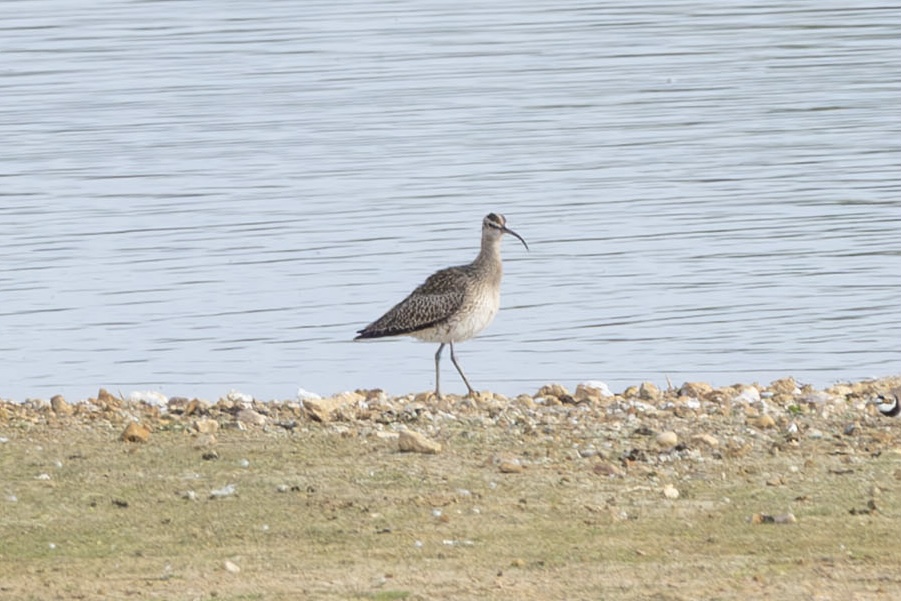
The week’s only Whimbrel – a lone individual –paid a brief visit to Clifford Hill GP on 22nd, the same site producing three Turnstones on 19th and one on 20th, while three visited Thrapston GP’s Titchmarsh NR, also on 19th.
Whimbrel, Clifford Hill GP, 22nd May 2025 (Tony Stanford)Turnstones, Clifford Hill GP, 19th May 2025 (Bob Bullock)
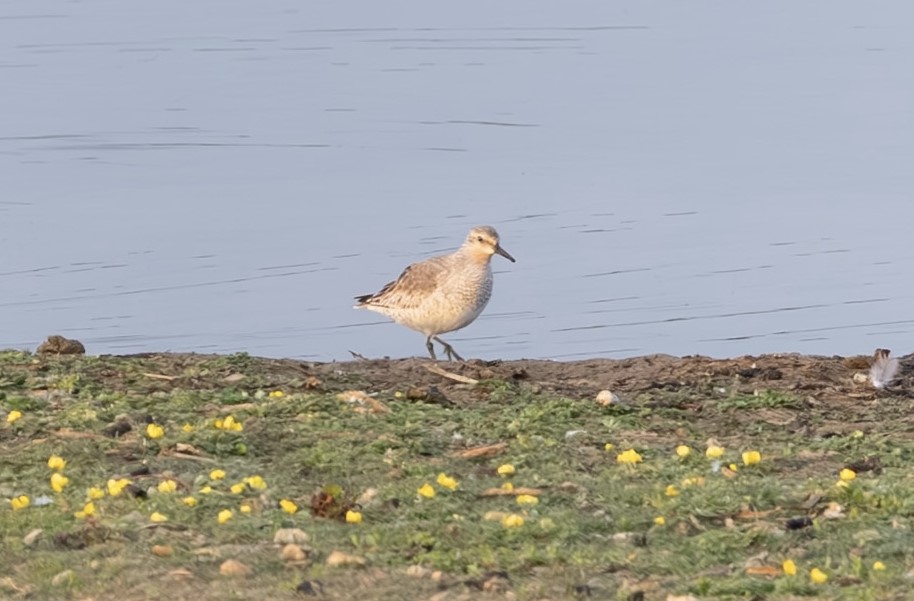
Clifford Hill was again in the spotlight for a first for the year in the shape of a Knot, again on 19th.
Knot, Clifford Hill GP, 19th May 2025 (Tyler Atkinson)Knot, Clifford Hill GP, 19th May 2025 (Bob Bullock)
Sticking with the Nene Valley, Earls Barton produced a Ruff at New Workings (South) on 19th-20th, the same bird moving downriver to Summer Leys on 22nd. The number of Sanderlings saw an increase on last week, with twos at both Clifford Hill and Earls Barton on 18th, one at the latter site on the following day, when three also visited Clifford Hill, where there was one again on 22nd.
Sanderling, Clifford Hill GP, 22nd May 2025 (Pete Grimbley)Sanderling, Clifford Hill GP, 19th May 2025 (Bob Bullock)
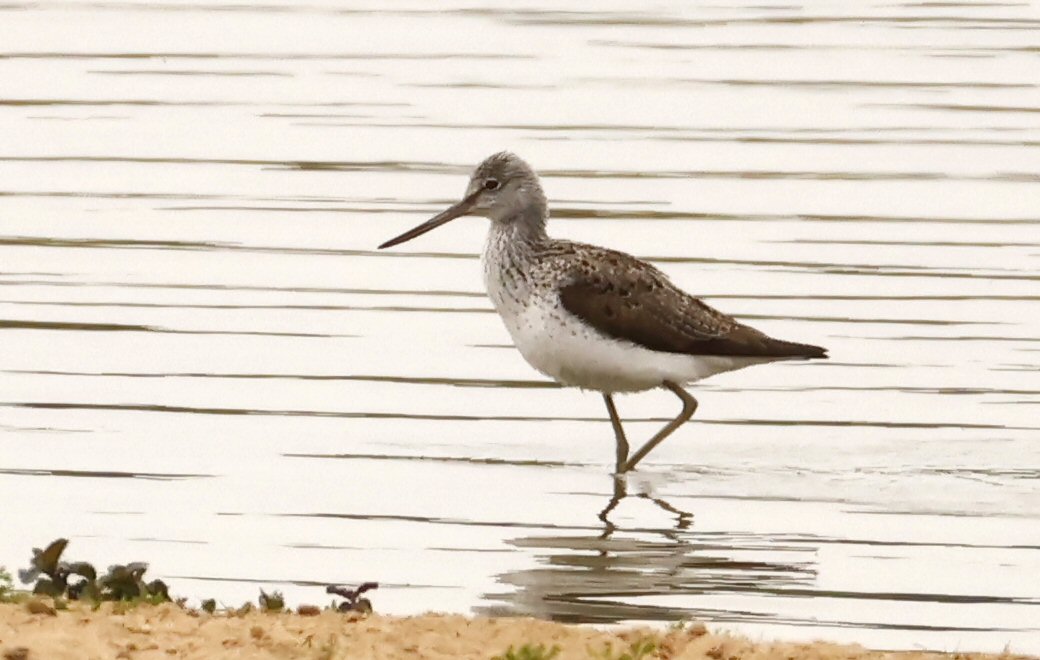
Adding to the wader mix, another Wood Sandpiper was found at Lilbourne Meadows, remaining there the next day. Greenshanks were still on the move, with Earls Barton holding up to three between 19th and 23rd, one at Clifford Hill on 19th, plus one at Pitsford at the week’s end.
Greenshank, Clifford Hill GP, 19th May 2025 (Bob Bullock)
Unsurprisingly, there was little to shout about as far as gulls were concerned, with just two Yellow-legged Gulls on offer – one at Pitsford on 17th and the other, a first-summer, on floodwater at Braunston on 22nd.
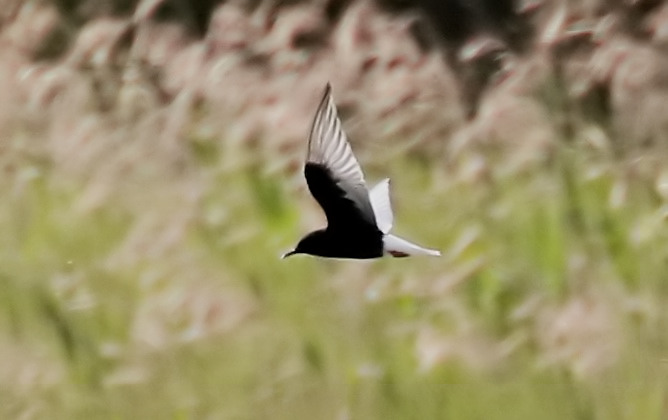
And, after a long wait for many, at the pinnacle of the week’s obtainable rarities was Northamptonshire’s seventeenth ever White-winged Black Tern – and we’ll stick with the old school name as it paints a much more vivid picture, summing up nicely the very essence of the bird itself. Found at Summer Leys, late in the morning on 18th, this, the first in the county for ten years, had the good grace to stick around for at least nine hours, thereby enabling plenty of local birders to catch up with it. And what a bird it was …
White-winged Black Tern, Summer Leys LNR, 18th May 2025 (Bob Bullock)White-winged Black Tern, Summer Leys LNR, 18th May 2025 (Alan Coles)White-winged Black Tern, Summer Leys LNR, 18th May 2025 (Tyler Atkinson)
Left very much in the shade were two Black Terns, downriver at Stanwick GP on the same date.
The period’s Bitterns consisted of just the one seen at Summer Leys on five days out of this week’s seven.
Bittern, Summer Leys LNR, 22nd May 2025 (Clive Bowley)Bittern, Summer Leys LNR, 22nd May 2025 (Stuart Mundy)
And while a Cattle Egret at Earls Barton on 23rd was the only one of its kind seen during the period, something a little more elevated in terms of appeal appeared in the shape of a Purple Heron reported in trees on the island in Ringstead GP’s Kinewell Lake, late in the afternoon of 19th. In a year that has produced a decent number already, another surely does not seem too unlikely.
The week’s Ospreys consisted of singles over Irchester CP on 17th, at Hollowell Res on 19th, Pitsford on 21st and 22nd and at Stanford, also on 22nd.
As for passerines, a Pied Flycatcher was seen briefly at Bucknell Wood on 18th but, going somewhat leftfield, how about the belated report of what could be inline to be Northamptonshire’s second ever Bluethroat – a male – being found between Kings Heath and Kingsthorpe Mill on 16th!? It’s been a long, long time since the first was seen at Ditchford GP on 26th June 1974 …
Seeing out another dry week with, initially, a warm, southerly airstream swinging round to a more northerly flow from mid-period, amid a not insignificant wader rush the county picked up two new birds for the year.
Another week, another Pink-footed Goose – or, more likely, one of last week’s, dropping into Clifford Hill GP on 12th – while the long staying drake Red-crested Pochard saw another week out on the River Nene in the vicinity of Earls Barton GP’s New Workings (South).
Apart from that, it was waders all the way and with Avocets now seemingly run of the mill – but always a pleasure, of course – it came as little surprise that more were to follow. New in were two at Ditchford GP’s Irthlingborough Lakes & Meadows NR on 13th, lingering there on Dragonfly Lake throughout the day, the same date seeing one at Clifford Hill, where it remained until the week’s end.
And after almost three weeks with none, two more Grey Plovers made it into the county, with one at Thrapston GP’s Titchmarsh NR on 10th and the second … where else but what seems to be the main attraction for the species this year, Clifford Hill, on 12th. Single Whimbrels were again to be had at Thrapston GP’s Elinor Trout Lake, where last week’s bird extended its stay until 13th, at Stanwick GP on 15th and at Titchmarsh NR the following day.
New for the year and constituting the very essence of mid-May, Turnstones and Sanderlings arrived on cue – the first of these two species being represented by a very confiding individual on the dam at Pitsford Res on 12th. This was followed the next day by one at Stanwick and three at Clifford Hill, two more turning up at the latter location on 15th, when two also visited Summer Leys LNR. To round the week off, one was found at Titchmarsh on 16th.
Turnstone, Pitsford Res, 12th May 2025 (Jon Cook)Turnstone, Pitsford Res, 12th May 2025 (Bob Bullock)
Sanderlings were in short supply, however, with just single birds at Titchmarsh on 12th and Irthlingborough Lakes & Meadows the following day.
Very much on its own this week, a Ruff made it onto the list for the period when one visited Lilbourne Meadows NR on 12th, while an already decent run of Wood Sandpipers this spring saw two more added, which included one at Lilbourne Meadows on 14th-15th followed by another at Summer Leys on 16th.
Scarce larids were at a premium, their sole representative being a fine adult Mediterranean Gull over Summer Leys on 10th.
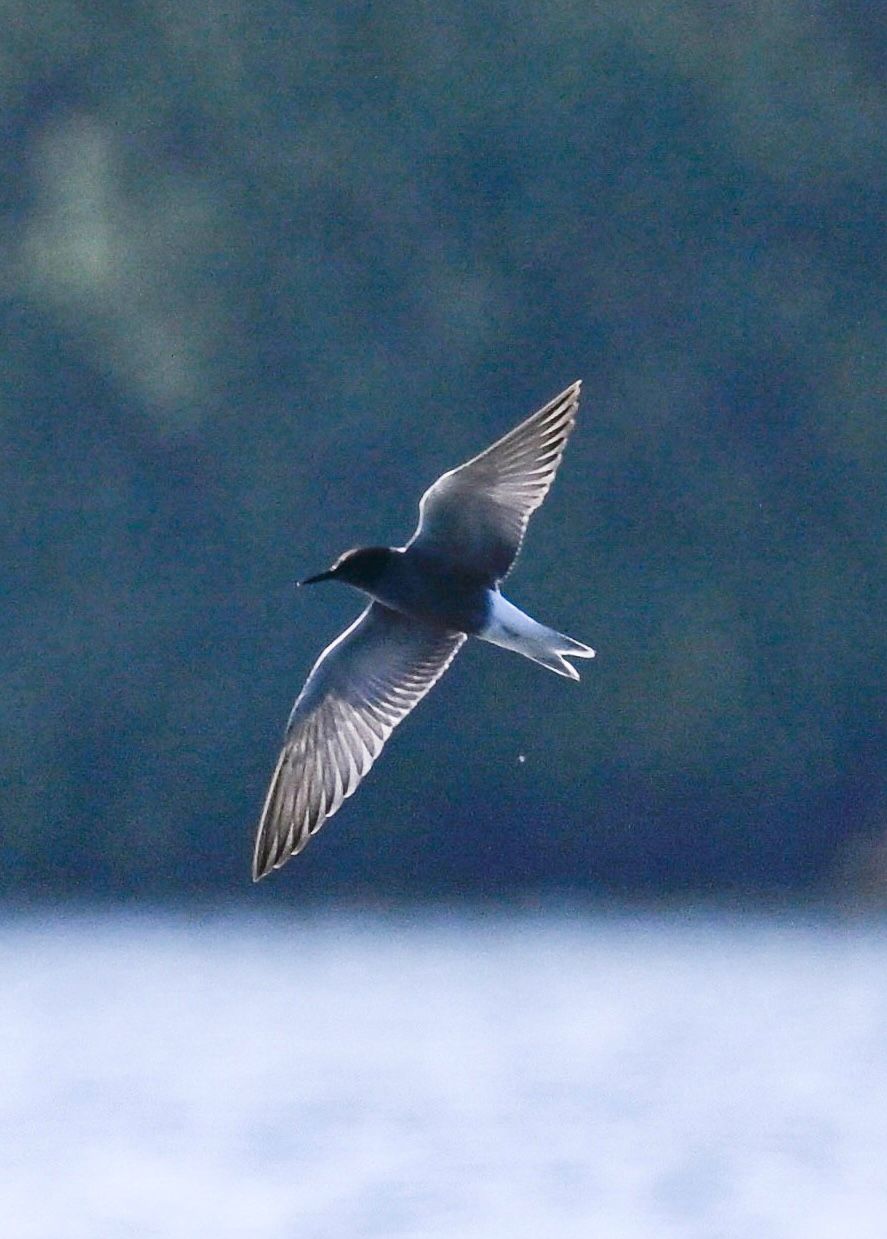
Made of sterna stuff, the same did not apply to terns, however, and a remarkable flock of five Little Terns flying north-east through Irthlingborough Lakes & Meadows on 12th was, unfortunately, not picked up elsewhere along the Nene Valley. An Arctic Tern at Summer Leys on 15th was the only one of the week but Black Terns did a little better with singles at Stanford Res on 10th and Clifford Hill on 12th, when four were also found on Earls Barton GP’s Mary’s Lake.
Black Tern, Stanford Res, 10th May 2025 (Barry Silverman)
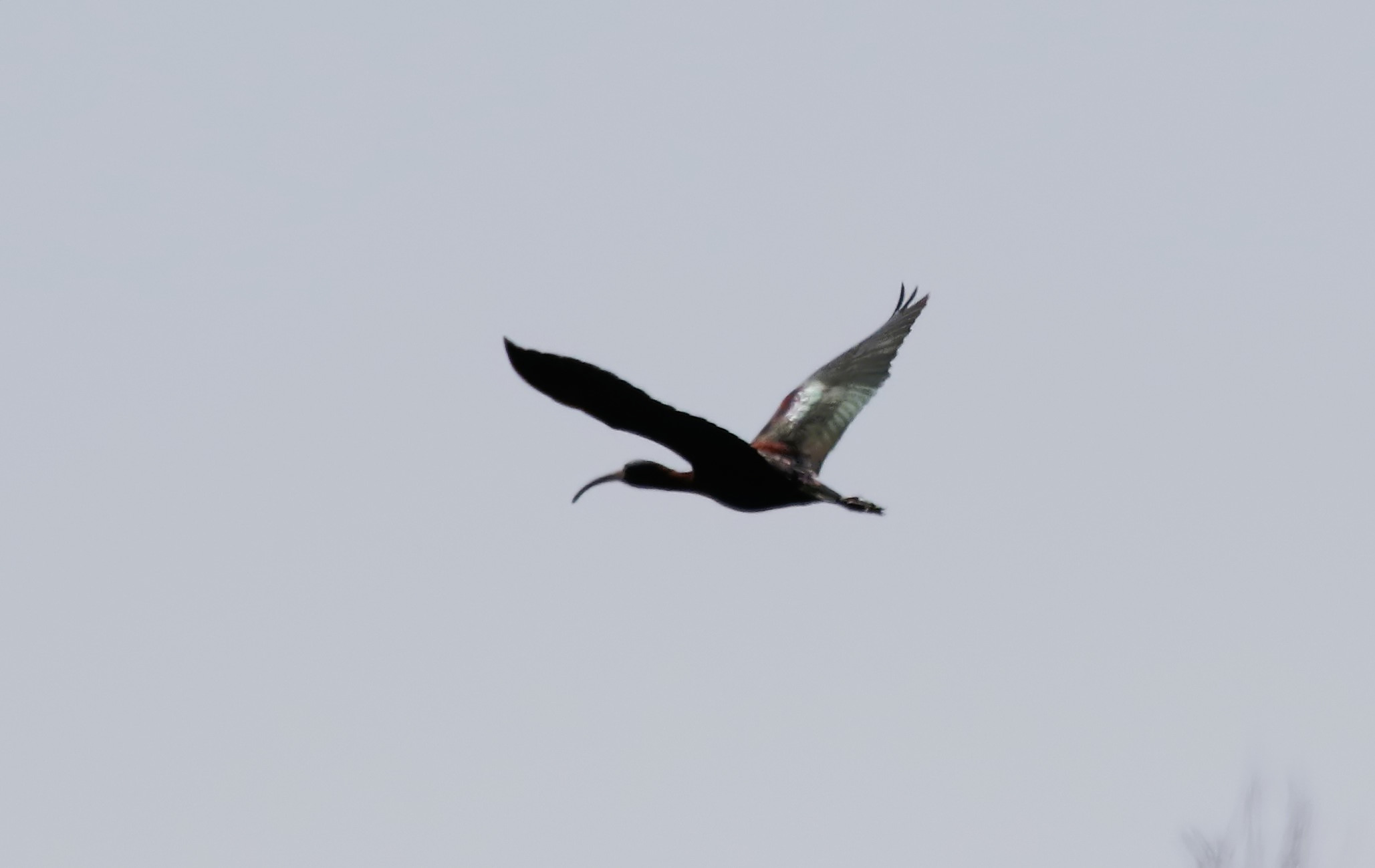
And just when we thought it was all over as far as Glossy Ibis is concerned – the Summer Leys long stayer now long gone – one pitched up at Lilbourne Meadows on 12th, remaining into the afternoon of the following day. On 14th it was no longer on site there but what was surely the same individual was discovered at Stanwick’s Main Lake, early in the morning on that date. Fidgety and flighty, by late morning it had made its way up the valley to Summer Leys, where it was equally skittish and difficult to pin down, before it was last seen flying off north-east in the evening.
Glossy Ibis, Summer Leys LNR, 14th May 2025 (Alan Coles)
It was subsequently seen again at Stanwick early in the mornings of 15th and 16th, after which there was no further sign. All this begs the question … was it our wintering bird from Summer Leys which, prior to this week, was last seen there on 20th April, or was it a new one entirely?
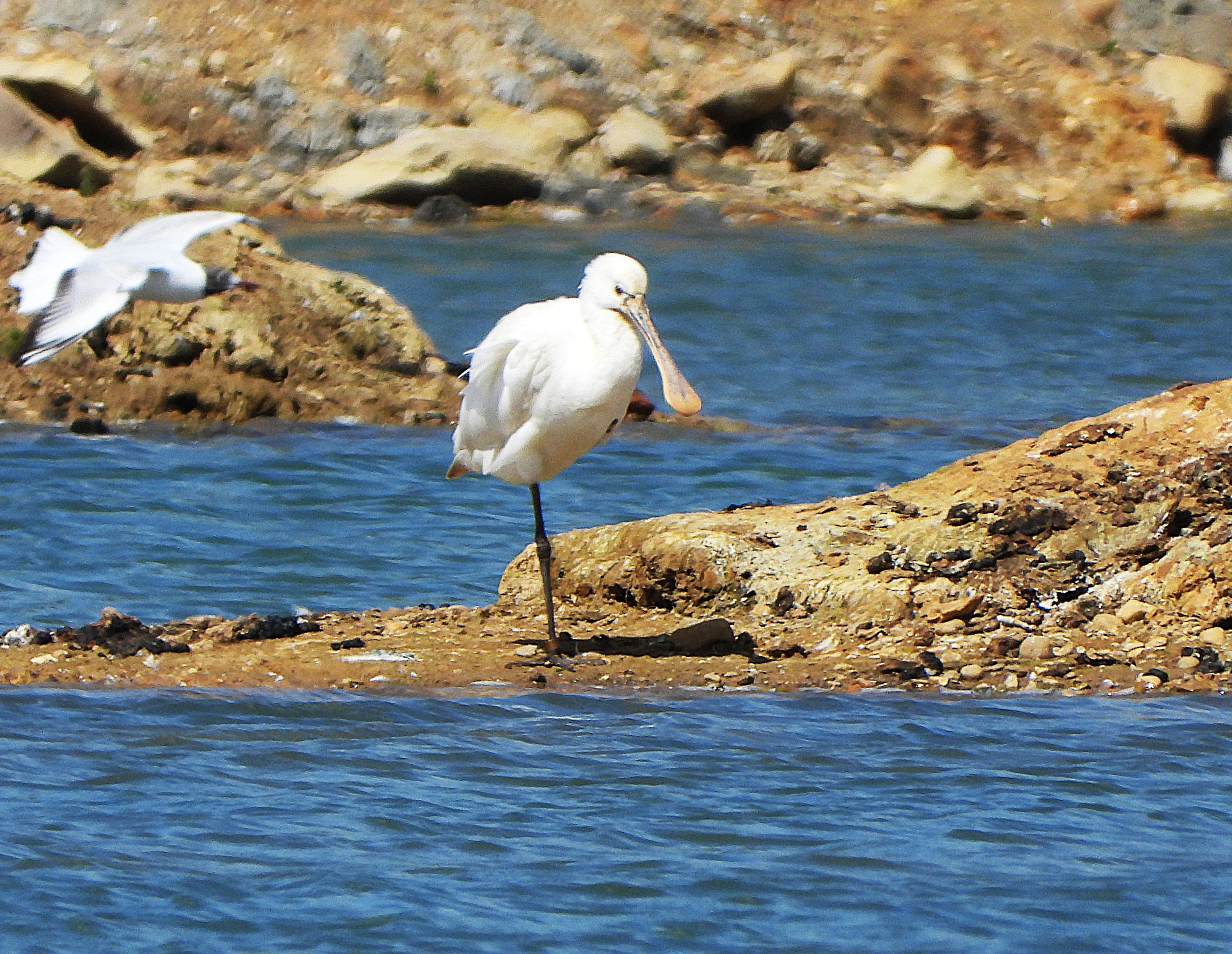
Given the latter’s showy, long winter stay, more desirable in view of its timing and brevity of visit was last week’s Spoonbill, which also made it into this week, hopping from Earls Barton’s New Workings (South) across the river to New Workings (North) on 10th.
Immature Spoonbill, Earls Barton GP, 10th May 2025 (Leslie Fox)Immature Spoonbill, Earls Barton GP, 10th May 2025 (Leslie Fox)
Meanwhile, Titchmarsh logged a Bittern on 10th-11th and 16th and one was in the vicinity of Summer Leys on 14th. Cattle Egrets popped up in two unexpected locations which included Upton CP, where there were two on 10th, and Thrapston GP, where one was present between Elinor Trout Lake and Harper’s Brook on 14th.
Cattle Egrets, Upton CP, 10th May 2025 (Tony Stanford)
The period’s large raptor slot was again filled by Ospreys, singles of which were over both Earls Barton GP and Summer Leys on 11th, Stanford on 15th and Hollowell Res on 16th.
Another Hoopoe – the fourth to be found in the county this year – came to post-observational light this week when one was reportedly flushed from the roadside just north of Watford, on the road to West Haddon, in the early evening of 16th. Another one that got away, leaving birders short-changed once again. One found in an accessible locality, combined with timely reporting, would be most welcome …
Late spring migrant passerines were restricted this week to 11th, when a Whinchat was in the Brampton Valley between Cottesbrooke and Hanging Houghton and a Northern Wheatear was found at Blueberry Farm, Maidwell.
A high pressure system stationed over the UK pulled in an easterly airstream off the continent for much of the period, turning north-easterly for a time during the latter part of the week. There were no new summer visitors recorded but this was more than made up for by some quality birds, topped by the county’s eleventh ever Red-footed Falcon …
Back on the week’s agenda, though, was Pink-footed Goose, appearing at three different locations but, in reality, it’s likely only two birds were involved. The Earls Barton GP’s New Workings (South) individual was again present on 6th, the date on which one was also found at Thrapston GP’s Titchmarsh NR before Summer Leys LNR produced one on 9th.
Equally enthralling was the now seemingly resident drake Red-crested Pochard still at the first of these three sites throughout the period.
In what has undeniably become the best ever year for the numbers of Avocets in Northamptonshire, two more turned up, spending the day at Summer Leys on 6th.
Avocets, Summer Leys LNR, 6th May 2025 (Mike Alibone)
Conversely, it’s been a poor spring so far for Bar-tailed Godwits, the year’s 6th being seen at Stanwick GP on the last day of the week. All have been single birds. A steady trickle of Whimbrels – mainly flyovers – continued throughout and included singles at Titchmarsh and Summer Leys on 4th, Stanwick GP on 5th and 8th where two also flew north-east on 6th. One flew over Clifford Hill GP on 7th and one was on the ground at Thrapston GP’s Elinor Trout Lake on 8th-9th.
And to date, it’s been a great spring for Wood Sandpipers, most of which have been at Summer Leys, which produced two on 3rd, at least four – if not five – on 4th, one on 5th and two on 6th. Greenshanks, too, have been above the usual spring level of abundance with, aside from a long staying bird at Lilbourne Meadows NR from 30th April until at least 9th and up to two at Earls Barton GP all week, three were at Stanwick on 3rd with one there on 4th, one was found at Ditchford GP’s Irthlingborough Lakes & Meadows NR on 5th and another at Pitsford Res on 9th.
Greenshank, Earls Barton GP, 3rd May 2025 (Leslie Fox)Greenshank, Pitsford Res, 9th May 2025 (Jon Cook)
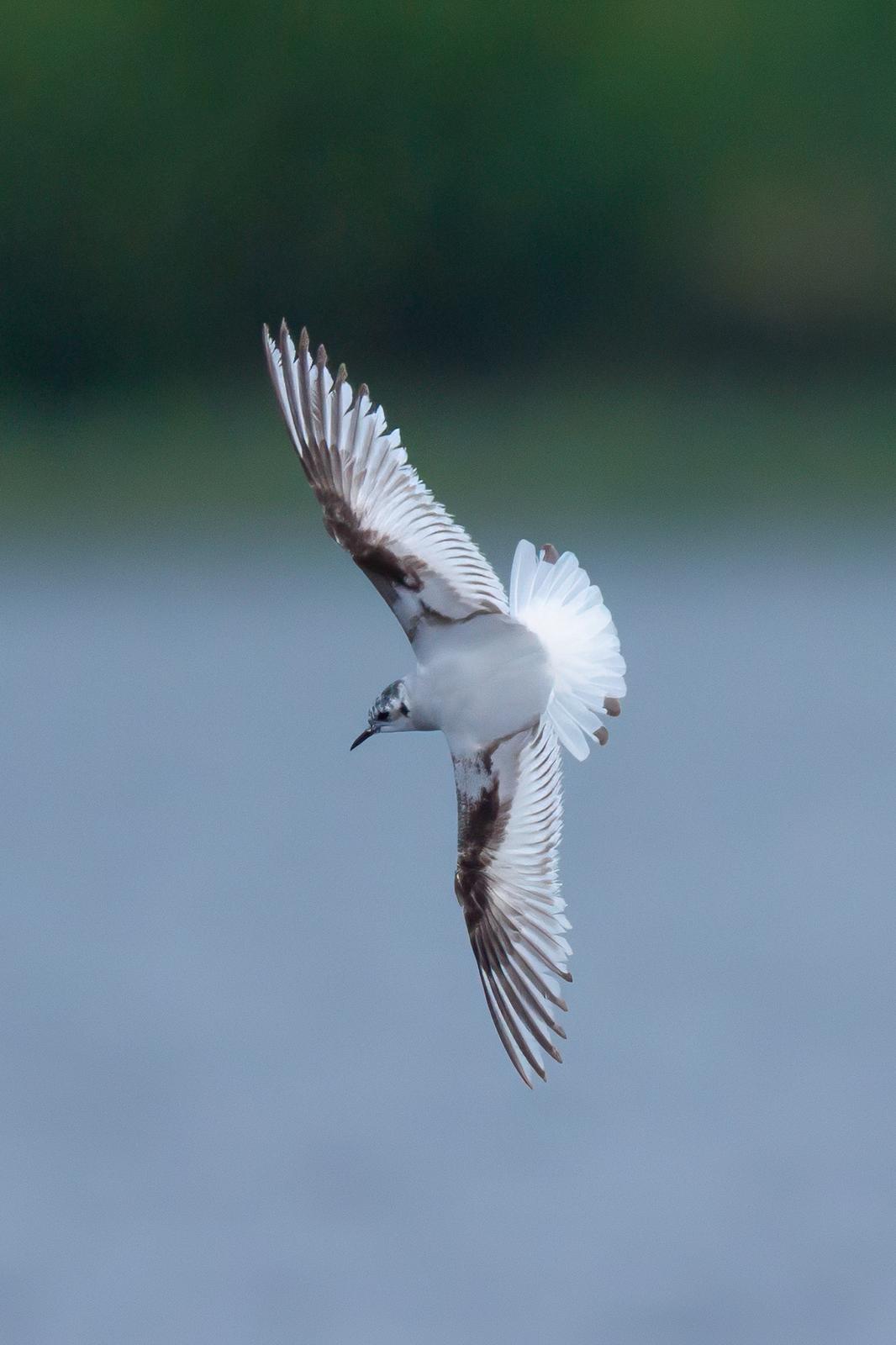
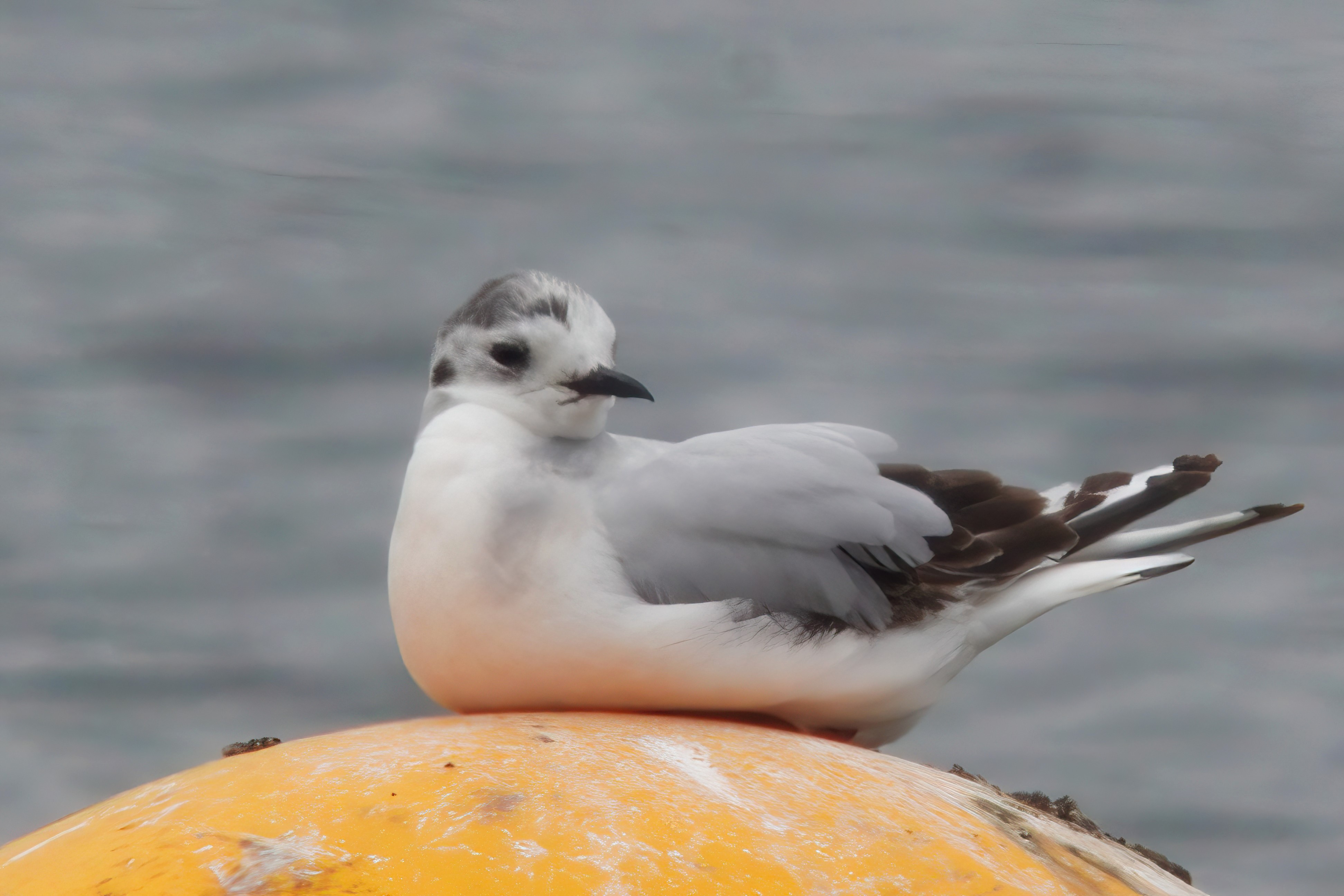
While we were almost running on empty this week, as far as Little Gulls were concerned, with just single first-summers at Stanford Res on 7th and at Daventry CP on 8th-9th, there were even fewer Yellow-legged Gulls, with just a second-summer at Pitsford on 6th.
First-summer Little Gull, Stanford Res, 7th May 2025 (Paul Bunyard)First-summer Little Gull, Daventry CP, 8th May 2025 (Gary Pullan)First-summer Little Gull, Daventry CP, 8th May 2025 (Mike Alibone)
This was not the case for Arctic Terns however, with, after none last week, a decent passage during the early half of the period comprising, on 5th, flocks of twenty-seven and two separate individuals at Stanford, approximately twenty at Summer Leys, eleven at Stanwick, six at Thrapston and two at Earls Barton. Two were at Summer Leys on 6th and 8th, with one at Earls Barton on the first of these two dates.
Summer Leys also produced the week’s Black Terns, with one on 4th-5th and four on 8th.
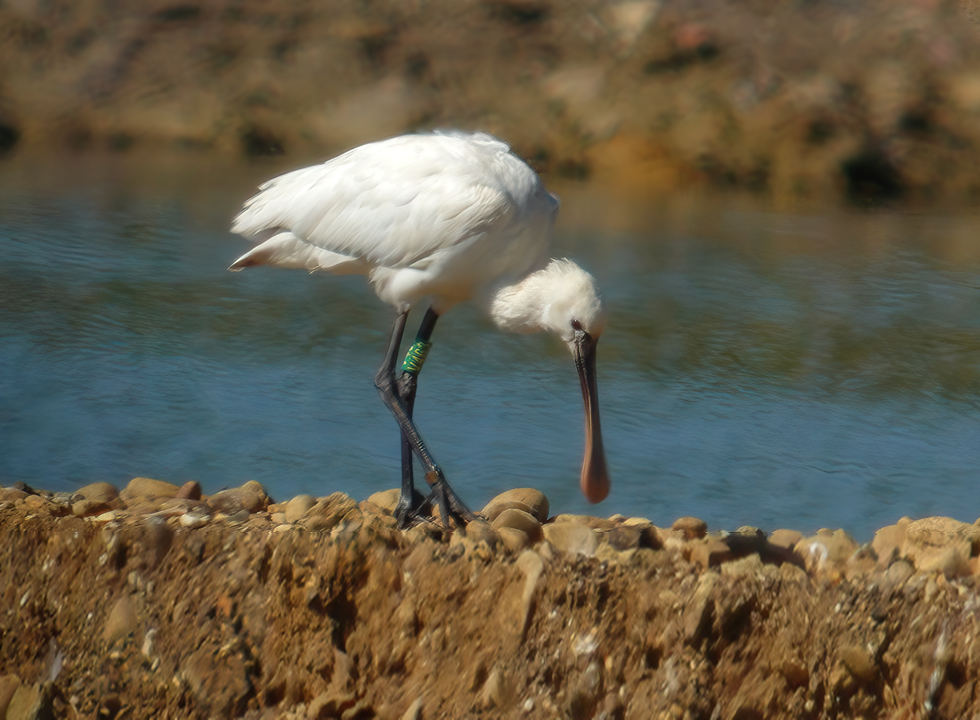
And following last week’s short-stayer, local birders were offered a second bite of the cherry when it came to catching up with a Spoonbill on the ground. After one seen flying west over Earls Barton’s New Workings during the morning of 9th, it appears the same bird surreptitiously doubled back and landed to roost awhile there, only to be discovered by visiting birders mid-afternoon. It was present for a shade over two hours before taking to the air once again, after which it wasn’t relocated.
Immature Spoonbill, Earls Barton GP, 9th May 2025 (Mike Alibone)Immature Spoonbill, Earls Barton GP, 9th May 2025 (Mike Alibone)
But the story on this individual continues, as a peek at it stretching its left leg – the latter tucked up while roosting – revealed a green colour ring inscribed with the white alphanumeric code V463, identifying it as a bird from Denmark, where it was ringed as a nestling at Høje Sande, Ringkøbing Fjord on 10th June 2023. It subsequently appeared at Marazion Marsh, Cornwall on 28th September of the same year, before moving north to Potteric Carr, South Yorkshire, where it was seen on 10th-15th October, and then returning to Marazion Marsh four days later, commuting between there and the Hayle Estuary and remaining in the area until March 2024. It again returned to the Hayle in September 2024.
Single Bitterns were again seen and heard around the Summer Leys/Earls Barton area on 5th and 7th and the week’s Cattle Egrets were limited to a group of four at Stanwick on 3rd.
The period’s large raptor slot was filled by Ospreys including two together at Hollowell Res on 3rd and 9th, plus singles at Summer Leys on 3rd, Pitsford on 5th and 6th, Stanford on 8th and 9th and Earls Barton on the last of these dates.
Male Osprey, Stanford Res, 9th May 2025 (Paul Bunyard)
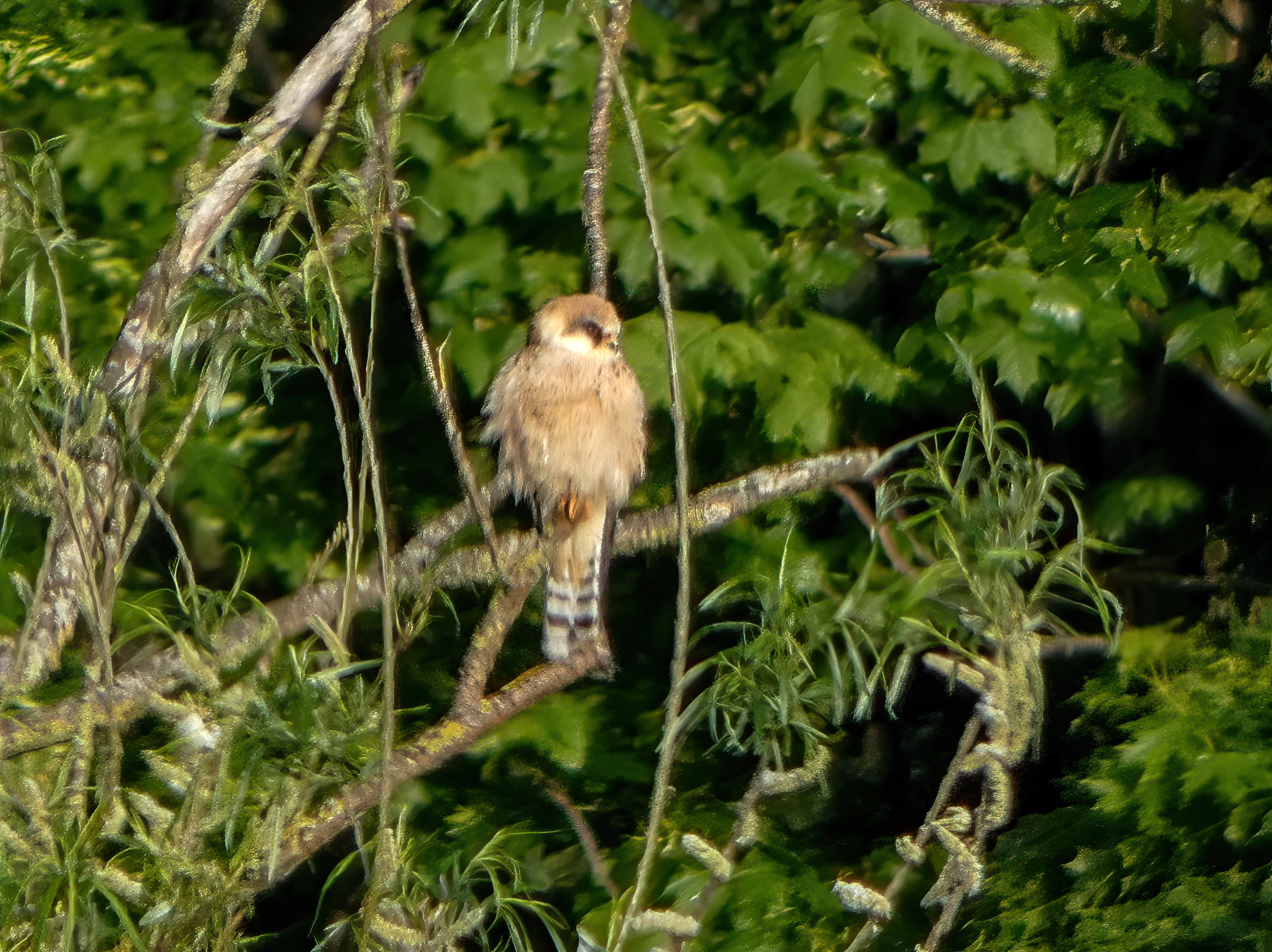
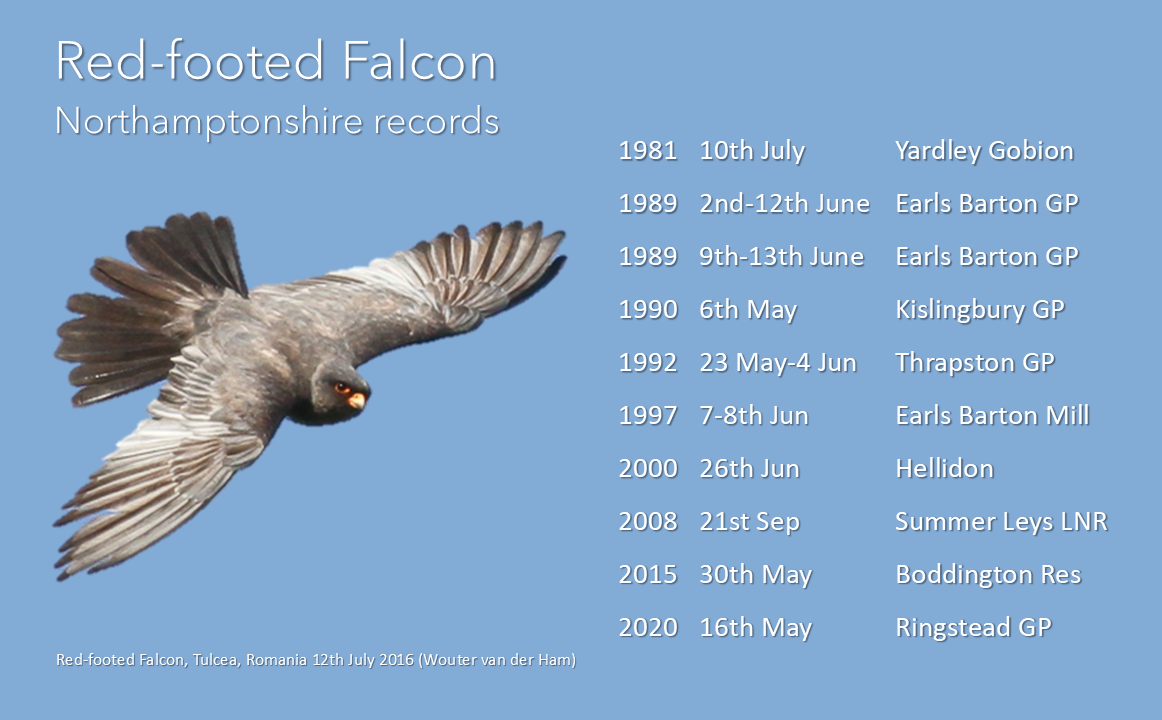
But occupying the week’s prime slot was the first Red-footed Falcon for five years – and rightly so as the county has done nothing to deserve being excluded from the nation’s hefty influx of at least fifty birds over the last week … which makes a refreshing change for Northamptonshire. The bird, a female, was found at Clifford Hill GP early in the day on 7th and remained in the area for nearly two and a half hours, allowing those quick off the mark to reap the benefit of its presence before it spiralled up, up and away … This is only the eleventh Redfoot for Northants, following the last, at Ringstead GP, in May 2020.
Female Red-footed Falcon, Clifford Hill GP, 7th May 2025 (Chris Gibbs)Female Red-footed Falcon, Clifford Hill GP, 7th May 2025 (Chris Gibbs)
And then there were passerines … just. A male Pied Flycatcher was reported fleetingly from Summer Leys on 8th and what might just turn out to be the last Common Redstart of the spring was at Cransley Res on the same date. More to come? We’ll see soon enough …
Another dry week, weatherwise, saw a largely southerly airflow across the UK – indeed in the last few days all four nations of the UK experienced their hottest temperatures of 2025 so far. On the penultimate day, we saw the UK’s highest ever 1st May temperature of 29.3°C at Kew Gardens, London, while Northamptonshire mustered a decent 26°C – all of which facilitated the continued passage of spring migrants and the arrival of more summer visitors …
Two new summer visitors were logged during the week, with Whinchat and Spotted Flycatcher making it onto the clock before April was out.
As the number of wildfowl continued to wane, a female Smew found at Thrapston GP’s Titchmarsh NR on 2nd was likely the first May record for the county and only the fourth for the year. A single drake Garganey in the Brampton Valley between Brixworth and Spratton, on 26th, was only the third this year in what has turned out to be a rather lacklustre spring for the species so far. Lest we should forget, the drake Red-crested Pochard remained on the River Nene in the Earls Barton GP’s New Workings (South) area throughout the period.
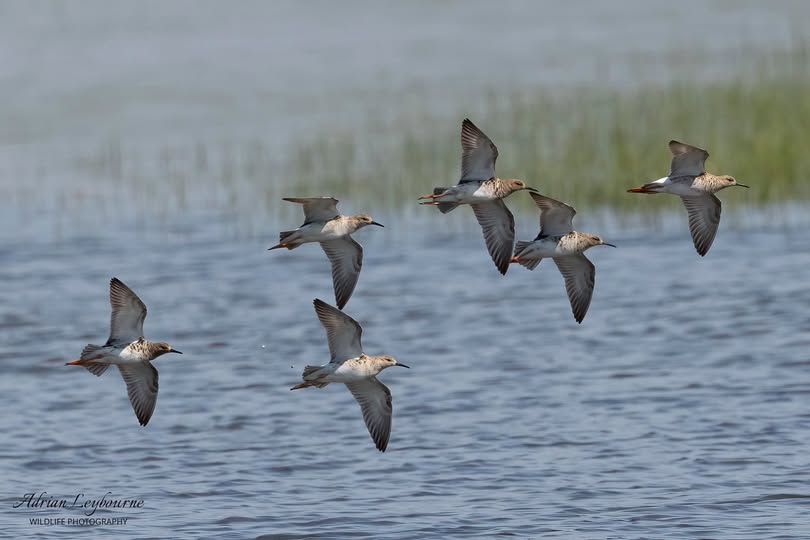
Avocets notwithstanding, the week’s waders comprised five species that were readily accessible and yielded no surprises. Five Whimbrels flew low east over Earls Barton’s New Workings on 28th, followed by singles over Stanford Res on the same date, at Titchmarsh NR on 29th, over Stanwick GP on 30th, at Clifford Hill GP on 1st and at Summer Leys LNR on 2nd. The latter site also produced single Black-tailed Godwits on 27th and 29th, as well as a run of Ruffs, with four on 26th, one on 28th, six on 29th and two on 30th, on which there was also one at Lilbourne Meadows NR and a remarkable fifteen at Titchmarsh NR.
Ruffs, Summer Leys LNR, 29th April 2025 (Adrian Leybourne)
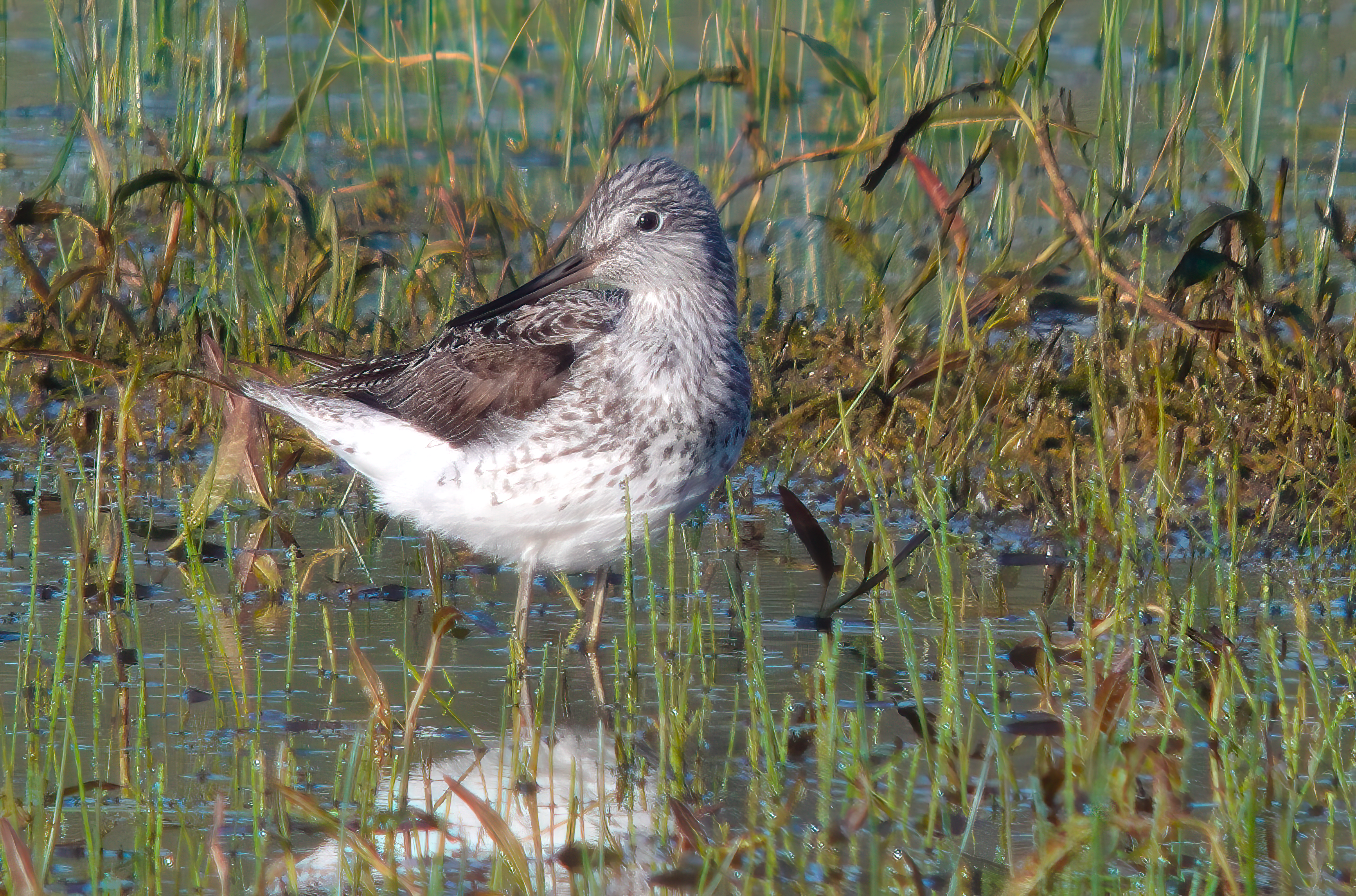
That just leaves the period’s Tringas to deal with – this week’s in the form of Greenshanks and Wood Sandpipers. In the first instance, Summer Leys was the standout site, producing a respectable five on 29th, singles on 28th and 30th and two on 1st. Elsewhere, two were at Ditchford GP’s Irthlingborough Lakes & Meadows NR on 2nd and singles were at Earls Barton on 26th, 30th and 2nd and one lingered at Lilbourne Meadows from 30th until 2nd.
Greenshank, Summer Leys LNR, 30th April 2025 (Mike Alibone)
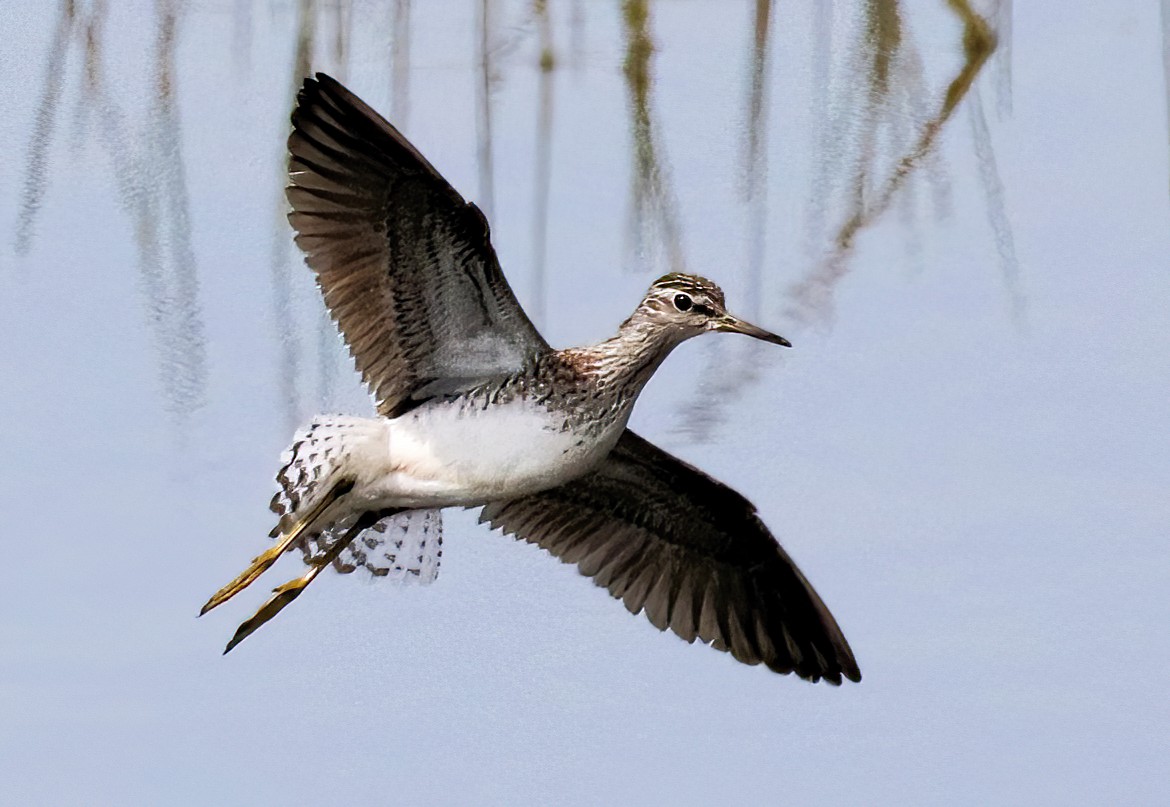
Summer Leys was also the prime site for Wood Sandpipers, holding two on 29th, three on 1st and two on 2nd while, way out west, one was present on floodwater by the canal at Braunston on 1st-2nd.
Wood Sandpiper, Summer Leys LNR, 1st May 2025 (Clive Bowley)Wood Sandpiper, Summer Leys LNR, 1st May 2025 (Bob Bullock)Wood Sandpiper, Summer Leys LNR, 2nd May 2025 (Alan Coles)Wood Sandpiper, Summer Leys LNR, 2nd May 2025 (Alan Coles)
A minor resurgence of Little Gulls occurred mid-week, when a first-summer was mobile around Summer Leys and adjacent Mary’s Lake on 29th and 30th and three visited Clifford Hill on the first of these two dates.
First-summer Little Gull, Earls Barton GP, 29th April 2025 (Richard Hall)
And last week’s two adult Mediterranean Gulls managed another Nene Valley flypast when they cruised over Earls Barton GP’s New Workings before taking in the delights of Summer Leys and adjacent Mary’s Lake on 27th. Meanwhile, Yellow-legged Gulls were down to just the one at Ravensthorpe Res on 30th and three at Pitsford on the same day.
The week’s tern highlight was provided by two the Little Terns that stuck around at Earls Barton GP’s Hardwater Lake, putting on a decent show for most of the day on 29th, also commuting to, and from, Summer Leys Main Lake. One also paid a fleeting visit to Titchmarsh NR on the morning of the same date.
Little Terns, Earls Barton GP, 29th April 2025 (Alan Coles)Little Terns, Earls Barton GP, 29th April 2025 (Bob Bullock)
The busy proceedings of the 29th also extended to include three Black Terns at Summer Leys, followed by six at Stanford Res one the following day.
Meanwhile, Pitsford’s long-staying Great Northern Diver enjoyed a resurgence in popularity as it was flagged up as still being present in its much favoured area of The Narrows on 29th, remaining there until at least 1st.
After two flying high north-east over Summer Leys on 21st, the second Spoonbill sighting of the year was, this time, one on the ground at Stanwick in the early morning of 2nd. Nothing good lasts for ever, though, and it was up, up and away to the south-west only 35 minutes after its discovery. What was presumably the same bird was seen heading west over Summer Leys some 90 minutes later.
Immature Spoonbill, Stanwick GP, 2nd May 2025 (Steve Fisher)Immature Spoonbill, Stanwick GP, 2nd May 2025 (Steve Fisher)
And while single Bitterns were again seen and heard around the Summer Leys/Earls Barton area during the period, they were undoubtedly totally overshadowed by a Purple Heron in flight over the reserve on 27th. It was believed likely to have landed in the vicinity and, adding credence to this, it was seen again briefly in flight before undeniably landing there on 1st. Interestingly, one was seen in flight over Pitsford during the intervening period, on 29th. This represent only the twenty-third Northamptonshire record, as well as being the third consecutive year that this scarce, slinky Ardea has been clocked in the county …
Purple Heron, Summer Leys LNR, 27th April 2025 (Andy Howell)
As far as raptors were concerned, Osprey was the sole representative of the tribe this week, with singles on 26th at Hollowell, Pitsford and Stanford Reservoirs, on 27th over Earls Barton and Glapthorn Cow Pasture, again at Pitsford on 29th and at both Hollowell and Ravensthorpe the following day.
Passerines were really rather thin on the ground during the period with the best being a female Ring Ouzel left over from last week at Harrington AF on 26th.
Female Ring Ouzel, Harrington AF, 26th April 2025 (Phil West)
The same site produced the year’s first Whinchat, two days later, on 28th, followed by further singles in the Brampton Valley between Cottesbrooke and Hanging Houghton on 29th, Blueberry Farm, Maidwell on 1st and Hollowell on 2nd.
Male Whinchat, Hollowell Res, 2nd May 2025 (Jon Cook)Male Whinchat, Hollowell Res, 2nd May 2025 (Bob Bullock)
And in line with the maturity of the spring, the number of Northern Wheatears tailed off, with Harrington producing up to two between 26th and 28th and Summer Leys one on 1st. The same also applies to White Wagtail, just one of which was found at Summer Leys on 2nd. Back at Harrington, a flyover Corn Bunting was only the second of the year of this sadly declining species.
The largely south-westerly airstream continued as the country became sandwiched between an Atlantic low and a North Sea high pressure system. Unsurprisingly, there were more firsts for the year, set against a dramatic backcloth of mostly rain-driven Arctic Terns and some interesting waders.
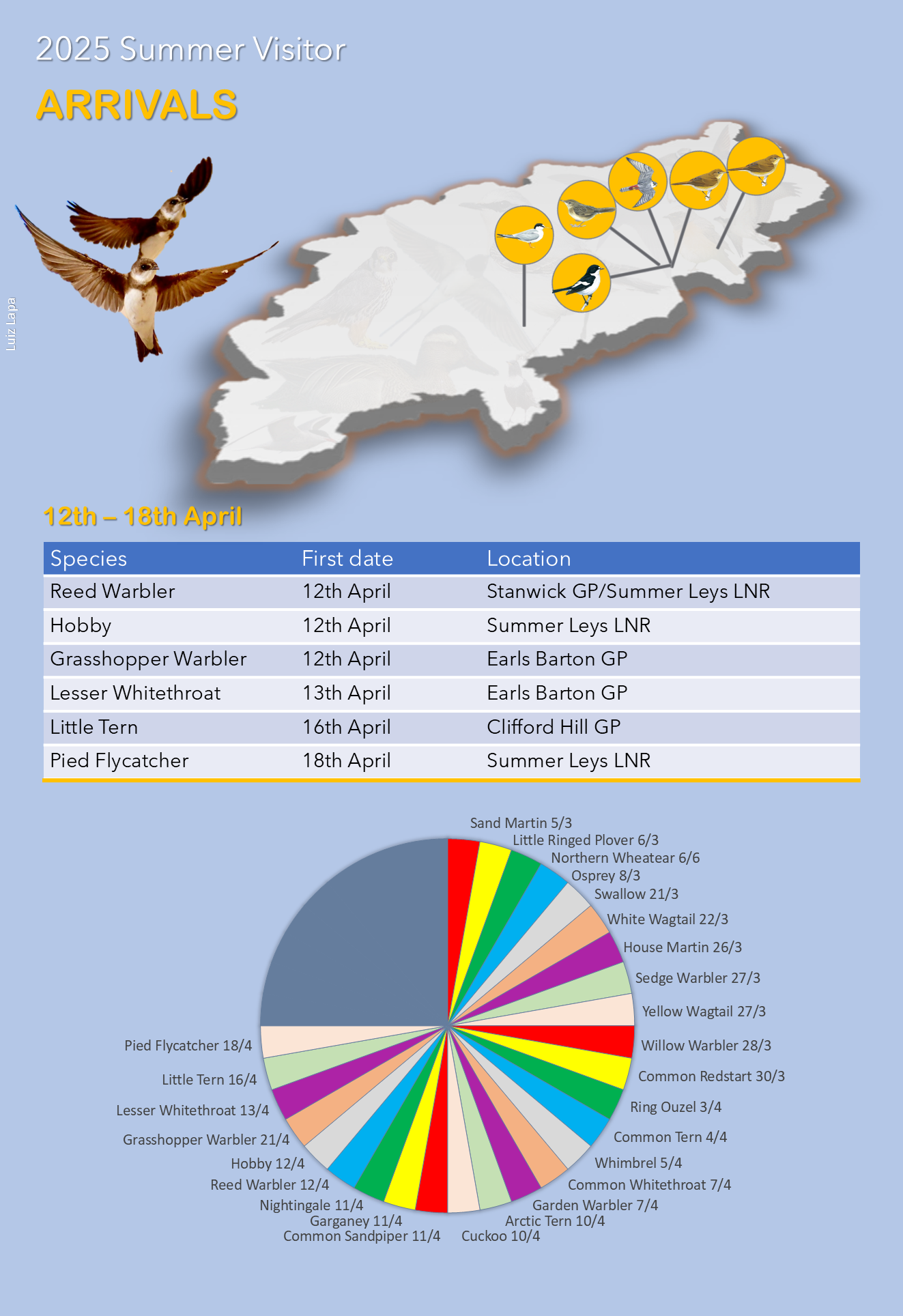
Added to the summer visitor clock this week were Common Swift, two rather less common species and one now deemed scarce.
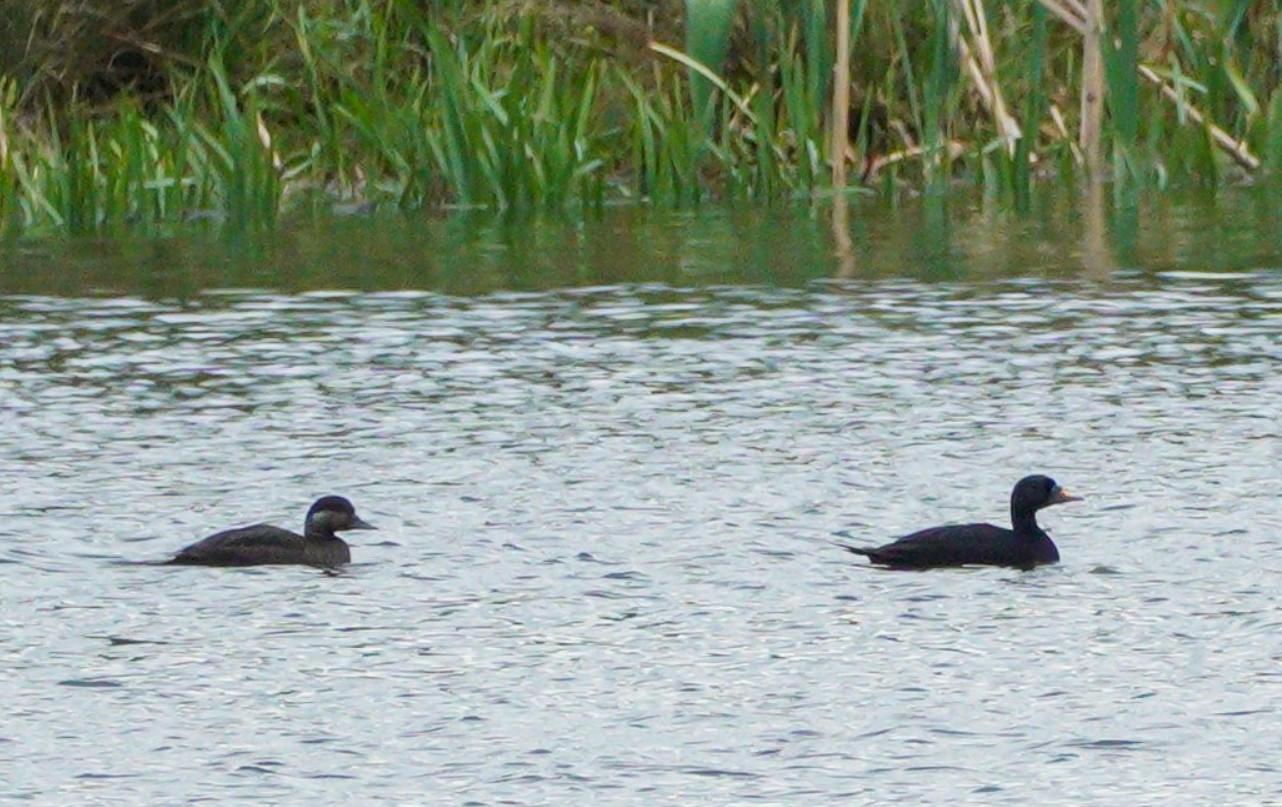
Aside from the lingering Pink-footed Goose and drake Red-crested Pochard – both in the Earls Barton GP’s New Workings (South) area, top wildfowl this week were a Garganey reported at the aforementioned site on 23rd and two Common Scoters at Ditchford GP’s Irthlingborough Lakes & Meadows NR on the same date.
Common Scoters, Irthlingborough Lakes & Meadows NR, 23rd April 2025 (Tony Vials)
And as we edge closer toward May – generally acknowledged as the prime month for rare and scarce waders (and much, much more) – the mix was up on last week and included up to five Avocets at Earls Barton GP at the period’s end, plus six at Clifford Hill GP on 19th, followed by another three there on 24th.
Avocets, Clifford Hill GP, 24th April 2025 (Tyler Atkinson)
Having laid claim to all of this year’s Grey Plovers so far, the latter locality once again produced another, on 23rd.
Grey Plover and Wood Sandpiper, Clifford Hill GP, 23rd April 2025 (Tyler Atkinson)
Not restricted to the Nene Valley and, therefore, unlike all of the above, single Whimbrels visited Clifford Hill on 19th, Pitsford Res on 22nd and both Lilbourne Meadows NR and Summer Leys LNR on 25th.
Whimbrel, Lilbourne Meadows NR, 25th April 2025 (Jon Cook)
More Bar-tailed Godwits followed last week’s Summer Leys individual, with four single birds paying fleeting visits to both Clifford Hill and Stanwick GP on 21st and Clifford Hill and Irthlingborough Lakes & Meadows on 23rd.
Bar-tailed Godwit, Clifford Hill GP, 21st April 2025 (Tyler Atkinson)Bar-tailed Godwit, Irthlingborough Lakes & Meadows NR, 23rd April 2025 (Tony Vials)Bar-tailed Godwit, Clifford Hill GP, 23rd April 2025 (Tyler Atkinson)
Solitary Black-tailed Godwits were also on the week’s agenda, appearing at Summer Leys on 19th and 24th and at Stanwick on 21st and Ditchford on 23rd, the latter having been present for several days prior to this date. Meanwhile, Clifford Hill remained ever fruitful, delivering the year’s first Wood Sandpiper on 23rd, although the latter moved on very quickly, evading all but a handful of birders who were quick off the mark. More Greenshanks came through during the period, including five on the dam at Hollowell Res on 19th, when four also visited Summer Leys. The remainder of the week’s quota were all at Earls Barton GP, which held two on 24th and singles on 20th and 25th.
Greenshank, Summer Leys LNR, 19th April 2025 (Andy Howell)
Late April is not renowned for producing numbers of scarce gulls and this week turned out to be no real exception. Two adult Mediterranean Gulls spent the best part of the day at Summer Leys and adjacent Mary’s Lake on 21st but moved on thereafter.
Single adult Yellow-legged Gulls were logged at Priors Hall Quarry Lake on 19th, Earls Barton on 21st and Pitsford on 21st and 25th.
Adult Yellow-legged Gull, Priors Hall Quarry Lake, 19th April 2025 (James Underwood)
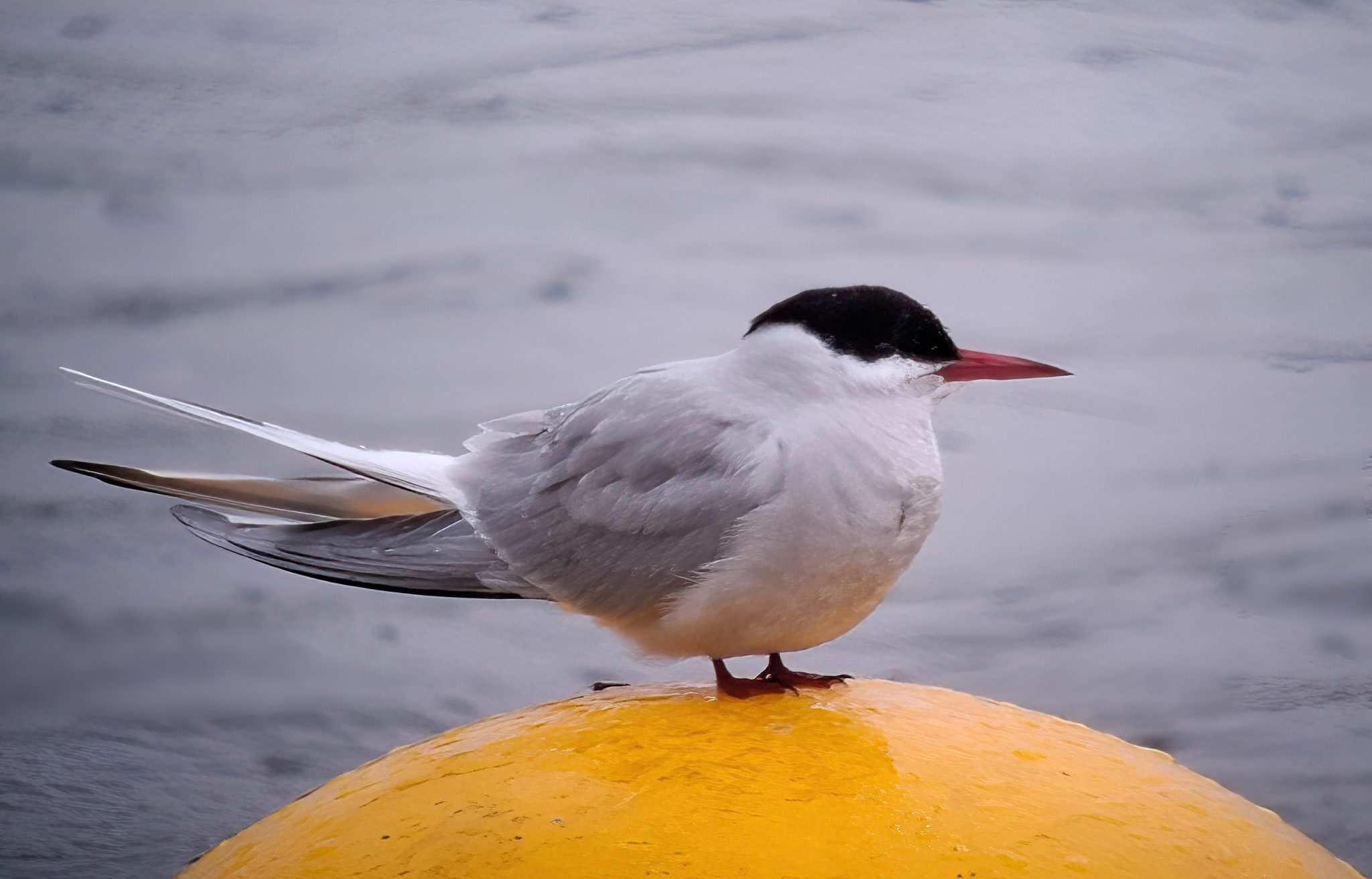
Leaving local Common Terns totally overshadowed, a significant standout feature of the week was the passage of Arctic Terns, impressive numbers of which pulsed through during, and immediately after, intermittent showers and heavy rain across the country. The largest flocks appeared on 21st, when approximate numbers were forty at Hollowell, at least twenty-five at Summer Leys and twenty at Clifford Hill. The following day saw sixteen at Thrapston GP and, on 23rd, Stanford Res scored twenty-eight, Stanwick’s total was nineteen in three separate groups, Clifford Hill’s sixteen and Boddington Res notched up eight. Lower numbers included four at Earls Barton on 24th and singles at both Boddington and Thrapston on 19th and one at Daventry CP on 21st.
Arctic Tern, Clifford Hill GP, 21st April 2025 (Tyler Atkinson)Arctic Terns, Clifford Hill GP, 21st April 2025 (Tyler Atkinson)Arctic Tern, Daventry CP, 21st April 2025 (Gary Pullan)Arctic Tern, Hollowell Res, 21st April 2025 (Jon Cook)Arctic Tern, Stanford Res, 23rd April 2025 (Chris Hubbard)
Black Terns put in their first appearance of the year on 23rd, when two visited Stanford and one was seen at Summer Leys.
Black Tern, Stanford Res, 23rd April 2025 (Chris Hubbard)
And, while we’re touching on Summer Leys, appearances by the Glossy Ibis there became increasingly intermittent and it went unreported after 20th. Making up for it – if only to a modest extent – two Spoonbills flew high north-east over the reserve late in the afternoon of 21st and at least one Bittern was present in the wider environs of the Earls Barton complex throughout, following two there on 19th. One was also at Cransley Res on 25th.
Continuing their relative scarcity, two Cattle Egrets paid a brief visit to Summer Leys on 21st and one was at Thrapston GP’s Elinor Trout Lake on the last day of the period.
After a week with no reports, Ospreys were seen at three localities, starting with a blue-ringed male, ‘1H7’, over Summer Leys and adjacent Mary’s Lake on 22nd. This individual originated from a brood in Rutland, where it was ringed as a pullus in 2022, arriving back there on 17th April when it was photographed at a local trout farm. So, quite clearly a different male to the one that visited Summer Leys on 4th April. The other two Osprey sightings came from Hollowell and Pitsford, both of which were on 25th.
Male Osprey, Summer Leys LNR, 22nd April 2025 (Julie Roe)
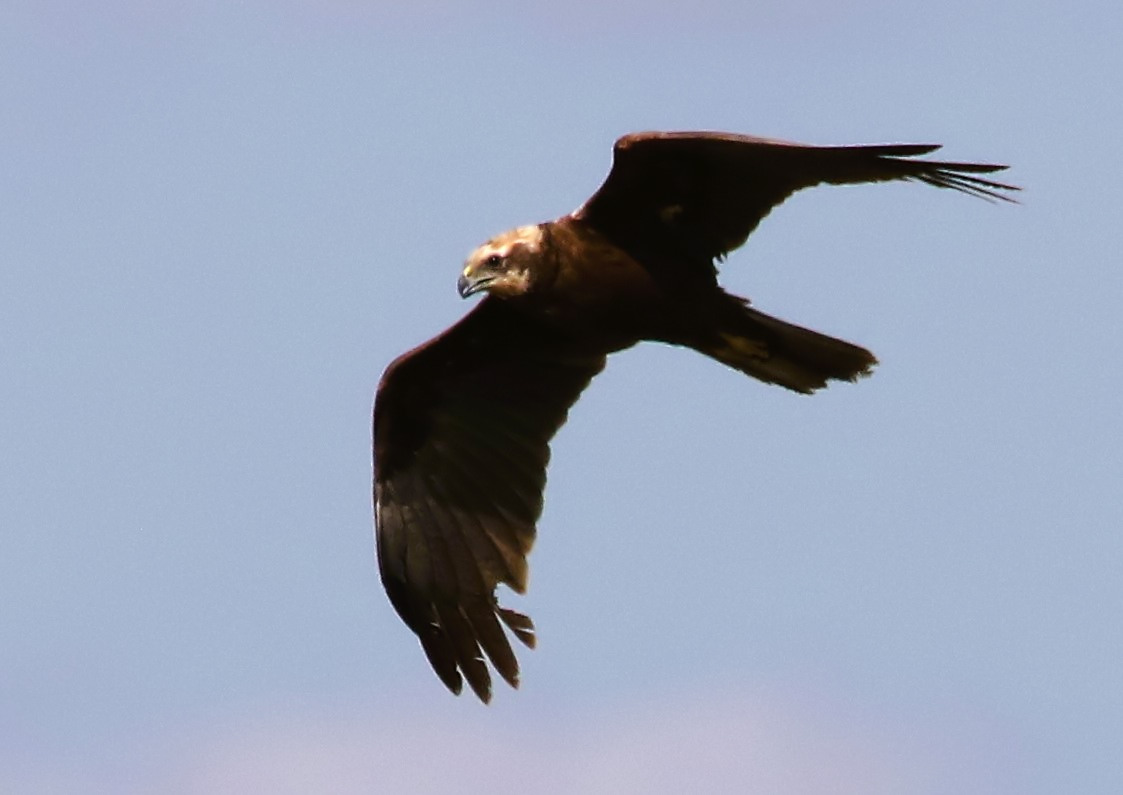
Encounters with Marsh Harriers fell to just the one, at Summer Leys on 21st.
Heading up the cast of passerines, the week’s two Ring Ouzels were where you’d expect them to be – where else than in a field below Hanging Houghton, where there was a male on 20th, and at Harrington AF, which produced what was likely to be one mobile female between 22nd and 25th … but we’re not ruling out two.
And, on 25th, a female-type Black Redstart in the car park at Yarwell Mill in the far flung reaches of eastern Northants was perhaps considered too far away for most to take a punt on … The week’s Common Redstarts were limited to singles at Stanford on 20th, Harrington on 21st and Blueberry Farm, Maidwell on 22nd.
Northern Wheatears were about par for the time of year with a maximum count of four at Harrington AF on 21st and smaller numbers consisting of one at Earls Barton on 19th and one at Clifford Hill on the same date, followed by another there on 22nd, two on 22nd-23rd and one on 24th. Two were also at Harrington on 23rd.
First-summer male Northern Wheatear, Clifford Hill GP, 23rd April 2025 (Mike Alibone)Female Northern Wheatear, Clifford Hill GP, 24th April 2025 (Tyler Atkinson)
Clifford Hill was also the venue for a female Blue-headed Wagtail, present there with a small group of Yellow Wagtails on 23rd-24th.
First-summer female Blue-headed Wagtail, Clifford Hill GP, 23rd April 2025 (Mike Alibone)First-summer female Blue-headed Wagtail, Clifford Hill GP, 23rd April 2025 (Mike Alibone)
Also in the wagtail camp, reasonably good numbers of White Wagtails coming through during the period included a super seven at Earls Barton on 19th, followed by between two and four there from 22nd to 24th and singles at Clifford Hill on 20th, Pitsford on 21st and Summer Leys on 22nd.
White Wagtail, Earls Barton GP, 22nd April 2025 (Mike Alibone)
A Tree Pipit between Althorp and Little Brington on 23rd was the first of the year and, who knows, may turn out to be the only one …
A cooler week by far, despite a run of strong southwesterlies delivering a temperate airstream off the Atlantic and western Europe. With more inbound spring migrants there was plenty to play for but, once again, the cream of the crop was well out of reach for all but those in the right place at the right time …
Summer visitors added to the clock during the period all occurred in the Nene Valley, although there was a Reed Warbler at Stanford Res the previous week but it was, alas, on the Leicestershire side of the county line.
Pink-footed Geese were still very much in evidence this week and, as well as the long-stayer in the Earls Barton GP/Cogenhoe area being present throughout, the period’s quota included one again at Stanford Res on 13th and 14th and nine flying east over Lilbourne Meadows NR on the latter date. Last week’s Garganey duo remained throughout at Earls Barton GP’s New Workings, moving to the northern section on 18th, while the drake Red-crested Pochard was also keeping up appearances on the adjacent River Nene.
And, while we’re still in the same area, this site laid claim to the fourth occurrence of Common Crane for the county this year as one flew over, calling, on 12th.
Further up the valley, Clifford Hill GP notched up its – and the county’s – second record of Grey Plover this year as an eastbound flock of five flew through without stopping on 15th. Whimbrels were also on the move, with singles at Earls Barton GP’s New Workings (South), Lower Barnwell Lock (Oundle) and Summer Leys – all on 12th and another paid a brief visit to Clifford Hill GP on 17th.
Whimbrel, Clifford Hill GP, 17th April 2025 (Tyler Atkinson)Whimbrel, Clifford Hill GP, 17th April 2025 (Tyler Atkinson)
Last week’s solitary Bar-tailed Godwit at Summer Leys made it into the week, still being present there on 12th, while the same site produced a Black-tailed Godwit on 12th, 15th, 17th and 18th and two were at Stanford Res at different points in time on 15th.
Black-tailed Godwit, Summer Leys LNR, 17th April 2025 (Alan Coles)
More Greenshanks moved through during the period in which singles visited Lower Barwell Lock on 12th and 15th, Summer Leys on 12th, Earls Barton GP on 14th and Stanford on 15th and a single Jack Snipe was still holding out at Hollowell Res on 14th.
Compared to last week, this week’s Little Gull passage had reduced to a mere drip comprising three at Earls Barton GP on 12th, while a Mediterranean Gull dropped into Stanford on 17th. Larger gulls included a first-summer apparent hybrid Caspian x Herring Gull at DIRFT 3 on 13th, where there was also a first-summer Yellow-legged Gull on the same date.
First-summer presumed Caspian Gull x Herring Gull hybrid, DIRFT 3, 13th April 2025 (Mike Alibone)
The only other Yellow-legged Gulls were single adults at Pitsford Res on 13th and 16th.
A Little Tern at Clifford Hill on 16th was much appreciated as well as equalling the earliest ever county record – the latter being at Earls Barton GP in 1996.
Little Tern, Clifford Hill GP, 16th April 2025 (Tyler Atkinson)Little Tern, Clifford Hill GP, 16th April 2025 (Tyler Atkinson)
And another week, another White Stork – this one visually tracked as it took its time in moving westward from Earls Barton/Whiston Lock toward Ecton. Surprisingly, there were no subsequent sightings in Northants but undoubtedly the same bird was logged later in the day over Napton Res in east Warwickshire, 37 km further west.
White Stork, Earls Barton GP, 13th April 2025 (Ant Hall)
Once again, the Summer Leys Glossy Ibis clocked up another week, the latter site also producing a showy Bittern on 16th and 18th.
Bittern, Summer Leys LNR, 18th April 2025 (Tony Stanford)
Four Cattle Egrets flying south-west over Stanwick GP on 17th once again represented a rather poor weekly showing for this species.
Not so for Marsh Harriers, though – that is, of course, for those in the right place at the right time. Favouring the reedbed, the immature male was again seen at Stanwick on 12th and 18th, Summer Leys produced two on 14th and one on 16th and one was nearby at Earls Barton GP’s Quarry Walk on the latter date.
Marsh Harrier, Summer Leys LNR, 16th April 2025 (Alan Coles)
We’ve become increasingly aware of this spring’s invasion of Hoopoes into the southern reaches of the UK and their subsequent penetration further north. Given that this week saw just over a hundred in the country, prior to the astoundingly higher total of one hundred and eighty the week before, it would have been surprising if we’d not managed to secure one in our own good county. And we did. Two, to be precise. Unfortunately, they were both off limits and appeared to be short-stayers only. The first was in a garden in Hanging Houghton on 13th before flying off, giving rise to a local search that yielded no result. The following day, one was photographed on the windowsill of a farmhouse at Silverstone prior to making a similar rapid departure. The wait for one nailed down goes on …
Hoopoe, Silverstone, 14th April 2025 (Tom Howse)
Meanwhile, there were more Ring Ouzels, unsurprisingly comprising one at Blueberry Farm, Maidwell on 14th and another at Harrington AF the following day – both favoured localities that have history for the species.
Conversely, Summer Leys does not have history when it comes to producing Pied Flycatchers, a male of which was seen briefly from the car park on 18th.
A Black Redstart at Harrington did a bunk before any would-be observers were on the scene on 17th, as did one photographed on a roof in Easton on the Hill the previous day. These are the fourth and fifth for the year, none of which has had the decency to stay put.
Black Redstart, Easton on the Hill, 16th April 2025 (Jeff Davies)
Single male Common Redstarts were found at Harrington on 13th-14th, Blueberry Farm on 15th and at Lilbourne Meadows on 17th.
Male Common Redstart, Harrington AF, 14th April 2025 (David Arden)
There was a mini-surge in Northern Wheatears this week with, on 17th, Harrington producing nine, Hinton AF at least six, Clifford Hill four, and both Earls Barton and Mears Ashby one apiece.
Male Northern Wheatear, Earls Barton GP, 17th April 2025 (Leslie Fox)
On other dates, two were at Heathencote on 12th, three were at Harrington and two at Earls Barton on 14th, two were at Blueberry Farm and one below Great Doddington on 15th and one was at Borough Hill on 18th. A male Greenland Wheatear was at Clifford Hill on 17th.
Male Greenland Wheatear, Clifford Hill GP, 17th April 2025 (Tyler Atkinson)
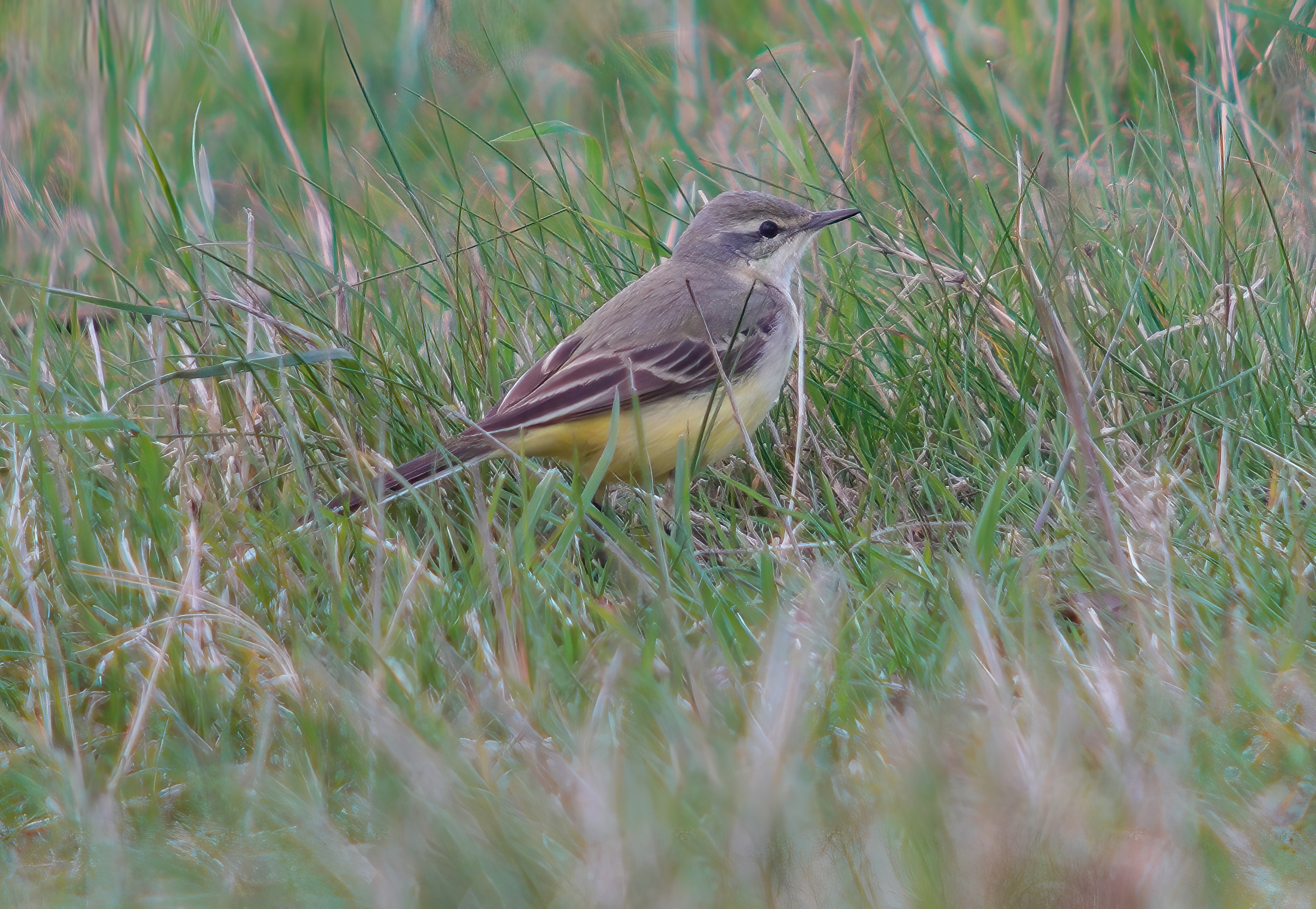
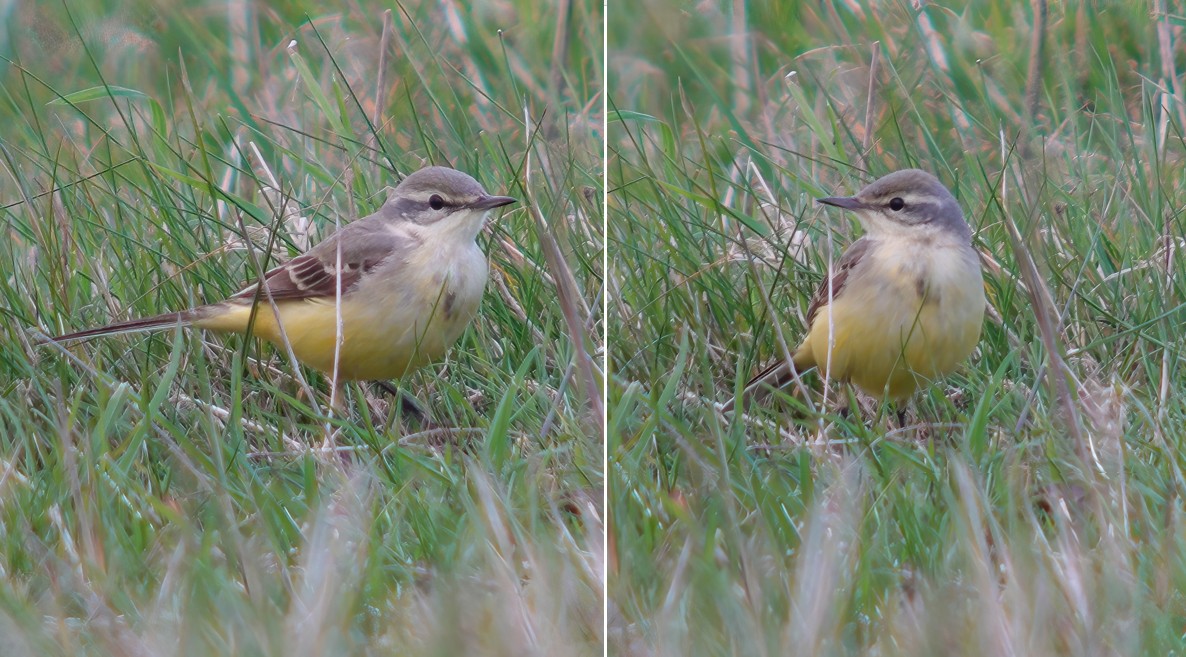
With Earls Barton GP’s New Workings (South) rising in popularity and attracting more birders of late, it comes as no surprise that more interesting birds are being found there. One such individual – a ‘yellow’ wagtail – came under scrutiny on 15th when it exhibited some features inconsistent with the standard fare in the Yellow Wagtail group of races and may have been a hybrid (see here for a more detailed discussion).
Apparent ‘hybrid’ Yellow Wagtail showing some Citrine Wagtail-like characteristics, Earls Barton GP, 15th April 2025 (Mike Alibone)
No such queries were raised by this week’s White Wagtails, a maximum of at least five of which were at the latter site on 18th, while singles were logged at Lower Barnwell Lock on 12th, Clifford Hill on 15th and 17th, Pitsford on 16th and at Ditchford GP’s Rushden Lakes on 17th.
While talking to Martin Swannell and David Smith during a visit to Earls Barton GP late afternoon on Tuesday 15th April, MS picked up a ‘yellow’ wagtail in flight before it dropped down in a muddy corner at the eastern end of New Workings (South), about 60 metres away from where we were standing.
Looking through bins, it was immediately apparent that this was no ordinary Yellow Wagtail as it had strikingly grey upperparts and bold, white tips to the median coverts, which produced a noticeably strong white wing-bar. Scope views enabled more detail to be seen as the bird moved around feeding and, appearing fidgety, flying short distances within the area.
Looking like a female, to my eyes, the bird had a citreola vibe to it but it was certainly not identifiable as a Citrine Wagtail, as it lacked a number of diagnostic features of that species.
Apparent ‘hybrid’ Yellow Wagtail showing some Citrine Wagtail-like characteristics, Earls Barton GP, 15th April 2025 (Mike Alibone)
An interesting looking bird with a grey mantle that was concolourous with the nape and extended into the crown, the latter then merging into a yellowish-grey forehead, itself merging with the supercilium above the dark lores. On rear views, the rump had a slight greenish tinge to it.
Apparent ‘hybrid’ Yellow Wagtail showing some Citrine Wagtail-like characteristics, Earls Barton GP, 15th April 2025 (Mike Alibone)
Pro-citreola features are the grey upperparts, strong white median covert tips and strong(est) yellow colouration on the throat as opposed to the belly. Pro-flava features are off-white/yellow-buff-tinged greater covert tips, yellow undertail coverts and lack of supercilium curving around behind ear coverts.
Apparent ‘hybrid’ Yellow Wagtail showing some Citrine Wagtail-like characteristics, Earls Barton GP, 15th April 2025 (Mike Alibone)
After some 15 minutes, the bird flew off north and, unfortunately, was not heard to call.
Individuals with almost identical features to this have been recorded in the UK on previous occasions (see here) and a Citrine x Yellow Wagtail hybrid, photographed in July 2010, appears not too dissimilar but with a more Citrine-like head pattern (see here). Mixed pairs have bred in Poland, while hybrids have also been recorded in India, Israel and the United Arab Emirates, although images (here) appear to show birds with more striking head patterns, which are probably males.
The above bird, though exhibiting hybrid characteristics may, of course, be an established, unknown Yellow Wagtail variant – an alternative advocated by Martin Garner back in 2012 …
References and suggested reading for further information














































 Northants birds