The latest Northamptonshire Bird Report, with records for 2011, is now available. Contents include full Systematic List compiled using records from more than 250 local observers, sections on Escapes and Ferals and Corrections and Additions from previous years, as well as many photos and illustrations. There is also the East Midlands Red Kite Report and data from the Stanford Reservoir Ringing Group as well as the full list of the species ever recorded in Northants, tables of arrival and departure dates for summer and winter visitors and a County Site Map.
Copies and back issues from:
R W Bullock, 81 Cavendish Drive, Northampton NN3 3HL
Price £8.10 each, including postage. Cheques payable to ‘Northamptonshire Bird Report’
This is the first in a new series of weekly reports which picks out the highlights from the past seven days – in this case 1st-7th December.
This month usually sees the beginning of a build up of scarcer wintering wildfowl but eight Dark-bellied Brent Geese which flew over Haselbech on 2nd was a great, unexpected record for a species which normally only occurs as singles in late autumn. A first-winter drake Scaup was discovered on the fishing lake at Ditchford GP on the same date, being joined by another there on 5th while an adult drake was seen off the dam at Pitsford Res the following day. Three ‘redhead’ Smew were found on the ‘small side’ at Ravensthorpe Res on 1st and a drake had joined them by 7th, while the highest count of the more common Goosander was eighteen at the now well established urban wintering site of Abington Park Lake, Northampton on 1st.
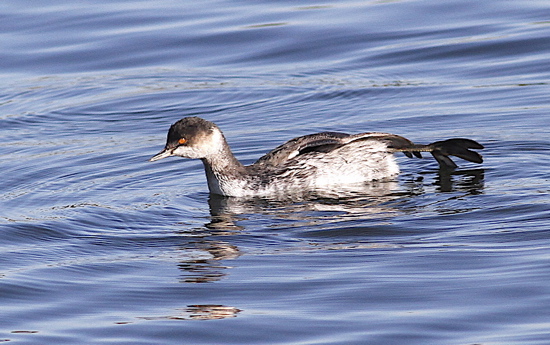
A Bittern was found at Summer Leys on 2nd and last month’s Great White Egret continued to show sporadically at Pitsford Res (and on adjacent floodwater at Holcot) throughout the week. The long-staying Black-necked Grebe, present since September, remained in the vicinity of the yacht club at Pitsford Res until at least 3rd and a ‘ringtail’
Black-necked Grebe, Pitsford Res, October 2012 (Dave Jackson)
Hen Harrier was watched hunting south of Weston on 1st but subsequent searches failed to relocate it. Other scarce raptors included single Merlins at Blueberry Farm, Maidwell on 4th and at Fineshade Wood and near Firmyn Woods CP the following day, while two Peregrines were at Fineshade Wood on 5th with two more at Ditchford GP on the same date. A count of 17 Common Snipe at Ditchford GP on 2nd was noteworthy when a single Redshank was also present there.
A first-winter Mediterranean Gull visited Pitsford Res roost on 4th and an adult was at Ravensthorpe Res the following day, while an adult Caspian Gull was found at Sidegate Landfill an 5th and a third-winter roosted at Pitsford Res on 6th. The only Short-eared
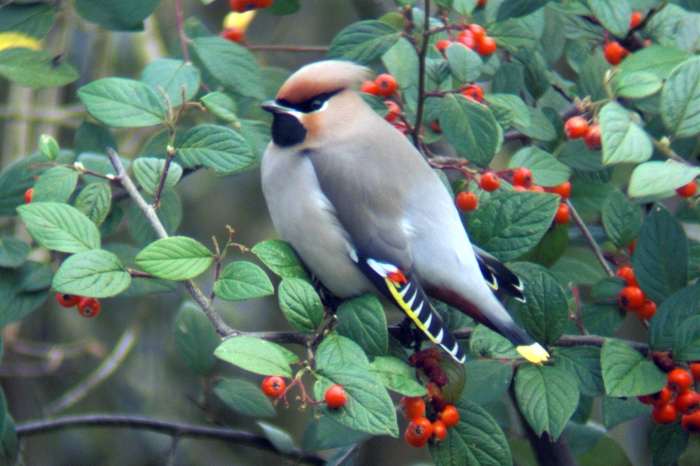
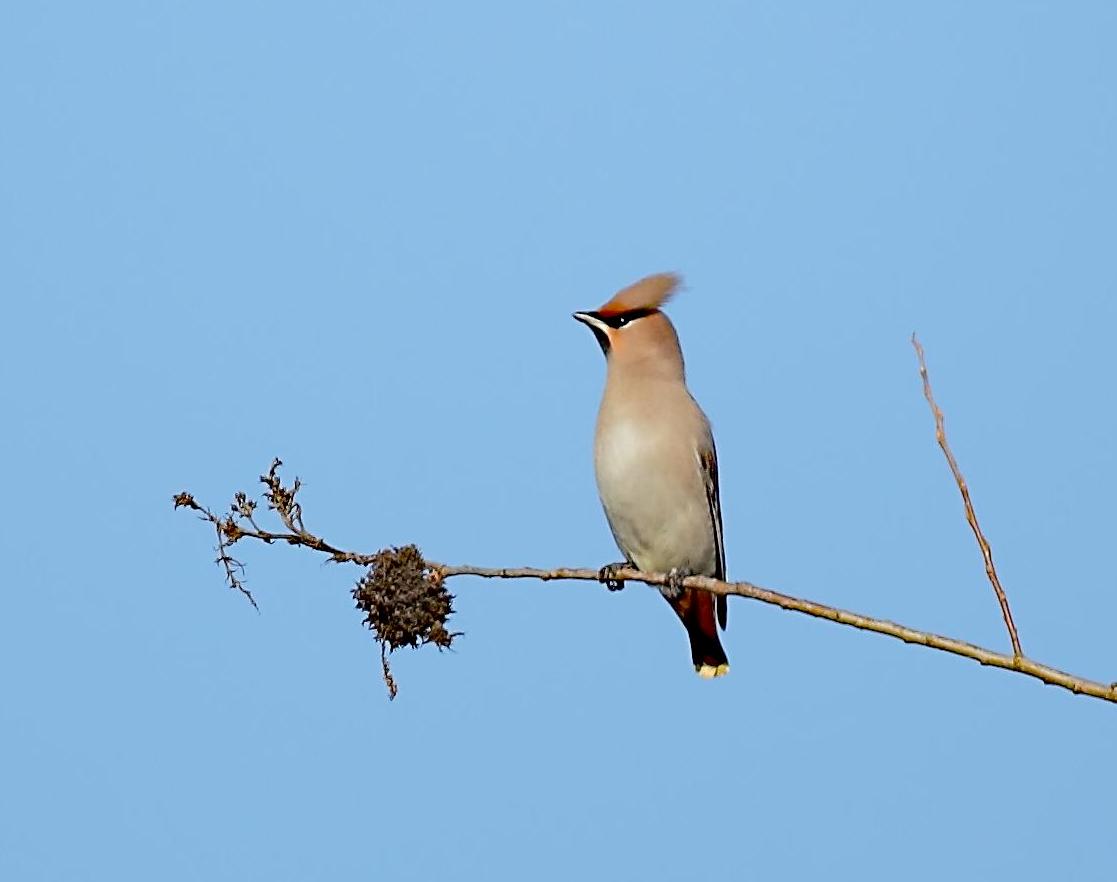
Waxwing, Sywell, 28th November 2012 (Jim Dunkley). One of two birds visiting a garden to 1st December.
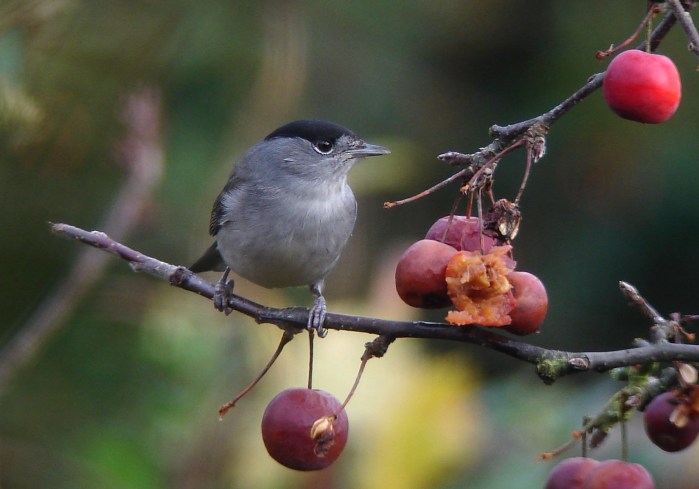
Owl of the week was one at Harrington AF on 6th and, braving the falling temperatures, a Chiffchaff was seen at Ravensthorpe Res on 5th and 7th and a male Central EuropeanBlackcapwas feeding on crab apples in a Northampton garden throughout the week while a Stonechat – locally scarce this winter – was at Ditchford GP on 2nd.
As the week drew to a close, however, Waxwings began to move in in force. Twos were seen at Hanging Houghton and Sywell on 1st and at Pitsford Res on 3rd, with one at the latter site on 4th when at least fourteen were found in Corby. Five were in Daventry on 5th with, the next day, four or five at Byfield and one at Daventry CP but the week ended with thirty-one at Oundle, approximately thirty in Kettering (at Sainsburys supermarket) and ten in Wellingborough at Appleby Lodge Farm.
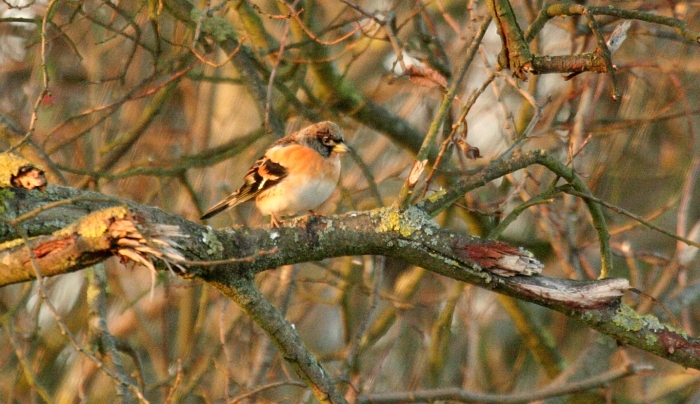
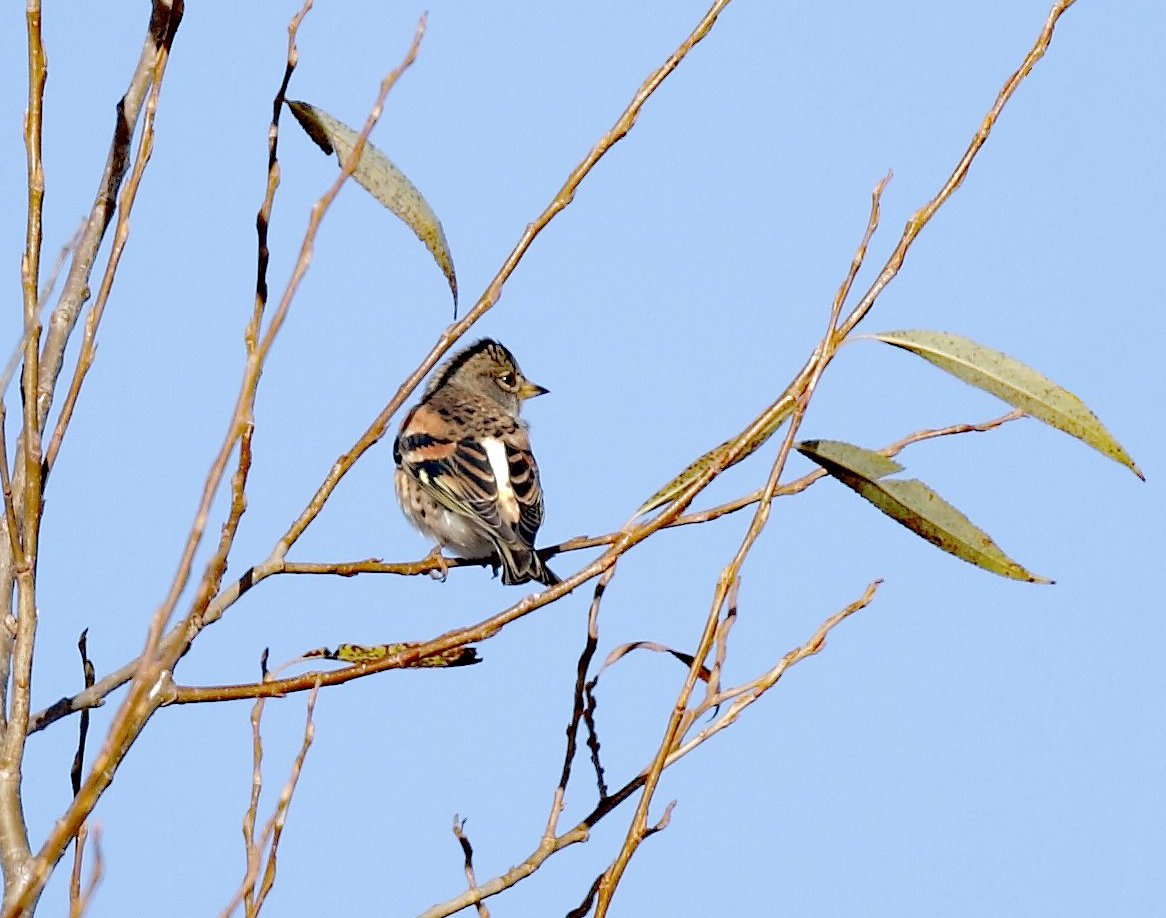
Brambling, Harrington AF, 2nd December 2012 (Ian Pretty)
A Hawfinch was reported from Firmyn Woods CP on 2nd and, apart from one at Hanging Houghton on 1st, up to ten Bramblings were visiting Harrington AF to feed on wild bird food throughout the week.
Blackcaps are not an uncommon sight in Britain during the winter months nowadays. We have a ‘healthy’ wintering population of around 3,000 individuals which compares with a summer population estimate of 932,000 pairs (Birdlife International, 2004). Numbers wintering in the UK have increased considerably since the 1960s and it would seem likely that the above number is an old and conservative estimate so if anyone has an up-to-date figure I would be pleased to receive it.
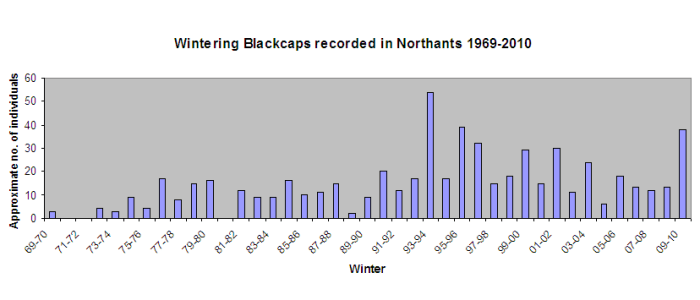
Numbers wintering in Northants appear to have risen and averaged higher since the early 1990s, although this may reflect better observer coverage and communication.
From the early 1990s numbers are approximate, based largely on localities and estimates rather than specific individuals. Source: Northamptonshire Bird Report 1969-2010.
Ringing data have established that UK winterers are from a breeding population in central Europe and, while most Blackcaps from this area head south-west in autumn to winter in Spain and northern Africa, some head north-west to the UK. The driver for this is not clear but milder winters and an abundance of ‘artificial’ food (i.e. winter bird feed provided by man) have been cited as the likely reasons. The latter of the two factors appears to be the subject of debate as many observations on wintering Blackcaps point to their feeding primarily on natural food sources such as berries and insect larvae when these are available.
Male Blackcap, Northampton, December 2012 (Dave Warner)
Dave Warner’s excellent portrait of a male in his Northampton garden last weekend illustrates this point perfectly with the principal choice of food, Dave suggests, being an abundant supply of crab apples. That said, it seems logical to assume that ‘artificial’ food may at least act as a regular supplement or backup in the absence of natural foods, thus helping maintain the wintering population.
What is clear, however, is that our wintering Blackcaps are very different from those which breed here in summer. Having a shorter distance to fly to their breeding area in spring means they arrive back before the Spanish winterers and therefore only have each other to mate with, effectively becoming reproductively isolated from the Spanish birds. So now there are morphological differences emerging. This population, in the space of little more than 50 years, has produced birds with rounder wings (as they don’t need to migrate so far) narrower and longer bills (supposedly for taking advantage of ‘artificial’ foods) and browner mantles and bills. A kind of ‘catalytic evolution.’ How far will it go? Full speciation?
So next time you come across a Blackcap in Britain in winter it’s worth remembering that it’s not just any Blackcap, it’s likely to be a breakaway Blackcap – an activist, a rebel, a pioneer and, although a potential champion of speciation, it may only ever become genetically distinct to a racial level, so don’t hold your breath for an ‘armchair tick’ any time soon …
For a more detailed look at this unfolding phenomenon see here and here.
I found this first-winter drake Scaup on the Fishing Lake at Ditchford Gravel Pits this morning. It was still present at midday. Difficult to see on the video below, surprisingly it was already showing a greenish sheen to the otherwise brown head and adult vermiculated grey scapulars were just beginning to appear.
Scaup is a scarce visitor to Northants with about half a dozen records per year, the vast majority of which relate to single birds although small flocks have occasionally occurred in the past.
After a small flock of up to eleven Waxwings was discovered visiting the Rowan trees in the car park at Homebase, Sixfields from 14th to 16th, another fourteen were found at nearby Sixfields Lake on the latter date and at least ten were still present there yesterday. Today, twenty-five have been present – though highly mobile – around the SixfieldsLake area, suggesting that the two flocks have now combined. Being flighty, they have not been easy to catch up with, giving many birders the run-around. Jonathan Philpot was fortunate in capturing the below images after most of us had given up this morning …
Waxwing, Sixfields Lake, Stortons GP, 18th November 2012 (Jonathan Philpot)
Waxwing, Sixfields Lake, Stortons GP, 18th November 2012 (Jonathan Philpot)
An added bonus came in the form of this unusually showy Cetti’s Warbler
Cetti’s Warbler, Sixfields Lake, Stortons GP, 18th November 2012 (Jonathan Philpot)
and a Brambling also put in an appearance. This species has appeared in reasonably good numbers this autumn.
Brambling, Sixfields Lake, Stortons GP, 18th November 2012 (Jonathan Philpot)
Earlier this week, Doug Goddard captured images of two Mealy Redpolls feeding on seed heads close to Mary’s Lake, adjacent to Summer Leys LNR. This species can often be tricky to identify as both Lesser and Mealy Redpolls can vary considerably in appearance according to age, sex, moult and feather wear, with some practically defying identification altogether. Most Mealies first attract attention as a result of their being rather pallid and colder toned compared to Lesser Redpoll but this isn’t always the case as some Mealies can be quite dark while, conversely, some Lessers can also take on a rather bright and cold-toned appearance.
Good views of a suite or ‘checklist’ of characteristics is normally required before a safe identification can be made. This individual appears to tick all the boxes: wholly white ground colour to under parts (no sign of Lesser’s strong buffish wash to flanks and breast sides); broad white (not buff) supercilium; large white spot below eye and whitish ear-coverts with darker streaking; white ‘tramlines’ on mantle (although Lesser can show these); strong white (not buff) tips to the greater coverts, median coverts, tertials and primaries. The tips to the outer couple of greater coverts are buffish, indicating unmoulted juvenile feathers indicating it is a first-winter and this is further supported by patchy/restricted amount of black on the throat and around the bill base which will become more extensive with feather wear. Compare the above with a typical Lesser Redpoll, also at Summer Leys.
Lesser Redpoll, Summer Leys LNR, 6th November 2012 (Douglas Goddard)
First-winter Lesser Redpoll never shows such clean white wing bars so early in the autumn (i.e. before wear). The red ‘poll’ of the Mealy is also rather pale, almost orange, which is a characteristic frequently shown by first-winter and female redpolls but ‘poll’ colour can vary greatly across the board, even becoming yellow in some instances (see here).
Finally, here’s the other redpoll which was accompanying the above Mealy.
Mealy Redpoll, Summer Leys LNR, 5th November 2012 (Douglas Goddard)
Again, this appears to be another Mealy Redpoll and gives the impression of being large, long and big-billed – which they are …
Late yesterday morning Mark Piper discovered a juvenile Black-throated Diver at the feeder stream end of Stanford Reservoir. It remained quite elusive, diving for long periods of time until it was flushed by a fisherman at 11.35 after which it flew off at tree-top height toward the dam. Subsequent searching failed to relocate it. This morning it was present again close to the Leicestershire side of the reservoir, where Chris Hubbard took the photo below.
Black-throated Diver, Stanford Res, 3rd November 2012 (Chris Hubbard)
It then moved again to the small feeder pool on the opposite side of the road to the reservoir before flying again to the main body of water, remaining in the vicinity of the raft during the early-mid afternoon.
Black-throated Diver, Stanford Res, 03 November 2012 (Chris Hubbard)
The white flank patch, visible just above the water, rules out Great Northern Diver (as does the relatively narrow bill, absence of both neck patches and bulging forehead) and vagrant Pacific Diver (as does the large bill and absence of chin strap or vent strap).
Black-throated Diver, Stanford Res, 3rd November 2012 (Paul Riddle)
This is only the nineteenth record for Northants, the last being one at Thrapston GP on 18th November 2001. Ten of the previous eighteen have been at Pitsford Reservoir. It is also the 40th for Leicestershire/Rutland, with most between November and February and 60% of records from Rutland Water, since it was constructed, (Steve Lister in litt).
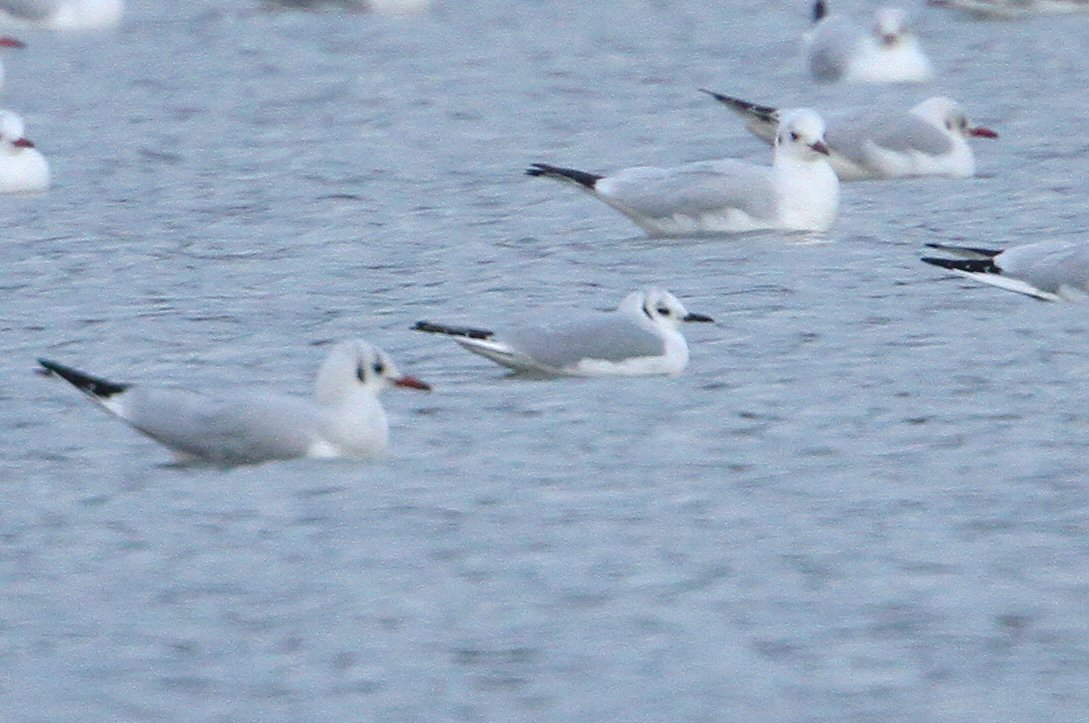
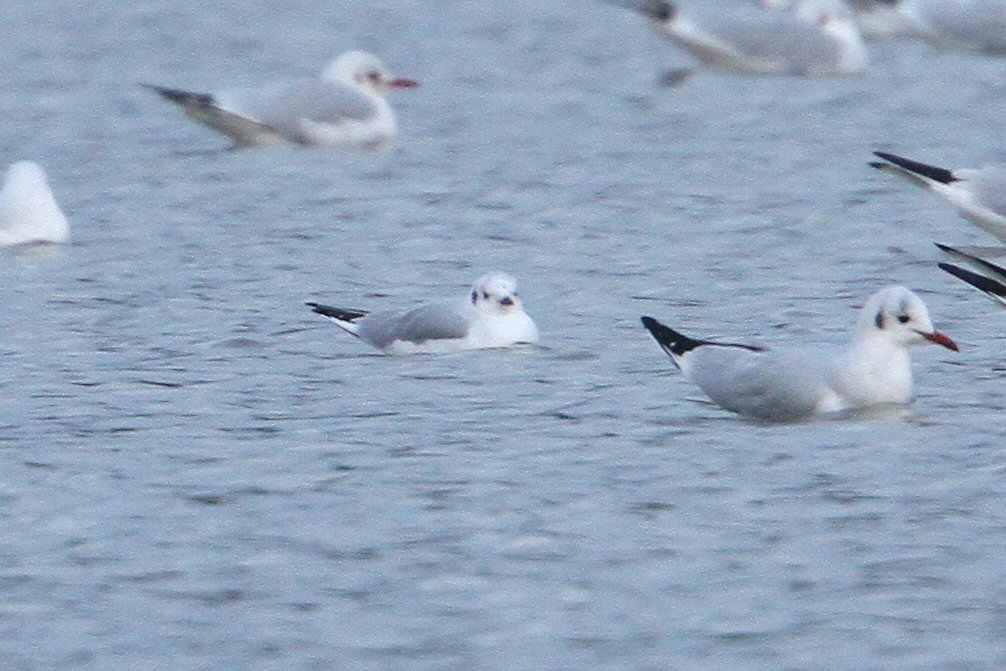
I was driving through Newnham, already on my way to the gull roost at Boddington Reservoir, when Gary Pullan – god bless him – phoned me with a message of just two words: “It’s here!” he said. Having visited the site twice yesterday and spent the last two hours of daylight shivering in the falling temperatures without it showing, it was comforting to know the adult Bonaparte’s Gull was there and on view.
While Gary continued to spread the word I stepped up a gear, unashamedly broke the speed limit, and arrived shortly afterward to find just a handful of birders watching it. It was with about two hundred Black-headed Gulls. A cracking little gull (or should I say small gull), the proportions of which can be appreciated when compared with the accompanying Black-headed Gulls, numbers of which had built to well over 1000 by dusk.
Adult Bonaparte’s Gull, Boddington Res, 3rd November 2012 (RW Bullock)
It spent most of its time at rest, flying only a short distance on a couple of occasions. It may be something or nothing but most of the time it held its bill in a horizontal, or slightly raised, position compared to the Black-headed Gulls, which (most of the time) held their bills pointing down, below the horizontal. I don’t know if this might be a useful way of picking it out among Black-headed Gulls at a large gathering such as the Boddington roost – this needs testing.
There are about 180 records of this North American species for the UK but they are rare inland and this is the first for Northamptonshire, although the neighbouring counties of Warwickshire and Oxfordshire have had two and three records respectively. Well done Gary for finding it on Thursday and thanks are due to Bob Bullock for the accompanying images – which are better than my digiscoped stills – but I did manage to get the videoscope footage below.
Referring to What the … !!!?? posted on 29th October. When I first saw the image below I was initially intrigued. It looked kind of familiar, of course, but the pink upper breast and light streaking reminded me of Linnet, which it clearly wasn’t.
The second image – the one in the original post – depicted a largely brownish finch with yellow outer edges to the primaries. It was now looking distinctly Greenfinch-like but it still had a pinkish breast and, although the bill looked large, was it really as large as that of a Greenfinch? My initial thinking was that it could be a Linnet x Greenfinch hybrid but the final image, sent subsequently by the photographer, poured cold water on everything: yellow in the outer tail and on the rump made this a Greenfinch beyond any shadow of a doubt and you would have identified the bird as such from this one photograph alone. But what about the abnormally coloured breast? It could be pigmentation but closer scrutiny shows a diffuse and uneven distribution of pink on the breast, which suggests that this has been acquired by feeding on fruit of some kind, possibly blackberries as suggested by Bob Bullock, whose analysis appears to be spot-on. Take away the pink breast colouration and the bird is a typical female Greenfinch, possibly a first-winter, and it was photographed in Walgrave by Pete Gilbert on 28th October 2012. Thanks to everyone who commented on the original post. This was just a bit of fun but it just goes to show how one anomalous feature, combined with restricted views, can conspire to fire the imagination in any number of different ways!
They have been particularly scarce in Northants this year with only two records (I think), so this fine male on the roof of a house in Upper Boddington a couple of days ago was a nice find for the photographer! Visit Barry’s site at www.britishbirdphotographs.com
Male Black Redstart, Upper Boddington, October 2012 (Barry Boswell)
 Northants Birds