A Firecrest is guaranteed to brighten the most dismal of days and the dank, drizzly conditions of Tuesday, 23rd October was one such miserable day in an extended period of late autumn gloom. Happily for Mick Townsend of the Stanford Ringing Group, this cracking little sprite found its way into one of the SRG’s nets from which Mick extracted it before ringing it and taking the below photographs yesterday morning. This is the only Firecrest to have been found in Northants this year. In a standard year there are, on average, 1-2 records (13 in the last 10 years) with the highest likelihood of a chance encounter with one in January or November.
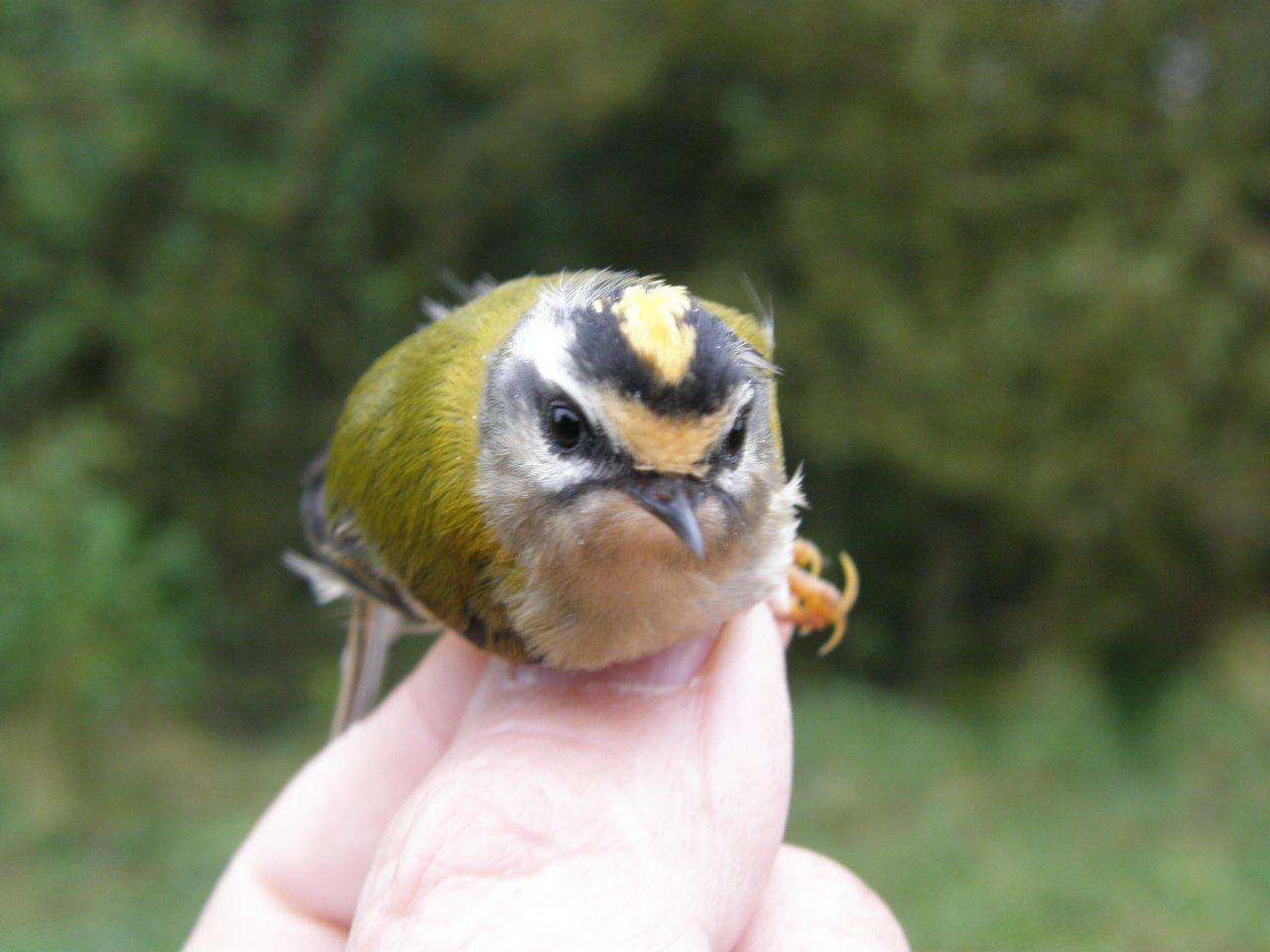
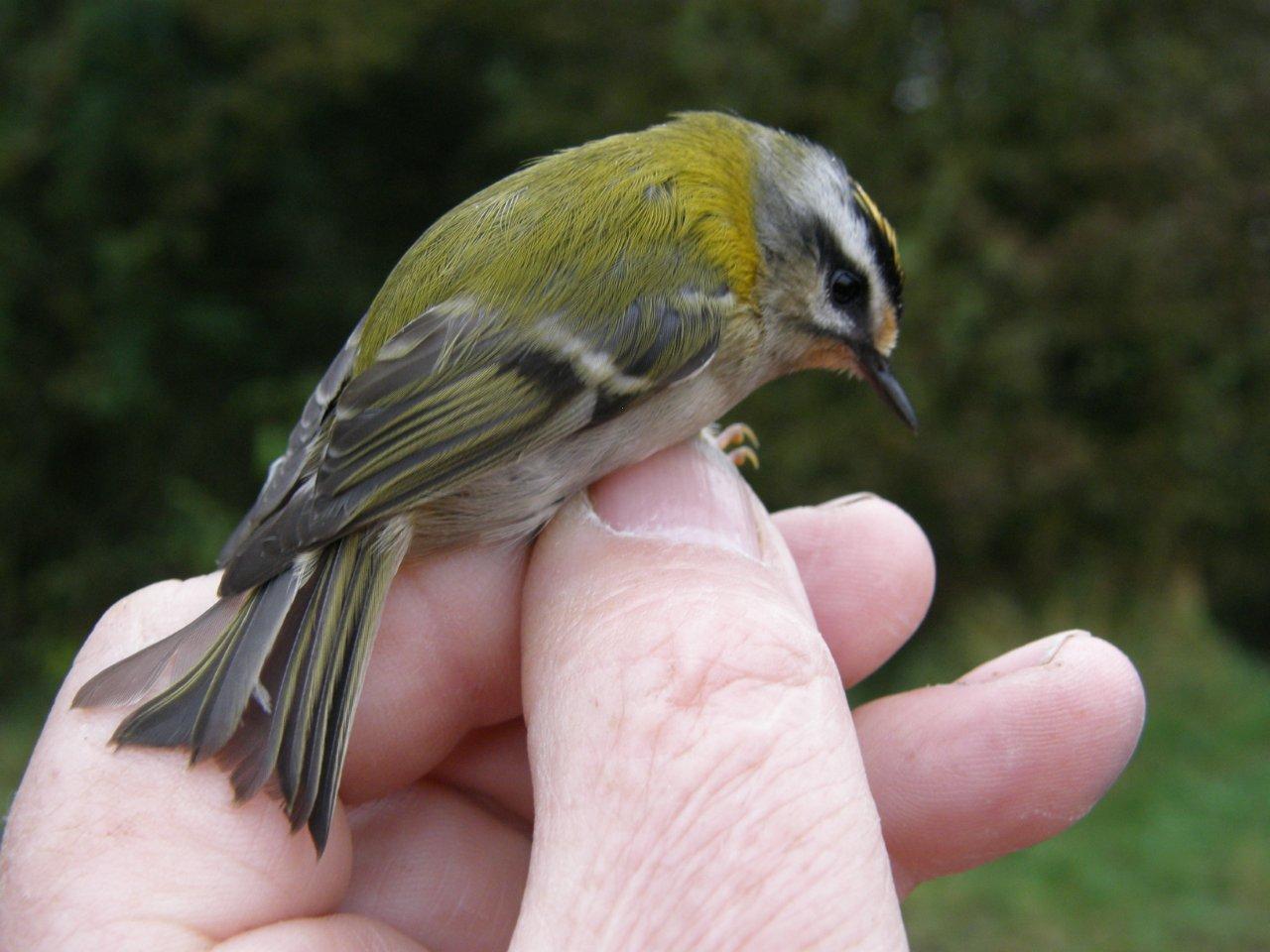 The obviously spiky tips to the tail feathers suggest this is a first-year. Many thanks to Mick for his images.
Under the spotlight: the Pitsford ‘Caspian Gull’
Hanging out on boats, buoys and just about anything which provides a suitable loafing site, since late August a fourth-winter large, white-headed gull has been almost resident at Pitsford Reservoir’s yacht club. Identified by some as a Caspian Gull, it exhibits a suite of features which are not fully consistent with that species and which hint strongly at mixed parentage. It can be safely aged as a fourth-winter as it closely resembles an adult but it has retained extensive black in the primary coverts and alula while the rather liberally ‘messy’ appearance of the bill, with a yellow tip divided from a pale, washed out base by a diffuse, dark subterminal band, is also a pointer to its not being fully mature.

Pro-Caspian features exhibited by this individual include the rather elongated body with a high-chested appearance and attenuated, sloping rear end, long, thinnish legs, largely white head (although there is a dark ‘eyebrow’ with some fine streaking on the ear coverts) with a restricted shawl of dark streaks on the hind neck, ‘Common Gull grey’ mantle and a washed out, green-tinged, yellow bill.
Conversely, anti-Caspian features are the absence of a long white tip to the upperside of the 10th primary (instead P10 has a very small white tip), absence of a long white tongue on the underside of P10 (where there is a single mirror set into an otherwise black distal end to the primary), broad – as opposed to fine – rear neck streaks, a rather deep, powerful-looking bill with a strong gonydeal angle and a sharply-angled and hooked culmen, a pronounced pale straw-coloured iris and a relatively large, ‘full’ head, lacking Caspian’s long, sloping forehead and ‘snouty’ appearance.
While pale eyes do not rule out Caspian Gull (a minority exhibit pale irises) and variation in wing tip pattern can be considerable, bill structure, head shape and jizz normally remain consistent and combine to lend a more ‘gentle’ appearance far removed from what we are seeing here. This individual appears to have a head shape, bill structure and a general ‘mean’ character much closer to Herring Gull or Yellow-legged Gull than to Caspian Gull.

However, the wing tip pattern is very similar to a known 4th year male Caspian Gull from Poland (see here) although the Pitsford individual has larger white primary tips. Interestingly, in threatening behaviour toward other gulls, this bird calls with its wings partly open, the bill pointing down initially before raising it to 45 degrees as it delivers a very convincing Caspian-like laughing call and posture.
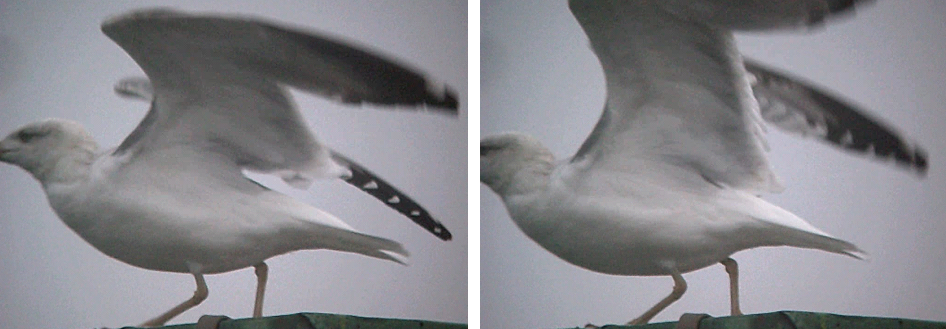
It is easy to speculate but difficult to draw any firm conclusions but I would guess this individual comes from the East European hybrid zone where mixed pairs of Caspian Gulls and Herring Gulls of the ‘Scandinavian’ race argentatus are known to occur. Hybrid Caspian Gull x Herring Gull from this zone has occurred in the UK before see, for example, here . However, it can also appear quite square-headed and sometimes takes on the appearance of Yellow-legged Gull, although structure and jizz are not quite right for that species. It is an interesting individual but it is certainly not a pure Caspian Gull. Watch the video below. What do you think? Comments welcomed.
From the long grass … Richard’s Pipit at Borough Hill
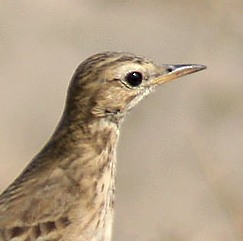 I received a text from Gary Pullan, late this morning, advising that Mark Spirito had just seen a large pipit with a ‘sparrow-like call’ to the right of the concrete track, which runs north-south along the top of Borough Hill. With Richard’s mooted in the text I sent a few texts and put the news out via Twitter before setting off to see if I could locate it, phoning Mark on the way in order to get further details. Although he was no longer on site, he subsequently advised that he had picked it up in flight after hearing a distinctive, though unfamiliar, call and that the bird had landed at the golf course end of the hill where, after another brief flight view, he had been unable to relocate it.
Upon arrival at Borough Hill I joined Chris Coe and Allan Maybury who were already on the concrete track. After a briefly watching a nearby Stonechat, we decided to split up to make a sweep of the general area. With Borough Hill summit currently ungrazed and overgrown the going was not easy underfoot. We covered the area to the right of the track as well as to the immediate left of the track, right down to the golf course perimeter fence and then back again to the compound. Chris and Allan departed and I was about to do the same when Mark phoned to say he had listened to online examples of the call of Richard’s Pipit and he was now confident that the Borough Hill pipit was a Richard’s Pipit.
I changed my mind about leaving and decided to have another go at trying to relocate the bird, this time concentrating well to the left of the track. After a while I reached the hedge which crosses the hill before the golf course, having put up a few Skylarks and Meadow Pipits on the way. I was about to turn back when a large pipit came up from the grass about 25 metres away and, remaining silent, it flew little more than 100 metres to alight in full view on top of the hedge which runs alongside the western perimeter track.
Brief ‘scope views revealed a lanky, large-billed, long-legged, long-tailed pipit which exhibited all the usual features of Richard’s. It was looking good! Viewing was rapidly curtailed, however, by two passing dog-walkers who flushed the bird over the hedge and I watched as it disappeared out of site. Quickly crossing to the hedge I entered the area beyond it via a small stile and unintentionally flushed the bird from the top of a low bush nearby. Fortunately if flew no more than 50 metres, uttering a single rasping “schreeep” as it did so. It was indeed a Richard’s Pipit! It pitched down in a rough area close to an Oak tree and I made no further attempt to pursue it.
I made a few phone calls before being rejoined on site by Chris Coe, who was just in time to see the bird as it broke cover, calling, having been flushed by another dog-walker. Unfortunately this is an occupational hazard at this site which is popular with other members of the public! The Richard’s Pipit flew back toward the main hill summit but it remained in the general area where it was seen again by several other birders, including Dave James and Graham Martin, until at least 15.45, when it was seen flying toward the main car park.
This is only the 8th County record, the previous records were in 1883 (2), 1966, 1968, 1994 (2) and 1995 – the latter having also been at Borough Hill on 10th October.
Full marks to Mark Spirito for finding this bird! An excellent county record! If anyone is able to obtain any photographs I would be pleased to receive them … but it is always going to be difficult in the long, long grass of Borough Hill.
- Header image: Richard’s Pipit, India (JM Garg) Wikimedia Commons
The Pitsford Black-necked Grebe
This Black-necked Grebe has been present at Pitsford Reservoir since I first found it on 14th September. Black-necked Grebe has been thin on the ground in Northants this year and it’s only the second one to be discovered in the County in 2012. I took some rather poor video footage today while the bird was off the dam. My attempts at videoscoping can only get better … 🙂
Latest Reports: email and text alerts
Some important news concerning the receipt of email and text alerts from Northantsbirds has emerged today. For those using ifttt.com as a conduit for receiving news from Twitter by email or SMS this organisation has announced that, from 27th September 2012, it will no longer offer this service as a result of Twitter policy changes that will affect how applications can interact with Twitter’s data. As a result of these changes, ifttt.com will be removing all Twitter ‘triggers’, disabling the ability to receive tweets by email and SMS. In short, anyone who has elected to use this service, by creating ‘recipes’ using the #Northantsbirds hashtag, will no longer be able to receive latest reports from Northantsbirds by this method.
This does not affect anyone who is receiving text alerts direct from Twitter (i.e. not via ifttt.com). So, from 27th September, the only method of receiving immediate Northantsbirds news will be by SMS text alert, directly from Twitter, to a mobile phone – and this can’t be a bad thing! To receive these alerts simply follow @bonxie on Twitter, register your mobile phone details on your Twitter account and then select ‘turn on mobile communications’ from the dropdown menu next to the ‘following’ button on the @bonxie profile page.
For those interested, a full explanation of ifttt.com’s changes to the way it will be operating with regard to Twitter can be found at tinyurl.com/bn4resq
The Daventry ‘Blue-winged Teal’
The discovery of a female Blue-winged Teal at Daventry Country Park yesterday morning looked set to initiate a local twitch as well as attracting more birders from further afield. Initially located at the south-eastern end of the reservoir it eventually moved toward the dam, where it remained for the rest of the day, favouring the small Lovell’s Bay directly opposite the ranger’s office.
With the arrival of more birders, however, it became apparent that some observers were not entirely convinced that this individual was, in fact, a ‘pure’ Blue-winged Teal. With the bird showing well – at times down to around fifty metres – a feather-by-feather analysis was soon being undertaken as this individual’s parentage was thrown into question.

The feature which cast the most doubt on the birds ‘purity’ was the structure of the bill. It appeared too long and too broad and spatulate for a Blue-winged Teal, recalling that of a Shoveler, a species with which Blue-winged Teal is known to occasionally hybridise.

Suddenly the ‘H’ word was being bandied about and a number of birders formed the opinion that this bird must, therefore, be a Blue-winged Teal x Shoveler hybrid.

This speculation was further fuelled by other features which were believed to be anomalous, i.e. a dull yellowish base to the underside of the lower mandible and, just visible (when blown up) in the photographs above, some yellow/ochre pigmentation at the base of the upper mandible. The legs and feet, too, were thought to be a shade too ‘orangey’ for Blue-winged Teal. Apart from these apparent bare part anomalies, however, there was nothing else radically wrong with the bird.
It appeared to be an adult (juveniles/first-winters have dull, greyish legs) and the thin white border behind the blue coverts, along with the dull green/blackish speculum, indicated it was a female. The remainder of the plumage (loral spot intensity, supercilium and eyestripe extent and prominence) and the dark iris colour were spot-on for Blue-winged Teal, as was the overall cold plumage tone, suggesting an absence of Cinnamon Teal genes in this individual.

I trawled through a number of images on the internet and found some which were good matches for leg colour (it is nowhere near as orange as that of a Shoveler – see the video below for comparison) and it would appear that, according to BWP, the bill colour is not ‘wrong’ for Blue-winged Teal at all. So, is it really a hybrid or is it conceivably a Blue-winged Teal with an abnormally large bill? Did some Shoveler genes get in there somewhere a few generations back? It surely cannot be a first-generation hybrid with so few Shoveler-type characteristics evident. The internet search also revealed a variation in bill size (drake Blue-winged Teals are known to have larger bills than females) although, admittedly, nothing quite as large as the bill on the Daventry bird … Images of a presumed Blue-winged Teal x Shoveler hybrid can be found here while a gallery of pure Blue-winged Teal images can be viewed here. When I was watching the bird in the early evening it was feeding constantly, either alone or with one or two Shovelers. Both the teal and the Shovelers engaged in a ‘hostile pumping’ display when they got too close to each other, i.e. a feeding territorial display (see video), which is said to be common behaviour among ‘blue-winged’ ducks. Despite rumours to the contrary it was fully-winged as is illustrated in the accompanying images.
- VIDEO Blue-winged Teal ‘with presumed Shoveler genes’, Daventry CP, 17th September 2012 (Mike Alibone)
This very interesting and instructive individual is worth seeing if you get the chance.
It is also worth pointing out that Blue-winged Teal remains a true rarity in Northants with three records comprising an adult drake at Ditchford GP on 13th April 1979, a female or eclipse drake at Thrapston GP from 25th August to 14th September 1985 and an adult drake at Earls Barton GP from 25th February until 1st March 2001.
Many thanks to Bob Bullock and Allan Maybury for supplying the stills used to accompany this post.
Phylloscopy
This morning I spent some time at Stanford Reservoir with the Stanford Ringing Group. With summer all but over, the number of birds trapped was relatively low with 48 new birds of 13 species ringed (25% of which were Swallows) and 18 retraps of 11 species.
When not singing or calling, two of these species, Chiffchaff and Willow Warbler, present perennial ID difficulties for many birders in the field but not, of course, in the hand where biometrics and key features not obviously visible to field observers make separation easy. However, one of these features – namely wing structure – can be used in the field, if the bird stays still long enough for it to be assessed! Willow Warbler has longer wings than Chiffchaff, which is illustrated well in the below set of photos of two of the individuals trapped at Stanford this morning.


These two photos show the diagnostic emarginated 6th primary of Chiffchaff and its absence in Willow Warbler – not visible in the field, of course – but in the image of Chiffchaff the short first primary is tucked away and not visible and the second primary is barely visible behind P3.

The above two show the difference in length of primary projection: in the Chiffchaff it is little more than half the length of the visible tertials while Willow Warbler has a much longer primary projection – often the same length as the tertials and at least three quarters the length in the shortest instance (click on image to enlarge).
Now have a go and apply this to the bird below, recently photographed by Doug McFarlane in Moulton. See here for the correct answer!
The final image is a bright juvenile Willow Warbler which, with its vivid yellow upper breast and whitish belly, is a pitfall for the unwary, sometimes accounting for erroneous reports of Wood Warblers in autumn …

Many thanks to John, Mick, Adam and Dawn for putting up with me and allowing me to photograph ‘their’ birds at Stanford this morning!
Black-necked Grebe: postscript
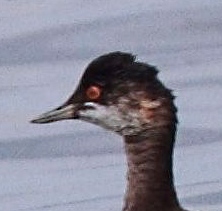 Ha! Having said the Clifford Hill Black-necked Grebe looks like it might be a moulting adult, I had closer views in better light late this afternoon and clearly I was wrong. It’s a juvenile with a considerable brown suffusion to the upperparts and neck, the latter with a faded, almost broken front. Just goes to show that photographs can be deceptive with regard to assessing true colour tones and extent!
Black-necked Grebe
Last Friday evening, Dave James and I found a Black-necked Grebe on the main barrage lake at Clifford Hill Gravel Pits and it is still present there today. This appears to be the only one to have been recorded in the County so far this year. We can normally expect up to half a dozen records annually, with Scaldwell Bay at Pitsford Reservoir being the place to find one as, in recent years, it has consistently produced one or two from late August into September.

The solid black crown and intensively dark fore-neck suggest this one is an adult in moult to winter plumage. Compare this with the full summer plumaged adult at Pitsford last August. Thanks are due to Jonathan Philpot, who appears to have managed a much closer approach to obtain images than I have been able to!
Turning turtle?
The decline of the Turtle Dove as a summer visitor to Britain has been well documented and it is believed to be at real risk of disappearing as a breeding species here within the decade. This is mirrored in Northamptonshire, where it has been recorded at only eight sites this year compared with thirty-six just ten years ago. Many of the records refer only to migrants and falling squarely into this category is this one at Stortons Gravel Pits yesterday morning.
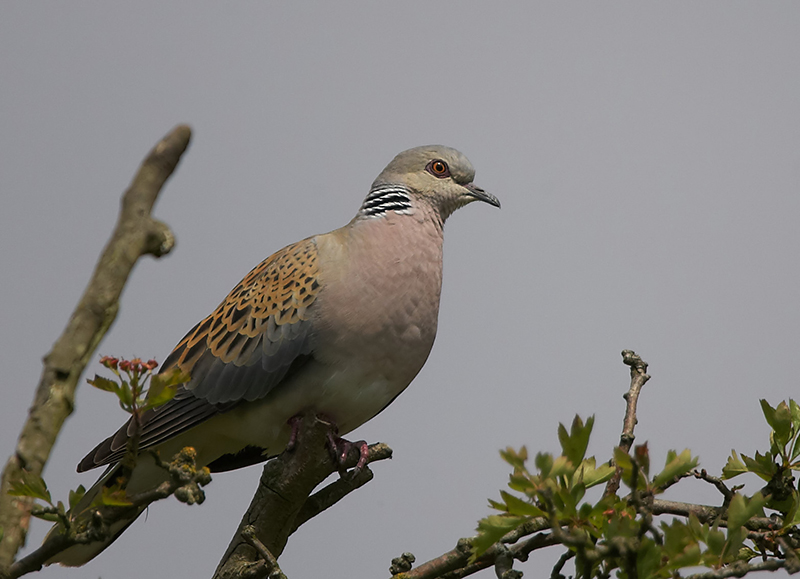
Doug McFarlane managed to capture a few images before it was flushed by a dog-walker and not subsequently relocated. This individual is a smart adult. Let’s hope they don’t ‘turn turtle’ and disappear as a breeding bird altogether. For the latest news see www.operationturtledove.org
 Northants birds