
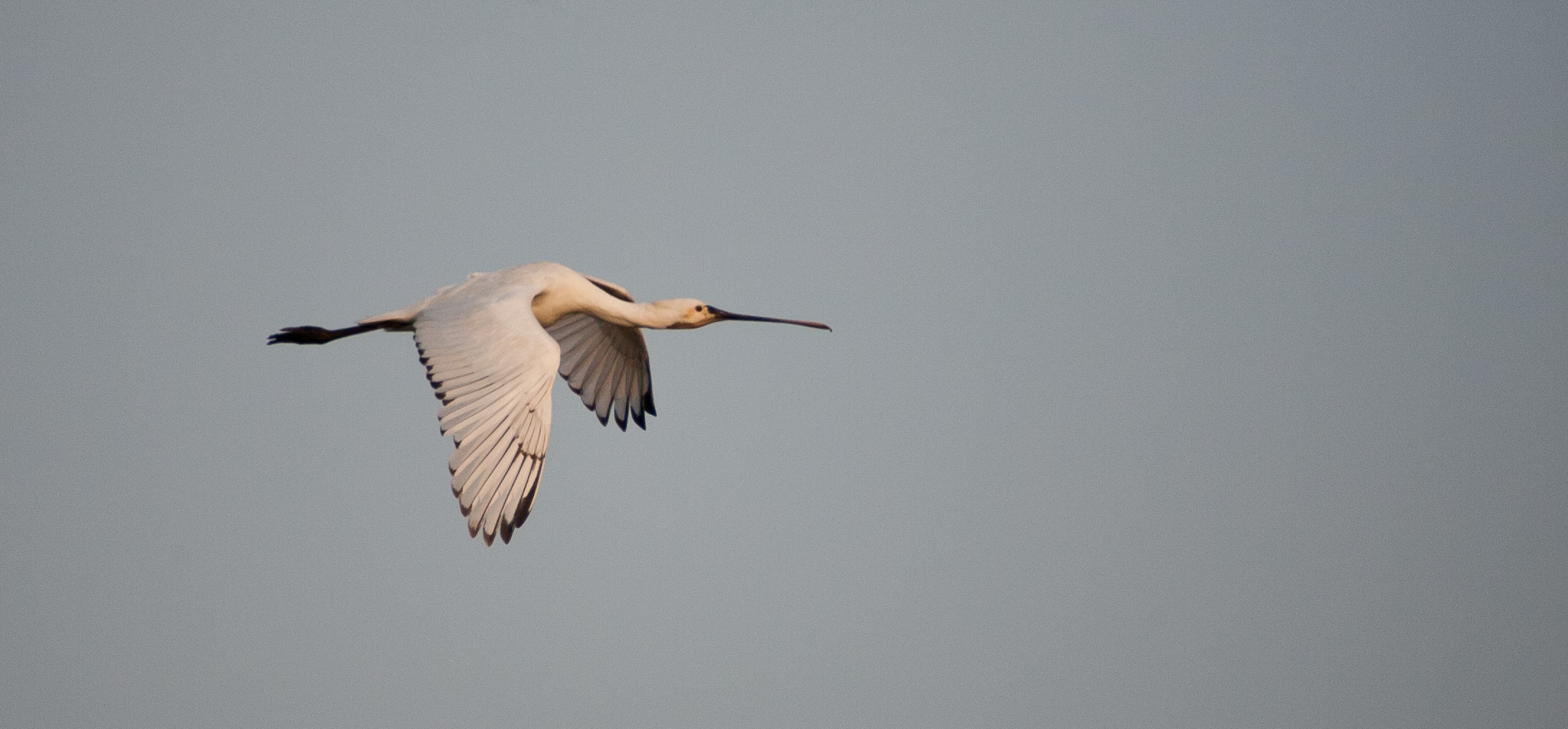
Let’s face it, 1st May 2011 provided a great start to the new birding month – if you were at Summer Leys, that is. At 6.35 AM a Spoonbill flew west but was seen only by local photographer, Ben Harrold, who has very kindly agreed to my using one of his splendid flight shots here. Arriving at 6.40, as I did, I was clearly too late for the Spoonbill but from
Pioneer Hide I shortly located a stint feeding among the sparse vegetation on the recently exposed mud of the scrape. Against the bright, early morning sunlight it appeared dark-legged, grey and looked for all the world like a winter-plumaged Little Stint but its crouching gait and creeping feeding action had subconsciously sowed the seeds of doubt in the minds of some of the observers in the hide and should have set alarm bells ringing. Viewing conditions from the Paul Britten Hide were far better in terms of lighting, however, and it became immediately obvious that this was actually a Temminck’s Stint, sporting dull, olive-green legs and the rather drab, subdued upperparts characteristic of this species in summer. The stint soon transfered to ‘the slips’, where it was joined briefly by a Turnstone in almost full summer plumage, a Greenshank and, a few moments later, by 20 Siberian Bar-tailed Godwits, which came in low over the reserve from the south-west before dropping in for an hour or so, allowing the assembled birders to appreciate the variation in size, bill length and plumage. The slightly larger, longer-billed females, which rarely approach the males in terms of rufous-chestnut summer plumage, were readily apparent and one in particular almost towered above nearby males,

with the difference in bill length being clearly evident. All the Bar-tailed Godwits passing through Northants at this time are of the Siberian race taymyrensis, which winters in equatorial west Africa, leaving there in late April to undertake the approximately 7000 km flight to breeding grounds far to the north-east. Satellite telemetry has proven this species capable of undertaking long, non-stop flights which cover around 1000 km per day. The record is held by a female, which flew non-stop from Alaska to New Zealand – a distance of 11,400 km – in just 11 days. Amazing to think that just three days previously, these 20 birds would have been in Mauretania, Guinea-Bissau – or somewhere in between – before their appearance at Summer Leys!
